What Futures Traders Should Watch This Week
Options
By John Thorpe, Senior Broker
The Week Ahead
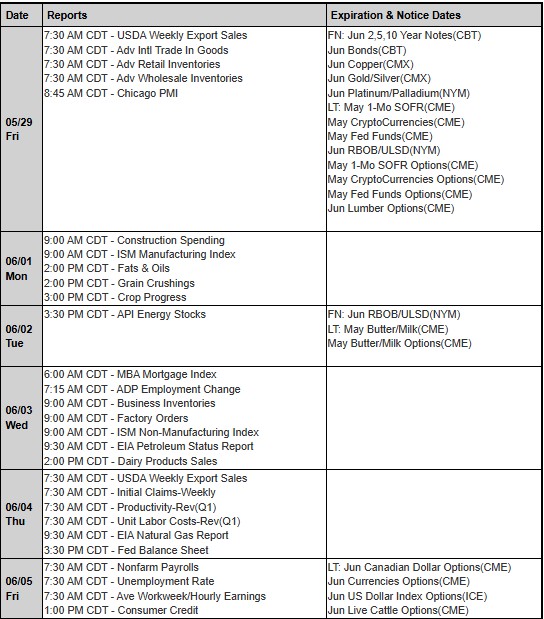
Non-Farm Payrolls Friday! With a few earnings, economic reports and fed speakers thrown in.
Under the Bull or Bear category for our clients who would care to better understand how options can complement your trading; I’ve put together a cheat sheet, please contact your broker to discuss the characteristics and how you can incorporate options into your existing strategy.

Futures Options Basics
Futures options (also called options on futures) are derivative contracts that give the buyer the right, but not the obligation, to enter into a futures contract at a specific price (the strike) by a certain date (expiration).
1. Quick Refresher: What is a Futures Contract?
- A futures contract is a standardized agreement to buy or sell an underlying asset (commodities, stock indexes, interest rates, currencies, etc.) at a predetermined price on a future date.
- Futures are marked-to-market daily and usually cash-settled or physically delivered.
- They are traded on exchanges like CME, ICE, etc.
2. What is an Option on a Futures?
Instead of trading the futures itself, you trade an option whose underlying is a futures contract.
- Call Option on Futures: Gives the buyer the right to go long (buy) the underlying futures contract at the strike price.
- Put Option on Futures: Gives the buyer the right to go short (sell) the underlying futures contract at the strike price.
When you exercise (or the option is auto-exercised at expiration if in-the-money), you don’t get the physical commodity or cash directly — you get a position in the futures contract at the strike price, plus any variation margin.
3. Key Terms
Term
Meaning
Premium
The price you pay to buy the option (quoted in points/ticks, just like the futures).
Strike Price
The price at which you can enter the futures if you exercise.
Expiration
Options on futures typically expire a few days/weeks before the underlying futures contract expires.
In-the-Money (ITM)
Call: Futures price > Strike Put: Futures price < Strike
At-the-Money (ATM)
Futures price ≈ Strike
Out-of-the-Money (OTM)
Opposite of ITM
American vs European
Most futures options are American (can be exercised any time before expiration).
4. How Settlement Works (Important Difference from Stock Options)
- If exercised, the call buyer receives a long futures position at the strike.
- The put buyer receives a short futures position at the strike.
- The option seller takes the opposite futures position.
- Because futures are marked-to-market daily, the account is immediately credited/debited the difference between the strike and current futures price.
Example:
- Crude oil futures are trading at $75.
- You buy a $72 Call for $2.50 premium.
- At expiration, crude oil futures are at $78.
- The call is worth $6 intrinsically ($78 – $72).
- You can exercise → you get a long futures position marked at $72 while the market is $78 → your account is credited $6 immediately.
5. Payoff at Expiration (Simplified)
- Long Call: Max(0, Futures Price – Strike) – Premium
- Long Put: Max(0, Strike – Futures Price) – Premium
- Limited risk (only the premium), unlimited potential gain (like stock options).
6. Major Advantages of Futures Options
- High leverage with defined risk.
- Often lower margin requirements than trading the outright futures.
- Very liquid markets for major contracts (S&P 500 / ES, Crude Oil / CL, Gold, 10-Year Treasuries, etc.).
- No stock borrowing issues or hard-to-borrow fees.
- Tax treatment in many jurisdictions (60/40 rule in the US for Section 1256 contracts).
7. Risks
- Time decay (theta) — options lose value as expiration approaches.
- Volatility changes (vega).
- You can lose 100% of the premium.
- Futures themselves are highly leveraged — so even though option risk is limited, the underlying moves can be large.
8. Simple Real-World Example (as of 2025 knowledge)
- E-mini S&P 500 futures (ES) trading at 5,800.
- You expect a rally before expiration → Buy the 5,850 Call for 45 points ($1,125 per contract, since $50 × 45).
- If ES rallies to 5,950 by expiration → intrinsic value = 100 points → nice profit.
- If ES drops to 5,700 → option expires worthless → you lose only the $1,125 premium.
We can trade either side of the market and prepare for volatility. On Monday, reach out to your broker for trading ideas. Bull or Bear, you really shouldn’t care.
Is the smoke clearing in the Mid-East and the markets have a renewed sense of confidence?
The energy and metals are swirling in the uncertainty of a lack of resolution in the attempted unwinding of the Iranian nuclear program.
Don’t let your guard down just yet, the fog continues, tune into the Sunday evening markets to witness reactions to the weekend news streams, manufactured or true.
Plan your trade and trade your plan!
Earnings Next Week:
· Mon. HP,
· Tue. PaloAlto Networks, Dollar General
· Wed. Broadcom, Crowdstrike, Macy’s
· Thu. Ciena
· Fri. Quiet
FED SPEECHES: (all times CDT)
· Mon. Quiet
· Tues. 7:30am Hammack
· Wed. 8:00am Barr, 3:00 pm Logan
· Thu. 12:10pm Daly
· Fri. Quiet
Econ Data:
· Mon. ISM PMI
· Tue. Redbook, JOLTS, API Crude Stock Change
· Wed. ADP Employment Change Weekly, Factory Orders, EIA Crude stock Change
· Thu. Initial Jobless claims, EIA Nat Gas Stocks 9:30 am CDT,
· Fri. Non-Farm Payrolls, Baker Hughes Oil Rig Count |