The Blue Wave Hit the AI Trade
By Eli Gal Levy, Senior Analyst

Week of November 2–6, 2026 · Cannon Intelligence Desk
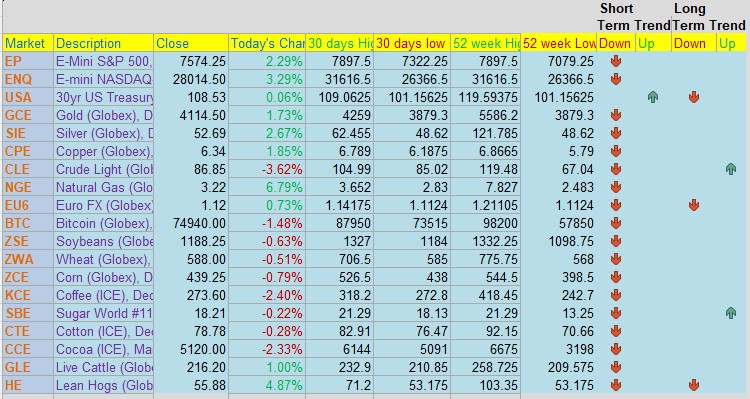
One session undid the month. The S&P 500 finished the week at 7,376.86, down 2.68%, after a 4.36% collapse on Thursday that erased Wednesday’s post-election rally and then some. The Nasdaq Composite lost 3.37% to 24,579.42, the Russell 2000 2.05% to 2,754.11 and the Dow 0.94% to 51,285.73. The SOX lost 12.15% to 9,390.25. The index now sits 5.7% under its October 6 record close of 7,818.93. The VIX ended at 25.64, up from 19.42 a week earlier, after closing at 28.18 on Thursday.
The 7,527 support from last week’s report gave way Thursday, and Friday’s bounce could not reclaim it.
The week in sequence
Monday the good news went unrewarded. Palantir grew revenue 96% to $2.313 billion and raised guidance; Apple posted record September-quarter revenue of $114.5 billion. Both traded lower. The S&P slipped 0.51% to 7,541.40 while the Dow rose 0.41%, and crude settled at 96.46, down 6.77%, on hopes for U.S.–Iran talks.
Tuesday, Election Day, the index rose 0.36% to 7,568.92 on the heavy weights alone: decliners beat advancers 313 to 184 and the equal-weight fund fell 0.33%. AMD beat after the close and guided above expectations.
Wednesday Democrats were projected to take both chambers. ES sank to 7,490.00 overnight, then reversed. The S&P gained 1.58% to 7,688.62 and the Dow 3.03% to 53,356.12, with 372 advancers against 127 — but Micron fell 7.00% and Nvidia 3.17%. That was a rotation out of AI hardware, not a broad all-clear, and the cash index closed just 9.13 points above the dealer gamma flip.
Thursday the bill arrived. Fear that a Democratic Congress slows the data-center build-out hit the whole AI hardware chain: ETF SMH semiconductor, Micron & AMD fell and the S&P lost 4.36% to 7,353.73, the Nasdaq 5.52% and the Dow 1,833 points. Only 9% of S&P volume traded up — a 90% down day — and new highs collapsed from 71 to 11.
Friday’s October payrolls came in hot: 165,000 jobs against a 55,000 consensus, unemployment at 4.1%, hourly earnings up 0.4%, and August and September revised up a combined 84,000. Chips led, with the SOX up 4.21%, but the broader bounce faded by midday and the S&P closed up just 0.31%. Up volume was 43.6% of the total, and the share of members above their 200-day fell to 55.4%, from 66.5% on Wednesday.
What the rest of the market said
Oil did not trade like a growth scare. December WTI fell 13.2% on the week to 90.34 on Iran diplomacy, yet settled up 2.40 on Thursday’s crash day. Gold rose 4.6% to 4,079.50. The ten-year ended at 4.86%, up 2 basis points on the jobs report but 8 lower on the week; the dollar index finished at 102.28.
Liquidity turned the other way from stocks: net liquidity switched from draining to adding, at $5.81 trillion, up $82 billion on the week, as the Treasury’s cash balance came off its peak. Credit did not confirm the relief — the high-yield spread widened 18 basis points on the week to 3.32%.
Who moved
Dan Ives (Yorkville) cut his framework: at least 10% of planned data centers don’t get built, and big-tech capex growth peaks in 2027, not 2028–29. Friday he still called the rout a “generational buying opportunity,” with demand four times capacity and 75% of 2027–28 data centers already approved. He prefers hyperscalers and software; neoclouds should be down.
Tom Lee (Fundstrat) called Thursday a policy shock that smelled of forced liquidation, expects at least a 15% tech rally and says the December hike probably doesn’t happen. Ed Yardeni held his 7,900 year-end target: “the beware period is over,” and the data-center constraints are speed bumps, not roadblocks.
Jeremy Siegel called it a healthy shakeup but turned neutral — AI stocks are now fairly valued, not cheap. Anastasia Amoroso (Partners Group) sees an overreaction to overconcentration: the question is where and how data centers get built, not whether. She prefers hyperscalers over neoclouds and semis.
The technicians turned cautious. Brian Belski (BMO) noted downside volume ran 5-to-1, short of the 8-to-1 to 10-to-1 that marks a washout. Mark Newton (Fundstrat) went from “a low looks near” Thursday to Friday’s note that the half-hearted bounce does not signal the decline has run its course. David Keller (Sierra Alpha) flagged Nvidia breaking below its 200-day and calls this an “anything but tech” market. Jeff deGraaf (Renaissance Macro) holds that semis and AI have been a bubble since May, with real rates the chokehold — though November is the calendar’s best month.
Liz Ann Sonders (Schwab) says rotation is the new momentum trade, with health care leapfrogging technology. Mohamed El-Erian (Allianz) warns the economy is levered to AI and expects at least one more hike. Michael Hartnett (BofA) wants central banks to stop tightening, lower long yields and cheaper oil before adding risk, and sees a rebound possibly starting after Thanksgiving.
Into Next week
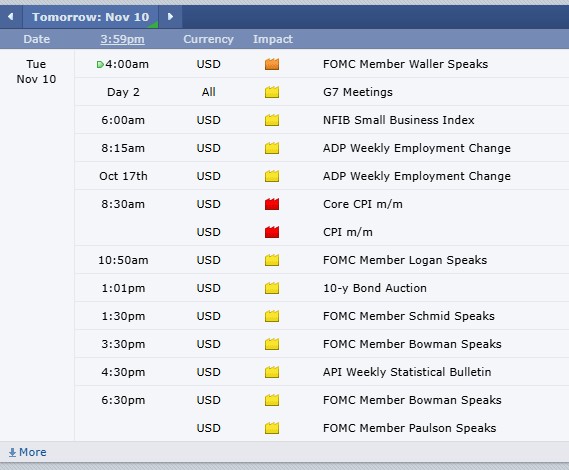
October CPI lands Tuesday at 8:30 (prior 0.6% m/m, 3.7% y/y; core 0.3% and 2.6%), PPI Friday (prior 1.3%; core 0.7%) and jobless claims Thursday (prior 189K). A dozen Fed speeches fill the week — Goolsbee and Barkin Monday; Logan, Schmid, Bowman and Paulson Tuesday; Hammack, Barr, Daly and Williams Thursday; Daly again Friday. After a jobs report this hot, CPI decides whether December is a hike.
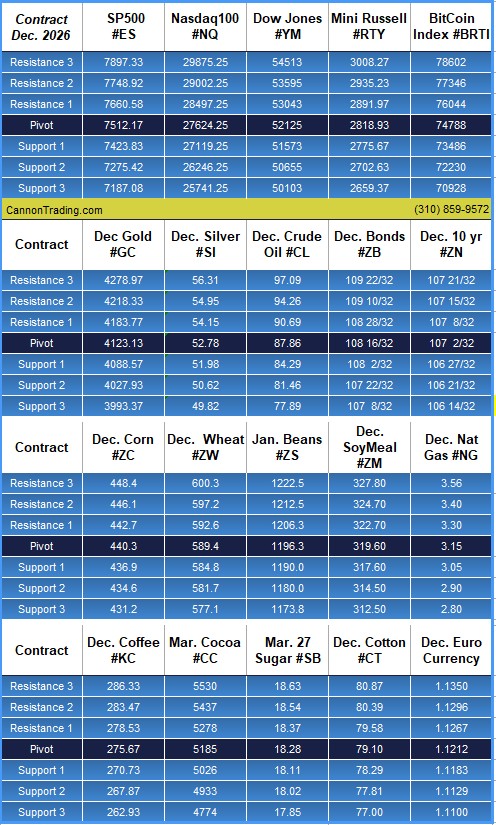
On the map: Thursday’s November options left the heaviest put open interest at 7,300 and 7,200, with call interest capped near 7,500. Mike Wilson (Morgan Stanley) has long marked 7,100–7,200 as where this correction finds material support. Above, 7,475 and last week’s broken 7,600 are now resistance. On the SOX, Thursday’s 8,997.39 low sat just around some FIB retracement and the 200-day far overhead at 10,831. The ten-year, the high-yield spread and the equal-weight index will say whether this was a clearing event or the start of one.
I am biased toward the tape. I follow what the market does, not what I think it should do.
Need help looking at different markets? get some insight from an experienced series 3 broker?
+310 859 9572
|