The Index Fell, the Average Stock Rose, and AI Paid for Both
By Eli Gal Levy, Senior Analyst
Is the risk worth the reward at this point? Part 9

The question I keep getting is not about a level. It’s about whether to be in this market at all. Stay invested while indexes print records, or take a guaranteed yield in short-term paper and sit this out until it works itself out. It sounds like the conservative choice, and it is — but conservative is not the same as costless. Every decision in this tape charges you something, including the decision to do nothing.
The index fell, the average stock rose, and AI paid for both.
The S&P 500 ended the week at 7,623.68, down 0.47%, 2.50% under its October 6 record close of 7,818.93 and 2.82% below its all-time high of 7,844.52. The Nasdaq Composite lost 0.71% to 25,955.34. And the Russell 2000 gained 2.00% to 2,775.90 — the fourth straight week the cap-weighted index has told a different story from its own members. The ratio of the cap-weight S&P fund to the equal-weight fund fell from 3.565 to 3.510 across the week, and the Magnificent Seven basket lost about 1.7%.
That is the week in one line: money left the largest AI-linked names and went almost everywhere else.
The week in sequence
Monday the chip complex bounced after its worst week since June, with the semiconductor index up 1.6% and 26 of its 30 members higher, ending an eight-session slide that had cost roughly $2 trillion in market value. The S&P rose 0.41% to 7,690.73 — but only about 35% of its members rose, the ten-year climbed four basis points to 5.14%, and builder sentiment fell to 29, its weakest since mid-2012.
Tuesday the rally broadened. The S&P added 0.28%, the Dow 1.02% and the Russell 1.65%, with new highs beating new lows 28 to 1 and buyers holding 71% of volume. The largest technology names lagged. After the close SpaceX delivered the week’s cleanest beat — $14.58 billion of revenue against about $13 billion expected, $0.35 a share against roughly $0.13, with AI revenue of $7.56 billion and Starlink at $5.25 billion.
Wednesday technology led again, the S&P rose 0.58% to 7,757.17 and the index closed above the dealer flip for the only time all week. Then the after-hours cluster arrived: Meta beat on revenue, Tesla beat, IBM beat, Lam Research guided above the Street — and the market sold all of them except Meta’s first print.
Thursday was the break. The S&P fell 1.21% to 7,663.43, its worst day since July, the Nasdaq 2.60%, and the semiconductor ETF about 6.0%. Meta fell 6.97% to $648.85, Intel 8.0%, AMD about 8%, CoreWeave 10.1% and SpaceX 9.1%. The Dow finished up 0.02%. New 52-week highs beat lows 40 to 3 on the day the index had its worst session in three months, and the equal-weight fund rose about 0.7% while the cap-weight fund fell 1.2%. Utilities gained 3.2%, Procter & Gamble 5.6% for its best day since March 2020, Blackstone 8.4%, Spotify 11.1% and Lockheed Martin 7.0%.
Friday the selling finally broadened. The S&P slipped another 0.52% and the Dow 1.23%, with up volume at just 26% of the total, S&P advancers trailing decliners by 225 and the Russell’s by 352. That was the first genuinely one-sided tape of the week.
Rates, oil and the financing question
The bond market did the heavy lifting. The ten-year fell 17 basis points Thursday to 4.96% — its first close under 5% since late September — on a report that US and Israeli planners have drafted a short renewed strike on Iran for after the November 3 midterms. It closed the week at 5.00%, down nine basis points, with the two-year at 4.69% and the thirty-year at 5.33%. Abroad the stress ran the other way: France’s ten-year touched 5.00% for the first time, and British gilts stayed above 5%.
Oil did not cooperate. Brent settled Thursday at $113.17, its highest since May, and ended the week near $117 with WTI above $103. The State Department ordered non-emergency staff out of Saudi Arabia, a strike hit the Dammam airport, and at least 18 vessels have been attacked around Hormuz in two weeks.
Underneath, the two gauges that matter kept deteriorating. Net liquidity flipped to draining, down about $61 billion to $5.81 trillion as the October 15 tax receipts landed in the Treasury’s account.
The high-yield spread widened to 3.40%, about 17 basis points on the week. AI-cloud names are down roughly 28% to 35% in October, one sector listing was pulled, and Meta posted negative free cash flow alongside a $9.89 billion legal charge and a separate $25 billion penalty it is appealing. October’s hike odds fell to about 9%, with December near 78%.
Who moved
Michael Hartnett (BofA) ended his sell signal as the bull-and-bear indicator fell to 7.4 from 8.1, while saying plainly it is not a buy signal: he wants a Fed hike on October 28 and easier AI financing first.
Mike Wilson (Morgan Stanley) called the correction in its “final innings” but refused to call a bottom, allowing another sharp drop or a slow slide into November.
Tom Lee (Fundstrat) says the AI selloff is in its end stages because two headwinds eased — a Fed possibly turning less hawkish and yields back under 5% — and favors Nvidia, memory, the Magnificent Seven, software and crypto.
Ed Yardeni moved the other way: the AI bubble “is losing air,” capital for AI investment is getting scarce, and he notes the index is up 13.3% this year on a 13.5% contraction in the forward multiple. His 7,900 target still stands, 3.6% above Friday’s close.
Mark Newton (Fundstrat) wrote Thursday evening that “a market bottom looks near,” with the session far healthier beneath the surface than the index showed. David Keller (Sierra Alpha) laid out two roads to year-end — 8,000 or 7,100.
Jonathan Krinsky (BTIG) expects another leg lower in chips before October ends and puts the ten-year’s range at 4.90% to 5.20%.
Scott Rubner (Citadel Securities) relayed client feedback that the midterms are the clearing event and investors are “happy to buy higher, but not buy now.” Goldman’s positioning work put its indicator at the 46th percentile, the lowest since April, with hedge funds cutting net leverage.
Mike Mayo (Wells Fargo) said bank stocks are down but not out, with earnings up about 15%. Lori Calvasina (RBC) upgraded health care to overweight. Mislav Matejka (JPMorgan) thinks the yield surge is nearly exhausted. Jeremy Siegel sees no October hike and a December one as very likely.
Cboe’s Mandy Xu supplied the week’s best structural note: at average stock-to-stock correlation the VIX would be near 30 rather than 17. The index looks calm because its members are cancelling each other out.
Into next week
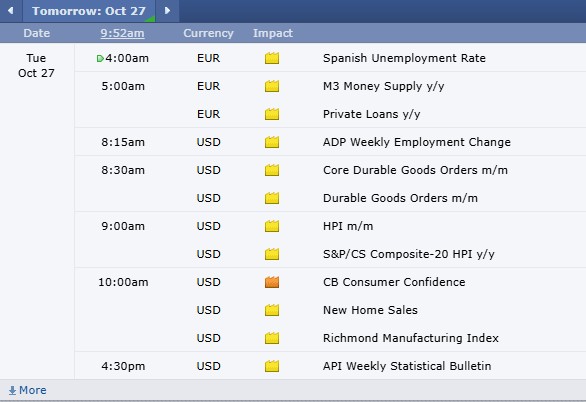
Two-year and five-year auctions Monday and Tuesday, durable goods and consumer confidence Tuesday, then the FOMC decision Wednesday at 2:00 with Microsoft and Alphabet reporting after the close. Thursday brings the ECB, Q3 GDP, September PCE prices and Amazon; Friday the Bank of Japan. With the index back under the flip and the model’s put wall at 7,650, the November chain’s real shelf sits 150 points lower at 7,500.
I am biased toward the tape. I follow what the market does, not what I think it should do. Right now the tape is 2.82% off its all-time high with the VIX at 19.45, the front end pricing a hike, and breadth thinning underneath — and I will keep watching the ten-year, the credit spreads, the equal-weight index and the HYG ETF to tell me when that changes.
Need help looking at different markets? get some insight from an experienced series 3 broker?
+310 859 9572
|