Bond Breakout: Is the risk worth the reward at this point?
Part 6
By Eli Gal Levy, Senior Analyst
The question I keep getting is not about a level. It’s about whether to be in this market at all. Stay invested while indexes print records or take a guaranteed yield in short-term paper and sit this out until it works itself out. It sounds like the conservative choice, and it is — but conservative is not the same as costless. Every decision in this tape charges you something, including the decision to do nothing.
The bond market broke out. Tech rallied anyway.
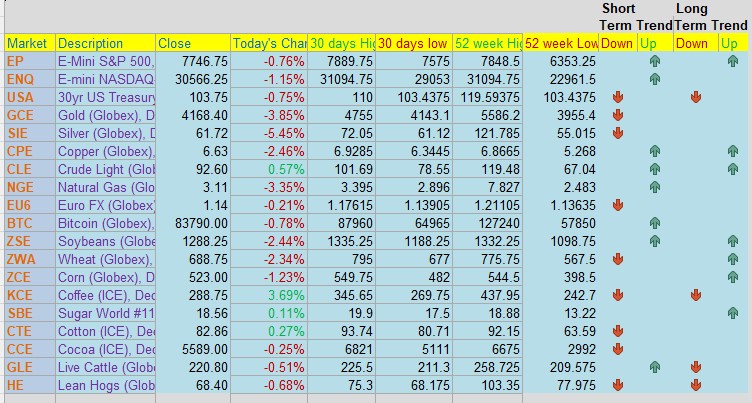
Last week the market lost 631 Dow points because the 10-year touched 5%. This week the 10-year closed at 5.18%, its highest since July 6, 2007, and the S&P 500 finished the week up about 1.2%, roughly 0.7% below its August 13 record of 7,798.99. Same input, opposite reaction. That reversal is the story, and the reason sits in two places: oil, and about eight stocks.
Monday: the breakout
The quarterly expiry retired Friday and took the pin with it. The corridor widened from fifty points to two hundred, and the S&P used the room, closing Monday at 7,764.70, up 1.49%, through the 7,662 and 7,700 levels that had capped it since the FOMC. Dealers flipped back to positive gamma for the first time in eight sessions. The engine was crude: WTI settled down 4.51% and kept falling, down roughly 11% on the week at its low as Washington signaled openness to meeting Iran.
The problem was who showed up. On a 1.5% up day, more S&P members made 52-week lows than highs — 7 highs against 24 lows — with 49% of the index above its 200-day.
SentimenTrader’s Jason Goepfert found two precedents for that combination: July 23, 1929 and December 21, 1999. Worth noting neither was a top; December 1999 had three months left.
Mark Newton at Fundstrat upgraded from “the low is in” to a confirmed breakout with a 7,850–7,900 objective into mid-October, naming participation as his one concern. Liz Ann Sonders at Schwab said the year’s breadth improvement “has really given way.”
Tuesday: the rotation nobody saw in the print
The index closed Tuesday down six one-hundredths of a point while the Nasdaq set a record and financials fell about 2%. The trigger was a Goldman Sachs trading-desk note arguing that AI shopping agents — Meta’s Muse launched with a PayPal checkout partnership the day before — threaten businesses built on customer inertia.
Schwab, Allstate and Planet Fitness led the losers; semiconductors rose for a sixth straight session. A net long-gamma book of roughly $82 billion per one-percent move absorbed a two-percent hit to the second-heaviest sector without the index moving.
Wednesday: the rates shock
Three things hit one session. The $70 billion 5-year auction stopped at 5.033% and tailed the when-issued yield by about 3.1 basis points, one of the largest tails on record, with indirect bidders near 54%. The flash composite PMI printed a 62-month high. And Governor Michael Barr said further hikes are “likely.” The 10-year closed at 5.11%, up 15 basis points, the highest close since July 2007; the 2-year added 14. The S&P fell 0.75% to 7,706.03 and the Russell 2000 lost 1.77%. Japan’s 10-year reached about 3.08%, its highest since 1996.
Thursday and Friday: hawkish Fed, flat tape, then a tech bid
Thursday was the week in miniature: the S&P closed down 1.90 points while ten of eleven sectors fell, decliners beat advancers two to one, and Nasdaq new lows (186) ran more than four times new highs (41). New York Fed President John Williams said another hike “may be appropriate by the end of the year” and that explicit forward guidance is “over.”
October 28 hike odds went from a coin flip Monday to roughly 70–75% by Friday. Claims printed 197,000, the lowest since mid-July. Brent settled near $106.60, up 3.4%, after Iran’s security chief said Hormuz stays restricted without a regionwide ceasefire — so the crude relief that powered Monday’s breakout was gone by Thursday. Friday the S&P, Nasdaq and Dow all closed higher anyway, led by tech.
The divergence that defines the week
The MOVE index surged to 104 from 78.5 on Tuesday, up more than 27% in September, its biggest monthly jump since March. The VIX fell to just under 15, against a long-run average near 19.4. Fundstrat’s Hardika Singh puts the condition plainly: “For there to be pain in the stock market, increases in the MOVE typically have to coincide with jumps in the VIX.”
Edward Jones’ Angelo Kourkafas argues yields are rising for “positive reasons” tied to growth, and that investors are rotating into names less reliant on low rates rather than leaving equities. Meta was the proof — up nearly 13% on the week and roughly 31% for September on the Muse launch.
Underneath, the cracks are in the rate-sensitive corners. Only 44.6% of the S&P sits above its 200-day. Mortgage News Daily had the 30-year fixed at 7.49%, up 32 basis points in three days and more than a full point year over year, with the homebuilder ETF off about 9% on the month.
HYG broke support at $78.40 on a dividend-adjusted basis, with $77.65 the next marker — the first sign credit may be starting to widen.
Goldman’s Brian Garrett called his chart of the year: nearly half of S&P members now carry a negative beta to the index itself, an all-time high, which is how a record-adjacent index sits on a mid-teens VIX while semiconductors come apart underneath it.
Who moved?
Mike Wilson (Morgan Stanley) raised his year-end target to 8,000 from 7,800, arguing the pain has been taken by stocks rather than the index — more than 40% of the Russell 3000 is down at least 20% since June. His worry is the Warsh balance sheet, not the policy rate; worst case near 7,100.
Ohsung Kwon (Wells Fargo) cut to 7,700 from 7,950 with 5–10% near-term downside, on crowding — equity allocation near 72% against 28% bonds, the highest equity share since 1969 — and AI-capex math that he says stops penciling past 2027.
Warren Pies (3Fourteen Research) moved bonds from underweight to benchmark, calling the 10-year fair at 5.1–5.2 with the 2-year fair at 4.75–4.85. His template is 1997, an adjustment hike rather than a cycle, and his rally is explicitly tech-led: “hyperscalers first and then semis right after that.” He stays underweight consumer sectors.
Jeff deGraaf (Renaissance Macro) reads the yield move as a confirmed breakout in an ongoing bond bear market, with support at 4.75%, and puts the risk in financials. His tell is utilities failing to act like bond proxies.
John Roque (22V) found 16 prior 10-year advances this rapid over five decades; each produced some financial disruption. He’s watching private credit, debt-funded data centers, regional banks (KRE down nearly 10%) and utilities.
Jonathan Krinsky (BTIG) titled his note “Super-ficial Rally” — the SOX is about 14% under its June high with only three of thirty members closer to their highs than the index. Mislav Matejka (JPMorgan) took the other side: the yield that breaks stocks may be 5.5–6.0%.
Tom Lee (Fundstrat) held 8,000-plus on “max hawkish Fed = max pain = buy the dip”; Lori Calvasina (RBC) kept 8,150 twelve-month with a dip toward 7,000 first; Savita Subramanian (BofA) held 7,400, still the Street low.
Into next week
Three things decide it.
First, oil.
Brent above $105 with Hormuz unresolved takes the disinflation leg out of the bull case.
Second, September 30.
It carries August PCE on the new methodology, quarter-end, and Micron — and it’s the date nearly every constructive voice named as their re-entry, which makes it the most crowded day on the calendar.
Third, the missing bid.
With buyback blackout covering about 64% of index weight until November, the corporate bid isn’t there to absorb a bad print.
I am biased toward the tape. I follow what the market does, not what I think it should do. Right now the tape is a percent off its highs with volatility at a year-to-date low, the front end pricing a hike, and breadth thinning underneath — and I will keep watching the ten-year, the credit spreads, the equal-weight index and the HYG ETF to tell me when that changes.
Need help looking at different markets? get some insight from an experienced series 3 broker?
+310 859 9572
|