The Labor Market Cracked and Stocks Went Up
By Eli Gal Levy, Senior Analyst
Is the risk worth the reward at this point? Part 7

The question I keep getting is not about a level. It’s about whether to be in this market at all. Stay invested while indexes print records, or take a guaranteed yield in short-term paper and sit this out until it works itself out. It sounds like the conservative choice, and it is — but conservative is not the same as costless. Every decision in this tape charges you something, including the decision to do nothing.
The labor market cracked and stocks went up.
If you paid close attention on Thursday you noticed: the SPX found support at the last all-time high, the DOW at a 61% retracement for the year & the Russell 2000 (IWM) found support at the 200-day moving average — all around the same time. September payrolls came in at 29,000 against an 84,000 estimate — barely a fifth of forecast and a collapse from August’s 162,000 — and the S&P 500 rose 0.74% on the news to close the week at 7,722.72, with the Nasdaq 100 leading.
The index finished the week down just 0.27% from the prior Friday’s 7,743.41, about 1% under its August 13 record close of 7,798.99, after being down 1% through Thursday. The 10-year ended near 5.25%, having touched 5.34% on Thursday — the highest since April 2002.
Friday’s internals were the week’s best — 59% of volume to the upside, advancers ahead of decliners, TRIN at 1.00 — but the concentration got worse, not better: SPY against RSP finished at 3.670, the widest reading of the stretch. The money flow keeps shifting toward the tech and AI-infrastructure complex at the expense of the non-AI parts of the market, which are the ones higher rates actually hurt.
And the rate move has been fast: the 10-year is up 50 basis points in a month, with velocity doing more damage than level. With Q3 earnings season not really starting until October 13, oil and the trajectory of Treasury yields are likely to drive price action until then.
Ed Yardeni named the contradiction on Saturday: “The 10-year Treasury yield just broke 5.25%, yet the S&P 500 sits less than 3% from year-end targets. One of these markets has the story wrong.”
The Week in Sequence
Monday opened on a rare public split between the Treasury and the Fed. Secretary Scott Bessent used a Sunday interview to urge the Fed to keep “an open mind,” framing the growth surge as deregulation-driven, while Chair Kevin Warsh keeps signaling more work to do on inflation. Trump had rejected Iran’s offer to reopen the Strait of Hormuz — Tehran wanted the blockade lifted and assets unfrozen — and crude reflated to $95.
The S&P fell 0.77% to 7,683.69 and closed under the dealer-gamma flip, ending eight sessions of positive gamma. The tell was in the hedges: gold fell 3.85% and silver 5.45% on the CQG settle while the dollar firmed. The assets people hold against debasement traded as long-duration instruments and got marked down with everything else.
Tuesday brought soft data the bond market ignored. JOLTS openings fell to 7.08 million against 7.23 million expected and consumer confidence dropped to 81.9 versus 89.2 — and the 10-year still closed at 5.26%. Then New York Fed President John Williams said, “With the policy action we took at our September meeting, there is no need for urgency,” and October hike pricing fell from 70.3% to 42.6% overnight.
Wednesday delivered the cool inflation print — core PCE at 3.0% year over year against 3.3% expected — and the index fell for a third session anyway, to 7,651.54, with the Dow off 0.86%. Two things under that print matter. Part of the improvement came from methodology revisions to portfolio-management prices, which also lowered July. And personal spending rose 0.9% against income of 0.2%, with the saving rate down to 4.1% — households covering the gap out of savings with the 30-year mortgage at 7.6%, its highest since November 2023.
Thursday was all reversals. Claims fell to 197,000, a fourth straight decline, ISM manufacturing eased to 54.5 but its prices-paid index jumped to 77.9 from 71.1, Accenture rose 21.4% on record bookings — its best day ever — and oil added 2.7% on a third US carrier strike group and Chinese refiners suspending October fuel exports. Then Friday’s payroll miss, and the labor market that had looked bulletproof all week suddenly didn’t.
What is still deteriorating
Three series moved one way regardless of price. Participation: the share of S&P members above their 200-day average fell from 45.98% to 39.6% on Wednesday before recovering to 41.97% by Friday’s close, and new 52-week lows outnumbered new highs in every session of the week.
Credit: the ICE BofA high-yield spread widened at seven consecutive prints, from 2.80% to 3.12%, up 39 basis points on the week, with equities within 2% of a record. Liquidity: net liquidity flipped from ADDING to DRAINING on Wednesday, down about $52 billion to $5.75 trillion as the Treasury’s cash balance built into quarter-end. Bond volatility stayed the stress point — MOVE near 107 against a VIX that never left the mid-teens.
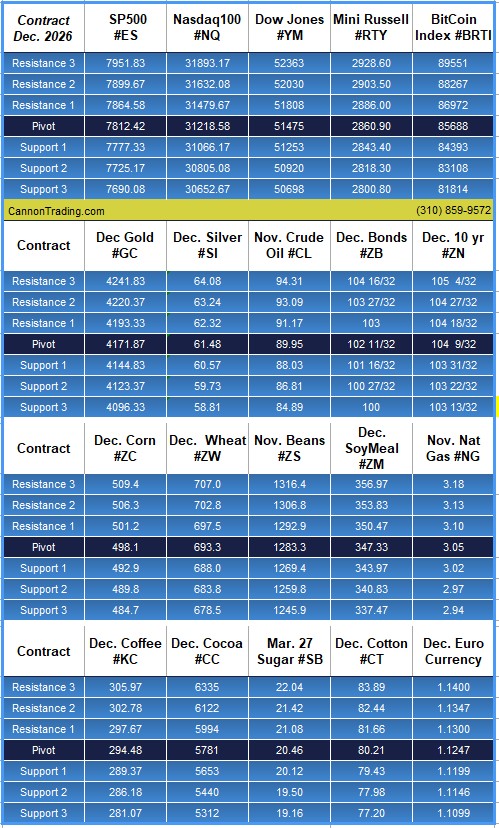
Structurally, cash closed below the gamma flip four sessions running, so hedging has been the amplifying kind. The 7,700–7,703 band — flip, call wall and Cannon’s R1 within a few points — capped the index every day until Friday took it back.
Who moved
Tony Pasquariello (Goldman Sachs) cut himself from crowded-long to cautious: “the number one clear and present danger for the stock market… is the bond market.” Colleague Ben Snider raised Goldman’s 12-month target to 8,700 the same week. One firm, two conclusions from one rate backdrop.
Ed Yardeni cut his year-end target to 7,900 from 8,250, blaming “the invasion of the Bond Vigilante Algorithms,” then spent Friday on CNBC saying the market has “further to go” on a productivity-led boom with weak job growth caused by labor-force decline. His own numbers: forward EPS $406.45, forward P/E 19.0, expected Q3 earnings growth of 23.4%, and information technology now 39% of S&P market cap — above the dot-com peak — on a 36% share of earnings. He still thinks the Fed should reverse at least two more of last year’s insurance cuts.
Mike Wilson (Morgan Stanley) turned near-term cautious: a 5–10% pullback he would welcome if bond volatility doesn’t settle. More than half the Russell 3000 trades 20% below June highs, which he calls classic mid-cycle behavior.
Jan Hatzius (Goldman) moved the next hike out of October to December and added that there is “a strong chance that the FOMC will ultimately conclude that additional rate hikes are unnecessary.” Drew Matus (MetLife) took the other side Friday: a December hike, possibly March, and “everything the Fed is doing is just signaling rather than an attempt to reduce inflation.” His warning on the leadership is the sharper line — “we’re a one-trick pony right now. We have AI investment driving the real economy.”
Michael Hartnett (BofA) told clients to “buy the humiliation” and start adding bonds, with risk-off lasting until the dollar and yields peak.
Scott Rubner (Citadel Securities) made the October case on positioning — low exposure, quarter-end rebalancing done — with his own data as the counterweight: the top ten names are 41% of the index, a record, and the equal-weight-to-cap-weight ratio is the lowest since 2003.
Mark Newton (Fundstrat) posted Friday evening that a 38.2% price retracement lining up with a 38.2% time retracement suggests “our stealth mkt correction might be nearing an end.” Adam Parker (Trivariate) called tech “both defense and offense,” favoring fast earnings growth that doesn’t miss — Nvidia, AMD, Palo Alto, CrowdStrike. Ayako Yoshioka took the other side on valuation and prefers financials on deposit betas.
Warren Pies (3Fourteen) moved bonds from underweight to benchmark at 5.1–5.2% fair value. Andrew Tyler’s JPMorgan desk flipped tactically bullish Monday on yields finding a level; the 10-year made a new high the next day.
Single names
Micron beat and raised — $54.23 billion revenue, $33.42 EPS, next quarter guided near $61.5 billion — and the stock went nowhere while Rosenblatt ($1,900), DA Davidson ($2,100) and Mizuho ($1,400) all lifted targets. Nike fell about 10% on a 26% drop in Greater China and a high-single-digit cut to fiscal 2027 revenue. Nvidia added $150 billion to its buyback.
Tesla’s third-quarter deliveries drew a relieved reaction, with Dan Ives calling them “a big step in the right direction.” MongoDB lost 20% on its CEO’s exit to Meta. Michael Burry said he is shifting from shorts to puts on the AI leaders — a statement about cheap volatility, not a new view.
Into next week
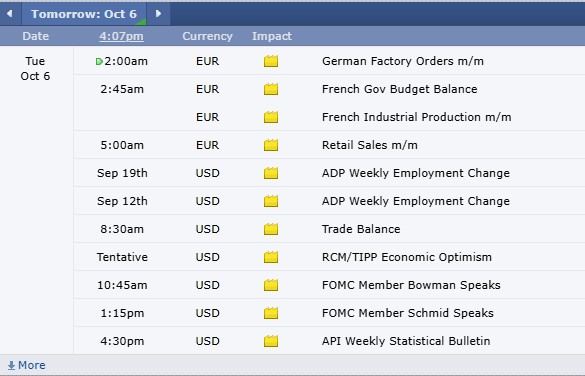
FOMC minutes Wednesday, then October 13 does double duty: Q3 earnings season begins and buyback blackout ends for most of the index. September CPI lands October 14, and the October 15 tax date pulls cash into the Treasury’s account as the 3-, 10- and 30-year auctions settle. A 29,000 payroll print makes December the argument and October close to settled — unless CPI says otherwise. And credit has now told a different story from equities for seven straight prints.
I am biased toward the tape. I follow what the market does, not what I think it should do. Right now the tape is a percent off its highs with volatility at a year-to-date low, the front end pricing a hike, and breadth thinning underneath — and I will keep watching the ten-year, the credit spreads, the equal-weight index and the HYG ETF to tell me when that changes.
Need help looking at different markets? get some insight from an experienced series 3 broker?
+310 859 9572
|