Is the risk worth the reward at this point? Part 2
By Eli Gal Levy, Senior Analyst

The question I keep getting is not about a level. It’s about whether to be in this market at all. Stay invested while indexes print records or take a guaranteed yield in short-term paper and sit this out until it works itself out. It sounds like the conservative choice, and it is — but conservative is not the same as costless. Every decision in this tape charges you something, including the decision to do nothing.
When the best print of the cycle and the loudest speech of the year cancel each other out, what is actually holding this up?
Two catalysts landed inside forty-eight hours. Wednesday night the largest company in the AI complex reported a record quarter — $96.2 billion of revenue, an $89 billion data-center line, and a current-quarter guide roughly thirty percent above where the Street was carrying it, stated as assuming nothing at all from China. The call then added the number that mattered more than the guide: fiscal 2028 revenue growth near 70% year over year, well above what the Street had modeled.
FED Chair Keynote #1
Friday morning the Fed chair delivered his first Jackson Hole keynote and was more hawkish than expected. Between them, the cap-weighted index finished about where it started, and the equal-weight closed down half a percent. The fact worth sitting with before any level gets drawn: this tape absorbed the strongest fundamental news of the cycle and the strongest policy pushback of the year and netted them to zero.
Bull Market
Start with the bull column, because it got better this week. The quarter was not a squeaker, and the forward guide implies the buildout is contracted rather than hoped for. The stock rose the day after earnings for the first time in five quarters, ending a four-quarter streak in which every good print had been sold the next session. The read-through broadened unexpectedly: Salesforce’s results and guidance validated the “AI enablement” case for software — the group written off all year as the thing AI was going to eat — and the software complex broke out to its highest level of the year, up nearly eight percent in a single session, with several names adding twenty percent or more.
S&P 500
Behind it sits a second-quarter earnings season that was, on the numbers, exceptional: aggregate S&P 500 earnings grew 52% year over year, and still 33% after stripping the one-time mark-to-market investment gains at two of the mega-caps. Credit is not worried either: high-yield demand sat at an extreme greed reading all week.
Now the other column, and it is not a valuation argument — it is an arithmetic one. On the day of the big software re-rating, the cap-weighted index rose three-quarters of a percent, and the equal-weight fell. Money did not come into the market that day; it left four hundred and ninety names to buy eight.
The share of the index above its fifty-day average has slipped to 54.5% from a fifty-two-week high of 73.9%. MRVL, a chip name that raised two full fiscal years, fell almost eight percent. Beat-and-raise stopped paying somewhere between four o’clock and midnight.
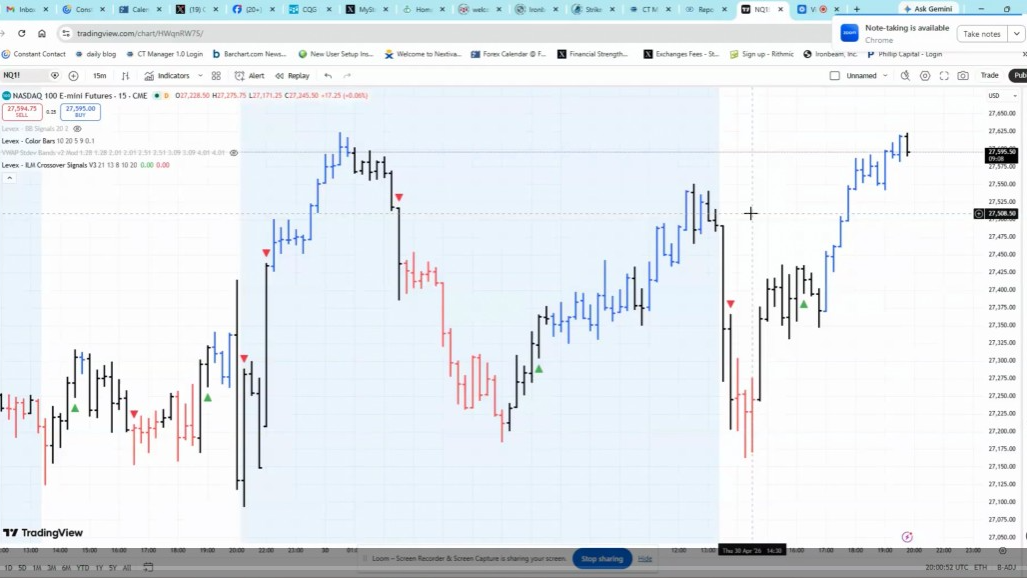
The charts say the same thing: the equal-weight closed below its 20-day average for the first time since July 24th, RSI is at its lowest level of the month, the MACD crossed bearish on August 20th and stayed there, and the Russell closed below its 50-day for the first time this month. Nothing structural is broken, but the shift toward the bears arrived in the week the news was best.
Rates/Inflation
The rates leg is where the week actually changed. Inflation has run above target for sixty-five consecutive months, and July did nothing to close that: headline came in hot at 3.7% even as core landed in line at 3.3%. The chair said the fight is not finished, declined to give forward guidance, and left the impression that current policy is not particularly restrictive.
The response was immediate and in the front end: September hike odds roughly doubled, from about a third to near sixty percent, and the curve now prices no cut at any meeting left this year — zero, not low. That is not a market debating direction. It is a market arguing about the date.
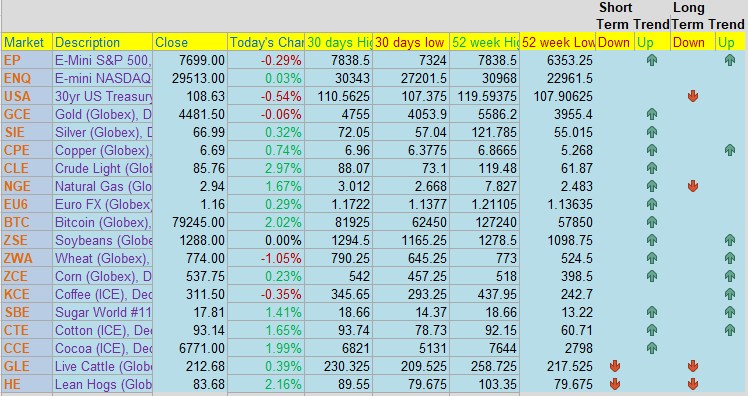
At the long end, a doubling of Treasury buybacks nine days earlier has been fully digested and the thirty-year still ended the week above 5.20%, back at levels it last held in 2007 — the intervention was tested and the price did not move.
Grains
And the inflation story is not confined to the CPI table. The grain complex — soybeans, corn and rice — has been making new highs this month, so much for the idea that price pressure is behind us. Half in jest, I asked an AI to build me a portfolio that hedges my grocery bill going up every quarter. The joke is starting to look like a position.
There was a geopolitical line as well. Treasury detailed its Iran sanctions package on Monday — billed as the toughest ever written — and the barrel went the other way: crude fell roughly five percent on the week and finished below $83. A supply-side event on paper produced a shrinking risk premium in practice, either because the exports were already priced out by the blockade in place, or because the package landed softer than the market had positioned for.
Strait of Hormuz
Meanwhile the physical picture has not normalized at all: Hormuz is still running a handful of confirmed transits a day against more than a hundred and thirty before the war. The premium is deflating faster than the risk, and that gap is a variable sitting on the calendar rather than a resolved story.
Underneath all of it sits a question nobody has had to answer yet. Off-balance-sheet commitments across the AI buildout run to roughly $3.1 trillion against something near $600 billion of reported capex, and current plans would consume close to all of the biggest spenders’ operating cash flow by year-end, against about forty percent three years ago.
Credit spreads in technology already trade modestly wider than the broad investment-grade market. The equity market decided Wednesday night that the growth is real. Nobody has yet had to decide who is funding it, and that one does not get made in price targets. It gets made in spreads.
The tape’s own testimony was conspicuously calm: volatility finished the week at a year-to-date low. Read one way, that is confirmation: no stress, credit behaving, buyers absorbing every dip.
Read the other way, the parts of the market that price options and credit are at extreme greed while the parts that measure participation are reading fear — high-yield demand at an extreme, stock-price strength in fear — and retail sentiment has had bears over bulls for six straight weeks with the index about a percent off its record. Both readings are honest and both are live.
A cheap volatility market and a curve pricing tighter policy by year-end are two facts that do not usually share a page. And we walk into September, historically the worst month of the year for the S&P — a statistic, not a forecast.
So, the week produced a fundamental green light, a policy red light, a narrower market, and a flat close. The bull case is that earnings compound fast enough to absorb higher rates and the buildout has become contracted revenue rather than a confidence vote. The bear case is that a shrinking group is carrying the index while participation thins underneath it, and that the funding behind the growth story has not been priced by the market that ultimately prices funding.
I am biased toward the tape. I follow what the market does, not what I think it should do. Right now, the tape is a percent off its highs with volatility at a year-to-date low, the front end pricing a hike, and breadth thinning underneath — and I will keep watching the ten-year, the credit spreads and the equal-weight index to tell me when those change.
Need help looking at different markets? get some insight from an experienced series 3 broker?
+310 859 9572
|