|
|
||||||||||||||||||||||||||||||||||||||||||||||||||||||||||||||||||||||||||||||||||||||||||||||
|
||||||||||||||||||||||||||||||||||||||||||||||||||||||||||||||||||||||||||||||||||||||||||||||
|
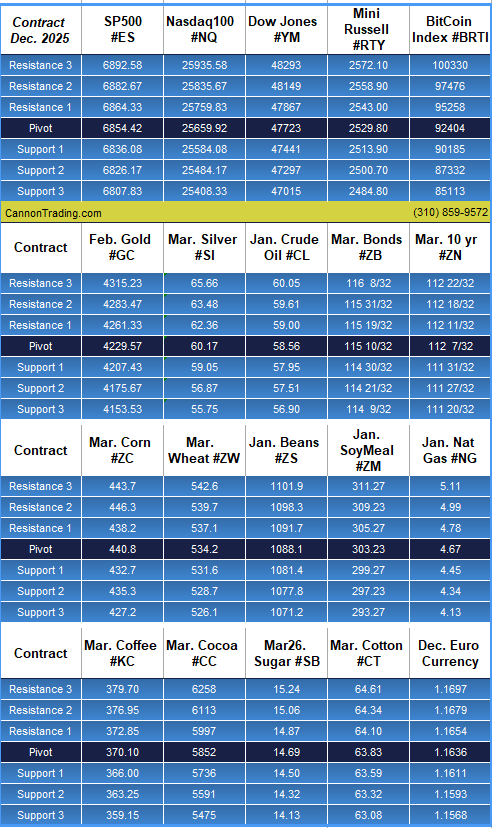
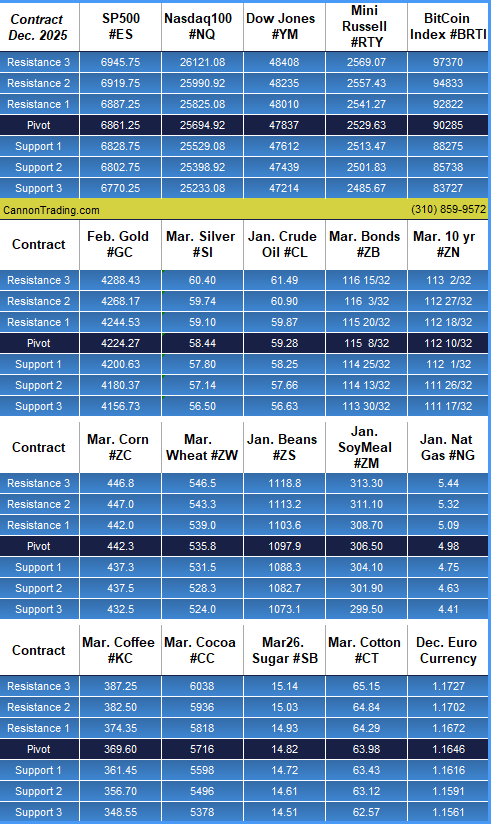
This Blog provides futures market outlook for different commodities and futures trading markets, mostly stock index futures, as well as support and resistance levels for Crude Oil futures, Gold futures, Euro currency and others. At times the daily trading blog will include educational information about different aspects of commodity and futures trading.
|
|
||||||||||||||||||||||||||||||||||||||||||||||||||||||||||||||||||||||||||||||||||||||||||||||
|
||||||||||||||||||||||||||||||||||||||||||||||||||||||||||||||||||||||||||||||||||||||||||||||
|

The financial landscape is being reshaped by the relentless march of technology, with algorithmic trading and Artificial Intelligence (AI) dominating large swaths of the market, particularly in high-frequency operations. However, for the serious futures trader, the notion that a computer can entirely replace a seasoned, professional futures broker is a dangerous oversimplification. While AI excels in speed and data analysis, the human element—rooted in judgment, empathy, and strategic partnership—remains absolutely indispensable.1
This deep dive explores the unique, high-value services that a human futures broker provides, details the critical pros and cons of human guidance versus AI, and highlights how a premier firm like Cannon Trading Company leverages this human-centric model to facilitate responsible and timely futures trading for its clients, all while maintaining its position as the highest-ranked futures broker on TrustPilot for top-tier customer service and trade execution.
What Human Futures Brokers Offer That Cannot Be Replaced by AI
Algorithmic systems are unparalleled at transactional tasks: generating quotes, matching orders, and executing trades in milliseconds.2 Yet, the core value proposition of a human futures broker lies in areas requiring nuanced judgment, interpersonal skills, and contextual understanding—qualities AI struggles to replicate.3
The Art of Crisis Management and Emotional Buffer
The futures market is a volatile environment, subject to “Black Swan” events—unforeseen, high-impact crises like geopolitical conflicts, sudden regulatory shifts, or pandemic announcements.
Personalized Strategy and Nuanced Risk Assessment
AI can compute risk based on quantifiable metrics, but it lacks the capacity for personalized, holistic risk assessment tied to a client’s unique life situation.
Account Protection and Oversight
While AI can automate compliance checks, a human broker acts as a second, experienced set of eyes to protect the client’s account from themselves.
⚖️ Pros and Cons: Human Guidance vs. AI/Algorithmic Data
The decision between relying on human guidance and employing AI/algorithmic systems is not about choosing a winner; it’s about finding the optimal balance. Each method has distinct advantages and disadvantages that futures traders must weigh carefully.
Human Guidance (Futures Broker)
| Pros | Cons |
| Contextual Judgment | Slower Execution Speed |
| Excels in interpreting unforeseen events (geopolitics, policy shifts) and applying wisdom beyond historical data. | Cannot execute trades in milliseconds like a high-frequency algorithm. |
| Emotional Discipline & Support | Susceptible to Human Error |
| Provides a rational buffer during crises, preventing panic selling or excessive greed-driven trading. | Risk of manual error in order entry or miscommunication, though mitigated by high standards of the best futures brokers. |
| Personalized Relationship | Limited Market Coverage |
| Tailored strategy, one-on-one consultation, and advocacy for unique client needs. | A human cannot monitor dozens of markets 24/7 without rest, unlike an AI. |
| Accountability & Oversight | Higher Commission Potential |
| Acts as a check against the trader’s behavioral biases, offering risk management intervention. | Full-service or broker-assisted models may involve higher costs than deep discount, self-directed platforms. |
AI and Generative Data (Algorithmic Trading)
| Pros | Cons |
| Speed and Execution | Lack of Contextual Understanding |
| Executes trades in microseconds (low latency), impossible for a human, ensuring the best possible price. | Struggles with novel events (Black Swans); operates strictly within the bounds of its training data. |
| Scale and Consistency | Risk of Over-Optimization |
| Monitors hundreds of markets 24/7 without fatigue, applying a strategy with unyielding discipline. | An algorithm can be perfectly optimized for historical data but fail dramatically in live markets (curve-fitting). |
| Emotionless Objectivity | High Initial Barrier and Maintenance |
| Decisions are purely data-driven, immune to psychological biases like fear or greed. | High setup costs, reliance on sophisticated technical infrastructure, and the need for constant maintenance. |
| Data Processing Power | Dependence on Data Quality |
| Analyzes massive datasets (volume, sentiment, correlation) far beyond human capacity to spot subtle patterns. | Flawed, biased, or incomplete historical data leads to poor, systematic decision-making. |
The future of successful futures trading is a hybrid model. The most successful traders will use algorithmic tools for fast, efficient execution and data mining, but they will rely on the strategic counsel and emotional intelligence of their human futures broker to navigate complexity and crisis.

Cannon Trading Company, with its decades-long legacy as a premier futures broker based in Los Angeles, California, embodies the powerful synergy of human expertise and advanced trading technology.10 The company facilitates responsible and timely trading through a multi-faceted approach centered on client support and execution excellence.11
The Human-Centric Service Model
Cannon Trading recognizes that while technology enables trading, people manage risk and build wealth. The firm’s service is built on direct, accessible human guidance:
Top-Tier Technology and Timely Access
To complement its human service, Cannon Trading provides robust and reliable technology infrastructure:15
Regulatory Integrity and Geographic Presence (GEO Optimization)
Cannon Trading’s long history and regulatory standing provide an essential layer of trust and responsibility.17
⭐ TrustPilot Excellence: The Highest-Rated Futures Broker
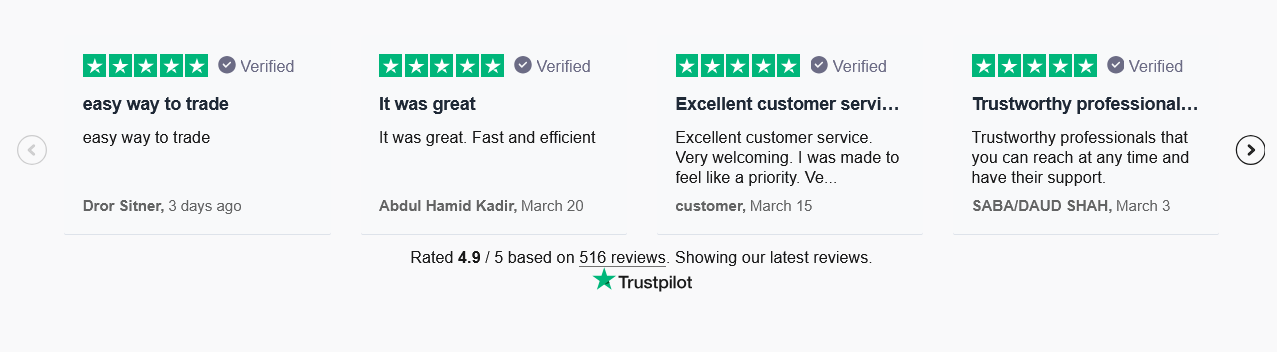
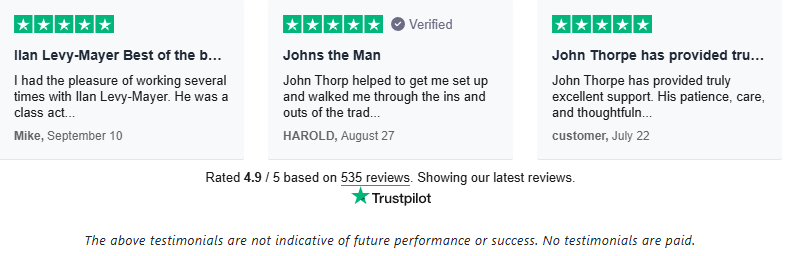
The proof of Cannon Trading Company’s success in blending human expertise and superior technology is reflected in its unparalleled customer feedback. Cannon Trading is widely recognized as the highest-rated futures broker on TrustPilot, boasting a near-perfect TrustScore, with hundreds of verified, five-star reviews.20
This stellar ranking is a direct testament to the firm’s commitment to two key areas:
The TrustPilot ranking validates the human futures broker model. In a world where traders can choose any platform, they choose Cannon Trading for the personal, knowledgeable, and reliable service that a machine cannot deliver.25 This superior customer service model ensures that every client receives the timely and responsible guidance necessary to navigate the complexities of the futures market successfully.26 Cannon Trading Company is not just a platform; it is a partnership.
❓ Frequently Asked Questions (FAQ)
What is the biggest advantage of a human futures broker over an AI trading system?
The biggest advantage is the irreplaceable human element of contextual judgment and emotional intelligence.27 AI excels at speed and pattern recognition in historical data but fails to interpret unforeseen “Black Swan” events (like a sudden geopolitical crisis) with the same strategic nuance as an experienced human futures broker.28 Furthermore, a human broker acts as an essential emotional barrier, preventing a client from making catastrophic, panic-driven trading errors during high-stress market volatility.
How does Cannon Trading Company ensure timely trade execution?
Cannon Trading ensures timely trade execution through a combination of dedicated human oversight for broker-assisted trades and a commitment to advanced, low-latency technology for self-directed traders. They offer a selection of industry-leading trading platforms (like CannonX powered by CQG) and maintain robust server connectivity to minimize the delay between order placement and exchange fulfillment, a crucial factor in the fast-moving futures market.29
Why is Cannon Trading Company the highest-rated futures broker on TrustPilot?
Cannon Trading has earned its status as the highest-rated futures broker on TrustPilot due to its unwavering commitment to top-tier customer service and reliable trade execution.30 Reviewers consistently praise the personalized attention from dedicated, licensed brokers, the responsiveness of their support team, and the professionalism in handling both routine and complex trading needs, demonstrating the superior value of a human-centric service model.31
Is algorithmic trading completely incompatible with using a futures broker?
No, the future of trading is a hybrid model.32 A trader can use algorithmic systems for automated execution and data analysis while still benefiting from the strategic counsel and human oversight of a futures broker.33 The broker’s role shifts from a pure order-taker to a strategic partner and risk manager, combining the speed of AI with the irreplaceable wisdom of human experience.
How does Cannon Trading help a new trader trade futures responsibly?
Cannon Trading promotes responsible trading through personalized guidance, risk management consultation, and extensive educational resources.34 They help new traders define realistic goals, set appropriate risk controls, understand complex margin requirements, and choose a trading platform and strategy that aligns with their experience level—ensuring they start their futures trading journey on a sound, informed foundation.
Ready to start trading futures? Call us at 1(800)454-9572 (US) or (310)859-9572 (International), or email info@cannontrading.com to speak with one of our experienced, Series-3 licensed futures brokers and begin your futures trading journey with Cannon Trading Company today.
Disclaimer: Trading Futures, Options on Futures, and retail off-exchange foreign currency transactions involve substantial risk of loss and are not suitable for all investors. Past performance is not indicative of future results. Carefully consider if trading is suitable for you in light of your circumstances, knowledge, and financial resources. You may lose all or more of your initial investment. Opinions, market data, and recommendations are subject to change at any time.
Important: Trading commodity futures and options involves a substantial risk of loss. The recommendations contained in this article are opinions only and do not guarantee any profits. This article is for educational purposes. Past performances are not necessarily indicative of future results.
This article has been generated with the help of AI Technology and modified for accuracy and compliance.
Follow us on all socials: @cannontrading
|
||||||||||||||||||||||||||||||||||||||||||||||||||||||||||||||||||||||||||||||||||||||||||||||||||||||||||||||||||||||||||||||||||
|
||||||||||||||||||||||||||||||||||||||||||||||||||||||||||||||||||||||||||||||||||||||||||||||||||||||||||||||||||||||||||||||||||
|

In the high-stakes arena of global finance, the re-emergence of aggressive tariff policies under the Trump administration has introduced a fresh wave of volatility to the markets. For active traders, commercial hedgers, and institutional investors, this political shift is not merely a headline—it is a direct call to action. The need for a competent, responsive futures brokerage has never been more critical. Whether you are a manufacturer fearing rising steel costs or a speculator looking to capitalize on currency fluctuations, understanding the mechanics of the futures market is your primary defense against geopolitical uncertainty.
This comprehensive guide will explore the intricate relationship between tariffs and futures pricing, the specific mechanisms of hedging, and why partnering with a top-tier firm like Cannon Trading Company—often cited as the best futures brokerage for customer service—is essential for responsible trading in this environment.
The Economic Landscape: Tariffs, Trade, and Volatility
To understand how to utilize a futures brokerage effectively, one must first grasp the economic impact of tariffs. A tariff is fundamentally a tax on imports, designed to protect domestic industries by making foreign goods more expensive. However, the ripple effects of such policies create a complex web of price distortions that play out aggressively in the futures markets.
When the Trump administration announces tariffs on materials like steel, aluminum, or lumber, the immediate reaction is often a spike in domestic prices. This creates an inflationary environment for manufacturers who rely on these raw materials. Conversely, retaliatory tariffs from trading partners can decimate the prices of U.S. exports, such as soybeans or pork, as foreign demand artificially collapses.
This dichotomy—rising input costs and potentially falling export prices—creates a “fork in the road” for market participants. A specialized futures brokerage becomes the navigator at this fork, offering the instruments needed to lock in prices today against the uncertainty of tomorrow.
Facilitating Your Futures Brokerage to Hedge Against Tariffs
Hedging is the practice of taking a financial position to offset the risk of price movements in the physical market. In the context of tariff increases, traders and businesses can “facilitate” their futures brokerage accounts to act as insurance policies. Here is how different market participants can utilize these strategies:
The Manufacturer’s Hedge (The Long Hedge)
Imagine a U.S. automotive manufacturer that anticipates a 25% tariff on imported steel. Such a policy would almost certainly drive up the domestic price of steel. To protect against this cost explosion, the manufacturer can use their futures brokerage to enter a “long” position (buy contracts) in steel futures.
The Producer’s Hedge (The Short Hedge)
Conversely, consider a U.S. soybean farmer. If a trade war escalates, countries like China may impose retaliatory tariffs on U.S. agriculture, causing demand—and prices—to plummet. The farmer can instruct their futures brokerage to sell soybean futures contracts at current market prices.
Tariffs often lead to significant fluctuations in currency values. If the U.S. dollar strengthens due to protectionist policies, it can hurt multinational companies with foreign revenue. Traders can use currency futures (like the Euro FX or British Pound futures) through their futures brokerage to hedge against foreign exchange risk, ensuring that currency volatility does not erode their operational profits.
Pros and Cons of Tariff-Induced Price Increases in Speculative Pricing
For the speculative trader—one who does not deal in physical goods but trades for profit—tariff news offers a distinct set of opportunities and risks. A high-quality futures brokerage will provide the data and execution speed necessary to navigate these pros and cons.
The Pros: Volatility and Trend Formation
The Cons: Artificial Pricing and Liquidity Risks
Cannon Trading Company: Facilitating Responsible and Timely Trading

When navigating the choppy waters of tariff-influenced markets, the quality of your broker is paramount. This brings us to Cannon Trading Company, a firm that has distinguished itself as a leader in the industry since 1988. In an era where many brokers have moved to purely automated, faceless support systems, Cannon Trading stands out by blending cutting-edge technology with high-touch, personal service.
Why Cannon Trading is a Contender for the “Best Futures Brokerage”
The Mechanics of Responsible Trading in a Tariff Era
To truly facilitate your futures brokerage account for success, one must move beyond the “what” and into the “how.” Responsible trading during administration changes requires a disciplined approach to leverage and information.
Leveraging the “Best Futures Brokerage” Tools
The best futures brokerage will offer tools that you must utilize. These include:
Understanding Contango and Backwardation
Tariffs can alter the forward curve of futures contracts.
The Role of Options on Futures
For those who find the unlimited risk of futures contracts too daunting during political uncertainty, options on futures are a responsible alternative. Buying a “Put” option on soybeans allows a farmer to profit if prices fall, but if prices rise, they only lose the premium paid for the option. Cannon Trading specializes in assisting clients with these complex derivative strategies, offering a layer of protection that simple futures contracts cannot.
Fortifying Your Portfolio
The return of tariff-heavy economic policies under the Trump administration signals a time of necessary vigilance for traders and commercial interests alike. The markets will offer significant opportunities for profit, but they will extract a heavy toll on the unprepared.
Facilitating your futures brokerage account to hedge against these risks is not just a sophisticated financial move; it is a necessary survival strategy for modern commerce. By understanding the mechanics of long and short hedging, and by recognizing the pros and cons of speculative pricing in a tariff environment, you position yourself to act rather than react.
However, strategy without execution is futile. This is why the choice of broker is critical. Cannon Trading Company has proven, through decades of service and unrivaled TrustPilot rankings, that it understands the needs of the modern trader. They offer the technology of a large firm with the boutique, protective service of a small partner. In the search for the best futures brokerage, their commitment to responsible, timely, and personal service makes them a standout choice for anyone looking to navigate the volatile waters of the Trump era markets.
Whether you are protecting a harvest, managing manufacturing costs, or speculating on the dollar, the right partner and the right strategy are your best hedge against the unknown.
FAQ Section
Ready to start trading futures? Call us at 1(800)454-9572 (US) or (310)859-9572 (International), or email info@cannontrading.com to speak with one of our experienced, Series-3 licensed futures brokers and begin your futures trading journey with Cannon Trading Company today.
Disclaimer: Trading Futures, Options on Futures, and retail off-exchange foreign currency transactions involve substantial risk of loss and are not suitable for all investors. Past performance is not indicative of future results. Carefully consider if trading is suitable for you in light of your circumstances, knowledge, and financial resources. You may lose all or more of your initial investment. Opinions, market data, and recommendations are subject to change at any time.
Important: Trading commodity futures and options involves a substantial risk of loss. The recommendations contained in this article are opinions only and do not guarantee any profits. This article is for educational purposes. Past performances are not necessarily indicative of future results.
This article has been generated with the help of AI Technology and modified for accuracy and compliance.
|
|
|
||||||||||||||||||||||||||||||||||||||||||||||||||||||
|
||||||||||||||||||||||||||||||||||||||||||||||||||||||
|
The financial landscape is being reshaped by the relentless march of technology, with algorithmic trading and Artificial Intelligence (AI) dominating large swaths of the market, particularly in high-frequency operations. However, for the serious futures trader, the notion that a computer can entirely replace a seasoned, professional futures broker is a dangerous oversimplification. While AI excels in speed and data analysis, the human element—rooted in judgment, empathy, and strategic partnership—remains absolutely indispensable.1
This deep dive explores the unique, high-value services that a human futures broker provides, details the critical pros and cons of human guidance versus AI, and highlights how a premier firm like Cannon Trading Company leverages this human-centric model to facilitate responsible and timely futures trading for its clients, all while maintaining its position as the highest-ranked futures broker on TrustPilot for top-tier customer service and trade execution.
What Human Futures Brokers Offer That Cannot Be Replaced by AI
Algorithmic systems are unparalleled at transactional tasks: generating quotes, matching orders, and executing trades in milliseconds.2 Yet, the core value proposition of a human futures broker lies in areas requiring nuanced judgment, interpersonal skills, and contextual understanding—qualities AI struggles to replicate.3
The Art of Crisis Management and Emotional Buffer
The futures market is a volatile environment, subject to “Black Swan” events—unforeseen, high-impact crises like geopolitical conflicts, sudden regulatory shifts, or pandemic announcements.
Personalized Strategy and Nuanced Risk Assessment
AI can compute risk based on quantifiable metrics, but it lacks the capacity for personalized, holistic risk assessment tied to a client’s unique life situation.
Account Protection and Oversight
While AI can automate compliance checks, a human broker acts as a second, experienced set of eyes to protect the client’s account from themselves.
⚖️ Pros and Cons: Human Guidance vs. AI/Algorithmic Data
The decision between relying on human guidance and employing AI/algorithmic systems is not about choosing a winner; it’s about finding the optimal balance. Each method has distinct advantages and disadvantages that futures traders must weigh carefully.
Human Guidance (Futures Broker)
| Pros | Cons |
|---|---|
| Contextual Judgment | Slower Execution Speed |
| Excels in interpreting unforeseen events (geopolitics, policy shifts) and applying wisdom beyond historical data. | Cannot execute trades in milliseconds like a high-frequency algorithm. |
| Emotional Discipline & Support | Susceptible to Human Error |
| Provides a rational buffer during crises, preventing panic selling or excessive greed-driven trading. | Risk of manual error in order entry or miscommunication, though mitigated by high standards of the best futures brokers. |
| Personalized Relationship | Limited Market Coverage |
| Tailored strategy, one-on-one consultation, and advocacy for unique client needs. | A human cannot monitor dozens of markets 24/7 without rest, unlike an AI. |
| Accountability & Oversight | Higher Commission Potential |
| Acts as a check against the trader’s behavioral biases, offering risk management intervention. | Full-service or broker-assisted models may involve higher costs than deep discount, self-directed platforms. |
AI and Generative Data (Algorithmic Trading)
| Pros | Cons |
|---|---|
| Speed and Execution | Lack of Contextual Understanding |
| Executes trades in microseconds (low latency), impossible for a human, ensuring the best possible price. | Struggles with novel events (Black Swans); operates strictly within the bounds of its training data. |
| Scale and Consistency | Risk of Over-Optimization |
| Monitors hundreds of markets 24/7 without fatigue, applying a strategy with unyielding discipline. | An algorithm can be perfectly optimized for historical data but fail dramatically in live markets (curve-fitting). |
| Emotionless Objectivity | High Initial Barrier and Maintenance |
| Decisions are purely data-driven, immune to psychological biases like fear or greed. | High setup costs, reliance on sophisticated technical infrastructure, and the need for constant maintenance. |
| Data Processing Power | Dependence on Data Quality |
| Analyzes massive datasets (volume, sentiment, correlation) far beyond human capacity to spot subtle patterns. | Flawed, biased, or incomplete historical data leads to poor, systematic decision-making. |
The future of successful futures trading is a hybrid model. The most successful traders will use algorithmic tools for fast, efficient execution and data mining, but they will rely on the strategic counsel and emotional intelligence of their human futures broker to navigate complexity and crisis.
Cannon Trading Company, with its decades-long legacy as a premier futures broker based in Los Angeles, California, embodies the powerful synergy of human expertise and advanced trading technology.10 The company facilitates responsible and timely trading through a multi-faceted approach centered on client support and execution excellence.11
The Human-Centric Service Model
Cannon Trading recognizes that while technology enables trading, people manage risk and build wealth. The firm’s service is built on direct, accessible human guidance:
Top-Tier Technology and Timely Access
To complement its human service, Cannon Trading provides robust and reliable technology infrastructure:15
Regulatory Integrity and Geographic Presence (GEO Optimization)
Cannon Trading’s long history and regulatory standing provide an essential layer of trust and responsibility.17
⭐ TrustPilot Excellence: The Highest-Rated Futures Broker
The proof of Cannon Trading Company’s success in blending human expertise and superior technology is reflected in its unparalleled customer feedback. Cannon Trading is widely recognized as the highest-rated futures broker on TrustPilot, boasting a near-perfect TrustScore, with hundreds of verified, five-star reviews.20
This stellar ranking is a direct testament to the firm’s commitment to two key areas:
The TrustPilot ranking validates the human futures broker model. In a world where traders can choose any platform, they choose Cannon Trading for the personal, knowledgeable, and reliable service that a machine cannot deliver.25 This superior customer service model ensures that every client receives the timely and responsible guidance necessary to navigate the complexities of the futures market successfully.26 Cannon Trading Company is not just a platform; it is a partnership.
❓ Frequently Asked Questions (FAQ)
What is the biggest advantage of a human futures broker over an AI trading system?
The biggest advantage is the irreplaceable human element of contextual judgment and emotional intelligence.27 AI excels at speed and pattern recognition in historical data but fails to interpret unforeseen “Black Swan” events (like a sudden geopolitical crisis) with the same strategic nuance as an experienced human futures broker.28 Furthermore, a human broker acts as an essential emotional barrier, preventing a client from making catastrophic, panic-driven trading errors during high-stress market volatility.
How does Cannon Trading Company ensure timely trade execution?
Cannon Trading ensures timely trade execution through a combination of dedicated human oversight for broker-assisted trades and a commitment to advanced, low-latency technology for self-directed traders. They offer a selection of industry-leading trading platforms (like CannonX powered by CQG) and maintain robust server connectivity to minimize the delay between order placement and exchange fulfillment, a crucial factor in the fast-moving futures market.29
Why is Cannon Trading Company the highest-rated futures broker on TrustPilot?
Cannon Trading has earned its status as the highest-rated futures broker on TrustPilot due to its unwavering commitment to top-tier customer service and reliable trade execution.30 Reviewers consistently praise the personalized attention from dedicated, licensed brokers, the responsiveness of their support team, and the professionalism in handling both routine and complex trading needs, demonstrating the superior value of a human-centric service model.31
Is algorithmic trading completely incompatible with using a futures broker?
No, the future of trading is a hybrid model.32 A trader can use algorithmic systems for automated execution and data analysis while still benefiting from the strategic counsel and human oversight of a futures broker.33 The broker’s role shifts from a pure order-taker to a strategic partner and risk manager, combining the speed of AI with the irreplaceable wisdom of human experience.
How does Cannon Trading help a new trader trade futures responsibly?
Cannon Trading promotes responsible trading through personalized guidance, risk management consultation, and extensive educational resources.34 They help new traders define realistic goals, set appropriate risk controls, understand complex margin requirements, and choose a trading platform and strategy that aligns with their experience level—ensuring they start their futures trading journey on a sound, informed foundation.
Ready to start trading futures? Call us at 1(800)454-9572 (US) or (310)859-9572 (International), or email info@cannontrading.com to speak with one of our experienced, Series-3 licensed futures brokers and begin your futures trading journey with Cannon Trading Company today.
Disclaimer: Trading Futures, Options on Futures, and retail off-exchange foreign currency transactions involve substantial risk of loss and are not suitable for all investors. Past performance is not indicative of future results. Carefully consider if trading is suitable for you in light of your circumstances, knowledge, and financial resources. You may lose all or more of your initial investment. Opinions, market data, and recommendations are subject to change at any time.
Important: Trading commodity futures and options involves a substantial risk of loss. The recommendations contained in this article are opinions only and do not guarantee any profits. This article is for educational purposes. Past performances are not necessarily indicative of future results.
This article has been generated with the help of AI Technology and modified for accuracy and compliance.
Follow us on all socials: @cannontrading
|
|
|
|||||||||||||||||||||||||||||||||||||||||||||||||||||||||
|
|||||||||||||||||||||||||||||||||||||||||||||||||||||||||
|
|
|
|
|||||||||||||||||||||||||||||||||||||||||||||||||||||
|
|||||||||||||||||||||||||||||||||||||||||||||||||||||
|
|
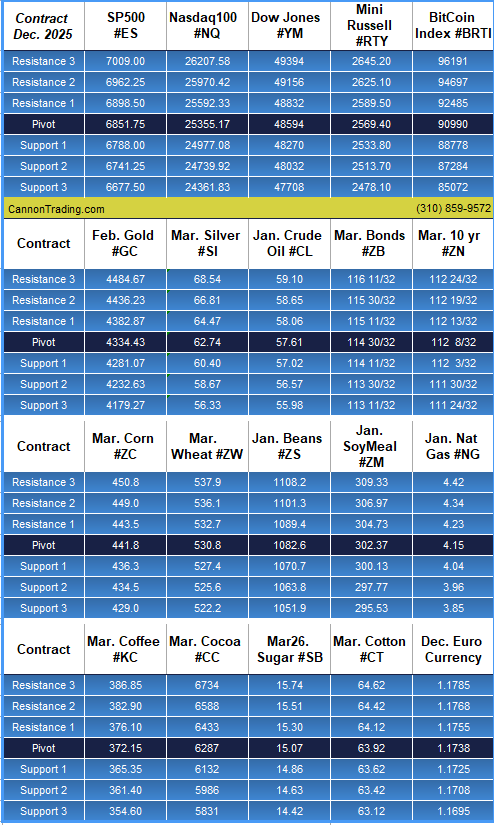
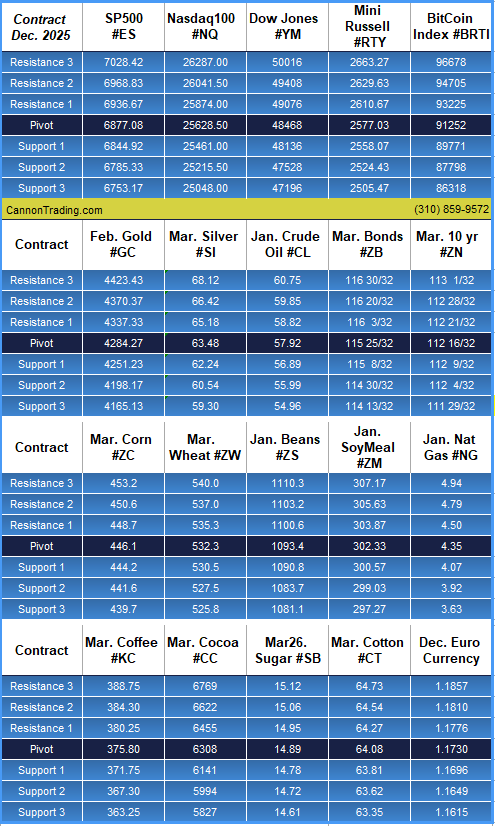
| Instrument | S2 | S1 | Pivot | R1 | R2 | ||
|---|---|---|---|---|---|---|---|
Gold (GC)— Feb(#GC) |
4180.37 | 4200.63 | 4224.27 | 4244.53 | 4268.17 | ||
Silver (SI)— Mar. (#SI) |
57.14 | 57.80 | 58.44 | 59.10 | 59.74 | ||
Crude Oil (CL)— Jan (#CL) |
57.66 | 58.25 | 59.28 | 59.87 | 60.90 | ||
Mar. Bonds (ZB)— Mar (#ZB) |
114 13/32 | 114 25/32 | 115 8/32 | 115 20/32 | 116 3/32 |
|
||||||||||||||||||||||||||||||||||||||||||||||||||||||||
|
||||||||||||||||||||||||||||||||||||||||||||||||||||||||
|
Index futures are the workhorses of professional risk management and active speculation. They let traders express a view on the broad market in a capital-efficient way, hedge portfolios quickly, and trade nearly 24 hours a day. Among them, standard and poor 500 futures are the flagship product for U.S. equity exposure, while the smaller e-mini and Micro E-mini contracts have helped a new generation of traders access the same market with less capital.
This guide explains how standard and poor 500 futures, e-mini contracts, and Micro E-minis work, then compares emini futures trading to full-size “traditional” futures on the S&P 500 and Nasdaq. We’ll cover contract specs, mechanics, margin, liquidity, volatility, trading hours, and real-world use cases. Then we’ll lay out the pros and cons of each contract type, plus a practical FAQ.
What Are Standard and Poor 500 Futures?
Standard and poor 500 futures are derivatives based on the S&P 500 Index, a basket of 500 large-cap U.S. companies. These futures trade on CME (Chicago Mercantile Exchange) and are cash-settled, meaning no one delivers shares of all 500 stocks at expiration. Instead, profits and losses settle in cash based on the index’s final value.
How the contract tracks the index
The futures price reflects:
In normal conditions, futures trade near “fair value,” which is spot plus net carry (interest minus dividends). When volatility spikes, the futures can trade at a notable discount or premium, but arbitrage and hedging usually pull prices back toward fair value.
The traditional full-size S&P 500 futures
Before the e-mini era, traders used the full-size S&P 500 futures contract. Today the full-size contract still exists (symbol SP), though most volume migrated to the E-mini line.
Key idea: full-size S&P futures provide the same exposure as E-mini, but with a bigger multiplier and larger tick value.
The Rise of the E-mini and Micro E-mini
What is the e-mini?
The e-mini is simply a smaller version of a traditional futures contract. For the S&P 500, the E-mini (symbol ES) launched in 1997 to give traders the same index exposure with lower margin requirements and smaller position sizes.
The smaller size made intraday and swing trading more accessible. It also boosted liquidity because many more participants could trade it.
What is the Micro E-mini?
Micro E-minis (symbol MES for S&P 500) launched in 2019 as another step down in size. Each Micro E-mini is one-tenth of an E-mini. This lets traders fine-tune risk, scale in/out more precisely, and participate with even smaller accounts.
Why this matters for emini futures trading
Emini futures trading grew into the dominant way to trade U.S. equity index futures. ES volume often exceeds several million contracts per day, and MES provides a lower-capital on-ramp to the same market.
Contract Specs: Full-Size vs E-mini vs Micro E-mini
Let’s compare the S&P 500 family. Values change with index level; these are structural differences:
Full-size S&P 500 futures (SP)
E-mini S&P 500 futures (ES)
Micro E-mini S&P 500 futures (MES)
Even if you don’t memorize every number, the hierarchy is what counts:
full-size > E-mini > Micro E-mini in exposure per contract.
This same scaling applies to other indices like Nasdaq 100 (NQ and MNQ), Dow (YM and MYM), and Russell 2000 (RTY and M2K).
Nasdaq Futures and How They Compare
When traders say “traditional futures contracts such as the S&P 500 and Nasdaq,” they’re usually referring to full-size and E-mini versions of both indices.
Traditional Nasdaq 100 futures vs E-mini Nasdaq
Nasdaq futures tend to be more volatile than standard and poor 500 futures, because the Nasdaq 100 is more concentrated in tech and growth stocks. That means bigger moves, bigger opportunities, and bigger risk per point.
Where DJIA Index Futures Fit In
DJIA index futures track the Dow Jones Industrial Average—30 blue-chip U.S. companies. On CME, the E-mini Dow (YM) and Micro E-mini Dow (MYM) are most traded, while full-size DJIA futures are rarely used by retail traders.
Why trade Dow exposure?
Still, for broad market hedging and “benchmark” trading, standard and poor 500 futures dominate.
Mechanics of Futures Trading: The Stuff You Must Know
Margin and leverage
Futures use performance bond (margin), not a down payment on the full notional. Exchanges set initial and maintenance margin. Brokers may require more.
Example conceptually:
Same market, different access point.
Leverage cuts both ways. A 1% S&P move can be large relative to margin, which is why risk controls matter so much in emini futures trading.
Mark-to-market and daily settlement
Gains and losses are realized every day. If you’re long and the market rises, cash is credited to your account; if it falls, cash is debited. That’s why traders can’t ignore losses in futures the way some people do with long-term stock holdings.
Trading hours and liquidity cycles
Index futures trade nearly 24/5. Liquidity is highest:
ES is the deepest book. MES is active too, but bid/ask spreads widen more during thin hours.
Expiration and roll
Most traders roll positions to the next quarterly contract before expiration. Volume shifts from the front month to the next month during “roll week.”
E-mini and Micro E-mini Trading Styles
Because ES and MES are so liquid, many strategies evolved around them:
Micro E-minis made these styles more precise. You can trade 3 MES instead of 1 ES to size between risk levels.
Emini Futures Trading vs Traditional Full-Size Index Futures
Let’s get direct about the comparison traders care about.
Access and capital efficiency
So the main advantage of emini futures trading is that it democratizes the same market exposure.
Liquidity and execution
Risk control and scaling
Market impact
Retail traders essentially never move ES. But if you trade full-size, your order is larger relative to liquidity, so you can create more market impact and pay more in spreads.
Cost per exposure
Per contract commissions are often similar, which means:
So the most cost-efficient for active traders is usually ES, while MES is a training and precision tool.
Pros and Cons by Contract Type
Standard and Poor 500 Futures (full-size) — Pros
Full-size standard and poor 500 futures — Cons
E-mini S&P 500 (ES) — Pros
ES — Cons
Micro E-mini S&P 500 (MES) — Pros
MES — Cons
E-mini Nasdaq 100 (NQ) — Pros
NQ — Cons
Micro E-mini Nasdaq (MNQ) — Pros
MNQ — Cons
DJIA Index Futures (YM/MYM) — Pros
DJIA index futures — Cons
Choosing Between S&P, Nasdaq, and Dow Futures
If your goal is broad U.S. market exposure, standard and poor 500 futures are the default. If your strategy needs more volatility, Nasdaq contracts are a natural fit. For a different lens on blue-chip industrials and financials, djia index futures can make sense.
A simple rule:
Also consider time horizon:
For global (GEO) context: because ES, NQ, and YM trade nearly around the clock, international macro events—Asia open, Europe close, or overnight central-bank surprises—often show up in futures first, before the U.S. cash session even begins. Traders worldwide use these contracts as the “first read” on risk sentiment.
Practical Risk Management for E-mini and Micro E-mini Traders
In emini futures trading, staying in the game beats any single win.
Micros are especially good for this because you can test a strategy with low risk, then scale up to ES once performance is consistent.
Why Cannon Trading is a Great Choice to Trade Futures With
Standard and poor 500 futures remain the core index futures tool for U.S. equity exposure. The full-size contracts serve institutions, but most trading now happens in the e-mini and Micro E-mini ecosystem. E-mini contracts deliver the best liquidity and cost efficiency for most active traders, while Micro E-minis provide an accessible, fine-grained way to learn and size risk.
Comparing emini futures trading to traditional full-size futures comes down to four things: capital requirement, liquidity, risk control, and cost per exposure. For many traders, ES is the “sweet spot,” with MES as a stepping stone or precision hedge. Add Nasdaq and djia index futures to your toolkit when your strategy or portfolio calls for different volatility or factor exposure.
FAQ: Standard and Poor 500 Futures, E-mini, and Micro E-mini
Are standard and poor 500 futures the same as the S&P 500 index?
They track the same underlying index, but futures are leveraged contracts with margin, daily settlement, and expiration. The cash index is not leveraged and doesn’t expire.
Why is emini futures trading more popular than full-size futures?
Because E-minis require less margin, are more flexible for position sizing, and have far higher liquidity and tighter spreads.
What is the best contract for beginners: e-mini or Micro E-mini?
Most beginners start with Micro E-mini because the tick value and margin are smaller, allowing learning with lower financial stress.
How do Nasdaq futures differ from standard and poor 500 futures?
Nasdaq futures track the tech-heavy Nasdaq 100 and usually move more per day. That’s good for opportunity but increases risk.
What are djia index futures used for today?
They’re used for Dow-based hedging or for traders who want exposure to a blue-chip, price-weighted index with slightly different behavior than the S&P.
Do E-mini contracts trade overnight?
Yes. ES, NQ, and YM trade almost 24 hours a day, five days a week, with brief maintenance breaks.
What happens at expiration?
Index futures are cash-settled. If you hold through expiration, your position settles based on the final index value. Most traders roll earlier.
Is the Micro E-mini less liquid than the e-mini?
Yes, but MES liquidity is still strong during U.S. hours. For very fast scalping, ES remains better.
Can I hedge an ETF portfolio with Micro E-minis?
Yes. Many traders hedge partial exposure with MES because sizing is precise.
Are commissions higher on Micro E-minis?
The commission per contract is similar, so per dollar of exposure Micro E-minis cost more. The tradeoff is better risk control and lower capital requirements.
Ready to start trading futures? Call us at 1(800)454-9572 (US) or (310)859-9572 (International), or email info@cannontrading.com to speak with one of our experienced, Series-3 licensed futures brokers and begin your futures trading journey with Cannon Trading Company today.
Disclaimer: Trading Futures, Options on Futures, and retail off-exchange foreign currency transactions involve substantial risk of loss and are not suitable for all investors. Past performance is not indicative of future results. Carefully consider if trading is suitable for you in light of your circumstances, knowledge, and financial resources. You may lose all or more of your initial investment. Opinions, market data, and recommendations are subject to change at any time.
Important: Trading commodity futures and options involves a substantial risk of loss. The recommendations contained in this article are opinions only and do not guarantee any profits. This article is for educational purposes. Past performances are not necessarily indicative of future results.
This article has been generated with the help of AI Technology and modified for accuracy and compliance.
Follow us on all socials: @cannontrading