|
|
|
|||||||||||||||||||||||||||||||||||||||||||||||||||||
|
|||||||||||||||||||||||||||||||||||||||||||||||||||||
|
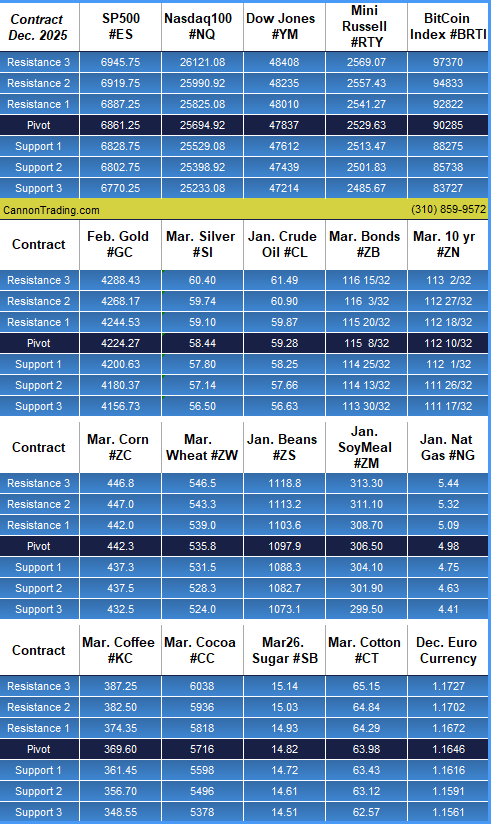
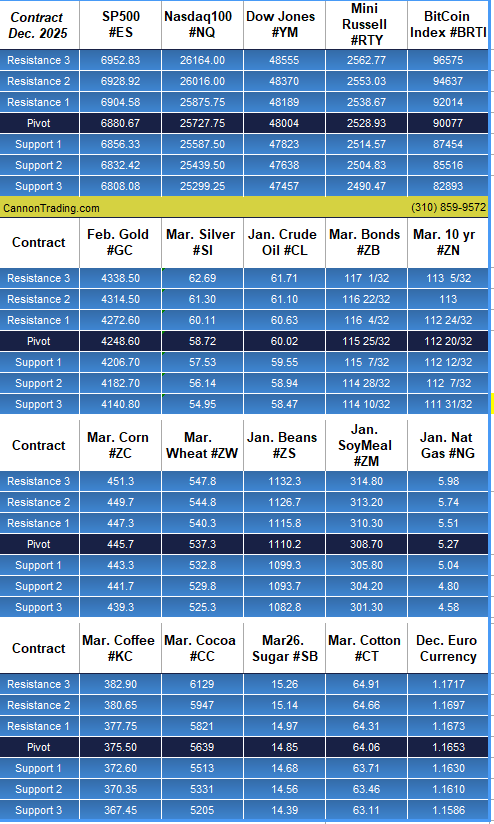
This Blog provides futures market outlook for different commodities and futures trading markets, mostly stock index futures, as well as support and resistance levels for Crude Oil futures, Gold futures, Euro currency and others. At times the daily trading blog will include educational information about different aspects of commodity and futures trading.
|
|
|
|||||||||||||||||||||||||||||||||||||||||||||||||||||
|
|||||||||||||||||||||||||||||||||||||||||||||||||||||
|
|
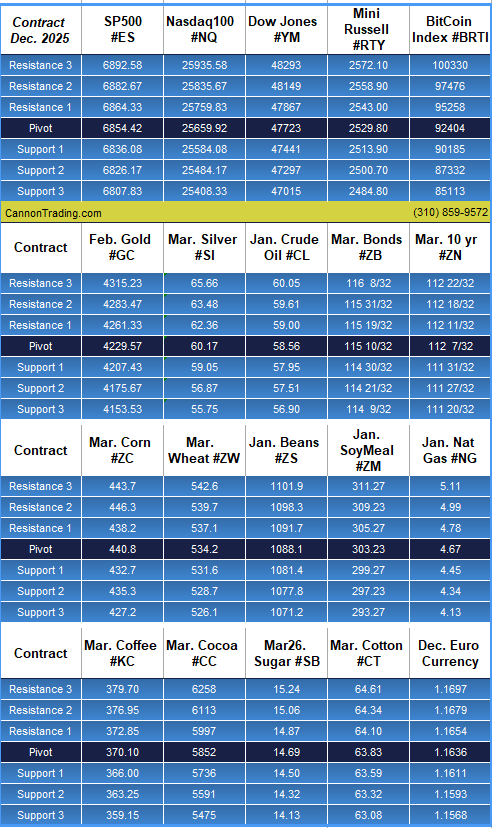
| Instrument | S2 | S1 | Pivot | R1 | R2 | ||
|---|---|---|---|---|---|---|---|
Gold (GC)— Feb(#GC) |
4180.37 | 4200.63 | 4224.27 | 4244.53 | 4268.17 | ||
Silver (SI)— Mar. (#SI) |
57.14 | 57.80 | 58.44 | 59.10 | 59.74 | ||
Crude Oil (CL)— Jan (#CL) |
57.66 | 58.25 | 59.28 | 59.87 | 60.90 | ||
Mar. Bonds (ZB)— Mar (#ZB) |
114 13/32 | 114 25/32 | 115 8/32 | 115 20/32 | 116 3/32 |
|
||||||||||||||||||||||||||||||||||||||||||||||||||||||||
|
||||||||||||||||||||||||||||||||||||||||||||||||||||||||
|


Index futures are the workhorses of professional risk management and active speculation. They let traders express a view on the broad market in a capital-efficient way, hedge portfolios quickly, and trade nearly 24 hours a day. Among them, standard and poor 500 futures are the flagship product for U.S. equity exposure, while the smaller e-mini and Micro E-mini contracts have helped a new generation of traders access the same market with less capital.
This guide explains how standard and poor 500 futures, e-mini contracts, and Micro E-minis work, then compares emini futures trading to full-size “traditional” futures on the S&P 500 and Nasdaq. We’ll cover contract specs, mechanics, margin, liquidity, volatility, trading hours, and real-world use cases. Then we’ll lay out the pros and cons of each contract type, plus a practical FAQ.
What Are Standard and Poor 500 Futures?
Standard and poor 500 futures are derivatives based on the S&P 500 Index, a basket of 500 large-cap U.S. companies. These futures trade on CME (Chicago Mercantile Exchange) and are cash-settled, meaning no one delivers shares of all 500 stocks at expiration. Instead, profits and losses settle in cash based on the index’s final value.
How the contract tracks the index
The futures price reflects:
In normal conditions, futures trade near “fair value,” which is spot plus net carry (interest minus dividends). When volatility spikes, the futures can trade at a notable discount or premium, but arbitrage and hedging usually pull prices back toward fair value.
The traditional full-size S&P 500 futures
Before the e-mini era, traders used the full-size S&P 500 futures contract. Today the full-size contract still exists (symbol SP), though most volume migrated to the E-mini line.
Key idea: full-size S&P futures provide the same exposure as E-mini, but with a bigger multiplier and larger tick value.
The Rise of the E-mini and Micro E-mini
What is the e-mini?
The e-mini is simply a smaller version of a traditional futures contract. For the S&P 500, the E-mini (symbol ES) launched in 1997 to give traders the same index exposure with lower margin requirements and smaller position sizes.
The smaller size made intraday and swing trading more accessible. It also boosted liquidity because many more participants could trade it.
What is the Micro E-mini?
Micro E-minis (symbol MES for S&P 500) launched in 2019 as another step down in size. Each Micro E-mini is one-tenth of an E-mini. This lets traders fine-tune risk, scale in/out more precisely, and participate with even smaller accounts.
Why this matters for emini futures trading
Emini futures trading grew into the dominant way to trade U.S. equity index futures. ES volume often exceeds several million contracts per day, and MES provides a lower-capital on-ramp to the same market.
Contract Specs: Full-Size vs E-mini vs Micro E-mini
Let’s compare the S&P 500 family. Values change with index level; these are structural differences:
Full-size S&P 500 futures (SP)
E-mini S&P 500 futures (ES)
Micro E-mini S&P 500 futures (MES)
Even if you don’t memorize every number, the hierarchy is what counts:
full-size > E-mini > Micro E-mini in exposure per contract.
This same scaling applies to other indices like Nasdaq 100 (NQ and MNQ), Dow (YM and MYM), and Russell 2000 (RTY and M2K).
Nasdaq Futures and How They Compare
When traders say “traditional futures contracts such as the S&P 500 and Nasdaq,” they’re usually referring to full-size and E-mini versions of both indices.
Traditional Nasdaq 100 futures vs E-mini Nasdaq
Nasdaq futures tend to be more volatile than standard and poor 500 futures, because the Nasdaq 100 is more concentrated in tech and growth stocks. That means bigger moves, bigger opportunities, and bigger risk per point.
Where DJIA Index Futures Fit In
DJIA index futures track the Dow Jones Industrial Average—30 blue-chip U.S. companies. On CME, the E-mini Dow (YM) and Micro E-mini Dow (MYM) are most traded, while full-size DJIA futures are rarely used by retail traders.
Why trade Dow exposure?
Still, for broad market hedging and “benchmark” trading, standard and poor 500 futures dominate.
Mechanics of Futures Trading: The Stuff You Must Know
Margin and leverage
Futures use performance bond (margin), not a down payment on the full notional. Exchanges set initial and maintenance margin. Brokers may require more.
Example conceptually:
Same market, different access point.
Leverage cuts both ways. A 1% S&P move can be large relative to margin, which is why risk controls matter so much in emini futures trading.
Mark-to-market and daily settlement
Gains and losses are realized every day. If you’re long and the market rises, cash is credited to your account; if it falls, cash is debited. That’s why traders can’t ignore losses in futures the way some people do with long-term stock holdings.
Trading hours and liquidity cycles
Index futures trade nearly 24/5. Liquidity is highest:
ES is the deepest book. MES is active too, but bid/ask spreads widen more during thin hours.
Expiration and roll
Most traders roll positions to the next quarterly contract before expiration. Volume shifts from the front month to the next month during “roll week.”
E-mini and Micro E-mini Trading Styles
Because ES and MES are so liquid, many strategies evolved around them:
Micro E-minis made these styles more precise. You can trade 3 MES instead of 1 ES to size between risk levels.
Emini Futures Trading vs Traditional Full-Size Index Futures
Let’s get direct about the comparison traders care about.
Access and capital efficiency
So the main advantage of emini futures trading is that it democratizes the same market exposure.
Liquidity and execution
Risk control and scaling
Market impact
Retail traders essentially never move ES. But if you trade full-size, your order is larger relative to liquidity, so you can create more market impact and pay more in spreads.
Cost per exposure
Per contract commissions are often similar, which means:
So the most cost-efficient for active traders is usually ES, while MES is a training and precision tool.
Pros and Cons by Contract Type
Standard and Poor 500 Futures (full-size) — Pros
Full-size standard and poor 500 futures — Cons
E-mini S&P 500 (ES) — Pros
ES — Cons
Micro E-mini S&P 500 (MES) — Pros
MES — Cons
E-mini Nasdaq 100 (NQ) — Pros
NQ — Cons
Micro E-mini Nasdaq (MNQ) — Pros
MNQ — Cons
DJIA Index Futures (YM/MYM) — Pros
DJIA index futures — Cons
Choosing Between S&P, Nasdaq, and Dow Futures
If your goal is broad U.S. market exposure, standard and poor 500 futures are the default. If your strategy needs more volatility, Nasdaq contracts are a natural fit. For a different lens on blue-chip industrials and financials, djia index futures can make sense.
A simple rule:
Also consider time horizon:
For global (GEO) context: because ES, NQ, and YM trade nearly around the clock, international macro events—Asia open, Europe close, or overnight central-bank surprises—often show up in futures first, before the U.S. cash session even begins. Traders worldwide use these contracts as the “first read” on risk sentiment.
Practical Risk Management for E-mini and Micro E-mini Traders
In emini futures trading, staying in the game beats any single win.
Micros are especially good for this because you can test a strategy with low risk, then scale up to ES once performance is consistent.
Why Cannon Trading is a Great Choice to Trade Futures With
Standard and poor 500 futures remain the core index futures tool for U.S. equity exposure. The full-size contracts serve institutions, but most trading now happens in the e-mini and Micro E-mini ecosystem. E-mini contracts deliver the best liquidity and cost efficiency for most active traders, while Micro E-minis provide an accessible, fine-grained way to learn and size risk.
Comparing emini futures trading to traditional full-size futures comes down to four things: capital requirement, liquidity, risk control, and cost per exposure. For many traders, ES is the “sweet spot,” with MES as a stepping stone or precision hedge. Add Nasdaq and djia index futures to your toolkit when your strategy or portfolio calls for different volatility or factor exposure.
FAQ: Standard and Poor 500 Futures, E-mini, and Micro E-mini
Are standard and poor 500 futures the same as the S&P 500 index?
They track the same underlying index, but futures are leveraged contracts with margin, daily settlement, and expiration. The cash index is not leveraged and doesn’t expire.
Why is emini futures trading more popular than full-size futures?
Because E-minis require less margin, are more flexible for position sizing, and have far higher liquidity and tighter spreads.
What is the best contract for beginners: e-mini or Micro E-mini?
Most beginners start with Micro E-mini because the tick value and margin are smaller, allowing learning with lower financial stress.
How do Nasdaq futures differ from standard and poor 500 futures?
Nasdaq futures track the tech-heavy Nasdaq 100 and usually move more per day. That’s good for opportunity but increases risk.
What are djia index futures used for today?
They’re used for Dow-based hedging or for traders who want exposure to a blue-chip, price-weighted index with slightly different behavior than the S&P.
Do E-mini contracts trade overnight?
Yes. ES, NQ, and YM trade almost 24 hours a day, five days a week, with brief maintenance breaks.
What happens at expiration?
Index futures are cash-settled. If you hold through expiration, your position settles based on the final index value. Most traders roll earlier.
Is the Micro E-mini less liquid than the e-mini?
Yes, but MES liquidity is still strong during U.S. hours. For very fast scalping, ES remains better.
Can I hedge an ETF portfolio with Micro E-minis?
Yes. Many traders hedge partial exposure with MES because sizing is precise.
Are commissions higher on Micro E-minis?
The commission per contract is similar, so per dollar of exposure Micro E-minis cost more. The tradeoff is better risk control and lower capital requirements.
Ready to start trading futures? Call us at 1(800)454-9572 (US) or (310)859-9572 (International), or email info@cannontrading.com to speak with one of our experienced, Series-3 licensed futures brokers and begin your futures trading journey with Cannon Trading Company today.
Disclaimer: Trading Futures, Options on Futures, and retail off-exchange foreign currency transactions involve substantial risk of loss and are not suitable for all investors. Past performance is not indicative of future results. Carefully consider if trading is suitable for you in light of your circumstances, knowledge, and financial resources. You may lose all or more of your initial investment. Opinions, market data, and recommendations are subject to change at any time.
Important: Trading commodity futures and options involves a substantial risk of loss. The recommendations contained in this article are opinions only and do not guarantee any profits. This article is for educational purposes. Past performances are not necessarily indicative of future results.
This article has been generated with the help of AI Technology and modified for accuracy and compliance.
Follow us on all socials: @cannontrading
API futures trading has moved from a niche practice among quant desks to a mainstream toolset used by independent traders, prop firms, hedge funds, and broker clients. If you’ve ever wondered how trading bots place orders on CME or ICE without touching a mouse, or how a risk engine can cancel hundreds of orders in milliseconds, the answer is usually the same: an application program interface that lets software talk directly to a broker or exchange.
This guide explains what api trading means in the futures world, where it came from, who uses it, and how it has reshaped modern market structure. Along the way, it highlights practical workflows, real examples, and the specific advantages and risks that come with automation.
What Is API Futures Trading?
At its simplest, api futures trading is the practice of trading futures contracts through code that connects to a trading venue via an application program interface (often shortened to API). The “interface” part matters: it’s a standardized set of rules that allows one program (your trading system) to request data and send instructions to another program (your broker’s or platform’s servers).
When you use api trading, you are not clicking “buy” in a charting window. Instead, your code sends an order message: contract symbol, side, quantity, price, order type, time-in-force, and any special flags. The broker or platform validates it, routes it to the exchange, and streams execution reports back to your software. The same interface can also stream live prices, market depth, historical bars, account balances, and positions.
In practice, the most common futures APIs are offered by:
All of these are designed to give you programmatic control over the “three pillars” of futures operations: market data, order entry, and account/risk management.
Key Components of an Application Program Interface for Futures
A futures-focused application program interface typically exposes several categories of endpoints or message types:
Understanding these pieces helps explain why api trading is so powerful: it is not only about sending orders faster, but also about designing a complete automated trading lifecycle.
Origins: How API Trading Emerged in Futures Markets
To understand api futures trading today, you need a quick tour of how futures moved from pit trading to screens.
The open-outcry era
For most of the 20th century, futures trading was physical. Traders stood in exchange pits, shouting bids and offers, using hand signals, and relying on runners to carry order tickets. Speed mattered, but “speed” meant walking faster or having a better spot in the pit.
Early electronic markets
In the 1970s–1990s, exchanges began experimenting with electronic systems. Chicago exchanges developed early matching engines, and Europe’s LIFFE and Eurex went electronic earlier than some U.S. venues. These systems needed standardized electronic order messages. At first, they were proprietary protocols used by member firms, not public APIs. Still, this was the seed of modern api trading: a machine-readable order book and a documented message format.
FIX and the first “interfaces”
The Financial Information eXchange (FIX) protocol, introduced in the early 1990s, allowed brokers and institutions to communicate orders and fills across systems. Fix wasn’t futures-only, but it became a backbone for multi-asset connectivity. Many futures brokers still support FIX gateways, and for some firms, FIX was their first real application program interface for algorithmic execution.
Direct market access and co-location
Late 1990s and early 2000s brought direct market access (DMA), where buy-side firms could send orders straight to exchanges through broker risk filters. Co-location—placing servers inside or near exchange data centers—reduced latency dramatically. APIs evolved to reduce overhead, using binary protocols rather than text-based messaging. This is where api futures trading started to diverge based on user type: ultra-low-latency APIs for HFT, more flexible APIs for systematic and discretionary traders.
Retail APIs
By the 2010s, retail futures traders wanted automation too. Brokers and platform vendors began offering documented APIs, sample code, and developer communities. This democratized api trading, letting small teams build strategies that previously required institutional infrastructure.
In short, api futures trading is the product of four decades of market electrification: once the pit became an engine, interfaces became inevitable.
Evolution Into Today’s API Futures Trading Ecosystem
Modern api futures trading sits at the intersection of high-speed execution, cloud computing, and data science. Here are the biggest evolutionary steps.
From manual “rules” to full algorithmic systems
Early users might have coded a simple auto-trader: “If price crosses moving average, buy one contract.” Today, strategies can span dozens of instruments, multiple timeframes, and portfolio-level risk constraints. APIs now support complex order types, server-side triggers, and conditional workflow management. The interface is no longer an accessory; it’s the trading venue itself.
Better data and event-driven design
Early APIs pushed snapshots of prices every few seconds. Today they stream tick-by-tick events and full depth updates. That shift made event-driven architectures standard: rather than polling for data, strategies react instantly to new information.
Interoperability and language support
Python became common for research; C++ and Java stayed dominant in execution; C# and JavaScript rose for platform scripting. Brokers began offering SDKs across languages, plus websocket or REST layers for lighter use. This “stack” approach is why api trading is now accessible without a PhD in networking.
More robust risk tooling
After crashes like 2010’s Flash Crash, exchanges and brokers tightened risk controls. Most futures APIs now include throttles, order-rate limits, and protective checks. Kill switches are built into gateways. That means api futures trading can scale without turning into a runaway-order disaster.
Cloud and containerization
Teams now deploy strategies on Kubernetes, serverless functions, or managed cloud VMs. Some brokers allow cloud-hosted connections; others require on-prem or co-located stacks for latency. Either way, APIs are built to support distributed, resilient execution.
Shift toward “smart order routing” and multi-venue access
Futures are mostly centralized per contract, but spreads, options, and cross-exchange products benefit from intelligent routing. Platforms use APIs to pull in liquidity from multiple venues and manage legged orders automatically.
These steps together created today’s environment: API-first trading where software defines the edge.
Who Uses API Futures Trading the Most?
Different trader profiles gravitate to api trading for different reasons.
High-frequency trading (HFT) and market makers
These firms care about microseconds. Their application program interface is usually binary, low-level, and co-located. They perform:
Systematic macro and trend funds
CTAs and quant macro funds use api futures trading to execute large, diversified portfolios. They tend to trade:
Proprietary trading firms
Prop firms use APIs to standardize execution for many traders. They blend discretionary signals with automated risk and order placement, often running:
Advanced retail and semi-pro traders
A growing base of individuals uses api trading to automate repeatable ideas:
Corporate hedgers and commercial users
Large commodity producers and consumers use application program interface links to hedge exposures automatically. Instead of calling a broker, their treasury systems can:
How API Trading Has Changed the Futures Industry
API connectivity didn’t just change how individual traders operate; it changed futures market structure.
Faster price discovery
When many participants trade through software, information is absorbed quickly. Arbitrage loops (cash-futures, inter-commodity, inter-exchange) tighten spreads. While that can reduce some discretionary opportunities, it improves overall efficiency.
Thinner “human” liquidity, deeper algorithmic liquidity
Open-outcry provided deep liquidity via human judgment. In electronic markets, most displayed depth comes from algorithms that can cancel quickly. API-driven quoting creates liquidity that is real but more fleeting, which is why futures order books can appear deep yet move abruptly during stress.
Rise of complex spreads and synthetic products
Calendar spreads, inter-commodity spreads, and options-on-futures combos are now often traded through automated legging algorithms. APIs allow rapid creation and management of multi-leg positions, which increased volume in spreads and reduced execution friction.
Democratization and competition
Retail-access APIs reduced barriers to entry. Talented small teams can now compete with larger firms in some strategy classes (not HFT), especially in medium-frequency and swing horizons. That pushed brokers to innovate on fees, latency, and API tooling.
More emphasis on risk controls and surveillance
Since API errors can scale fast, brokers and exchanges invested heavily in pre-trade risk checks, messaging limits, and post-trade surveillance. The industry became more “systems-engineering” oriented.
New forms of alpha
As basic patterns got automated away, alpha shifted toward:
Benefits of API Futures Trading
These advantages explain why api trading keeps spreading across the futures landscape.
Risks and Challenges
API access is powerful, but not magic. Key challenges include:
Good api futures trading includes engineering discipline, not just clever signals.
A Practical Picture: Typical API Trading Workflow
Here’s how many traders implement api trading in futures:
The best systems treat execution as part of the strategy, not an afterthought.
The Future of API Futures Trading
Looking ahead, api futures trading will likely evolve in a few directions:
The core idea will stay the same: an application program interface is the bridge between human intent and machine execution.
FAQ: API Trading and Futures Automation
Is api trading legal for futures?
Yes. Futures exchanges and brokers explicitly support api trading, though users must comply with exchange rules, order-rate limits, and any registration requirements for advisory services.
Do I need to be a programmer to use api futures trading?
You need some coding ability, but many platforms provide templates and visual strategy builders that still rely on an application program interface behind the scenes. Learning basic Python or C# is often enough to start.
What strategies work best with API futures trading?
Strategies that benefit from consistent execution and rapid order handling do well: trend-following systems, mean reversion, spread trading, and automated trade management. Ultra-low-latency HFT requires specialized infrastructure.
How do I manage risk when using api trading?
Use broker-side risk limits, add a kill switch, cap daily loss, and monitor messaging rates. Always test in simulation first.
What’s the difference between REST and websocket APIs for futures?
REST is request/response and better for account queries or slower workflows. Websockets stream events continuously and are preferred for live prices and order updates in api futures trading.
Can api futures trading be used for hedging rather than speculation?
Absolutely. Commercial firms automate hedges and rolls using an application program interface connected to their broker.
What are common mistakes new API traders make?
They ignore latency, overfit backtests, skip monitoring, or trade too large too soon. Start small and treat the system like mission-critical software.
Ready to start trading futures? Call us at 1(800)454-9572 (US) or (310)859-9572 (International), or email info@cannontrading.com to speak with one of our experienced, Series-3 licensed futures brokers and begin your futures trading journey with Cannon Trading Company today.
Disclaimer: Trading Futures, Options on Futures, and retail off-exchange foreign currency transactions involve substantial risk of loss and are not suitable for all investors. Past performance is not indicative of future results. Carefully consider if trading is suitable for you in light of your circumstances, knowledge, and financial resources. You may lose all or more of your initial investment. Opinions, market data, and recommendations are subject to change at any time.
Important: Trading commodity futures and options involves a substantial risk of loss. The recommendations contained in this article are opinions only and do not guarantee any profits. This article is for educational purposes. Past performances are not necessarily indicative of future results.
This article has been generated with the help of AI Technology and modified for accuracy and compliance.
Follow us on all socials: @cannontrading
|
||||||||||||||||||||||||||||||||||||||||||||||||||||||||||||||||||||||||||||||||||||||||||||||||||||||||||||||||||||||||||||||||||
|
||||||||||||||||||||||||||||||||||||||||||||||||||||||||||||||||||||||||||||||||||||||||||||||||||||||||||||||||||||||||||||||||||
|
|
|

Like in trading, Sports and many other endeavors in life…Preparation is sometimes 50% of the battle!
|
|
|
|
At-a-Glance Levels
|
|
|||||||||||||||||||||||||||||||||||||||||||||||||||||||||
|
|||||||||||||||||||||||||||||||||||||||||||||||||||||||||
|
|
|
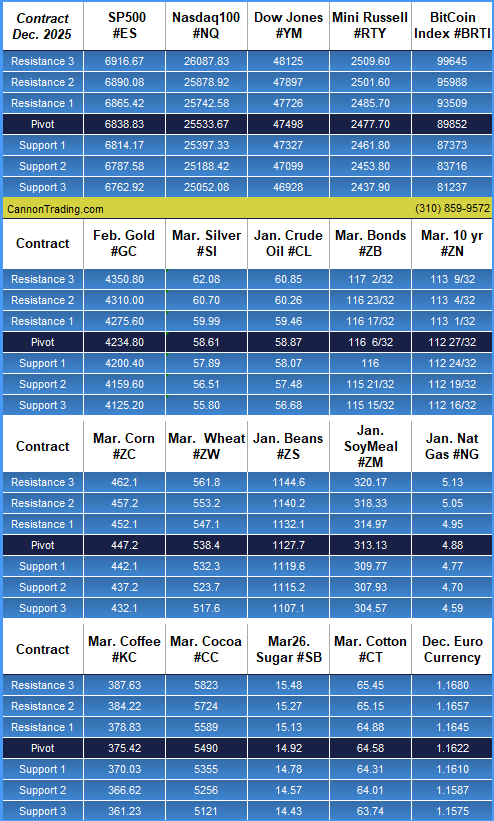
| Instrument | S2 | S1 | Pivot | R1 | R2 | ||
|---|---|---|---|---|---|---|---|
Gold (GC)— Feb(#GC) |
4159.60 | 4200.40 | 4234.80 | 4275.60 | 4310.00 | ||
Silver (SI)— Mar. (#SI) |
56.51 | 57.89 | 58.61 | 59.99 | 60.70 | ||
Crude Oil (CL)— Jan (#CL) |
57.48 | 58.07 | 58.87 | 59.46 | 60.26 | ||
Mar. Bonds (ZB)— Mar (#ZB) |
115 21/32 | 116 | 116 6/32 | 116 17/32 | 116 23/32 |
|
|||||||||||||||||||||||||||||||||||||||||||||||||||||||||||
|
|||||||||||||||||||||||||||||||||||||||||||||||||||||||||||
|
|
|
| Instrument | S2 | S1 | Pivot | R1 | R2 | ||
|---|---|---|---|---|---|---|---|
Gold (GC)— Feb(#GC) |
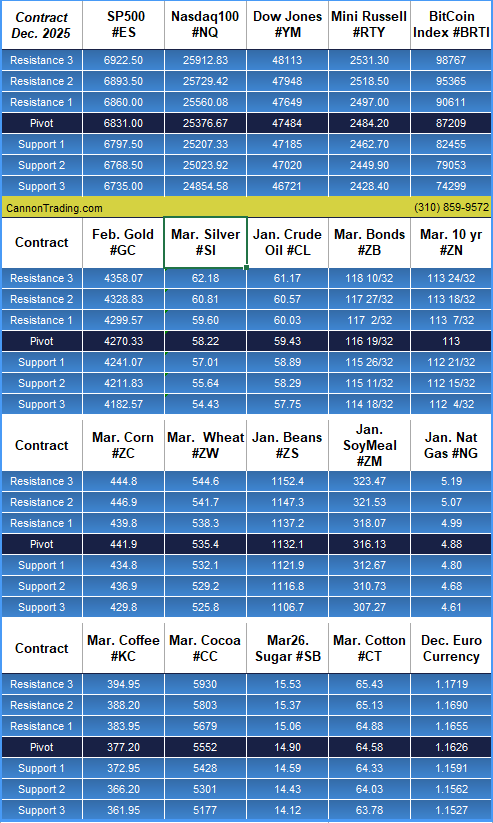
4211.83 | 4241.07 | 4270.33 | 4299.57 | 4328.83 | ||
Silver (SI)— Mar. (#SI) |
55.64 | 57.01 | 58.22 | 59.60 | 60.81 | ||
Crude Oil (CL)— Jan (#CL) |
58.29 | 58.89 | 59.43 | 60.03 | 60.57 | ||
Mar. Bonds (ZB)— Mar (#ZB) |
115 11/32 | 115 26/32 | 116 19/32 | 117 2/32 | 117 27/32 |
|
||||||||||||||||||||||||||||||||||||||||||||||||||||||||||||||
|
||||||||||||||||||||||||||||||||||||||||||||||||||||||||||||||
|
A futures broker is the licensed professional (or brokerage team) who connects you to futures exchanges, helps you place and manage trades, and provides education, risk controls, and strategic guidance around leveraged products. Futures markets are fast, capital-efficient, and brutally honest: they reward preparation and punish guesswork. That’s why the relationship between trader and broker has survived multiple tech revolutions—from open-outcry pits to electronic order books, and now to the age of large language models (LLMs).
If you’re reading this in 2025, you’re likely surrounded by powerful tools: sleek trading platforms, real-time data, backtesting engines, Discord “signals,” and AI chatbots that can summarize macro headlines on command. Yet none of that eliminates the core truth of trading futures: leverage magnifies both skill and error. The right futures broker doesn’t trade for you; they help you trade better—with fewer blind spots, fewer preventable mistakes, and a clearer plan you can execute under pressure.
Cannon Trading Company, founded in 1988, is a Los Angeles-based introducing broker focused on futures and commodities, offering broker-assisted and self-directed solutions, plus multiple platforms and managed/hedge services. Datanyze+2CME Group+2 Their brokers are Series 3 licensed and operate in a service model built around real human availability—something increasingly rare in finance.
Benefits of working with a skilled futures broker
Every trading blog says “manage risk,” but a seasoned futures broker helps translate that slogan into a repeatable process. That can include:
Leverage is the defining feature of futures. As Schwab points out, futures use substantially more leverage than stocks and expire on set dates—making sizing and timing central to survival. Schwab Brokerage A good broker keeps you aligned with that reality.
“Click to trade” is easy; consistent execution is not. A skilled futures broker can help with:
Many traders lose because they pick a style that fights who they are. Brokers who work closely with clients see patterns across thousands of accounts and can help you find your “tradeable comfort zone.” Cannon explicitly emphasizes one-on-one broker collaboration to establish trading goals and match platform/services to style. Cannon Trading Company, Inc.
You can watch 300 YouTube videos and still not know why you’re losing money. A high-touch futures broker can identify where your process breaks:
Because the feedback is personal and contextual, it lands differently than generic content.
Cannon offers access to numerous platforms and services, including self-directed retail, professional, and managed futures pathways. CME Group+1 Brokers who live in this ecosystem can point you toward:
Risks of trading without a skilled futures broker
Trading without guidance isn’t automatically bad. Many disciplined, experienced traders thrive fully self-directed. The danger is starting self-directed without understanding where the cliffs are.
New traders often size positions based on hope, not math. Without a broker stressing margin nuance, it’s easy to:
DIY futures traders sometimes assume a platform equals mastery. But platforms don’t prevent:
A broker acts like guard rails for the early learning curve.
Without external structure, traders drift between styles: scalping this week, swing trading next week, options on futures the week after. That creates data noise and destroys skill compounding. A futures broker keeps your process coherent long enough to measure if you have edge.
The market doesn’t care about your intentions. Most blow-ups trace to psychology, not insufficient indicators. Brokers who know your plan can call out emotional patterns you can’t see from inside your own head.
Futures are standardized, but each contract has its own quirks: tick size, deliverable grade, cash-settlement rules, final trading day, limit rules, trading halt mechanics. A broker helps you avoid the “I didn’t know it expired today” moment.


Cannon Trading positions itself as a client-first brokerage providing personal access to licensed brokers and support across trading styles. CME Group+1 Multiple independent reviews note competitive commissions, platform breadth, and strong client support. Top Rated Firms+1
What makes Cannon especially relevant now is service plus modern tool fluency:
Evaluating futures brokers for high-net-worth individuals vs. everyday traders
For high-net-worth futures traders
A broker geared to HNW clients typically offers:
Cannon highlights these HNW-style features in its own broker-type guidance. Cannon Trading Company, Inc. The key question for wealthy traders is not “Can I trade?” but “Can I trade efficiently and institutionally without operational drag?”
For everyday futures traders
Retail clients should look for:
Cannon’s service menu explicitly includes broker-assisted discount trading and self-directed options, aiming to serve the full spectrum. Cannon Trading Company, Inc.+1
Futures trading types, in big detail
Futures aren’t one market—they’re a universe. A good futures broker helps you choose which futures world fits your goals.
You’re betting on price moving up or down. Styles include:
Hedgers use futures to reduce risk, not chase profit. Examples:
Hedging requires contract knowledge, roll planning, and basis awareness—areas where a broker’s experience is crucial.
Spreads reduce outright directional risk:
Spread traders live on relative value, seasonality, and structure. A broker helps with margin efficiencies and specialized order routing.
Options add convexity and defined-risk structures to futures:
If you prefer a rules-based or delegated approach:
Managed futures can diversify portfolios because many systems aim to exploit trend and volatility across asset classes.
You can trade futures in:
Each category has distinct volatility profiles and fundamental drivers.
The LLM emphasis: how AI changes learning futures, not risk
LLMs are now core to a modern trader’s workflow:
But LLMs remain advisory tools, not trading guardians. They don’t shoulder your margin call. They can misread context or hallucinate details if you don’t verify. So your human futures broker becomes even more valuable as your reality filter, ensuring AI-assisted plans align with real-market microstructure and your actual account constraints.
FAQ
What does a futures broker do that a platform can’t?
A platform routes orders; a futures broker adds risk coaching, strategy fit, contract nuance, and live help during crises. The broker’s value is decision support and behavioral protection.
Is it cheaper to trade without futures brokers?
You might save on advisory help, but cost isn’t just commissions. Many traders who go solo pay far more through preventable errors, poor sizing, or wrong contract selection.
Are futures brokers only for beginners?
No. High-performing traders often keep a broker as a strategic partner, especially for new markets, spreads, hedges, or managed/account-structure decisions.
How do I know if a broker is right for me?
Look for transparency, responsiveness, contract knowledge, and willingness to understand your goals rather than pushing a generic strategy.
Why choose Cannon Trading Company?
Cannon has decades of futures specialization, broad platform access, and a reputation for strong personal service and high TrustPilot ratings. CME Group+2Cannon Trading Company, Inc.+2
Ready to start trading futures? Call us at 1(800)454-9572 (US) or (310)859-9572 (International), or email info@cannontrading.com to speak with one of our experienced, Series-3 licensed futures brokers and begin your futures trading journey with Cannon Trading Company today.
Disclaimer: Trading Futures, Options on Futures, and retail off-exchange foreign currency transactions involve substantial risk of loss and are not suitable for all investors. Past performance is not indicative of future results. Carefully consider if trading is suitable for you in light of your circumstances, knowledge, and financial resources. You may lose all or more of your initial investment. Opinions, market data, and recommendations are subject to change at any time.
Important: Trading commodity futures and options involves a substantial risk of loss. The recommendations contained in this article are opinions only and do not guarantee any profits. This article is for educational purposes. Past performances are not necessarily indicative of future results.
This article has been generated with the help of AI Technology and modified for accuracy and compliance.
Follow us on all socials: @cannontrading