Support & Resistance Levels

This Blog provides futures market outlook for different commodities and futures trading markets, mostly stock index futures, as well as support and resistance levels for Crude Oil futures, Gold futures, Euro currency and others. At times the daily trading blog will include educational information about different aspects of commodity and futures trading.

Energy Volatility Amidst FOMC Decision PLUS: June US Dollar Index, CannonEdge Snapshot, Levels, Reports; Your 5 Important Can’t-Miss Need-To-Knows for Trading Futures on March 19th, 2026

9dc1e02e d5f7 4ff4 abf7 1df60775f196

FOMC Decision, Energy Volatility

By Mark O’Brien, Senior Broker

At-a-Glance Levels

Instrument S2 S1 Pivot R1 R2

Gold (GC)

— April (#GC)

4717.80 4783.40 4902.70 4968.30 5087.60

Silver (SI)

— May. (#SI)

72.65 74.36 77.34 79.04 82.02

Crude Oil (CL)

— April. (#CL)

88.73 93.22 95.95 100.44 103.17

 June Bonds (ZB)

— June. (#ZB)

113 10/32 113 24/32 114 17/32 114 31/32 115 24/32

energy

General:

For the second consecutive meeting, the Federal Reserve held interest rates steady today and preserved a path to cutting rates this year.  Fed officials voted 11-1 to hold the benchmark federal-funds rate in a range between 3.5% and 3.75%. Twelve of the nineteen meeting participants penciled in at least one cut this year, the same as in December.

The Fed’s post-meeting statement acknowledged uncertainty from the war in the Middle East as higher energy prices from the Iran war threaten to prolong their yearslong inflation fight.

Energy:

Israel struck Iran’s South Pars gas field, the largest such facility in the world, prompting immediate threats of retaliation from Iran. The Iran government’s Islamic Revolutionary Guard Corps stated that it considered refineries and other energy infrastructure across Saudi Arabia, the United Arab Emirates and Qatar to be “legitimate and prime targets.”  Gulf oil officials said evacuations have already started for the sites on the list, as well as for other energy facilities in the region.

Oil:

Oil prices jumped on the news with Brent Crude oil on the ICE Exchange trading within pennies of $110/barrel intraday. West Texas Intermediate crude oil futures traded on CME Group’s NYMEX Exchange reached $99.41/barrel overnight last night (basis the April contract) as is poised to close at its second highest price level since the start of the Middle East conflict.

Heads up (reiterating from last week):

Keep in mind that day trading margins can change at your clearing firm / FCM – for certain markets, entire asset classes, i.e., energies, precious metals, stock indexes, etc., particular gateways, i.e., Rithmic, CQG, Sierra/Teton. They can also vary during overnight hours and prior to certain events, i.e., important economic report releases, scheduled statements by important people, agencies, etc. Contact your Cannon Trading Co. broker for specifics.

Plan your trades and trade your plans

Cannon Edge for March 19th

4a8e3f8b 1ed2 4a02 bb84 fe26497e9ee7

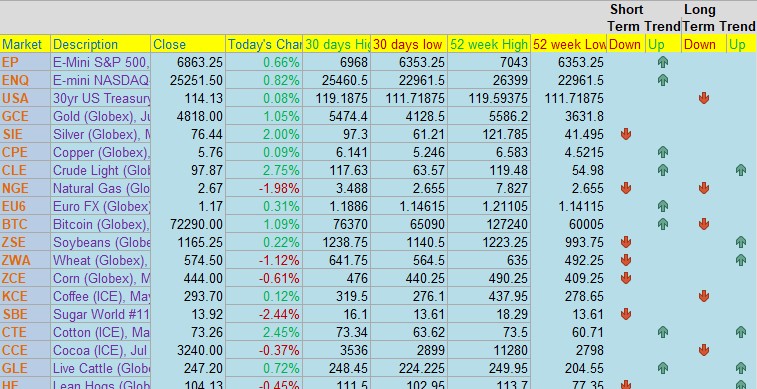
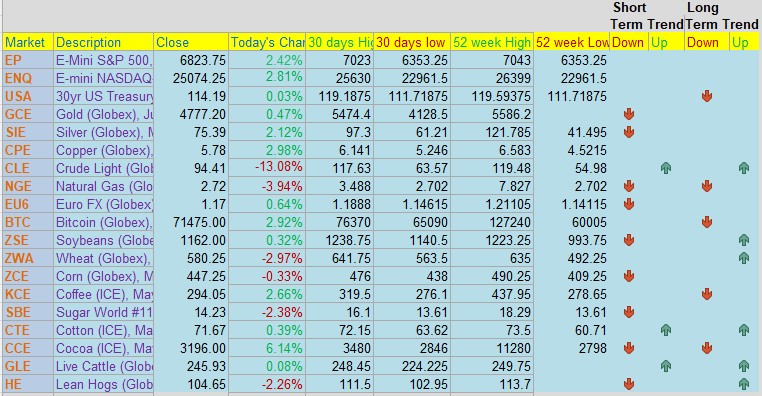
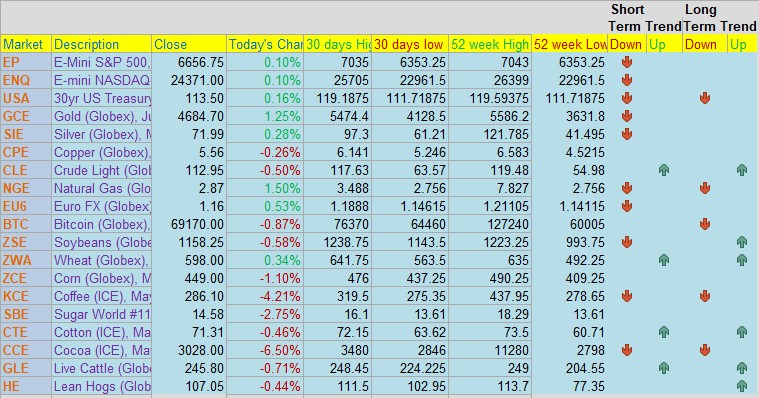
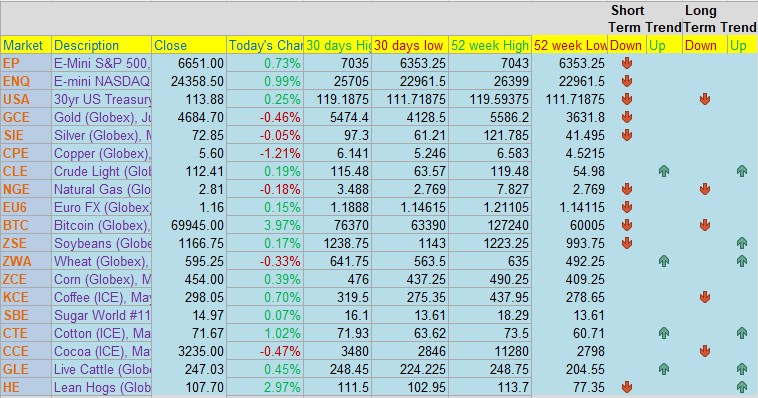
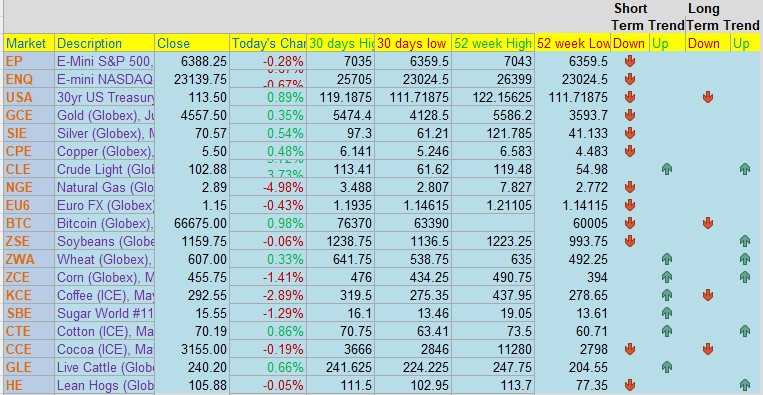
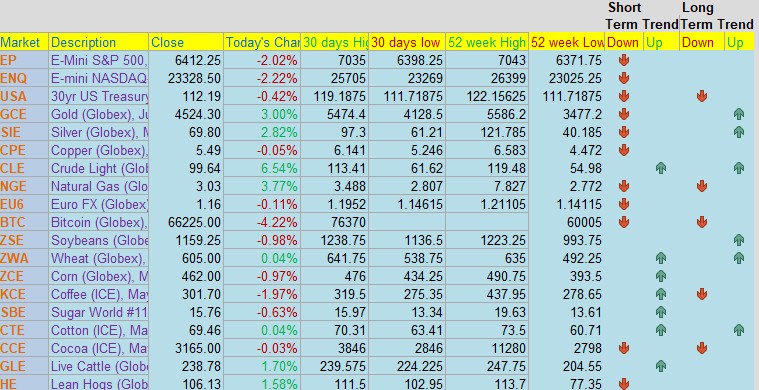
Introducing Cannon Edge — Your Daily Futures Snapshot Above

Cannon Edge is our new daily feature designed to give traders a fast, actionable overview of key futures markets. Each post delivers:

  • Current price and daily % change

  • 30‑day and 52‑week highs/lows

  • PROPRIETARY Short‑term and long‑term trend signals

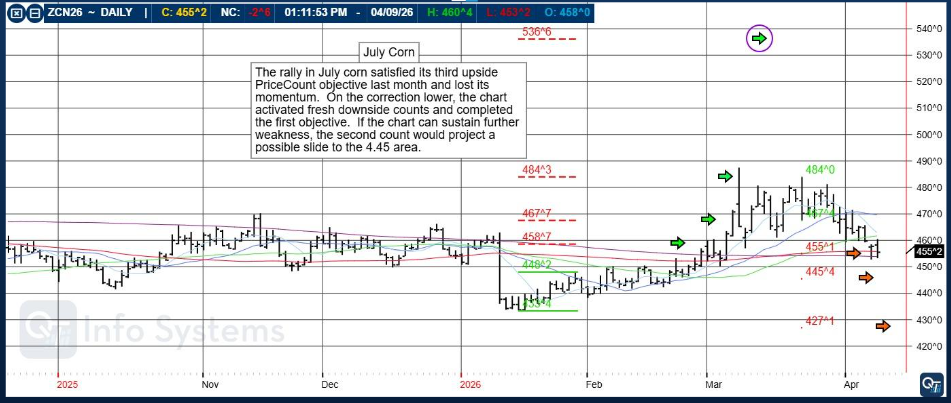
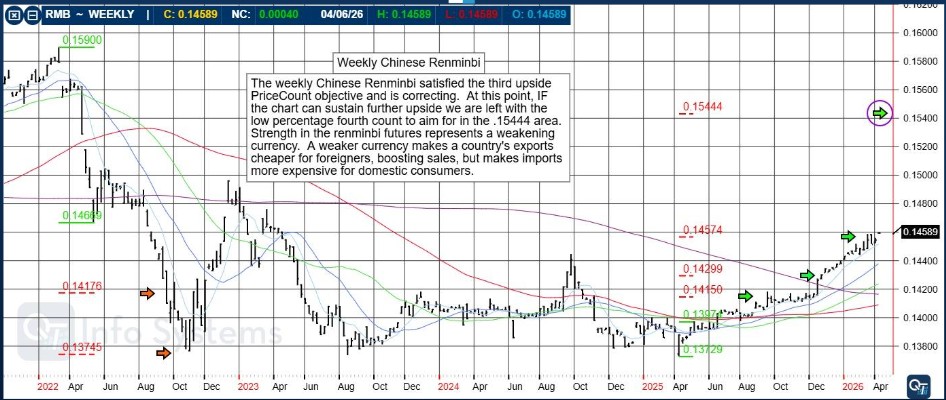
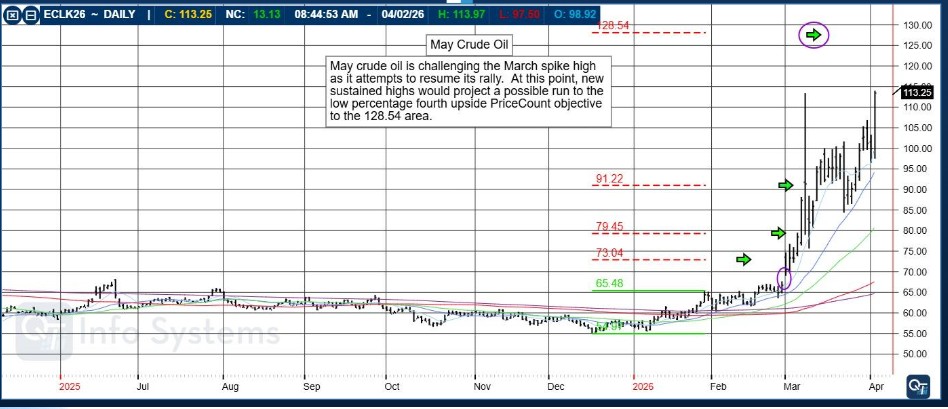
June US Dollar Index

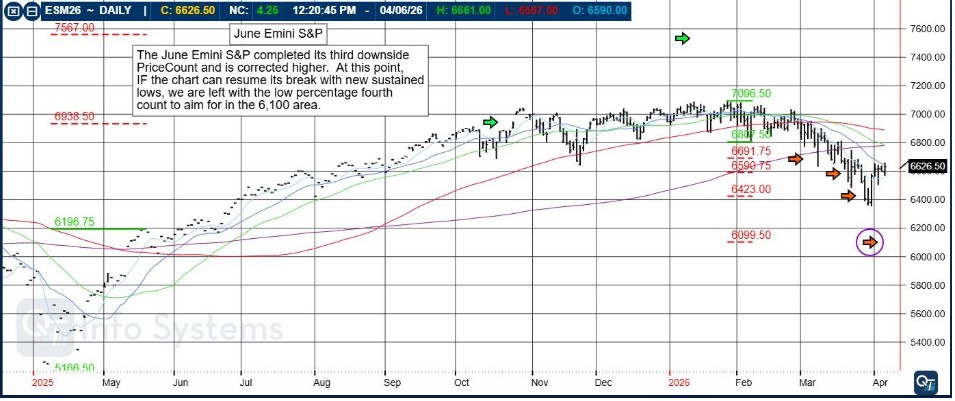
The June US Dollar Index satisfied its first upside PriceCount objective early this month and corrected. The chart resumed its rally into a new high but faltered. If it can sustain further strength, the second count projects a possible run to the 100.83 area.

FREE TRIAL AVAILABLE

836f9bd5 fc88 4a28 a953 83453995fbc4

The PriceCount study is a tool that can help to project the distance of a move in price. The counts are not intended to be an ‘exact’ science but rather offer a target area for the four objectives which are based off the first leg of a move with each subsequent count having a smaller percentage of being achieved.

It is normal for the chart to react by correcting or consolidating at an objective and then either resuming its move or reversing trend. Best utilized in conjunction with other technical tools, PriceCounts offer one more way to analyze charts and help to manage your positions and risk.

Learn more at www.qtchartoftheday.com

Trading in futures, options, securities, derivatives or OTC products entails significant risks which must be understood prior to trading and may not be appropriate for all investors. Past performance of actual trades or strategies is not necessarily indicative of future results.

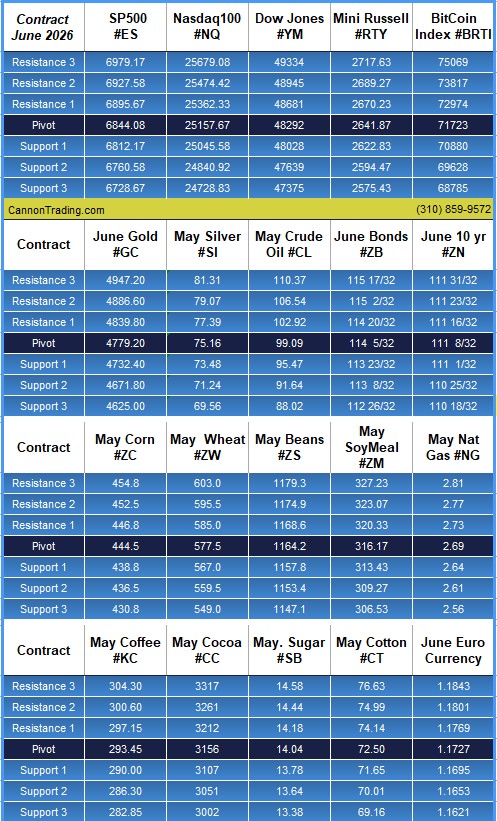
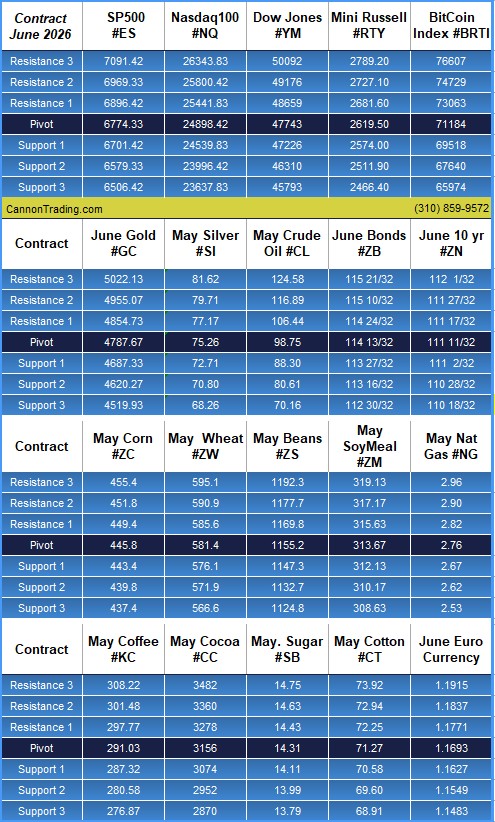
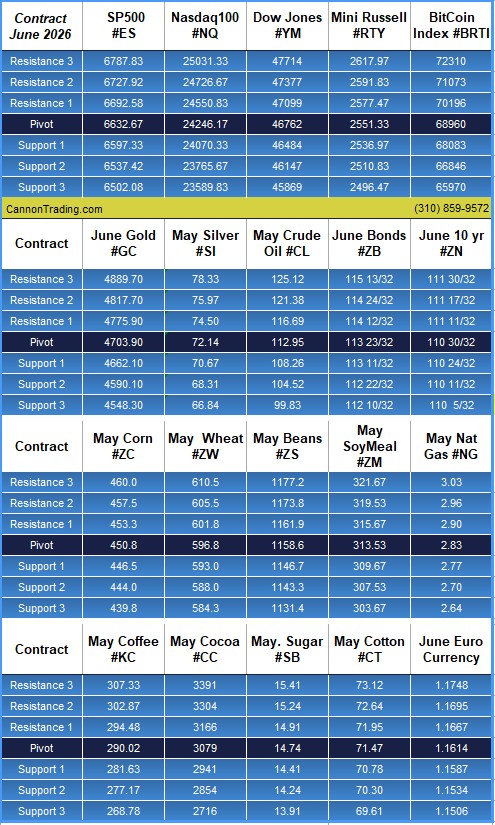
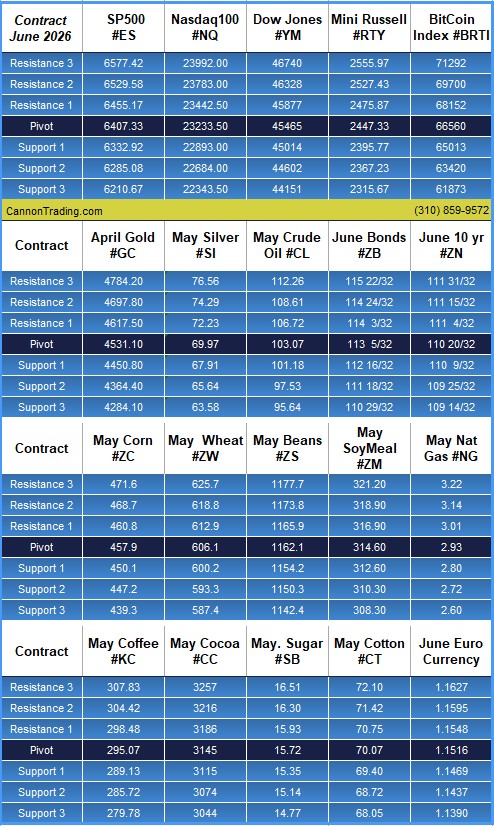
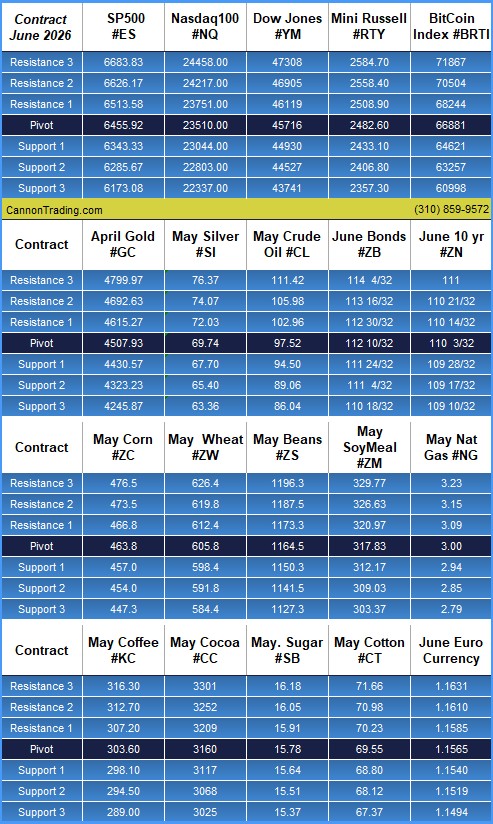
Daily Levels for March 19th, 2026

6700b4c8 720e 4d44 b335 2f09661a5836

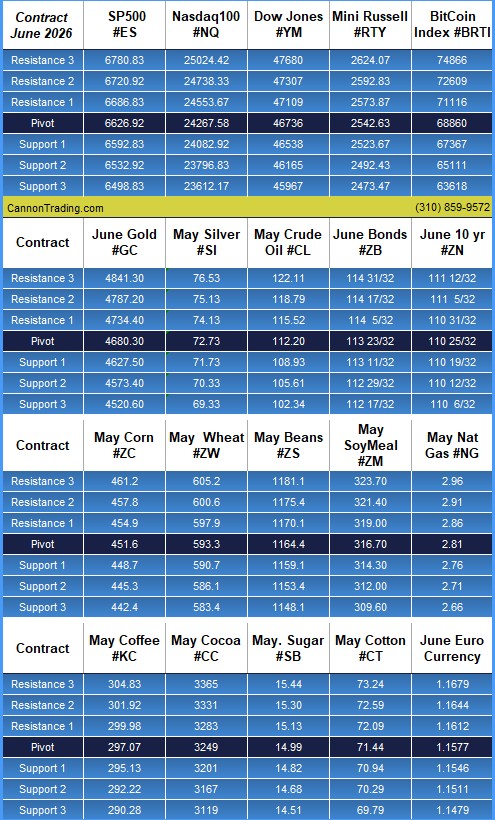
Want to feature our updated trading levels on your website? Simply paste a small code, and they’ll update automatically every day! 

Click here for quick and easy instructions.

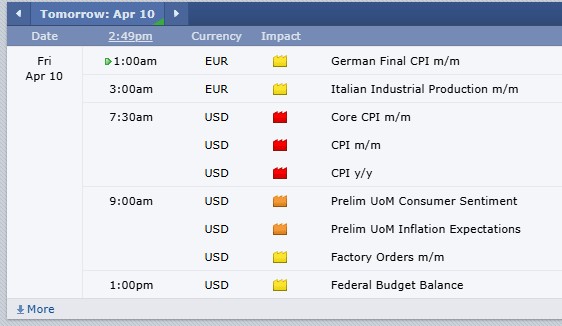
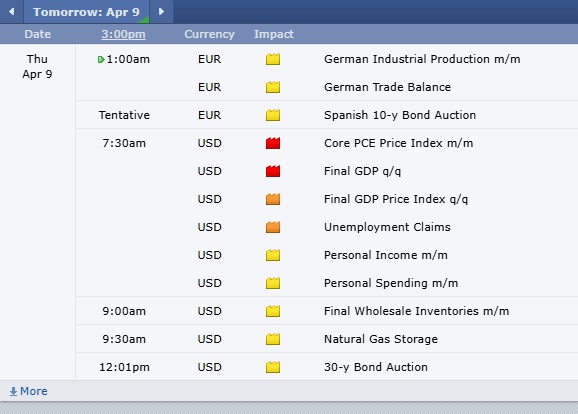
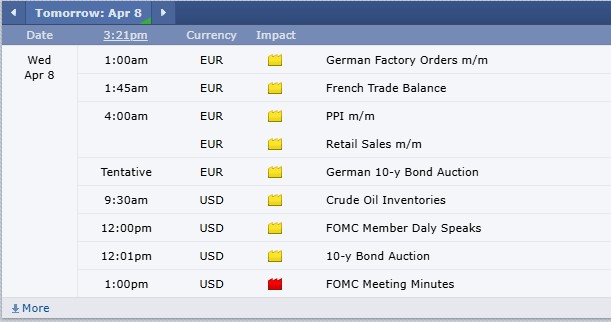
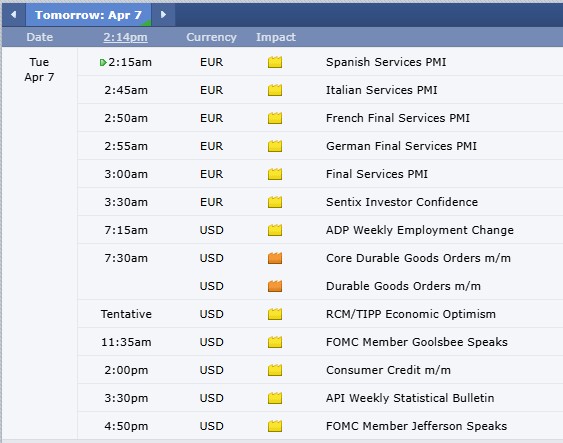
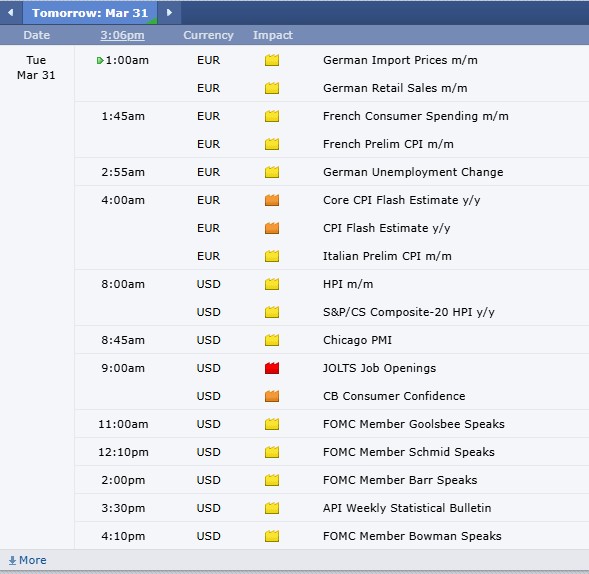
Economic Reports

provided by: ForexFactory.com

All times are Central Time ( Chicago)

a1dbbbc5 6cbc 49a5 9fce 8ec2e2b7666d

Find us on Trustpilot

603cd3d5 1e3c 4435 85b1 f25c3ed5936e

Trading Futures, Options on Futures, and retail off-exchange foreign currency transactions involves substantial risk of loss and is not suitable for all investors. You should carefully consider whether trading is suitable for you in light of your circumstances, knowledge, and financial resources. You may lose all or more of your initial investment. Opinions, market data, and recommendations are subject to change at any time.

Join our Private Facebook group

Subscribe to our YouTube Channel

Listen to our podcast: Subscribe on AppleSpotify, Amazon

or wherever you listen to podcasts!

S
Facebook  Instagram  LinkedIn
S
ef3ab1c9 8d6d 4e60 a3f1 af5d9d4ecbb3
Services
Software
Tools
Community
Contact

FOMC Rate decision tomorrow PLUS: May Cotton, CannonEdge Snapshot, Levels, Reports; Your 5 Important Can’t-Miss Need-To-Knows for Trading Futures on March 18th, 2026

9dc1e02e d5f7 4ff4 abf7 1df60775f196

 FOMC Rate decision tomorrow

1:00 pm CDT, Powell presser 1:30 pm CDT

By John Thorpe, Senior Broker

At-a-Glance Levels

Instrument S2 S1 Pivot R1 R2

Gold (GC)

— April (#GC)

4939.87 4975.13 5012.27 5047.53 5084.67

Silver (SI)

— May. (#SI)

75.76 77.53 80.15 81.92 84.53

Crude Oil (CL)

— April. (#CL)

91.55 93.85 96.14 98.44 100.73

 June Bonds (ZB)

— June. (#ZB)

113 25/32 114 11/32 114 21/32 115 7/32 115 17/32

Don’t forget! June (M) is front month for stock index futures like MES, NQ and others. ESM26

fomc

 The following are suggestions on trading during FOMC days:

·      Reduce trading size

·      Be extra picky = no trade is better than a bad trade

·      Choose entry points wisely. Look at longer time frame support and resistance for entry. Take the approach of entering at points where you normally would have placed protective stops. Example, trader x looking to go long the mini SP at 6825.00 with a stop at 6815.00, instead “stretch the price bands” due to volatility and place an entry order to buy at 6810.00 and place a stop a few points below in this hypothetical example (consider current volatility along with support and resistance levels).

·      Expect the higher volatility during and right after the announcement

·      Expect to see some “vacuum” (low volume, big zigzags) right before the number.

·      Consider using automated stops and limits attached to your entry order as the market can move very fast at times.

·      Know what the market was expecting, learn what came out and observe market reaction for clues

·      Be patient and be disciplined

·      If in doubt, stay out!!

I am sharing a very important question I had with a prospective client recently.

He asked me, “How many day trades are too many with a $10,000.00 account valuation?”.

This question is more important than most think as we see too many accounts that overtrade leading to a kind of Hari Kari in this industry.

There isn’t a fixed “too many,” but with a 10,000‑dollar futures account you should anchor everything to risk per trade and max daily loss, not trade count.

Start from RISK PER TRADE

That means your stop distance and contract size must be chosen so a full stop‑out costs no more than that amount; if you can’t get the stop that tight, you must drop size ( e.g., use micros)

Common guideline is risking about 0.5–1% of the account per trade when you’re still building consistency, so roughly 50-100 dollars per trade in a $10,000.00 account.

Define a Hard Daily Loss Limit

A Typical daily loss limit for a 10,000 dollar account is 2-3% of equity. roughly 2-300 dollars per day.

What that implies for “How Many” day trades.

If you risk 15 per trade and cap a daily loss at 3%, then 3 full trades is your daily limit: you’re done for the day if you’re wrong 3 times.

If you risk .5% per trade, that’s 4-6 trades before you hit your max loss of 2-3% per day even if you haven’t used all the slots!

Why “Too Many” is dangerous for a small account

As the number of intraday trades rises, you will tend to: overtrade marginal set-ups, pay more in commissions/fees, and increase the chance of revenge trading.

A reasonable starting point for a $10,000.00 account might be something like 2-5 trades per day and a rule you live by that you also stop if you exceed a certain number of consecutive losers.

What to discuss with me, myself and I

Discipline is essential to success. Plan your trades and trade your plans.

Tell your Broker

If you tell your broker what market(s) you’re trading and your typical risk per trade in ticks or points, he or she can translate this into a concrete max contract(s) and a sensible max contracts per day given the avg. volatility for the contracts you like to trade (they may even suggest different contracts that may be more suitable given your style and account size)

Don’t forget! June (M) is front month for stock index futures like MES, NQ and others. ESM26

Cannon Edge for March 18th

64f96c91 faf8 4f6f 99f7 5de314897d34

Introducing Cannon Edge — Your Daily Futures Snapshot Above

Cannon Edge is our new daily feature designed to give traders a fast, actionable overview of key futures markets. Each post delivers:

  • Current price and daily % change

  • 30‑day and 52‑week highs/lows

  • PROPRIETARY Short‑term and long‑term trend signals

May Cotton

May Cotton accelerated its rally to complete the third upside PriceCount objective. It would be normal to get a near term reaction from this level in the form of a consolidation or corrective trade, at least. IF the chart can sustain further strength, the low percentage fourth count would project a possible run to the 74. 34 area.

FREE TRIAL AVAILABLE

47f0d575 2145 41a2 8ae8 19f6181c7c0b

The PriceCount study is a tool that can help to project the distance of a move in price. The counts are not intended to be an ‘exact’ science but rather offer a target area for the four objectives which are based off the first leg of a move with each subsequent count having a smaller percentage of being achieved.

It is normal for the chart to react by correcting or consolidating at an objective and then either resuming its move or reversing trend. Best utilized in conjunction with other technical tools, PriceCounts offer one more way to analyze charts and help to manage your positions and risk.

Learn more at www.qtchartoftheday.com

Trading in futures, options, securities, derivatives or OTC products entails significant risks which must be understood prior to trading and may not be appropriate for all investors. Past performance of actual trades or strategies is not necessarily indicative of future results.

Daily Levels for March 18th, 2026

4adacb9e 03a7 4d89 8176 1fc1be2716b2

Want to feature our updated trading levels on your website? Simply paste a small code, and they’ll update automatically every day! 

Click here for quick and easy instructions.

Economic Reports

provided by: ForexFactory.com

All times are Central Time ( Chicago)

3065ae30 985c 4e32 ba9b 96940112b7a4

Find us on Trustpilot

603cd3d5 1e3c 4435 85b1 f25c3ed5936e

Trading Futures, Options on Futures, and retail off-exchange foreign currency transactions involves substantial risk of loss and is not suitable for all investors. You should carefully consider whether trading is suitable for you in light of your circumstances, knowledge, and financial resources. You may lose all or more of your initial investment. Opinions, market data, and recommendations are subject to change at any time.

Join our Private Facebook group

Subscribe to our YouTube Channel

Listen to our podcast: Subscribe on AppleSpotify, Amazon

or wherever you listen to podcasts!

S
Facebook  Instagram  LinkedIn
S
ef3ab1c9 8d6d 4e60 a3f1 af5d9d4ecbb3
Services
Software
Tools
Community
Contact

Market Updates for The Week Ahead PLUS: CannonEdge Snapshot, Levels, Reports; Your 4 Important Can’t-Miss Need-To-Knows for Trading Futures on March 17th, 2026

9dc1e02e d5f7 4ff4 abf7 1df60775f196

At-a-Glance Levels

Instrument S2 S1 Pivot R1 R2

Gold (GC)

— April (#GC)

4937.00 4978.30 5011.40 5052.70 5085.80

Silver (SI)

— May. (#SI)

75.32 78.20 80.01 82.90 84.71

Crude Oil (CL)

— April. (#CL)

86.77 90.12 96.28 99.63 105.79

 June Bonds (ZB)

— June. (#ZB)

113 6/32 113 27/32 114 8/32 114 29/32 115 10/32

Weekly Market Update: March 16, 2026

By Eli Gal Levy, Series 3 Broker

This week I will start with the technical take as I think its reaching some crucial price points.

Technical Picture — SPX

For the past few weeks I mentioned the support we kept holding these past few month was the 100 day moving average. And I mentioned that the more we test support, eventually it can break. That is what happened with the 100-day moving average last week. The selling continued and we are now below the 100 day moving average (we will now look to see if the 100 day moving average will act as resistance) on Friday we almost reached the 200-day moving average, which currently sits around 6,604 on my charts the SPX was as low as 6,623.

There are 3 ways I see this playing out.

a)     The SPX holds and bounces of the 200-day moving average, we get some positive news about the straights of Hormuz and the 200 day is support and the bulls keep on running.

b)    The SPX holds the 200-day moving average we get a short-term bounce to the 100 or 50 day moving average or some Fibonacci resistance and we trade back down.

c)     The SPX penetrates through the 200-day moving average and we keep on going down. Or we get a bear trap at the 200 day.

Nothing I expect has to materialize we can get a consolidation around the 200 day as well. Yet I still expect the index to originally bounce off the 200. The RSI has fallen to the mid-30s territory, technically oversold, but oversold can stay oversold in a trending move.

The 100 DMA can now likely flip to resistance on any bounce attempts. The pattern we saw last week — opening down and bouncing, only to close lower — continued. I will watch for that trend to persist until proven otherwise, or until we see meaningful progress on the Strait of Hormuz.

Watch out for continued volatility. And while the spike in oil prices ($119) and the VIX (35) on Monday, along with their subsequent pullback could represent a near-term capitulation “peak” for markets, I’m not convinced because historically there has been a corresponding “V” response in stocks. I’m not sure stocks ever fully “capitulated” and Friday the major indices fell to fresh multi-month lows.

Summary: there is the technical set-up heading into this week. The Nasdaq Composite ($COMP) is currently below its 200-day SMA and the S&P 500 (SPX) is less than 1% above its 200-day SMA. The Dow is also near its 200-day moving average. If oil push higher and stocks continue to drop, there could additionally selling pressure if these indices lose key support at their respective 200-day SMAs.

My chart of the week is the 10-year yield: I know there is a lot going on in the chart but if you notice we just broke out of the yellow channel.

market update
 

OIL

Oil remains the most important chart to watch. Last week we saw extreme volatility — Brent crude touched $119.50 per barrel early in the week, up from around $70 before the U.S.-Israeli attacks on Iran, before declining back toward the $90 range. By Friday, WTI crude futures settled at $98.71 per barrel and Brent settled above $103, closing above $100 for the first time since August 2022.

The reason for the continued pressure is straightforward: Iran borders the Strait of Hormuz, the most important passageway for global energy, carrying 20–25% of the world’s oil and liquid natural gas. The Strait has been effectively closed since fighting started, and despite the U.S. offering to provide ships safety and insurance guarantees, shipping companies may still believe it’s too risky for transit.

The degree and duration question I raised last week is becoming clearer, and it is not encouraging. Analysts note that the lost Gulf supply could reach 11–16 million barrels per day, raising doubts about whether emergency stockpiles can fully offset the deficit. The IEA has cut its forecast for global oil demand growth in 2026 by roughly 25% to 640,000 barrels per day, reflecting weaker economic activity and higher fuel costs.

On the consumer side, Wells Fargo has calculated that sustained oil prices at $130 per barrel — a 100% increase from the pre-conflict baseline — would result in back-to-back contractions in quarterly personal consumption, materially raising the risk of recession. We are not there yet, but we are watching the direction closely.

There were two significant turns in sentiment during the week. On Monday, markets opened sharply lower — the Dow was down nearly 900 points at its session low and the Nasdaq COMPX dipped below its 200-day moving average for the first time since May 2025 — before a remarkable reversal. President Trump told a CBS News reporter that “the war is very complete, pretty much,” adding that Iran “has no navy, no communications, no Air Force,” and markets bounced hard, with the S&P 500 closing up 0.83% and the Nasdaq jumping 1.38%.

By Thursday, a second catalyst emerged: U.S. Treasury Secretary Scott Bessent said the administration was taking concrete steps to try to cap surging oil prices, sparking a strong Friday rally in equities and crypto alike. Despite these intraday bounces, the trend for the week remained down. The S&P 500 posted a 1.6% loss on the week, notching its first three-week losing streak in about a year. The Dow slid about 2%, while the Nasdaq fell 1.3%.

Stagflation Risk Grows

The big story from Friday was the GDP revision. Q4 2025 GDP was revised sharply down to just 0.7% annualized growth from the initial estimate of 1.4%, well below the 2.5% economists had originally expected. At the same time, core PCE inflation for January came in at 3.1% year-over-year — still well above the Fed’s 2% target — with core PCE rising 0.4% on the month.

As one analyst put it, “the big downward revision in GDP is a gut check going into this energy crunch, increasing the risk of stagflation.” The economy entered this oil shock weaker than many realized.

Midweek, the February CPI report offered a brief respite. The headline CPI rose 0.3% for the month, putting the 12-month inflation rate at 2.4%. Core CPI posted a 0.2% monthly reading and a 2.5% annual rate — both in line with Wall Street estimates. However, the market largely looked through that print. Stocks slumped and Treasury yields spiked after the release, as traders were focused on the oil price surge and what it will mean for March and April data.

“CPI inflation for February was along expectations but this is the calm before the storm,” said Carson Group’s chief macro strategist. Economists estimate that if crude oil averages around $100 per barrel for the rest of the year, CPI inflation could rise to 3.5% by year-end, and gasoline prices could hit nearly $5 per gallon in the second quarter.

The Fed Is in a Bind

As I noted last week, the Fed is in a tough spot. Markets have largely abandoned expectations of rate cuts this year, with several Wall Street economists including TD Securities, Barclays, and Goldman Sachs pushing back the timing of their expected next cut.

The probability of a cut at this week’s meeting has almost disappeared, and markets are now pricing around 20 basis points of easing for all of 2026 — less than one full 25-basis-point cut. The FOMC decision comes Wednesday, March 19.

No rate change is expected, but the updated dot plot and Chair Powell’s press conference will be closely scrutinized for any signals about the path ahead — particularly any hint that hikes could come back on the table if oil-driven inflation persists.

Russell 2000

Small caps continued to underperform, and for the same reasons as last week. Higher oil raises input costs and compresses margins, while elevated Treasury yields make financing more expensive for smaller companies that rely more heavily on debt. The 10-year Treasury yield climbed 14 basis points on the week to 4.28%, and the 30-year rose 14 basis points to 4.90%. Until we see a reversal in oil and yields, we can see the Russell to continue lagging the large-cap indices.

Private Credit

Private credit continued to generate headlines. Last week Blackstone’s BCRED hit record redemption requests; this week BlackRock said it is limiting withdrawals from one of its private credit funds following a surge in redemption requests — investors sought roughly $1.2 billion in redemptions but only $620 million was paid out. I continue to monitor bond prices of private credit issuers as a leading stress indicator. This is a slow-developing story but one that warrants close attention.

AI Buildout

Deutsche Bank upgraded software to overweight and raised its rating on tech overall to neutral from overweight, citing software stocks’ outperformance last week — even amid the broader turmoil — as a sign that the group may have finally bottomed after months of AI disruption concerns weighing on valuations. I continue to watch the bonds and stocks of the major AI infrastructure investors as a barometer of confidence in the buildout thesis. Such as ORCL and Softbank.

Cryptocurrency

Bitcoin was a standout performer this week, showing meaningful relative strength against equities. Bitcoin rose about 8.5% this week and more than 13% since the Middle East conflict escalated, outperforming tech stocks, gold, and U.S. equities. U.S. spot Bitcoin ETFs recorded roughly $1.3 billion in net inflows so far in March, potentially marking the first positive month for flows since October.

A notable milestone: on March 9, the Bitcoin network mined its 20 millionth coin, leaving only 1 million BTC to be issued over the next 114 years.

Technically, Bitcoin is approaching a key level. BTC is trading around $73,000, and a decisive move above $74,000 on strong volume could trigger a rally toward $80,000, a former support level. On the downside, $65,000 — roughly the network’s estimated production cost — remains the first key support, followed by $60,000. The Fed meeting on Wednesday is the next macro event that could move crypto meaningfully in either direction.

Any hawkish surprise from Powell would likely hit risk assets including Bitcoin hard.

The Week Ahead: March 16–20, 2026

The highlight of the week is the FOMC decision Wednesday, March 19. No rate change is expected (current target range 3.50%–3.75%), but the updated Summary of Economic Projections — the dot plot — and Powell’s press conference will be the most closely watched events of the week.

Nvidia’s annual Global Technology Conference (GTC) kicks off Monday and runs through Thursday. Nvidia CEO Jensen Huang will likely deliver several AI-related headlines, which could have an impact on tech stocks.

There will also be several monetary policy meetings from global central banks–the U.S. Federal Reserve (Tue-Wed), the Bank of Japan (Wed-Thur), and the European Central Bank (ECB) (Thur). On Wednesday after the bell, we’ll also get an earnings report from memory and storage specialist Micron Technology, which has been one of the best-performing stocks over the past year.

Economic:

  • Monday (Mar. 16): Capacity Utilization, Empire State Manufacturing, Industrial Production
  • Tuesday (Mar. 17): Building Permits, Housing Starts, NAHB Housing Market Index, Pending Home Sales
  • Wednesday (Mar. 18): Federal Open Market Committee (FOMC) Rate Decision, Producer Price Index (PPI), EIA Crude Oil Inventories, Mortgage Applications Index, Net Long-Term TIC, BOJ starts two-day Monetary Policy Meeting
  • Thursday (Mar. 19): ECB Governing Council monetary policy meeting, Continuing Claims, EIA Natural Gas Inventories, Initial Claims, New Home Sales, Philadelphia Fed Index, Wholesale Inventories
  • Friday (Mar. 20): no reports

Earnings:

  • Monday (Mar. 16): Annexon Inc. (ANNX), Dollar Tree Inc. (DLTR), Forgent Power Solutions Inc. (FPS), Ke Holdings Inc. (BEKE), MBX Biosciences Inc. MBX), Oruka Therapeutics Inc. (ORKA), Science Applications International Corp. (SAIC), Semtech Corp. (SMTC), VinFast Auto Ltd. (VFS)
  • Tuesday (Mar. 17): Academy Sports and Outdoors Inc. (ASO), Alour Lifestyle Holdings Ltd. (ATAT), Corporacion America Airports SA (CAAP), DocuSign Inc. (DOCU), Elbit Systems Ltd. (ESLT), GDS Holdings Ltd. (GDS), Lululemon Athletica Inc. (LULU), New Gold Inc. (NGD), Oklo Inc. (OKLO), Tencent Music Entertainment Group (TME)
  • Wednesday (Mar. 18): Dlocal Ltd. (DLO), Equipmentshare.com Inc. (EQPT), Five Below Inc. (FIVE), General Mills Inc. (GIS), H World Group Ltd. (HTHT), Jabil Inc. (JBL), Macy’s Inc. (M), Micron Technology Inc. (MU), Williams-Sonoma Inc. (WSM)
  • Thursday (Mar. 19): Accenture PLC (ACN), Alibaba Group Holding Ltd. (BABA), Carnival Corp. (CCL), Darden Restaurants Inc. (DRI), Erasca Inc. (ERAS), FedEx Corp. (FDX), PDD Holdings Inc. (PDD), Planet Labs (PL), Signet Jewelers Ltd. (SIG)
  • Friday (Mar. 20): SANUWAVE Health Inc. (SNWV), Xpeng Inc. (XPEV)

Disclaimer: Trading Futures, Options on Futures, and retail off-exchange foreign currency transactions and other financial instruments involve substantial risk of loss and are not suitable for all investors. Past performance is not indicative of future results. Carefully consider if trading is suitable for you in light of your circumstances, knowledge, and financial resources.

You may lose all or more of your initial investment. Opinions, market data, and recommendations are subject to change at any time. I am registered solely as a commodities broker. Any references, recommendations & information contained in this article are of opinion only, should not be considered investment advice, and do not guarantee any profits.

S

Cannon Edge — Your Daily Futures Snapshot for March 17th

26725ad2 59e4 4cd7 b9a1 60c354ac6408

Daily Levels for March 17th 2026

b7ca2beb 5c05 4ec2 a09d 958ba145378c
Want to feature our updated trading levels on your website? Simply paste a small code, and they’ll update automatically every day! Click here for quick and easy instructions.

Economic Reports

provided by: ForexFactory.com

All times are Central Time ( Chicago)

36ea1ff2 5d43 480c a736 8e4f8973fd70

Find us on Trustpilot

603cd3d5 1e3c 4435 85b1 f25c3ed5936e

Trading Futures, Options on Futures, and retail off-exchange foreign currency transactions involves substantial risk of loss and is not suitable for all investors. You should carefully consider whether trading is suitable for you in light of your circumstances, knowledge, and financial resources. You may lose all or more of your initial investment. Opinions, market data, and recommendations are subject to change at any time.

Join our Private Facebook group

Subscribe to our YouTube Channel

Listen to our podcast: Subscribe on AppleSpotify, Amazon

or wherever you listen to podcasts!

S
Facebook  Instagram  LinkedIn
S
ef3ab1c9 8d6d 4e60 a3f1 af5d9d4ecbb3
Services
Software
Tools
Community
Contact

 FOMC Rate Decision, Roll into June Equity Contracts PLUS: Futures 102 – How to Use the RSI while in a Trade, May KC – Chicago Wheat Spread, CannonEdge Snapshot, Levels, Reports; Your 6 Important Can’t-Miss Need-To-Knows for Trading Futures the Week of March 16th, 2026

7cfe5b36 db9f 4933 824a 7f264613e7fe

Cannon Futures Weekly Letter

In Today’s Issue #1282

  • The Week Ahead – Iran Crude Oil, FOMC & More!

  • Futures 102 – Trading Video – How to Use the RSI while in a Trade

  • Cannon Edge – Your Futures trading Map for the week ahead!

  • Hot Market of the Week – May KC – Chicago Wheat Spread

  • Broker’s Trading System of the Week – Gold Swing Trading System

  • Trading Levels for Next Week
  • Trading Reports for Next Week

At-a-Glance Levels

Instrument S2 S1 Pivot R1 R2

Gold (GC)

— April (#GC)

4937.43 4979.07 5055.73 5097.37 5174.03

Silver (SI)

— May. (#SI)

75.73 78.04 81.83 84.14 87.93

Crude Oil (CL)

— April. (#CL)

89.25 93.74 96.53 101.02 103.81

 June Bonds (ZB)

— June. (#ZB)

113 3/32 113 13/32 113 30/32 114 8/32 114 25/32

What Futures Traders Should Watch This Week

By John Thorpe, Senior Broker

 FOMC Rate Decision, Roll into June Equity contracts

equity

 Fertilizer and the continuing conflicts in the Middle East.

Jerome Powell’s second to last presser will be on Wednesday, 1:30 pm CDT. After the FOMC rate decision. The CME FedWatch tool is reflecting a 99% probability, as of today, remaining in the .035-.0375 % range. Investors will pay close attention to the language in the speech and q&a to follow and adjust their market positions accordingly, especially since the U.S. is heavily engaged in the Middle East conflict.

His final speech will be the April FOMC meeting before Trump’s man, Kevin Warsh, assumes the chairmanship. Warsh has expressed belief that, artificial Intelligence can boost productivity and lower costs, potentially offsetting inflation. Known as a Hawk on rates, his first meeting May, will be met with great anticipation given the current administration prefers a more dovish tone.

As many investors have been watching the fog of the  “Energy Sector” rally from the supply shock potential as a result of the fighting in the middle east, there are also substitutes in production for commodity contracts we also trade and have had the same directional bias. The Biofuels; Soybeans, Corn, Bean oil, Ethanol, these markets are all conducive to spread trading, spot vs deferreds, option spreads, product vs product like the traditional WTI, Unleaded , Heating oil and Nat. Gas markets.

The Urea market trades at the CME as well as the fertilizer market too has exploded with the threat of the Straits of Hormuz closing at the worst time for American farmers as they purchase the bulk of fertilizer in the spring time and over 20% of U.S. row crop fertilizer travels through the straights. Reach out to your broker if you are interested in these other products that a extremely liquid as well.

Begin trading the M26 contracts  June, M26 is the next month and year designation. Here is a quick Youtube Video on how to change your contract on CannonX (cqg StoneX) https://www.youtube.com/watch?v=AzeOgBa5HwA

We’ll see you next week! Please enjoy a safe and memorable weekend.

 Earnings Next Week:

·        Mon. Dollar Tree,

·        Tue. Lululemon

·        Wed. Tencent, Micron

·        Thu.  FedeX, Darden Restaurants

·        Fri.  Carnival

FED SPEECHES: (all times CST)

·        Mon.  quiet

·        Tues.   quiet

·        Wed. Jerome Powell 1:30 p.m. CDT

·        Thu.  quiet

·        Fri.   quiet

Econ Data: (all times CST)

·        Mon. NY Empire State mfg Index, Cap. Utilization, Industrial Production

·        Tue. ADP Weekly, Redbook, NAHB Housing, Pending Home Sales, API Crude Stock Change

·        Wed. Core PPI, Factory Orders, EIA Crude stocks, Fed Rate Decision, Economic projections, net long term tic flows

·        Thu. Building Permits, Initial Jobless claims, Philly Fed, new home sales Nat Gas Stocks, Fed Balance Sheet

·        Fri. Baker Hughes Rig Count

Futures 102: Using RSI as Your Trade‑Management GPS

In this week’s Futures 102 feature, broker Eli Gal Levy breaks down how he uses the Relative Strength Index (RSI) as a real‑time “GPS” while managing open trades ( in this video Crude Oil Futures).

Instead of treating RSI as a simple overbought/oversold indicator, Eli shows how it can guide position adjustments, confirm momentum, and help traders stay disciplined during fast markets.

Watch the video, and if you’d like to explore how tools like RSI can fit into your own trading plan, we’re offering a free consultation or free platform demo to help you take the next step with confidence

WATCH VIDEO HERE

thumbnail?url=https%3A%2F%2Fi.ytimg.com%2Fvi%2FU7Ke M03ETY%2Fhqdefault
1ab82322 3fe6 467c 8a06 58a08d52f845

Cannon Edge — Your Daily Futures Insight for the Next Trading Day! Cannon Edge for March 16th 2026

984a60a1 5c31 4b0b 9d48 9191e6bab0bb

Cannon Edge is our new daily feature designed to give traders a fast, actionable overview of key futures markets.

Each post delivers:

  • Current price and daily % change

  • 30‑day and 52‑week highs/lows

  • PROPRIETARY Short‑term and long‑term trend signals

  • Coverage across equity indices, metals, energies, currencies, and ags

Whether you’re scanning for breakout setups, trend reversals, or just staying informed — Cannon Edge puts the data in your hands before the open.

Built for speed. Backed by insight. Powered by CQG.

Hot Market of the Week

Hot market of the week is provided by QT Market Center, A Swiss army knife charting package that’s not just for Hedgers, Cooperatives and Farmers alike but also for Spread traders, Swing traders and shorter time frame application for intraday traders with a unique proprietary indicator that can be applied to your specific trading needs.

Free Trial Available

May KC – Chicago Wheat Spread

After testing contract lows last month, the May KC – Chicago wheat spread came roaring back, erasing the winter highs and activating upside PriceCount objectives in the process. The first count projects a possible run to the 27.5 area.

 Learn more spreads and seasonal patterns in commodity futures HERE

26ea2000 bfdc 417f a0fc cf455d7d4b94

The PriceCount study is a tool that can help to project the distance of a move in price. The counts are not intended to be an ‘exact’ science but rather offer a target area for the four objectives which are based off the first leg of a move with each subsequent count having a smaller percentage of being achieved.

It is normal for the chart to react by correcting or consolidating at an objective and then either resuming its move or reversing trend. Best utilized in conjunction with other technical tools, PriceCounts offer one more way to analyze charts and help to manage your positions and risk.

Learn more at www.qtchartoftheday.com

Trading in futures, options, securities, derivatives or OTC products entails significant risks which must be understood prior to trading and may not be appropriate for all investors. Past performance of actual trades or strategies is not necessarily indicative of future results.

Brokers Trading System of the Week

Edvardus – Breakout Gold Trading System SID#:3528

***Past performance may not be necessarily indicative of future results.

To learn more about this system, contact 800-454-9572 / 310-859-9572 or info@cannontrading.com .

This system is available for the 100 OZ gold contract and results below are based on the 100 oz contract – However, you can trade the same system logic and execution with the 10 Oz contract going as low as one micro gold which is 1/10 of the large contract.

System Description

Market Sector: Metals

Markets Traded:  GC , MGC

System Type: Swing Trading

Risk per Trade: varies

Trading Rules: Partially Disclosed

Suggested Capital: $60,000/ $6,000

Developer Fee per contract: $300.00/ $30 Monthly Subscription

System Description: 

Edvardus Breakout GOLD is a breakout swing trading strategy. It has passed robustness testing such as walk-forward analysis.

Get Started

Learn More

44591f4a 0c75 4a1c b797 117e6baa2330

Disclaimer The risk of trading can be substantial and each investor and/or trader must consider whether this is a suitable investment. Past performance is not necessarily indicative of future results.

System Trades Disclosure:

System Description

“System Description” is based upon information obtained from specific system marketing documents, system developers and/or system vendors themselves. While the information is believed to be reliable, we cannot guarantee its completeness or accuracy.

Actual Monthly Performance

The table and charts represent the monthly/quarterly/annual summation of actual trades based on system-specified contract(s) executed through Striker Securities, Inc. using the referenced trading system or system vendor for the stated time period. Commissions and monthly vendor fees are deducted from the tabulation. Results are based on 1 contract. If a client trades 2 contracts his gain or loss is twice as displayed (and so on).

This table is presented for information purposes only and is not a solicitation for the referenced system or vendor. The purpose of this information is for clients to compare their brokerage statements to what is displayed on Striker’s site. Striker as a matter of policy has no ownership with the referenced system or vendor or any other trading system or vendor. Past trade history may not be indicative of future results.

The results indicated here may or may not be typical of the performance of this system and, ALTHOUGH WE BELIEVE THIS INFORMATION TO BE ACCURATE, CANNON TRADING COMPANY MAKES NO ENDORSEMENT OF THIS OR ANY SYSTEM NOR WARRANTS ITS PERFORMANCE. This is not the only trading system that Striker executes for its clients. Potential traders should carefully investigate, evaluate and compare trading systems before investing capital. Some or all trading systems may involve an inappropriate level of risk for potential traders.

It is the nature of commodity trading that where there is the opportunity for profit, there is also the risk of loss. In opening an account through CANNON TRADING COMPANY, Customer acknowledges and agrees that he/she will rely solely upon the information that CANNON TRADING COMPANYprovides to you. Thus, all prior third-party materials provided are superseded by the information and disclosures provided by CANNON TRADING COMPANY.

Important Information About this Trading System Analysis

Statistics, tables, charts and other information on trading system monthly performance are based on actual trading unless otherwise specified. Actual dollar and percentage gains/losses experienced by investors would depend on many factors not accounted for in these statistics, including, but not limited to, starting account balances, market behavior, developer fees, incidence of split fills and other variations in order execution, and the duration and extent of individual investor participation in the specified system.

While the information and statistics given are believed to be complete and accurate we cannot guarantee their completeness or accuracy as they results are key punched and subject to human error. Performance information is not the performance of a single account, but a compilation of several accounts over time, and is based on the physical trading ticket.

THIS INFORMATION IS PROVIDED FOR EDUCATIONAL/ INFORMATIONAL PURPOSES ONLY AND USED BY CURRENT CLIENTS TO AUDIT THEIR STATEMENTS TO STRIKER SITE. These results are not indicative of, and have no bearing on, any individual results that may be attained by the trading system in the future.

This trading system, like any other, may involve an inappropriate level of risk for prospective investors. THE RISK OF LOSS IN TRADING COMMODITY FUTURES AND OPTIONS CAN BE SUBSTANTIAL AND MAY NOT BE SUITABLE FOR ALL INVESTORS. Prior to purchasing or leasing a trading system from this or any other system vendor or investing in a trading system with a registered commodity trading representative, investors need to carefully consider whether such trading is suitable for them in light of their own specific financial condition. In some cases, futures accounts are subject to substantial charges for commission, management, incentive or advisory fees.

It may be necessary for accounts subject to these charges to make substantial trading profits to avoid depletion or exhaustion of their assets. In addition, one should carefully study the accompanying prospectus, account forms, disclosure documents and/or risk disclosure statements required by the CFTC or NFA, which are provided directly by the system vendor and/or CTA’s.

The information contained in this report is provided with the objective of “standardizing” trading systems measurements, and it is intended for educational /informational purposes only. All information is offered with the understanding that an investor considering purchasing or leasing a system must carry out his/her own research and due diligence in deciding whether to purchase or lease any trading system noted within or without this report. This report does not constitute a solicitation to purchase or invest in any trading system which may be mentioned herein.

CANNON TRADING COMPANY AND STRIKER SECURITES, INC. MAKES NO ENDORSEMENT OF THIS OR ANY OTHER TRADING SYSTEM NOR WARRANTS ITS PERFORMANCE. THIS IS NOT A SOLICITATION TO PURCHASE OR SUBSCRIBE TO ANY TRADING SYSTEM.

Futures Trading Disclaimer:

Transactions in securities futures, commodity and index futures and options on futures carry a high degree of risk. The amount of initial margin is small relative to the value of the futures contract, meaning that transactions are heavily “leveraged”. A relatively small market movement will have a proportionately larger impact on the funds you have deposited or will have to deposit: this may work against you as well as for you. You may sustain a total loss of initial margin funds and any additional funds deposited with the clearing firm to maintain your position.

If the market moves against your position or margin levels are increased, you may be called upon to pay substantial additional funds on short notice to maintain your position.

If you fail to comply with a request for additional funds within the time prescribed, your position may be liquidated at a loss and you will be liable for any resulting deficit.

Would you like to get weekly updates on real-time, results of systems mentioned above?

Daily Levels for March 16th, 2026

cfb10129 5328 43c8 a64a 7f9000ef0618

Would you like to receive daily support & resistance levels?

Trading Reports for Next Week

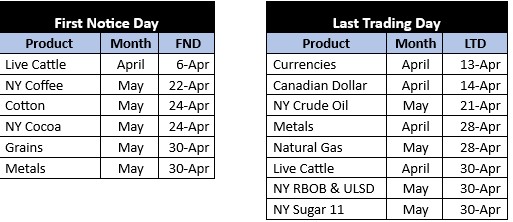
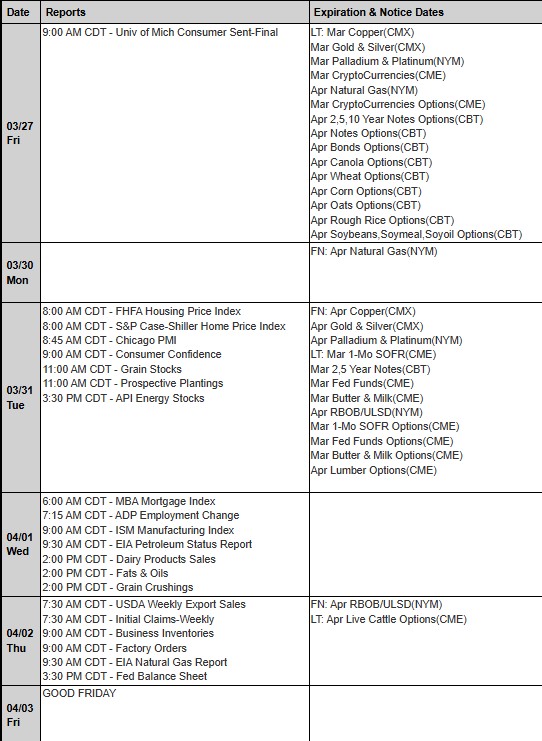
First Notice (FN), Last trading (LT) Days for the Week:

www.mrci.com

47aeb4b1 dde4 49a0 9237 07d3f4722209

Find us on Trustpilot

4ad8134c aa57 4adb a428 7cc476773107

Trading Futures, Options on Futures, and retail off-exchange foreign currency transactions involves substantial risk of loss and is not suitable for all investors. You should carefully consider whether trading is suitable for you in light of your circumstances, knowledge, and financial resources. You may lose all or more of your initial investment. Opinions, market data, and recommendations are subject to change at any time.

Join our Private Facebook group

Subscribe to our YouTube Channel

Listen to our podcast: Subscribe on AppleSpotify, Amazon

or wherever you listen to podcasts!

S
Facebook  Instagram  LinkedIn
S
ef3ab1c9 8d6d 4e60 a3f1 af5d9d4ecbb3
Services
Software
Tools
Community
Contact

Crude Oil Swings $42 as Mideast Crisis Deepens PLUS: CannonEdge Snapshot, April Feeder Cattle, Levels, Reports; Your 5 Important Can’t-Miss Need-To-Knows for Trading Futures on March 12th, 2026

9dc1e02e d5f7 4ff4 abf7 1df60775f196

Commodity Chaos: Crude Oil Swings $42 as Mideast Crisis Deepens

By Mark O’Brien, Senior Broker

At-a-Glance Levels

Instrument S2 S1 Pivot R1 R2

Gold (GC)

— April (#GC)

5115.93 5150.97 5190.93 5225.97 5265.93

Silver (SI)

— May. (#SI)

81.64 83.88 86.79 89.03 91.94

Crude Oil (CL)

— April. (#CL)

79.17 83.74 86.37 90.94 93.57

 June Bonds (ZB)

— June. (#ZB)

113 16/32 114 115 1/32 115 17/32 116 18/32

oil

General:

Volatility in major commodity futures remained high as the crisis in the Mideast expanded into its second week. April crude oil traded as high as $119.48 / barrel Sunday night – a near 29% increase – and down to today’s low of  $76.73 for a jaw-dropping $42.75 / barrel price range over that time.

March E-Mini S&P 500

The March E-mini S&P 500 spiked down over 100 points to near 4-month lows below 6,600 late Sunday night, with the E-mini Dow losing over 1000 points at the same time. Gold and silver futures daily price ranges stayed well-above average with April gold holding above $5,000 / ounce for the last three weeks.

Notable News – Crude Oil

Notable news items contributing to recent movement include at least three ships were hit today in and around the Strait of Hormuz and the U.S. military said it struck 16 Iranian mine-laying vessels near this crucial conduit for the global oil trade

Additionally, the International Energy Agency, which has operated for decades to monitor global crude oil supplies and help prevent price shocks, said that its 32 member countries would release 400 million barrels of oil from their strategic reserves, representing the largest release ever and the first such coordinated action since 2022, after Russia’s full-scale invasion of Ukraine.

Heads up:

Keep in mind that day trading margins can change at your clearing firm / FCM – for certain markets, entire asset classes, i.e., energies, precious metals, stock indexes, etc., particular gateways, i.e., Rithmic, CQG, Sierra/Teton. They can also vary during overnight hours and prior to certain events, i.e., important economic report releases, scheduled statements by important people, agencies, etc. Contact your Cannon Trading Co. broker for specifics.

Cannon Edge for March 12th

f80a1c3f 70cb 4b2d bf1b 601834dd3a2a

Introducing Cannon Edge — Your Daily Futures Snapshot Above

Cannon Edge is our new daily feature designed to give traders a fast, actionable overview of key futures markets. Each post delivers:

  • Current price and daily % change

  • 30‑day and 52‑week highs/lows

  • PROPRIETARY Short‑term and long‑term trend signals

1ab82322 3fe6 467c 8a06 58a08d52f845

April Feeder Cattle

The break off the February high in April feeder cattle completed a second downside PriceCount objective and bounced with a corrective trade. At this point, IF the chart can resume its slide with new sustained lows, the third count would project a possible decline to the 331.90 area.

FREE TRIAL AVAILABLE

dc35893b db12 4509 b273 54ef1357b9e4

The PriceCount study is a tool that can help to project the distance of a move in price. The counts are not intended to be an ‘exact’ science but rather offer a target area for the four objectives which are based off the first leg of a move with each subsequent count having a smaller percentage of being achieved.

It is normal for the chart to react by correcting or consolidating at an objective and then either resuming its move or reversing trend. Best utilized in conjunction with other technical tools, PriceCounts offer one more way to analyze charts and help to manage your positions and risk.

Learn more at www.qtchartoftheday.com

Trading in futures, options, securities, derivatives or OTC products entails significant risks which must be understood prior to trading and may not be appropriate for all investors. Past performance of actual trades or strategies is not necessarily indicative of future results.

Daily Levels for March 12th, 2026

4b0ecc4f a71e 4374 9edd 321b95a979a4

Want to feature our updated trading levels on your website? Simply paste a small code, and they’ll update automatically every day! 

Click here for quick and easy instructions.

Economic Reports

provided by: ForexFactory.com

All times are Central Time ( Chicago)

15d8b770 b812 4e89 b7b1 4b7d7ef84e09

Find us on Trustpilot

603cd3d5 1e3c 4435 85b1 f25c3ed5936e

Trading Futures, Options on Futures, and retail off-exchange foreign currency transactions involves substantial risk of loss and is not suitable for all investors. You should carefully consider whether trading is suitable for you in light of your circumstances, knowledge, and financial resources. You may lose all or more of your initial investment. Opinions, market data, and recommendations are subject to change at any time.

Join our Private Facebook group

Subscribe to our YouTube Channel

Listen to our podcast: Subscribe on AppleSpotify, Amazon

or wherever you listen to podcasts!

S
Facebook  Instagram  LinkedIn
S
ef3ab1c9 8d6d 4e60 a3f1 af5d9d4ecbb3
Services
Software
Tools
Community
Contact

CPI February Out Tomorrow! PLUS: November Soybeans, CannonEdge Snapshot, Levels, Reports; Your 4 Important Useful Can’t-Miss Need-To-Knows for Trading Futures on March 11th, 2026

9dc1e02e d5f7 4ff4 abf7 1df60775f196

Energy Markets and the Inflationary Benchmark, CPI

By John Thorpe, Senior Broker

At-a-Glance Levels

Instrument S2 S1 Pivot R1 R2

Gold (GC)

— April (#GC)

5072.20 5138.90 5193.80 5260.50 5315.40

Silver (SI)

— May. (#SI)

85.06 86.89 88.64 90.47 92.22

Crude Oil (CL)

— April. (#CL)

70.19 78.41 84.94 93.16 99.69

 June Bonds (ZB)

— June. (#ZB)

115 3/32 115  15/32 116 4/32 116 16/32 117 5/32

CPI February Tomorrow Morning!

cpi

The Consumer Price Index for February is released tomorrow morning. Although the Fed (rate decision next week) would rather pin their forecasts and create decisions based on the Core PCE, the CPI has created much more market volatility than Core PCE ever has.

Why CPI moves markets more

  • Timing: CPI hits about two weeks before PCE, so CPI effectively becomes the market’s first look at monthly inflation; PCE is treated more like a “revision” unless it sharply contradicts CPI.​
  • Habit and coordination: Most traders and media still frame “inflation day” around CPI, so liquidity, positioning, and optionality cluster around that release, reinforcing CPI’s impact despite the Fed’s formal preference for PCE.
  • Headline profile: CPI typically runs a bit higher than PCE (about 0.4 percentage points on average since 2000), which can make surprises feel more acute and headline‑worthy.
  • Policy signal vs. tradable catalyst: The Fed leans on PCE because of its broader coverage and more frequently updated weights, but markets prioritize “flawed data now” over “better data later” and trade the earlier CPI release more aggressively.

Practical trading takeaway

  • For short‑term index, vol, and USD trades, CPI is typically the higher‑octane event: implied and realized vol around the release are generally higher, and positioning is more crowded into CPI Day.
  • PCE still matters for repricing the path of Fed policy, especially if it diverges meaningfully from CPI, but its average impact on realized equity volatility is smaller and more conditional on surprise magnitude.

While the Iran War and many other geopolitical genuflections effect the perception of supply shortages, energy prices experienced extreme volatility by exploding higher over the last week followed by a severe retracement to date, economists say February’s CPI data was collected before the start of the conflict and won’t reflect the surge in energy prices.

The data generating this release of the CPI is from before the recent conflict in the Middle East broke out, so it’s not going to give us a whole lot of information on how prices are starting to respond to that. That’s going to be a March and April dynamic.

Graphical representations of the recent historical relationships Between CPI and Core CPI then CPI and Core PCE are below.

562854c5 6a6c 42d4 83e2 4d8f9a2d9772
aec032db ef10 4672 bf5e 559681b7d6d7

Plan your trades and trade your plans

Cannon Edge for March 11th

65b75125 38a7 4c03 ae15 e78bde1fd0f3

Introducing Cannon Edge — Your Daily Futures Snapshot Above

Cannon Edge is our new daily feature designed to give traders a fast, actionable overview of key futures markets. Each post delivers:

  • Current price and daily % change
  • 30‑day and 52‑week highs/lows
  • PROPRIETARY Short‑term and long‑term trend signals

November Soybeans

The rally in November Soybeans came close enough to satisfy the third upside PriceCount objective. It would be normal to get a near term reaction from this level in the form of a consolidation or corrective trade, at least. At this point, IF the chart can resume its move with new sustained highs, we are left with the low percentage fourth count to aim for in the $13.68 area.

FREE TRIAL AVAILABLE

5b06bbbf d549 43f9 9b8f 8157145289f3

The PriceCount study is a tool that can help to project the distance of a move in price. The counts are not intended to be an ‘exact’ science but rather offer a target area for the four objectives which are based off the first leg of a move with each subsequent count having a smaller percentage of being achieved.

It is normal for the chart to react by correcting or consolidating at an objective and then either resuming its move or reversing trend. Best utilized in conjunction with other technical tools, PriceCounts offer one more way to analyze charts and help to manage your positions and risk.

Learn more at www.qtchartoftheday.com

Trading in futures, options, securities, derivatives or OTC products entails significant risks which must be understood prior to trading and may not be appropriate for all investors. Past performance of actual trades or strategies is not necessarily indicative of future results.

Daily Levels for March 11th, 2026

e345b965 db52 4b5d a2ca acb70f9a4b96
Want to feature our updated trading levels on your website? Simply paste a small code, and they’ll update automatically every day! Click here for quick and easy instructions.

Economic Reports

provided by: ForexFactory.com

All times are Central Time ( Chicago)

274da8a7 ddc9 41ba aca1 110591e15e2b

Find us on Trustpilot

603cd3d5 1e3c 4435 85b1 f25c3ed5936e

Trading Futures, Options on Futures, and retail off-exchange foreign currency transactions involves substantial risk of loss and is not suitable for all investors. You should carefully consider whether trading is suitable for you in light of your circumstances, knowledge, and financial resources. You may lose all or more of your initial investment. Opinions, market data, and recommendations are subject to change at any time.

Join our Private Facebook group

Subscribe to our YouTube Channel

Listen to our podcast: Subscribe on AppleSpotify, Amazon

or wherever you listen to podcasts!

S
Facebook  Instagram  LinkedIn
S
ef3ab1c9 8d6d 4e60 a3f1 af5d9d4ecbb3
Services
Software
Tools
Community
Contact

Futures Brokers and You: 8 Useful Crude Oil Market Insights and Predictions

futures brokers

Crude Oil Market Insights and Predictions

trustpilot

futures brokers

The Strategic Importance of Crude Oil Futures

Crude oil remains one of the most actively traded commodities in global derivatives markets. Energy contracts shape economic expectations, influence inflation, and guide corporate hedging strategies. For traders seeking opportunity in volatile markets, crude oil futures provide liquidity, leverage, and clear price discovery.

Geopolitical instability significantly amplifies oil market volatility. Recent tensions involving the United States and Iran have reintroduced risk premiums into global crude supply chains. Events affecting the Strait of Hormuz, where nearly one-fifth of global oil passes daily, immediately influence futures pricing.

In these environments, experienced futures brokers help traders interpret market signals and execute trades efficiently. Understanding supply disruptions, shipping risks, and OPEC responses allows traders to act strategically rather than emotionally.

Professional commodities brokers also assist clients in identifying hedging opportunities during geopolitical crises. Energy producers, airlines, and hedge funds frequently turn to crude futures to offset risk when Middle East tensions escalate.

Modern commodity trading platforms enable real-time monitoring of energy contracts, allowing traders to react quickly to breaking geopolitical developments. Platforms integrated with market data, depth-of-market analytics, and algorithmic execution tools help traders maintain an advantage.

For decades, Cannon Trading Company has supported traders navigating complex markets like crude oil futures.

How U.S.–Iran Tensions Influence Oil Market Dynamics

The conflict between the United States and Iran historically drives immediate reactions in crude oil futures markets. Political statements, military movements, and sanctions policies can trigger rapid price spikes.

Energy traders track these developments because Iran controls strategic access to the Persian Gulf. Any disruption to oil shipping routes can tighten global supply expectations.

Key geopolitical triggers include:

  1. Sanctions and Export Restrictions
    U.S. sanctions on Iranian oil exports reduce global supply expectations. Futures prices often rise as markets anticipate tighter inventories.
  2. Military Activity Near the Strait of Hormuz
    Naval deployments or threats to shipping lanes create immediate volatility in crude contracts.
  3. OPEC Policy Adjustments
    Other oil producers may increase output to offset potential shortages, moderating price spikes.

Experienced futures brokers analyze these factors daily. Their role includes helping traders interpret news events and translate them into actionable trading strategies.

Professional commodities brokers also provide insights into global inventory reports and refinery demand trends. This perspective allows traders to differentiate between temporary price reactions and long-term structural changes.

Many traders rely on advanced commodity trading platforms to track crude oil contracts listed on CME Group exchanges. These systems allow rapid execution when geopolitical headlines break.

Crude Oil Futures Mechanics and Trading Strategy

Crude oil futures contracts allow traders to speculate on or hedge against changes in oil prices. Contracts typically represent 1,000 barrels of crude and trade electronically through regulated exchanges.

Understanding contract mechanics is essential before entering the market.

Common crude oil trading strategies include:

  • Directional Trading
    Traders take long or short positions based on geopolitical expectations.
  • Calendar Spreads
    This involves trading price differences between different delivery months.
  • Inventory Reaction Trades
    U.S. Energy Information Administration reports frequently trigger short-term volatility.
  • Options Hedging
    Combining futures with options can help limit downside exposure.

Working with experienced futures brokers ensures traders understand margin requirements, contract specifications, and risk exposure.

Similarly, knowledgeable commodities brokers guide clients through advanced strategies such as spread trading or volatility hedging.

Reliable commodity trading platforms provide tools such as order-flow analytics, time-and-sales tracking, and DOM trading. These features allow traders to detect institutional activity and liquidity levels in real time.

Cannon Trading Company provides access to several leading trading technologies designed specifically for futures traders.

How a Futures Broker Supports Crude Oil Traders During Geopolitical Crises

Geopolitical conflicts introduce extreme volatility into oil markets. Sudden news releases can cause price swings of several dollars per barrel within minutes.

In these conditions, the expertise of professional futures brokers becomes invaluable.

A broker assists traders in several ways:

  1. Market Interpretation
    Brokers translate geopolitical developments into potential market scenarios.
  2. Execution Support
    Rapid order routing ensures trades are filled efficiently during volatile market conditions.
  3. Risk Management Guidance
    Brokers help traders determine position sizing and margin considerations.
  4. Strategy Development
    Traders receive insights into spread opportunities and volatility trades.

Skilled commodities brokers also maintain relationships with institutional research providers. This enables them to provide clients with deeper insight into energy supply forecasts and macroeconomic influences.

Additionally, modern commodity trading platforms enable traders to automate strategies that react to market volatility. Algorithmic tools can adjust stop levels, manage risk thresholds, and capture price momentum.

Cannon Trading Company’s brokerage services combine technology, human expertise, and decades of market experience.

The Role of Technology in Modern Oil Trading

Technology has transformed how traders interact with energy markets.

Today’s commodity trading platforms integrate advanced analytics, real-time news feeds, and customizable charting tools. These features allow traders to respond instantly to geopolitical developments.

Key technological advantages include:

  • Depth-of-Market Visualization
    Shows real-time liquidity across price levels.
  • Algorithmic Trading Tools
    Allows automated strategy execution.
  • Risk Management Dashboards
    Displays margin usage and exposure in real time.
  • Multi-Asset Integration
    Energy contracts can be analyzed alongside currencies, equities, and bonds.

Professional futures brokers help traders select the most suitable platform for their trading style. Some traders prefer DOM-based scalping interfaces, while others rely on advanced charting environments.

Experienced commodities brokers also assist clients in configuring data feeds and optimizing order routing.

Cannon Trading Company provides access to several industry-leading technologies through its brokerage infrastructure.

These advanced commodity trading platforms help traders maintain speed and precision in volatile oil markets.

Risk Management Strategies for Crude Oil Traders

Crude oil trading carries significant opportunity but also considerable risk.

Geopolitical developments can cause rapid price movements that exceed typical volatility ranges.

Traders should implement disciplined risk management strategies such as:

  1. Stop-Loss Orders
    Automatic exits limit downside exposure.
  2. Position Sizing
    Traders should limit risk per trade relative to account size.
  3. Diversification
    Combining energy contracts with other commodities reduces concentration risk.
  4. Spread Strategies
    Calendar spreads often carry lower volatility than outright positions.

Experienced futures brokers play a crucial role in guiding traders through these risk management techniques.

Professional commodities brokers also help clients interpret inventory reports, seasonal demand patterns, and refinery utilization rates.

Advanced commodity trading platforms support these strategies by allowing automated risk controls and conditional orders.

By combining broker expertise with sophisticated technology, traders can navigate oil market volatility more effectively.

Why Cannon Trading Company Is a Leading Choice for Futures Traders

futures brokers

tp 5

Cannon Trading Company has served futures traders for decades. Its reputation stems from transparent service, technological access, and personalized brokerage support.

The company has built strong relationships with both institutional and independent traders.

Reasons traders choose Cannon Trading include:

  • Experienced Brokerage Team
    Knowledgeable futures brokers provide personalized guidance.
  • Access to Global Markets
    Traders can access major energy, metals, and agricultural futures.
  • Advanced Technology
    Multiple professional commodity trading platforms are available.
  • Responsive Customer Support
    Traders receive direct assistance from experienced professionals.
  • Trusted Reputation
    Client reviews on Trustpilot reflect strong service quality.

Cannon’s team of commodities brokers understands the unique challenges of energy trading. Their expertise helps traders navigate volatile conditions caused by geopolitical developments.

This combination of experience, technology, and service has positioned Cannon Trading Company among the most respected brokerage firms in the futures industry.

Crude Oil Market Outlook and Predictions

Looking ahead, crude oil markets are likely to remain influenced by geopolitical developments.

Several factors will shape oil prices in the coming months.

  1. Middle East Security Risks
    Continued tensions involving Iran may maintain a geopolitical risk premium.
  2. Global Economic Growth
    Demand from major economies influences long-term price trends.
  3. OPEC Production Decisions
    Output adjustments can stabilize or amplify price movements.
  4. Energy Transition Policies
    Long-term shifts toward renewable energy could influence future demand expectations.

Traders who remain informed and disciplined will be best positioned to navigate these changes.

Working with experienced futures brokers helps traders stay ahead of market developments.

Professional commodities brokers provide valuable insights into supply disruptions, production forecasts, and inventory changes.

Reliable commodity trading platforms ensure traders can react instantly to breaking news events.

Cannon Trading Company continues to support traders seeking opportunities in the global energy markets.

FAQ: Crude Oil Futures Trading

What are crude oil futures?

Crude oil futures are standardized contracts that allow traders to buy or sell oil at a predetermined price for future delivery. They are widely used for speculation and hedging in energy markets.

Why do geopolitical tensions affect oil prices?

Oil supply chains depend heavily on politically sensitive regions. Events affecting production or transportation routes can reduce supply expectations, driving prices higher.

How can futures brokers help oil traders?

Professional brokers assist traders with market analysis, order execution, and risk management strategies during volatile market conditions.

What role do commodities brokers play?

They provide specialized expertise in physical supply trends, inventory data, and seasonal demand patterns that influence commodity pricing.

Why are commodity trading platforms important?

Modern trading platforms provide real-time market data, charting tools, and automated order execution that allow traders to react quickly to price movements.

Why choose Cannon Trading Company?

Cannon Trading Company offers decades of experience, advanced trading technology, personalized brokerage support, and access to global futures markets.

Try a FREE Demo!

Ready to start trading futures? Call us at 1(800)454-9572 (US) or (310)859-9572 (International), or email info@cannontrading.com to speak with one of our experienced, Series-3 licensed futures brokers and begin your futures trading journey with Cannon Trading Company today.

Disclaimer: Trading Futures, Options on Futures, and retail off-exchange foreign currency transactions involve substantial risk of loss and are not suitable for all investors. Past performance is not indicative of future results. Carefully consider if trading is suitable for you in light of your circumstances, knowledge, and financial resources. You may lose all or more of your initial investment. Opinions, market data, and recommendations are subject to change at any time.

Important: Trading commodity futures and options involves a substantial risk of loss. The recommendations contained in this article are opinions only and do not guarantee any profits. This article is for educational purposes. Past performances are not necessarily indicative of future results.

This article has been generated with the help of AI Technology and modified for accuracy and compliance.

Follow us on all socials: @cannontrading
 

Oil amidst the US Iran Conflict, Weekly Market Updates, CannonEdge Snapshot, Levels, Reports; Your 5 Important Can’t-Miss Need-To-Knows for Trading Futures on March 10th, 2026

9dc1e02e d5f7 4ff4 abf7 1df60775f196

At-a-Glance Levels

Instrument S2 S1 Pivot R1 R2

Gold (GC)

— April (#GC)

4938.53 5045.07 5127.73 5234.27 5316.93

Silver (SI)

— Mar. (#SI)

77.15 82.08 84.57 89.49 91.98

Crude Oil (CL)

— April. (#CL)

58.12 73.34 96.41 111.63 134.70

 Mar. Bonds (ZB)

— Mar. (#ZB)

114 14/32 115  18/32 116 5/32 117 9/32 117 28/32


Weekly Market Update

By Eli Gal Levy, Series 3 Broker

When markets are in disarray, I tend to listen to what top managers have to say. I thought Ed Yardeni summed it up best; I will point that in my opinion he always sounds optimistic, this time around not so much.

On Friday he said “this reminds him of 2022 Russia invaded Ukraine and the immediate response in the financial markets was huge increase in the price of oil and it reversed itself after a few months. But while it was happening the stock market got spooked and we saw a bear market in 2022.

But the economy remained resilient, it continued to grow, and he thinks we’re kind of in the same situation, though he thinks we’re more likely to get a correction, he thinks we’re in the middle of a correction that can take us down 10%. Clearly everything will depend on when are we going to see some tankers going through the strait of Hurmuz.

Until we see that this market is going to be under pressure because the price of oil is going to continue to go higher”. 

That’s not to say that things can’t turn on a dime, if you read my past articles, this market has some good points going for it. So, for now, the most important chart is Oil.

oil
As of this writing oil was as high as $119 – 3 hours ago and came back in to around $100, that’s very high volatility.

It’s all abought the degree and duration of the jump in oil prices. The questions I leave open are if crude oil quickly reverses is that not going to impact the US earnings? If oil prices stay high that’s where we can see the transmission mechanism actually impact earnings. 2022 was weak because GDP estimates were cut and EPS estimates were cut. But in our market, we’ve seen EPS estimates get raised. So are analysts going to start cutting EPS forecasts? Some analysts thought the forecast was high for the back half of this year anyway.

The estimates for EPS are at $314 which prices in 200 basis points of margin expansion. And for 2027 the forecasts are $363 that’s aggressive. The past few years have benefited from oil prices going down consistently, is that going to change now.

Analyst Matt Boss said “a 30% increase in gas, it abought a 9 billion headwind to consumer spending. Interesting metric is tax refunds in February are up 10% that’s roughly 9 to 10 billion $ headwind”.

I bring this up because last week we were up around 30% for oil, oil at $120 is close to 60%. Bottom line: how long will this war last and how much effect will it have on higher sustained oil prices. The U.S./Iran conflict is in its seventh day. Earlier this morning, U.S. President Donald Trump said there will be no deal with Iran to end the war without “unconditional surrender.”

The second thing I will keep an I out on is private credit, it was staring in the news last few weeks, talk about; that it started showing cracks. I tend to look at bond prices for companies that issue private credit.

The third sign I look at is the AI buildout, President Donald Trump talked up a joint venture investing up to $500 billion for infrastructure tied to AI by a new partnership formed by OpenAI, Oracle and SoftBank. Since they are some of the largest investors in the AI buildout, I view how their stock and bonds are trading.

All this leads to higher inflation. Which puts The FED is in a tuff spot, how can they lower interest rates if inflation might creep up with oil prices going higher.

In my last articles I pointed out that support for the SPX was the 100 Day Moving average and we bounced of that level a few times in the past few months. I also mentioned that the more we keep slamming into a door, eventually it opens and that’s what happened, we broke that level of support and closed below that level on Friday. Next level of support for the SPX comes in at the 200 DMA which currently sits at 6,582.

Last week the market trend was opening down and bouncing on most days and eventually we closed lower for the week. I will be watching for that trend to continue until proven otherwise or if positive news comes out regarding the war and its effect on oil. I will also be watching if the 100 DMA level will turn into resistance.

Russell 2000 Index (RUT −50 to 2,534)

The Russell 2000 Index (RUT) is on pace to finish the week down approximately 3.7%, pressured by a combination of rising oil prices and higher Treasury yields. Elevated yields tend to impact smaller companies more heavily because they rely more on borrowing, making financing costs more expensive. At the same time, higher oil prices raise input costs, compress profit margins, and create a broader headwind for the U.S. economy. As a result, it is not surprising to see the Russell 2000 underperform the larger major indices this week.

From a technical perspective, this week’s sell-off has pushed the index below key support levels, including the 50-day simple moving average (SMA) and the 100-day SMA.

Artificial intelligence (AI) disruption concerns around the software space eased up last week as the iShares Expanded Tech-Software Sector ETF (IGV + $0.13 to $87.75) is on track to be up ~7.50% on the week. On the flipside, the PHLX Semiconductor Index was on track to register its worst weekly performance (-4%) since November.

Private credit concerns are still hovering over Wall Street.

On Wednesday, Blackstone’s flagship private credit fund (BCRED) was hit with record redemption requests. In response, Blackstone raised the fund’s repurchase cap and provided additional capital to meet all the requests. Elsewhere, earlier today BlackRock said that it is limiting withdrawals from one of its private credit funds following a surge in redemption requests.

Investors were seeking ~$1.2B in redemptions but only $620M was paid out.

On the economic front, this morning’s Nonfarm Payrolls report stands out and the report was discouraging. Employers cut 92,000 jobs in February vs. expectations for +55,000, which represents the largest monthly drop since the pandemic.

Q4 earnings scorecard: out of the 493 S&P 500 companies that have reported results, 65% have beat on the top line while 74% have beat on the bottom line. Revenue growth has been tracking at +9.23% year-over-year while EPS growth is +13.65%.

Cryptocurrency News

Over the weekend, Bitcoin initially sold off as investors reacted to developments in the Middle East. As the crypto market has matured, it has increasingly served as a real-time gauge of investor sentiment while traditional financial markets are closed.

During the week, sentiment improved as prediction markets began assigning higher odds to the passage of the Financial Innovation and Technology for the 21st Century Act (FIT21) / CLARITY Act, helping push Bitcoin back above the $70,000 level. While the administration and much of the crypto industry continue to advocate for the bill, the banking sector has not significantly softened its opposition, particularly regarding provisions related to stablecoin rewards.

Bitcoin’s rally, however, stalled near $74,000, an area that coincides with the 50-day exponential moving average (EMA) and has acted as a technical resistance level.

Following the rejection at the 50-day EMA, Bitcoin could retest recent support levels. The first key level sits near $65,000, which roughly aligns with the network’s estimated production cost. A deeper pullback could bring prices toward $60,000, the recent swing low.

On-chain data is showing early signs of strengthening demand. Spot crypto ETPs have recorded two consecutive weeks of inflows, and large digital-native investors continue to accumulate.

Economic:

  • Monday (Mar. 9): no reports
  • Tuesday (Mar. 10): Existing Home Sales, NFIB Small Business Optimism
  • Wednesday (Mar. 11): Consumer Price Index (CPI), EIA Crude Oil Inventories, Mortgage Applications Index, Treasury Budget
  • Thursday (Mar. 12): Producer Price Index (PPI), Continuing Claims, EIA Natural Gas Inventories, Initial Claims, Factory Orders
  • Friday (Mar. 13): PCE Prices, GDP – Second Estimate, Personal Income, Personal Spending, University of Michigan Consumer Sentiment – Preliminary

 Here’s a breakdown of the reports:

  • Nonfarm Payrolls: Headline payrolls declined 92,000 in February, which was well below the +55,000 economists were expecting. There were also negative revisions to the prior two months totaling 69,000.
  • Unemployment Rate: Ticked up to 4.4% from 4.3% in the prior month (and above the 4.3% economists had expected)
  • Average Hourly Earnings: Increased 0.4% versus the +0.3% expected. This brings the year-over-year gain up to 3.8% from 3.7% in January and versus the +3.7% expected.
  • Average Workweek: 34.3 versus 34.3 expected.
  • ADP Employment Change: U.S. private employers added 63K jobs in February. This represented the largest monthly gain since last July and was above the 50K economists had expected.
  • Retail Sales: Declined 0.2% in January, the largest drop since last May, and worse than the flat reading economists were expecting. However, the Control Group measure of sales rose 0.4%.
  • ISM Manufacturing Index: 52.4% vs. 53.0% est.
  • S&P Global U.S. Manufacturing PMI – Final: Fell to 51.6 in February from 53.4 in January and below the 52.6 economists had expected.
  • ISM Non-Manufacturing Index: 56.1 highest since July of 2022.
  • S&P Global U.S. Services PMI: 51.7.
  • Import Prices: +0.2%.
  • Export Prices: +0.6%.
  • Productivity – Preliminary: +2.8% vs. +4.5% est.
  • Unit Labor Costs: +2.8% vs. +0.5% est.
  • Initial Jobless Claims: Initial applications for US jobless benefits were unchanged from last week at 213K, which was below the 215K economists had expected. Continuing Claims increased 35K from the prior week to a seasonally adjusted 1.868M.
  • EIA Crude Oil Inventories: +3.48M barrels.
  • EIA Natural Gas Inventories: -132 bcf.
  • The Atlanta Fed’s GDPNow “nowcast” for Q1 GDP was revised down 1.0% to 2.1% from 3.1% last Friday.

U.S. Treasury yields jumped across the board this week, and the yield curve saw some modest flattening. This week’s treasury selling is essentially tied to the ramp up in oil prices and the potential inflation implications. Compared to last Friday, two-year Treasury yields rose by ~18 basis points (3.561% vs. 3.379%), 10-year yields also increased ~18 basis points (4.142% vs. 3.962%), while 30-year yields (4.777% vs. 4.633%) saw a ~14 basis point lift.

Disclaimer: Trading Futures, Options on Futures, and retail off-exchange foreign currency transactions and other financial instruments involve substantial risk of loss and are not suitable for all investors. Past performance is not indicative of future results. Carefully consider if trading is suitable for you in light of your circumstances, knowledge, and financial resources. You may lose all or more of your initial investment. Opinions, market data, and recommendations are subject to change at any time. I am registered solely as a commodities broker. Any references, recommendations & information contained in this article are of opinion only, should not be considered investment advice. And do not guarantee any profits.

S
Name Exchange Class Exchange Symbol CQG Symbol Size
nano XRP Coinbase Crypto XRP XRP 500 XRP
XRP Coinbase Crypto XRL XRL 10,000 XRP
nano XRP Perp-Style Coinbase Crypto XPP XPP 500 XRP
nano Solana Coinbase Crypto SOL SOL 5 Solana
nano Solana Perp-Style Coinbase Crypto SLP SLP 5 Solana
Solana Coinbase Crypto SLC SLC 100 Solana
nano Ether Perp-Style Coinbase Crypto ETP ETP 0.1 Ethereum
Ether Coinbase Crypto ETI ETI 10 Ethereum
nano Ether Coinbase Crypto ET NET 0.1 Ethereum
nano Bitcoin Coinbase Crypto BIT BIT 0.01 Bitcoin
nano Bitcoin Perp-Style Coinbase Crypto BIP BIP 0.01 Bitcoin

Cannon Edge — Your Daily Futures Snapshot for March 10th

b59139d2 ae8a 428f 8971 bf532513dc31

Daily Levels for March 10th, 2026

eef2661b b681 4d7c 9258 3e827a95d851

Want to feature our updated trading levels on your website? Simply paste a small code, and they’ll update automatically every day! 

Click here for quick and easy instructions.

Economic Reports

provided by: ForexFactory.com

All times are Central Time ( Chicago)

587431e7 29a8 4ff3 b3e5 3acb1320d619

Find us on Trustpilot

603cd3d5 1e3c 4435 85b1 f25c3ed5936e

Trading Futures, Options on Futures, and retail off-exchange foreign currency transactions involves substantial risk of loss and is not suitable for all investors. You should carefully consider whether trading is suitable for you in light of your circumstances, knowledge, and financial resources. You may lose all or more of your initial investment. Opinions, market data, and recommendations are subject to change at any time.

Join our Private Facebook group

Subscribe to our YouTube Channel

Listen to our podcast: Subscribe on AppleSpotify, Amazon

or wherever you listen to podcasts!

S
Facebook  Instagram  LinkedIn
S
ef3ab1c9 8d6d 4e60 a3f1 af5d9d4ecbb3
Services
Software
Tools
Community
Contact

Futures Brokers FYI: 10 Critical Upcoming Technological Developments in the Futures Brokering Industry for Traders

Cannon Trading Final v2 scaled

Futures Brokers

trustpilot

futures brokers

Futures markets have evolved dramatically over the past several decades. Electronic execution, algorithmic strategies, and institutional-grade analytics have reshaped how traders interact with global derivatives markets.

In this changing environment, futures brokers play a far greater role than simply executing orders. Modern brokerage firms provide infrastructure, research, technology integration, and risk tools that can significantly enhance a trader’s performance.

As markets become increasingly data-driven, choosing the right brokerage partner becomes a strategic decision. The most effective brokers combine cutting-edge platforms with experienced support teams.

Cannon Trading Company has established itself as one of the most respected firms in the industry, helping traders navigate futures markets for decades through technology, education, and execution expertise.

Understanding how brokers support traders in the modern era reveals why strong brokerage relationships remain essential.

Learn More HERE

The Evolution of Futures Trading Technology

The futures industry once relied on open outcry trading pits. Traders shouted orders on exchange floors and relied heavily on human intermediaries.

The introduction of electronic trading platforms changed everything.

According to CME Group historical market development data, electronic futures trading expanded dramatically during the early 2000s and quickly became the dominant execution method.

Modern trading platforms now allow traders to access global futures markets instantly.

Key technological advancements include:

  • High-speed electronic order routing
  • Cloud-based trading platforms
  • Advanced charting tools
  • Integrated risk management systems

Numbered innovations have also changed trader workflows:

  1. Algorithmic order execution
  2. Real-time market depth visualization
  3. AI-driven analytics
  4. Mobile futures trading access

Because markets evolve rapidly, futures brokers help traders stay competitive by offering access to the latest technology and execution tools.

Why Brokerage Technology Matters to Traders

Speed and accuracy matter enormously in futures markets. Price movements occur in milliseconds, especially in highly liquid contracts such as E-Mini index futures.

Technology provided by brokerage firms helps traders compete effectively.

For example, modern trading platforms allow traders to monitor multiple markets simultaneously.

Common platform features include:

  • Customizable dashboards
  • Real-time data feeds from CME markets
  • Automated order entry tools
  • Integrated news and analytics

Technology also supports better decision-making.

Numbered examples include:

  1. Backtesting strategies using historical futures data
  2. Simulating trades through demo environments
  3. Automating repetitive trading tasks
  4. Visualizing liquidity through order-flow tools

The best futures brokers ensure traders have access to these capabilities without requiring expensive infrastructure.

This democratization of technology has allowed independent traders to compete alongside institutional market participants.

Platform Integration and Execution Infrastructure

Execution infrastructure is one of the most important services provided by brokerage firms.

When a trader submits an order, that order must travel through secure routing systems to reach exchange matching engines.

Latency, reliability, and data integrity are critical.

Modern brokerage infrastructure typically includes:

  • Direct connectivity to CME exchange gateways
  • Redundant server networks
  • Real-time margin monitoring
  • Advanced order routing algorithms

These systems ensure trades execute quickly and accurately.

Key technological features include:

  1. Co-located servers near exchange data centers
  2. Smart order routing technology
  3. Integrated risk controls
  4. Multi-platform connectivity

Professional futures brokers maintain these systems so traders do not need to build expensive trading infrastructure themselves.

For many traders, this backend technology represents the difference between efficient trading and costly execution delays.

Advanced Market Data and Analytics

Data has become the most valuable resource in modern futures trading.

Market participants analyze order flow, volume patterns, volatility structures, and macroeconomic signals.

Brokerage firms help traders access this data efficiently.

High-quality futures platforms offer powerful analytical tools.

These tools often include:

  • Volume profile analysis
  • Depth-of-market visualization
  • Historical volatility metrics
  • Institutional order flow indicators

Analytics also support strategy development.

Examples include:

  1. Identifying liquidity clusters in E-Mini contracts
  2. Detecting momentum shifts in commodity futures
  3. Monitoring macroeconomic releases affecting currency futures
  4. Evaluating historical market correlations

Through these services, futures brokers transform raw market data into actionable insights.

This analytical edge is increasingly important as global markets grow more competitive.

Risk Management Tools Provided by Brokers

Successful futures trading requires strong risk management.

Futures contracts are leveraged instruments, meaning price movements can produce significant gains or losses.

Brokerage platforms help traders control exposure.

Key risk management tools include:

  • Real-time margin monitoring
  • Automatic stop-loss order functionality
  • Position sizing calculators
  • Portfolio exposure analysis

These tools protect traders from excessive risk.

Important automated safeguards include:

  1. Margin alerts when account equity drops
  2. Pre-trade risk checks
  3. Position limits for specific contracts
  4. Auto-liquidation safeguards during extreme volatility

Professional futures brokers integrate these systems directly into their trading platforms.

This ensures traders remain aware of their exposure at all times.

Such safeguards are particularly important during volatile market periods.

Algorithmic and Quantitative Trading Support

Algorithmic trading continues to expand across futures markets.

Institutional participants increasingly rely on automated strategies to execute trades efficiently.

Retail traders now have access to similar capabilities through brokerage platforms.

Many platforms supported by brokerage firms allow strategy automation.

Key capabilities include:

  • Custom scripting environments
  • API connections for automated trading
  • Strategy backtesting frameworks
  • Real-time algorithm monitoring

Algorithmic trading advantages include:

  1. Eliminating emotional decision-making
  2. Executing trades faster than manual input
  3. Managing multiple markets simultaneously
  4. Maintaining consistent strategy rules

With proper support from futures brokers, traders can deploy sophisticated algorithmic systems previously available only to hedge funds.

The democratization of algorithmic tools has significantly expanded trading opportunities.

Education and Market Guidance from Brokerage Firms

Technology alone does not guarantee trading success.

Education remains one of the most valuable services offered by professional brokers.

Experienced brokerage firms provide educational resources that help traders understand market dynamics.

Common educational offerings include:

  • Futures trading webinars
  • Market outlook reports
  • Strategy development tutorials
  • Platform training sessions

Structured learning opportunities may include:

  1. Beginner courses explaining futures contract mechanics
  2. Risk management workshops
  3. Platform walkthrough demonstrations
  4. Strategy development discussions

Educational guidance from futures brokers helps traders avoid common mistakes and develop disciplined trading approaches.

This guidance is particularly valuable for traders transitioning from equities into derivatives markets.

Why Cannon Trading Company Has Remained a Leading Brokerage

futures brokers

tp 5

Cannon Trading Company has built a strong reputation over decades of serving futures traders.

The firm combines deep industry experience with advanced technology access.

Its approach focuses on personalized support and robust trading infrastructure.

Key strengths include:

  • Access to leading futures trading platforms
  • Competitive commission structures
  • Experienced broker support teams
  • Educational resources for traders

Cannon Trading Company also provides connectivity to major exchanges such as CME Group.

Important brokerage advantages include:

  1. Reliable execution technology
  2. Strong client service reputation
  3. Flexible platform choices
  4. Long-standing regulatory experience

Unlike some firms that emphasize automation alone, Cannon Trading combines technology with human expertise.

This hybrid model helps traders navigate complex market environments.

Many traders trust the firm because it has consistently adapted to new market technologies while maintaining personalized client relationships.

Reputation and Trust in the Futures Brokerage Industry

Reputation plays a major role when selecting a brokerage partner.

Trust becomes critical when traders rely on a firm to handle funds, orders, and market access.

Platforms such as Trustpilot provide insights into client experiences with brokerage firms.

Reliable futures brokers typically share several common characteristics.

These characteristics include:

  • Transparent fee structures
  • Responsive customer support
  • Strong regulatory compliance
  • Proven execution reliability

Experienced brokers also demonstrate:

  1. Longevity in the industry
  2. Positive client feedback
  3. Continuous technology upgrades
  4. Commitment to trader education

Cannon Trading Company’s decades-long presence in the futures industry reflects its ability to maintain client trust while adapting to new technological demands.

This consistency remains one of the firm’s most valuable strengths.

The Future of Technology in Futures Brokerage

Technology will continue reshaping futures trading in the coming years.

Artificial intelligence, predictive analytics, and automation are already influencing market behavior.

Brokerage firms will play a central role in making these innovations accessible to traders.

Expected developments include:

  • AI-driven trade signal generation
  • Predictive market modeling
  • Advanced risk management automation
  • Cloud-based multi-device trading systems

Future technological developments may include:

  1. Machine learning strategies analyzing CME data streams
  2. Automated portfolio rebalancing
  3. Real-time macroeconomic analysis engines
  4. Integrated cross-market trading dashboards

As these tools evolve, futures brokers will continue bridging the gap between advanced financial technology and individual traders.

Brokerage firms that combine innovation with experienced guidance will remain essential to traders seeking an edge in global futures markets.

Cannon Trading Company’s commitment to technology, education, and execution reliability positions it strongly for the next generation of futures trading.

FAQ

What do futures brokers actually do?

Futures brokers provide traders with access to futures exchanges such as CME Group. They facilitate order execution, provide trading platforms, offer market data, and manage account risk and margin requirements.

Why are futures brokers important for modern trading?

Modern futures markets require fast execution, advanced analytics, and reliable infrastructure. Brokers provide the technology, connectivity, and support that individual traders typically cannot build independently.

What technology do futures brokers provide traders?

Most brokerage firms provide:

  • Electronic trading platforms
  • Market data feeds
  • Algorithmic trading support
  • Risk management tools

These technologies help traders analyze markets and execute strategies efficiently.

Why is Cannon Trading Company considered a top brokerage?

Cannon Trading Company has served futures traders for decades. The firm offers advanced trading platforms, experienced broker support, strong exchange connectivity, and extensive educational resources.

How can technology improve futures trading performance?

Technology improves trading performance by enabling faster execution, better market analysis, improved risk management, and the ability to automate strategies.

Examples include algorithmic trading systems, advanced charting tools, and automated order routing.

Try a FREE Demo!

Ready to start trading futures? Call us at 1(800)454-9572 (US) or (310)859-9572 (International), or email info@cannontrading.com to speak with one of our experienced, Series-3 licensed futures brokers and begin your futures trading journey with Cannon Trading Company today.

Disclaimer: Trading Futures, Options on Futures, and retail off-exchange foreign currency transactions involve substantial risk of loss and are not suitable for all investors. Past performance is not indicative of future results. Carefully consider if trading is suitable for you in light of your circumstances, knowledge, and financial resources. You may lose all or more of your initial investment. Opinions, market data, and recommendations are subject to change at any time.

Important: Trading commodity futures and options involves a substantial risk of loss. The recommendations contained in this article are opinions only and do not guarantee any profits. This article is for educational purposes. Past performances are not necessarily indicative of future results.

This article has been generated with the help of AI Technology and modified for accuracy and compliance.

Follow us on all socials: @cannontrading

Futures Brokers and You: 11 Important Facts for Mastering E-Mini Futures Trading Basics

Cannon Trading Final v2 scaled

Mastering E-Mini Futures Trading Basics

trustpilot

futures brokers

E-Mini futures have become one of the most actively traded derivatives in global markets. Introduced by CME to provide smaller, accessible contracts, E-Mini products opened futures participation to a broader audience while maintaining institutional-grade liquidity.

Understanding the mechanics of E-Mini futures trading is essential for modern traders. Equally important is the role that professional futures brokers play in navigating advanced markets, selecting reliable commodity trading platforms, and building strategies supported by experienced commodities brokers.
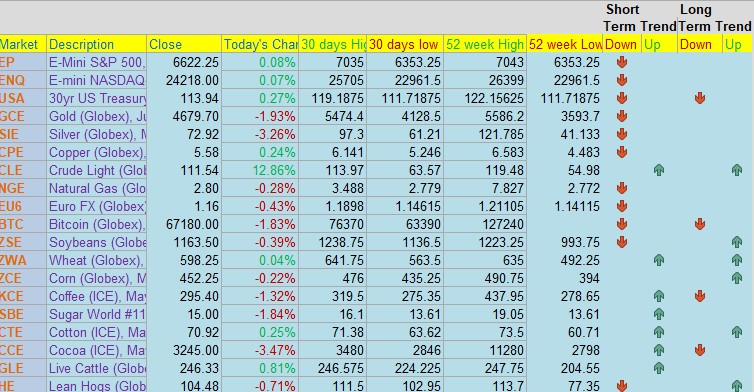
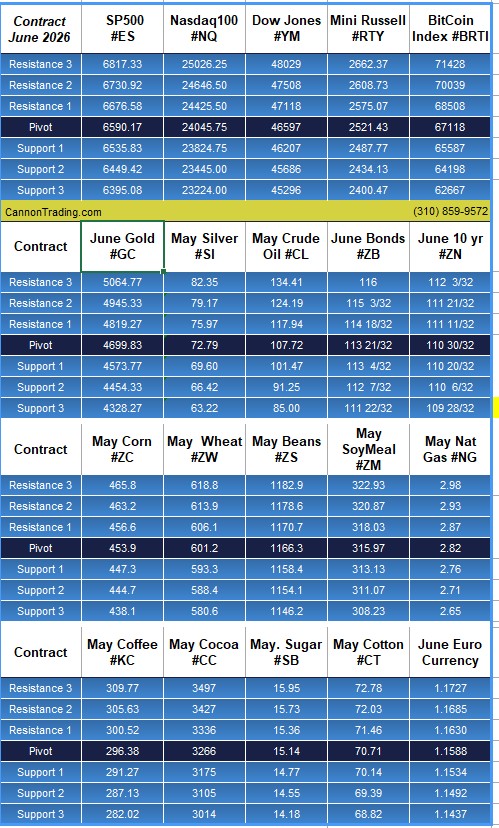
Technology continues reshaping futures markets. From faster execution to sophisticated data visualization, traders rely on brokerage infrastructure more than ever. Firms like Cannon Trading Company have built decades of expertise helping traders adapt to this technological evolution.
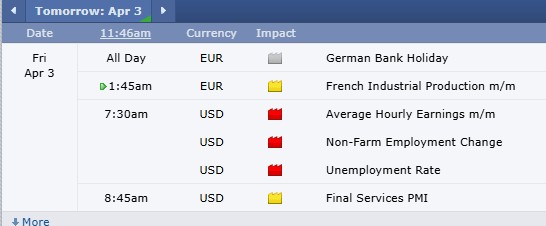
This guide explains the foundations of E-Mini futures trading and how the right broker partnership can dramatically enhance trading outcomes.
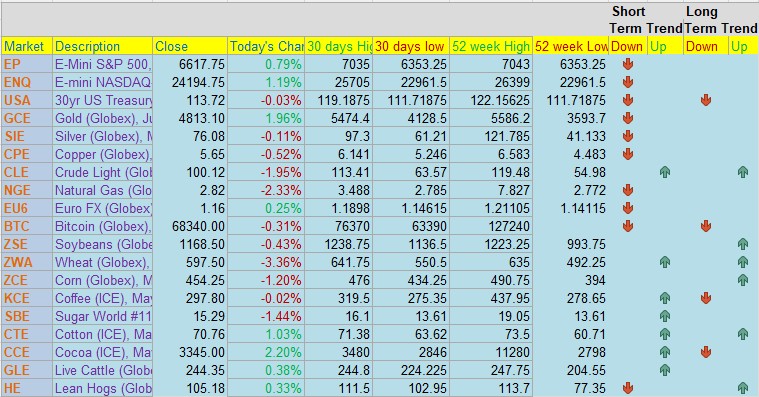
Learn More HERE

Understanding What E-Mini Futures Are
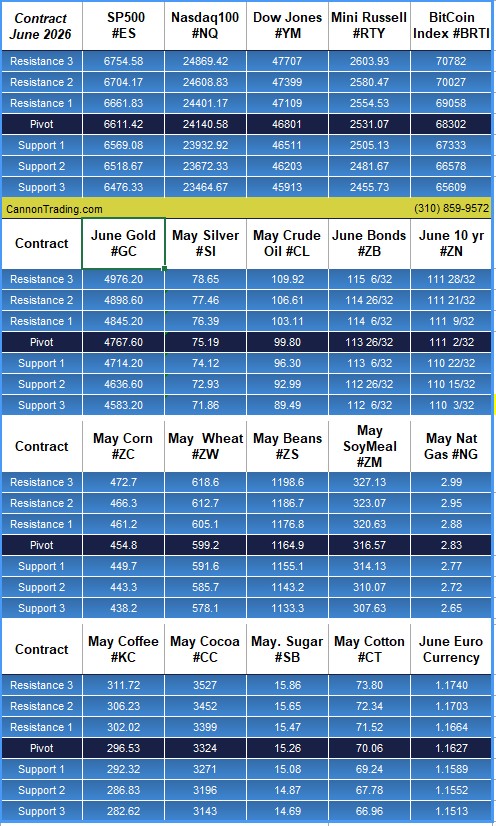
E-Mini futures are electronically traded futures contracts representing a fraction of the value of standard futures contracts. They were created by CME to make futures trading more accessible.
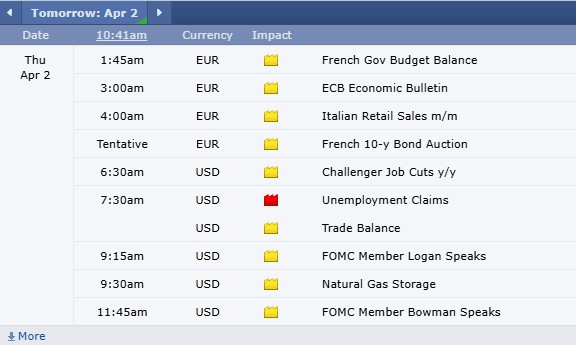
The most widely traded contract is the E-Mini S&P 500.

Key characteristics include:

  • Smaller contract size than standard futures
  • Electronic trading nearly 24 hours per day
  • High liquidity across global sessions
  • Margin efficiency compared with many equities

Because E-Mini contracts are standardized through CME, they offer consistent pricing and transparency. These qualities attract both institutional traders and individual participants.

However, successful participation requires infrastructure. Traders rely on experienced futures brokers to access exchanges, manage risk, and maintain reliable execution.

Modern commodity trading platforms provide depth-of-market tools, real-time charting, and order management systems necessary for active futures trading.

In addition, knowledgeable commodities brokers help traders interpret contract specifications, margin requirements, and settlement procedures.

The Evolution of E-Mini Futures Trading

Since their introduction in the late 1990s, E-Mini futures have transformed derivatives markets.

Originally designed to mirror larger index futures, they quickly gained popularity due to efficiency and lower capital requirements.

Several technological milestones accelerated growth:

  1. Electronic trading through CME Globex
  2. High-speed data feeds for market depth
  3. Algorithmic trading integration
  4. Advanced risk management systems

These developments changed the role of futures brokers.

Traditional brokerage once focused primarily on order execution. Today, brokers offer integrated trading ecosystems, combining education, technology, and execution.

Modern commodity trading platforms allow traders to analyze order flow, simulate strategies, and automate execution.

At the same time, experienced commodities brokers help traders understand the practical implications of volatility, contract rollover, and margin adjustments.

This combination of technology and human expertise forms the backbone of professional futures trading.

Why E-Mini Futures Remain Popular

E-Mini futures remain one of the most popular derivative instruments for several reasons.

First, they offer efficient exposure to major financial indexes.

Second, they allow traders to participate in both rising and falling markets.

Third, liquidity is extremely high.

Traders often choose E-Mini futures because:

  • They require less capital than full-size contracts
  • They trade nearly around the clock
  • Execution is typically extremely fast
  • Pricing transparency is strong

However, trading these contracts effectively still requires professional infrastructure.

Reliable commodity trading platforms ensure that orders reach exchanges quickly and accurately.

Meanwhile, experienced futures brokers help traders maintain proper risk controls and margin compliance.

Professional commodities brokers also provide insights into market structure, contract expiration cycles, and exchange rule changes.

These services become increasingly important as trading technology evolves.

Core Mechanics Every Trader Must Understand

Before trading E-Mini futures, traders must understand several key mechanics.

These fundamentals influence profitability and risk management.

Important concepts include:

  1. Contract specifications
  2. Tick size and tick value
  3. Initial and maintenance margin
  4. Expiration cycles
  5. Settlement procedures

Each element directly affects trading decisions.

For example, tick size determines how price movements translate into profits or losses.

Experienced commodities brokers often walk traders through these details during account setup and onboarding.

Professional futures brokers also provide margin guidance, ensuring traders understand the capital required to maintain positions.

Modern commodity trading platforms display these parameters automatically, helping traders monitor exposure in real time.

Understanding these fundamentals builds the foundation for consistent trading performance.

Technology and the Future of Futures Trading

Technology has become one of the most important factors in modern derivatives trading.

Today’s futures markets operate at extraordinary speed.

Execution latency, data quality, and platform stability all influence trading outcomes.

Advanced commodity trading platforms now include features such as:

  • Algorithmic order routing
  • Automated trade management
  • Real-time risk analytics
  • Order flow visualization tools

These tools give traders deeper insights into market behavior.

However, technology alone is not enough.

Experienced futures brokers help traders select appropriate platforms, configure data feeds, and ensure stable connectivity.

Professional commodities brokers also assist in understanding how automated systems interact with market volatility.

As markets become increasingly digital, the collaboration between traders and brokers becomes even more critical.

The Strategic Role of Futures Brokers

Professional brokerage support plays a vital role in futures trading success.

Quality futures brokers offer far more than simple order routing.

They provide expertise across multiple areas:

  1. Platform selection
  2. Risk management planning
  3. Execution optimization
  4. Regulatory compliance guidance

Many traders underestimate how valuable broker guidance can be.

During periods of extreme volatility, experienced brokers can provide insight into margin adjustments, exchange rule changes, and liquidity shifts.

Professional commodities brokers often serve as strategic advisors, helping traders refine trading plans and avoid costly mistakes.

In addition, brokers ensure traders have access to the most stable commodity trading platforms, minimizing downtime during active market sessions.

This partnership can significantly improve a trader’s long-term consistency.

Choosing the Right Commodity Trading Platforms

Platform selection is one of the most important decisions a futures trader makes.

The best commodity trading platforms combine reliability, speed, and analytical tools.

Important features to evaluate include:

  • Market depth visualization
  • Advanced charting capabilities
  • Order execution speed
  • Customizable risk controls

Many traders use multiple commodity trading platforms depending on their strategy.

Scalpers may prefer highly responsive interfaces designed for rapid execution.

Swing traders may prioritize analytical charting environments.

Experienced futures brokers help traders evaluate these differences and determine which platform best fits their strategy.

Meanwhile, knowledgeable commodities brokers often assist in configuring platform settings, ensuring traders understand order types, bracket orders, and automated risk management tools.

Proper platform selection can significantly influence execution efficiency.

Risk Management in E-Mini Futures Trading

Risk management remains the cornerstone of professional futures trading.

Even the best trading strategy can fail without proper risk controls.

Effective risk management involves both discipline and infrastructure.

Common techniques include:

  1. Position sizing rules
  2. Stop-loss placement
  3. Margin monitoring
  4. Portfolio diversification

Professional futures brokers help traders establish margin policies that prevent over-leveraging.

Advanced commodity trading platforms provide real-time monitoring of open positions and account equity.

Meanwhile, experienced commodities brokers help traders interpret volatility changes that may require adjustments to risk parameters.

These safeguards become especially important during major economic announcements or geopolitical events.

By combining technology with professional guidance, traders can manage risk more effectively.

Why Cannon Trading Company Stands Out

futures brokers

tp 5

Cannon Trading Company has built a reputation as one of the most respected brokerage firms in the futures industry.

Founded decades ago, the firm has consistently focused on client support, advanced technology, and market expertise.

Several factors contribute to its long-standing reputation.

Key advantages include:

  • Decades of brokerage experience
  • Access to multiple professional commodity trading platforms
  • Dedicated client support from experienced professionals
  • Competitive commission structures

Cannon Trading Company’s team includes knowledgeable commodities brokers who work closely with traders at every experience level.

These professionals help clients understand market structure, select platforms, and refine risk management practices.

In addition, the firm works with a wide network of futures brokers and technology providers, ensuring traders receive reliable exchange connectivity.

This combination of experience and innovation has helped Cannon Trading Company remain a trusted brokerage partner for decades.

The Human Advantage in a Technology-Driven Market

While automation continues transforming financial markets, human expertise remains indispensable.

Trading technology may execute orders instantly, but interpreting market context requires experience.

Experienced commodities brokers understand how macroeconomic factors influence futures markets.

Professional futures brokers also help traders interpret exchange announcements, margin adjustments, and contract changes.

Meanwhile, powerful commodity trading platforms provide the analytical tools necessary to evaluate these developments.

When traders combine technology with experienced brokerage support, they gain both speed and perspective.

This hybrid approach represents the future of successful futures trading.

Building Long-Term Success in E-Mini Futures

Mastering E-Mini futures trading requires discipline, education, and the right infrastructure.

Traders who succeed typically combine several key elements.

Successful trading often involves:

  • Continuous education
  • Reliable technology
  • Structured risk management
  • Experienced brokerage support

Professional futures brokers help traders build a structured approach to market participation.

Knowledgeable commodities brokers provide ongoing guidance as market conditions evolve.

At the same time, advanced commodity trading platforms allow traders to analyze market data, execute strategies, and manage positions with precision.

When these components work together, traders gain a significant advantage.

E-Mini futures trading is not simply about placing orders. It is about building a professional trading environment supported by technology, expertise, and disciplined strategy.

Cannon Trading Company has spent decades helping traders build exactly that kind of environment.

FAQ: E-Mini Futures Trading

What are E-Mini futures?

E-Mini futures are smaller versions of major futures contracts introduced by CME. They provide exposure to major financial indexes while requiring less capital than standard futures contracts.

Why are E-Mini futures popular among traders?

They offer high liquidity, nearly 24-hour trading, efficient margin usage, and transparent pricing through CME electronic markets.

What role do futures brokers play in trading?

Futures brokers provide exchange access, risk management guidance, execution infrastructure, and support for trading technology. Their expertise helps traders navigate complex futures markets.

Why are commodity trading platforms important?

Professional commodity trading platforms provide charting tools, order execution systems, and real-time risk monitoring that allow traders to manage positions effectively.

What do commodities brokers do?

Commodities brokers help traders understand futures contracts, margin requirements, trading strategies, and market structure. They also assist with platform configuration and account management.

Why choose Cannon Trading Company?

Cannon Trading Company offers decades of brokerage experience, access to advanced platforms, competitive commissions, and personalized support from knowledgeable brokerage professionals.

Try a FREE Demo!

Ready to start trading futures? Call us at 1(800)454-9572 (US) or (310)859-9572 (International), or email info@cannontrading.com to speak with one of our experienced, Series-3 licensed futures brokers and begin your futures trading journey with Cannon Trading Company today.

Disclaimer: Trading Futures, Options on Futures, and retail off-exchange foreign currency transactions involve substantial risk of loss and are not suitable for all investors. Past performance is not indicative of future results. Carefully consider if trading is suitable for you in light of your circumstances, knowledge, and financial resources. You may lose all or more of your initial investment. Opinions, market data, and recommendations are subject to change at any time.

Important: Trading commodity futures and options involves a substantial risk of loss. The recommendations contained in this article are opinions only and do not guarantee any profits. This article is for educational purposes. Past performances are not necessarily indicative of future results.

This article has been generated with the help of AI Technology and modified for accuracy and compliance.

Follow us on all socials: @cannontrading