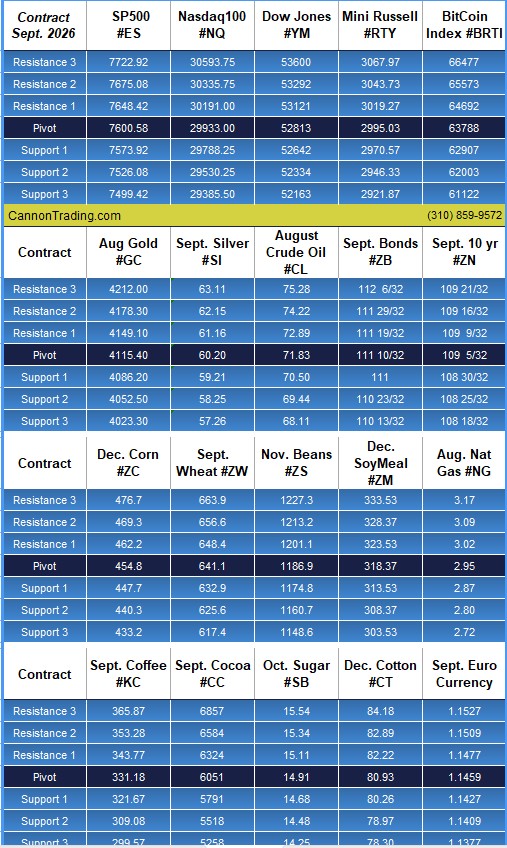
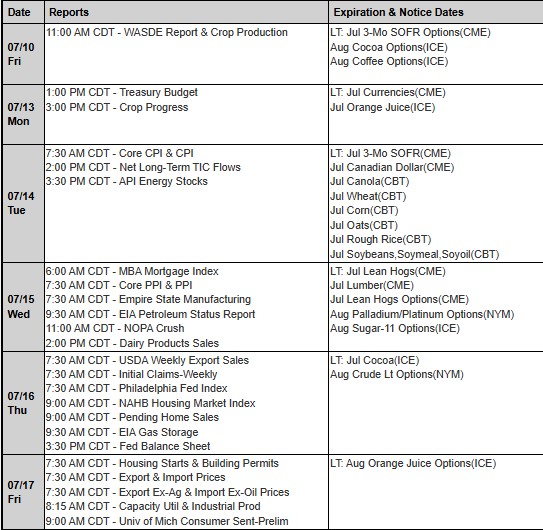
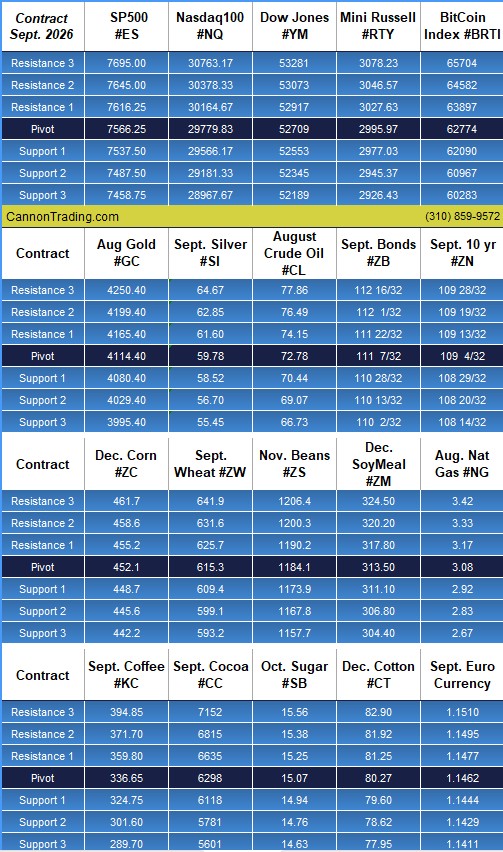
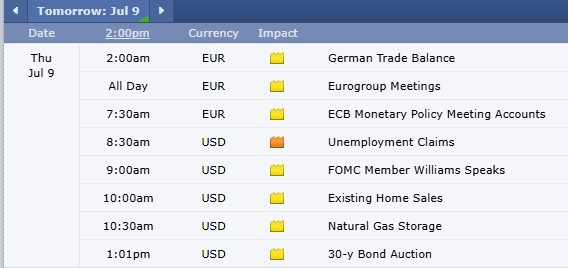
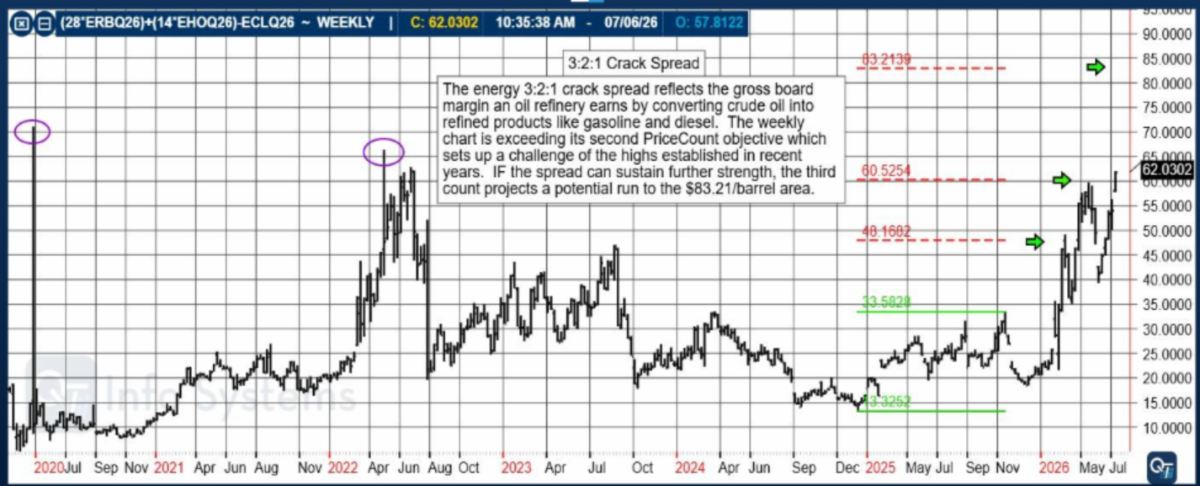
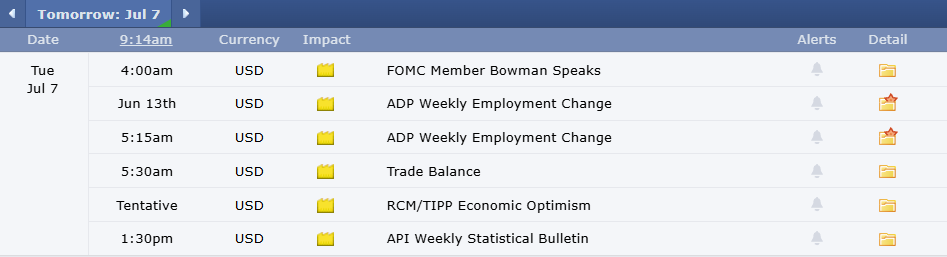
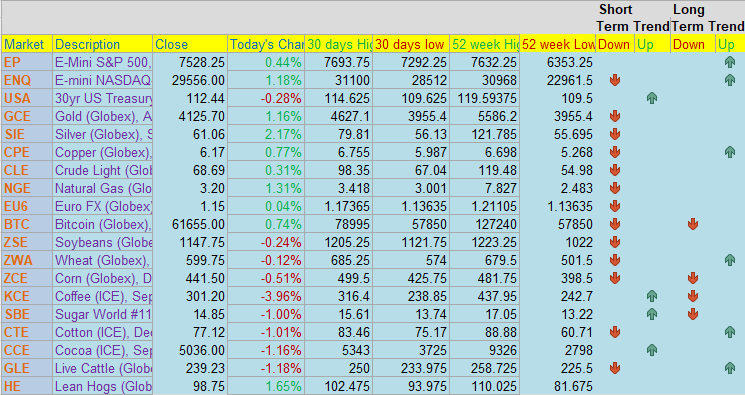
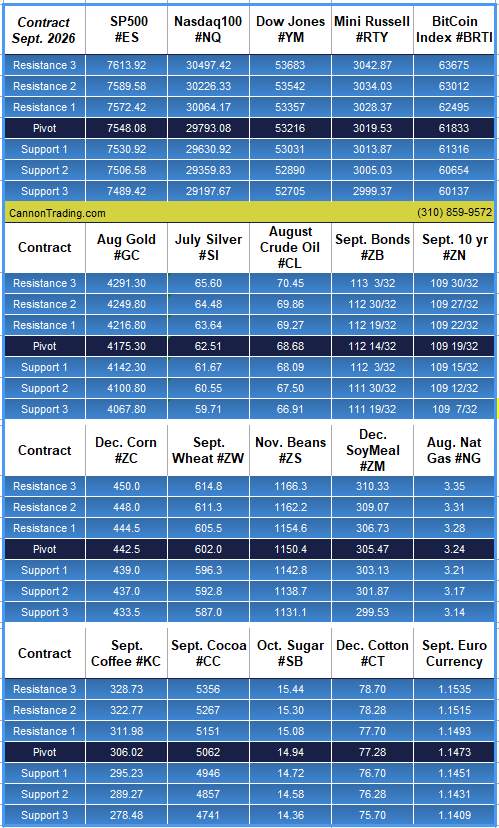
Support & Resistance Levels

This Blog provides futures market outlook for different commodities and futures trading markets, mostly stock index futures, as well as support and resistance levels for Crude Oil futures, Gold futures, Euro currency and others. At times the daily trading blog will include educational information about different aspects of commodity and futures trading.

Institutional Futures Trading Platforms

institutional futures trading platforms

Volatility Strategies for Commodity Markets


institutional futures trading platforms

institutional futures trading platforms

Commodity markets are inherently volatile. Prices react quickly to macroeconomic shifts, geopolitical conflicts, weather disruptions, supply shortages, and monetary policy changes. For traders, volatility creates both risk and opportunity.

Experienced traders often rely on institutional futures trading platforms and the expertise of top-rated futures brokers with volume-based commission rebates to navigate these complex market conditions efficiently.

Volatility strategies require disciplined execution, risk management, and reliable technology. A knowledgeable brokerage partner can provide the infrastructure and guidance necessary to convert uncertainty into structured trading opportunities.

Volatility in Commodity Futures

Commodity futures markets frequently experience sharp price swings due to global supply and demand shocks.

Examples include energy shortages, crop yield disruptions, and unexpected interest rate changes affecting currency-linked commodities.

Traders must recognize that volatility expands both profit potential and downside exposure.

Common drivers of commodity volatility include:

  • Weather patterns affecting agriculture
  • Geopolitical tensions impacting energy supply
  • Central bank policy shifts influencing currencies
  • Global economic growth cycles affecting metals demand

Volatility is not random. It often follows identifiable patterns tied to fundamental data.

For instance, the CME frequently reports increased volatility in crude oil during OPEC policy announcements.

Agricultural markets often surge during planting and harvest seasons.

Using institutional futures trading platforms allows traders to monitor these patterns with real-time data and advanced analytics.

Meanwhile, working with top-rated futures brokers with volume-based commission rebates helps traders maintain cost efficiency when frequent volatility-driven trades occur.

Core Volatility Trading Strategies in Commodity Markets

Volatility trading requires structured strategies rather than impulsive reactions.

Below are several common approaches used by professional futures traders.

  1. Breakout Trading

Breakouts occur when price moves outside established support or resistance levels.

Steps traders follow include:

  1. Identify consolidation ranges on charts.
  2. Monitor volume increases signaling institutional participation.
  3. Enter positions once price confirms direction.

Breakouts frequently occur after major reports released by the CME or macroeconomic announcements.

  1. Mean Reversion Strategies

Markets often overreact during high volatility.

Mean reversion traders attempt to profit from price returning to historical averages.

Key indicators used include:

  • Bollinger Bands
  • VWAP
  • Relative Strength Index (RSI)

Professional traders using institutional futures trading platforms often automate mean reversion signals for faster execution.

  1. Volatility Expansion Strategies

When volatility compresses for extended periods, large price moves often follow.

Traders watch for volatility squeezes and prepare for directional expansion.

Common tools include:

  • Average True Range (ATR)
  • Implied volatility indicators
  • Options skew analysis

Working with top-rated futures brokers with volume-based commission rebates helps active traders manage trading costs during these frequent volatility cycles.

How Futures Brokers Provide Guidance During Volatile Markets

During intense market swings, execution and risk management become critical.

A reputable brokerage provides guidance that extends beyond trade placement.

Professional futures brokers assist traders through:

  • Market commentary and analysis
  • Margin requirement updates
  • Platform training
  • Risk management tools

Many brokers also provide insights based on CME market data trends.

With institutional futures trading platforms, traders gain access to professional-grade tools such as advanced order routing and liquidity tracking.

Brokerage specialists can also help traders interpret unusual volatility spikes.

At the same time, top-rated futures brokers with volume-based commission rebates ensure high-frequency strategies remain economically viable.

This cost structure is particularly valuable for day traders and algorithmic traders executing multiple contracts.

Risk Management Tools for Volatile Futures Markets

Volatility magnifies both profits and losses.

Professional traders prioritize risk management above all else.

Effective tools include:

  • Stop-loss orders
  • Position sizing models
  • Portfolio diversification
  • Margin monitoring

Key protective strategies include:

  1. Scaling into positions gradually rather than entering full size immediately.
  2. Using trailing stops to lock in profits during fast-moving markets.
  3. Hedging correlated assets, such as crude oil and refined products.
  4. Monitoring margin requirements, especially during CME volatility adjustments.

Many of these tools are integrated directly into institutional futures trading platforms, allowing traders to automate protective actions.

Broker support teams can also help traders adjust strategies when volatility spikes unexpectedly.

Why Cannon Trading Company Is a Leading Futures Brokerage

Cannon Trading Company has built a reputation as one of the industry’s most respected brokerages.

For decades, the firm has supported traders ranging from retail participants to institutional market professionals.

Several factors contribute to Cannon Trading’s reputation.

Key strengths include:

  • Deep futures market expertise
  • Advanced trading technology
  • Personalized broker support
  • Transparent commission structures

Many traders rely on institutional futures trading platforms offered through Cannon Trading to access global futures markets efficiently.

Additionally, the firm consistently ranks among top-rated futures brokers with volume-based commission rebates, helping active traders reduce overall trading expenses.

Trustpilot reviews frequently highlight Cannon Trading’s strong customer service and responsive brokerage team.

Technology and Institutional-Level Trading Platforms

Technology plays a critical role in modern futures trading.

Execution speed and data access can significantly impact performance during volatile markets.

Professional trading tools available through Cannon Trading include:

  • Advanced charting systems
  • Direct market access routing
  • Algorithmic trading capabilities
  • Depth-of-market analytics

These features are standard within institutional futures trading platforms, enabling traders to operate with the same tools used by professional market participants.

Platforms also provide integrated CME market data, helping traders analyze liquidity shifts in real time.

With fast-moving commodities like crude oil or natural gas, milliseconds can matter.

Institutional-grade technology helps traders react immediately to sudden volatility.

Cost Efficiency and Commission Structures

Frequent trading during volatile markets can lead to significant commission costs.

Professional traders therefore seek brokers offering flexible pricing models.

Cannon Trading offers cost advantages commonly associated with top-rated futures brokers with volume-based commission rebates.

These rebate programs reward traders who execute larger trading volumes.

Benefits of rebate structures include:

  1. Lower effective trading costs
  2. Greater profitability for active strategies
  3. Improved scalability for algorithmic trading
  4. Incentives for institutional-level execution

By working with top-rated futures brokers with volume-based commission rebates, traders maintain consistent cost control even during rapid market fluctuations.

Institutional Perspectives on Volatility Trading

Institutional traders often view volatility as a core opportunity rather than a risk.

Large trading firms rely heavily on institutional futures trading platforms to monitor cross-market correlations.

These platforms help identify opportunities such as:

  • Intermarket spreads
  • Commodity index arbitrage
  • Energy crack spreads
  • Agricultural seasonal trades

Institutions also rely on top-rated futures brokers with volume-based commission rebates to manage high-frequency execution costs.

Retail traders increasingly access these same institutional-grade tools through modern brokerage services.

Cannon Trading bridges the gap between professional trading technology and independent traders.

Execution Support During Extreme Market Conditions

Volatile markets often create liquidity gaps and slippage risks.

Broker guidance becomes especially important during these moments.

Cannon Trading provides execution support including:

  • Market condition alerts
  • Margin updates during CME volatility changes
  • Risk management consultations

Professional brokers also help traders understand order types such as:

  • Iceberg orders
  • Stop-limit orders
  • Market-if-touched orders

These tools can help control execution quality during extreme volatility.

Working with top-rated futures brokers with volume-based commission rebates ensures traders maintain operational efficiency even when markets move rapidly.

Commodity volatility is unavoidable, but it can be managed with the right strategy and infrastructure.

Successful traders combine disciplined volatility strategies with professional technology and broker support.

Using institutional futures trading platforms allows traders to analyze market data, execute trades efficiently, and manage risk with precision.

Partnering with top-rated futures brokers with volume-based commission rebates ensures traders maintain cost efficiency while executing high-frequency volatility strategies.

Cannon Trading Company has supported futures traders for decades by providing technology, brokerage expertise, and personalized guidance.

In volatile markets, having the right broker can make the difference between reacting emotionally and trading strategically.

FAQ Section

What causes volatility in commodity futures markets?

Commodity volatility often results from supply disruptions, geopolitical conflicts, weather events, and economic policy changes. CME reports frequently highlight how macroeconomic announcements can rapidly impact commodity pricing.

Why are institutional futures trading platforms important?

Institutional futures trading platforms provide advanced charting, execution speed, algorithmic trading tools, and professional market data. These capabilities allow traders to react quickly to volatility and implement complex strategies.

What are volume-based commission rebates?

Volume-based rebates reward traders for executing larger trade volumes. Many top-rated futures brokers with volume-based commission rebates reduce commission costs as trading activity increases.

How does Cannon Trading help traders during volatile markets?

Cannon Trading provides advanced trading platforms, risk management tools, market guidance, and responsive broker support. This infrastructure helps traders navigate volatile market conditions effectively.

Are volatility strategies suitable for new traders?

Volatility strategies can be profitable but require discipline and strong risk management. New traders often benefit from broker guidance and educational resources before deploying these strategies.

Try a FREE Demo!

Ready to start trading futures? Call us at 1(800)454-9572 (US) or (310)859-9572 (International), or email info@cannontrading.com to speak with one of our experienced, Series-3 licensed futures brokers and begin your futures trading journey with Cannon Trading Company today.

Disclaimer: Trading Futures, Options on Futures, and retail off-exchange foreign currency transactions involve substantial risk of loss and are not suitable for all investors. Past performance is not indicative of future results. Carefully consider if trading is suitable for you in light of your circumstances, knowledge, and financial resources. You may lose all or more of your initial investment. Opinions, market data, and recommendations are subject to change at any time.

Important: Trading commodity futures and options involves a substantial risk of loss. The recommendations contained in this article are opinions only and do not guarantee any profits. This article is for educational purposes. Past performances are not necessarily indicative of future results.

This article has been generated with the help of AI Technology and modified for accuracy and compliance.

Follow us on all socials: @cannontrading


Futures Options Basics PLUS: The Week Ahead – NFP, Earnings, Middle East Smoke Clearing? Crypto Cup – $50,000 Total Prizes!! Futures 102 – The Daily Briefing – What the Pros Know Before Trading, June Emini S&P, CannonEdge Snapshot, Levels, Reports; Your 8 Important Can’t-Miss Need-To-Knows before Trading Futures the Week of June 1st, 2026

7cfe5b36 db9f 4933 824a 7f264613e7fe

Cannon Futures Weekly Letter

In Today’s Issue #1291

  • The Week Ahead – NFP, Earnings, Middle East Smoke Clearing?

  • Crypto Cup – $50,000 Total Prizes!!

  • Futures 102 – The Daily Briefing – What the Pros Know Before Trading

  • July Soymeal Chart & Outlook

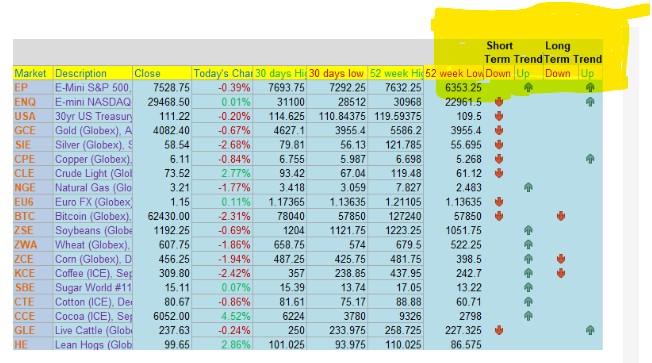
  • Cannon Edge – Your Futures trading Map for the week ahead!

  • Trading Levels for Next Week
  • Trading Reports for Next Week

At A Glance Levels

Instrument S2 S1 Pivot R1 R2

Gold (GC)

— June (#GC)

4467.07 4522.23 4574.67 4629.83 4682.27

Silver (SI)

— July. (#SI)

73.75 74.82 75.89 76.97 78.04

Crude Oil (CL)

— July. (#CL)

85.16 86.63 87.83 89.30 90.50

 Sept. Bonds (ZB)

— Sept. (#ZB)

111  29/32 112 6/32 112 13/32 112 22/32 112 29/32

What Futures Traders Should Watch This Week

Options

By John Thorpe, Senior Broker

The Week Ahead

Non-Farm Payrolls Friday! With a few earnings, economic reports and fed speakers thrown in.

Under the Bull or Bear category for our clients who would care to better understand how options can complement your trading; I’ve put together a cheat sheet, please contact your broker to discuss the characteristics and how you can incorporate options into your existing strategy.

options


Futures Options Basics

Futures options (also called options on futures) are derivative contracts that give the buyer the right, but not the obligation, to enter into a futures contract at a specific price (the strike) by a certain date (expiration).

1. Quick Refresher: What is a Futures Contract?

  • A futures contract is a standardized agreement to buy or sell an underlying asset (commodities, stock indexes, interest rates, currencies, etc.) at a predetermined price on a future date.
  • Futures are marked-to-market daily and usually cash-settled or physically delivered.
  • They are traded on exchanges like CME, ICE, etc.

2. What is an Option on a Futures?

Instead of trading the futures itself, you trade an option whose underlying is a futures contract.

  • Call Option on Futures: Gives the buyer the right to go long (buy) the underlying futures contract at the strike price.
  • Put Option on Futures: Gives the buyer the right to go short (sell) the underlying futures contract at the strike price.

When you exercise (or the option is auto-exercised at expiration if in-the-money), you don’t get the physical commodity or cash directly — you get a position in the futures contract at the strike price, plus any variation margin.

3. Key Terms

Term

Meaning

Premium

The price you pay to buy the option (quoted in points/ticks, just like the futures).

Strike Price

The price at which you can enter the futures if you exercise.

Expiration

Options on futures typically expire a few days/weeks before the underlying futures contract expires.

In-the-Money (ITM)

Call: Futures price > Strike Put: Futures price < Strike

At-the-Money (ATM)

Futures price ≈ Strike

Out-of-the-Money (OTM)

Opposite of ITM

American vs European

Most futures options are American (can be exercised any time before expiration).

4. How Settlement Works (Important Difference from Stock Options)

  • If exercised, the call buyer receives a long futures position at the strike.
  • The put buyer receives a short futures position at the strike.
  • The option seller takes the opposite futures position.
  • Because futures are marked-to-market daily, the account is immediately credited/debited the difference between the strike and current futures price.

Example:

  • Crude oil futures are trading at $75.
  • You buy a $72 Call for $2.50 premium.
  • At expiration, crude oil futures are at $78.
  • The call is worth $6 intrinsically ($78 – $72).
  • You can exercise → you get a long futures position marked at $72 while the market is $78 → your account is credited $6 immediately.

5. Payoff at Expiration (Simplified)

  • Long Call: Max(0, Futures Price – Strike) – Premium
  • Long Put: Max(0, Strike – Futures Price) – Premium
  • Limited risk (only the premium), unlimited potential gain (like stock options).

6. Major Advantages of Futures Options

  • High leverage with defined risk.
  • Often lower margin requirements than trading the outright futures.
  • Very liquid markets for major contracts (S&P 500 / ES, Crude Oil / CL, Gold, 10-Year Treasuries, etc.).
  • No stock borrowing issues or hard-to-borrow fees.
  • Tax treatment in many jurisdictions (60/40 rule in the US for Section 1256 contracts).

7. Risks

  • Time decay (theta) — options lose value as expiration approaches.
  • Volatility changes (vega).
  • You can lose 100% of the premium.
  • Futures themselves are highly leveraged — so even though option risk is limited, the underlying moves can be large.

8. Simple Real-World Example (as of 2025 knowledge)

  • E-mini S&P 500 futures (ES) trading at 5,800.
  • You expect a rally before expiration → Buy the 5,850 Call for 45 points ($1,125 per contract, since $50 × 45).
  • If ES rallies to 5,950 by expiration → intrinsic value = 100 points → nice profit.
  • If ES drops to 5,700 → option expires worthless → you lose only the $1,125 premium.

We can trade either side of the market and prepare for volatility. On Monday, reach out to your broker for trading ideas. Bull or Bear, you really shouldn’t care.

Is the smoke clearing in the Mid-East and the markets have a renewed sense of confidence?

The energy and metals are swirling in the uncertainty of a lack of resolution in the attempted unwinding of the Iranian nuclear program.

Don’t let your guard down just yet, the fog continues, tune into the Sunday evening markets to witness reactions to the weekend news streams, manufactured or true.

  Plan your trade and trade your plan!

Earnings Next Week:

·        Mon. HP,

·        Tue. PaloAlto Networks, Dollar General

·        Wed. Broadcom, Crowdstrike, Macy’s

·        Thu. Ciena

·        Fri.   Quiet


FED SPEECHES: (all times CDT)

·        Mon. Quiet

·        Tues.  7:30am Hammack

·        Wed. 8:00am Barr, 3:00 pm Logan

·        Thu.  12:10pm Daly

·        Fri.   Quiet

Econ Data:

·        Mon. ISM PMI

·        Tue.   Redbook, JOLTS, API Crude Stock Change

·        Wed. ADP Employment Change Weekly, Factory Orders, EIA Crude stock Change

·        Thu.  Initial Jobless claims, EIA Nat Gas Stocks 9:30 am CDT,

·        Fri. Non-Farm Payrolls,  Baker Hughes Oil Rig Count

As a Cannon Trading client OR prospect, you’re invited to compete in the

Great Summer Escape Trading Competition featuring Coinbase Derivatives futures contracts!

From June 22 – July 2, trade in a simulated environment and compete for your share of $50,000 in prizes

Contracts include:

·    Etherium: Ether, nano Ether, nano Ether Perp-Style

·    Bitcoin: Bitcoin, nano Bitcoin, nano Bitcoin Perp-Style

·    Solana: Solana, nano Solana, nano Solana Perp-Style

·    XRP: XRP, nano XRP, nano XRP Perp-Style

Sign Up Now!

8967d0dc 1211 44c4 b037 44c6a19c3147

Futures 102: The Daily Briefing by Cannon

Every morning, the world’s biggest banks and macro strategists publish where markets are headed. The rest of the world waits for the headline.

That intelligence stays locked inside trading desks, institutional terminals, and private client portals — accessible only to the few who pay for the privilege, and even they only get what they pay for.

This briefing changes that (100% FREE on Cannon’s website!!). Every morning we scour the open web and aggregate everything that matters — pulling from publicly available sources so you never have to — and distill it into one clear, readable edition you can get through before your first coffee is finished.

No terminals. No subscriptions. No private portals. Just everything the market is saying, gathered in one place, every morning before the bell.

Read the Latest Briefing HERE and make sure to Bookmark this page!

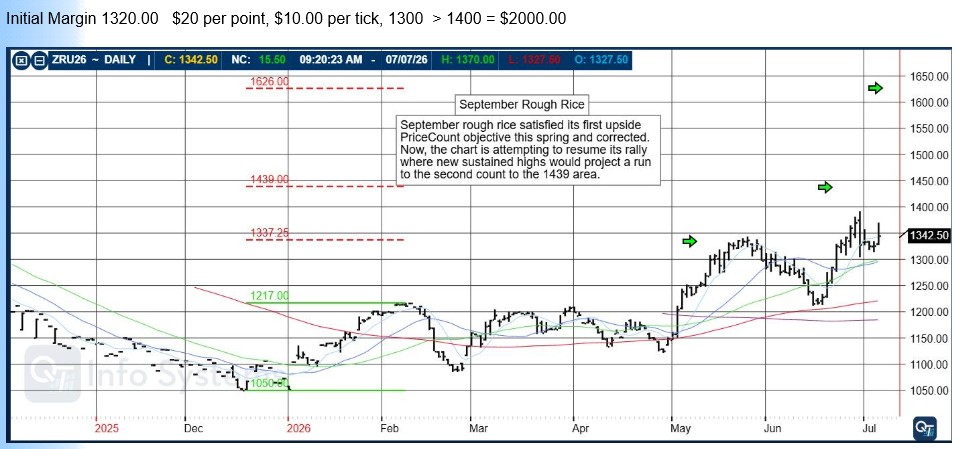
June Emini S&P

The June Emini S&P satisfied its second upside PriceCount objective where it would be normal to get a near term reaction in the form of a consolidation or corrective trade. At this point, IF the chart can sustain further strength, the third could project a possible run to the 8720 area.

18f5408c 64d3 4cd3 a812 b5a5fba73827

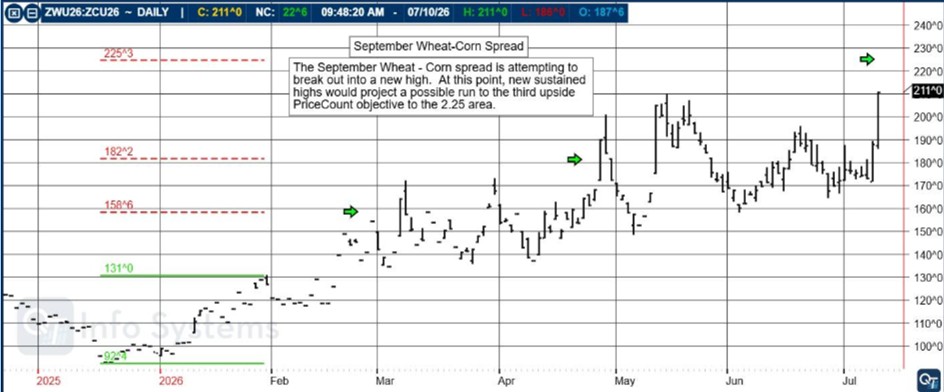
The PriceCount study is a tool that can help to project the distance of a move in price. The counts are not intended to be an ‘exact’ science but rather offer a target area for the four objectives which are based off the first leg of a move with each subsequent count having a smaller percentage of being achieved.

It is normal for the chart to react by correcting or consolidating at an objective and then either resuming its move or reversing trend. Best utilized in conjunction with other technical tools, PriceCounts offer one more way to analyze charts and help to manage your positions and risk.

Learn more at www.qtchartoftheday.com

Trading in futures, options, securities, derivatives or OTC products entails significant risks which must be understood prior to trading and may not be appropriate for all investors. Past performance of actual trades or strategies is not necessarily indicative of future results.

FREE TRIAL TO QT MARKET Center – Access to analysis, tools, news & much more!

Highly recommended for HEDGERS!

1ab82322 3fe6 467c 8a06 58a08d52f845

Cannon Edge — Your Daily Futures Insight for the Next Trading Day! Cannon Edge for June 1st, 2026

329bd3ec 3afc 4ae3 a0f1 231c4271ac59

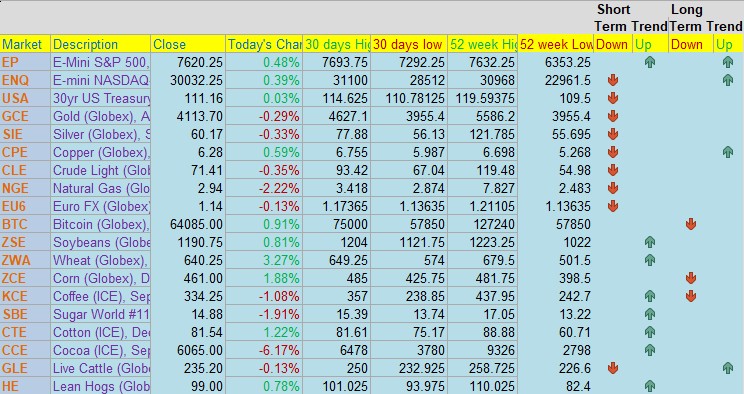
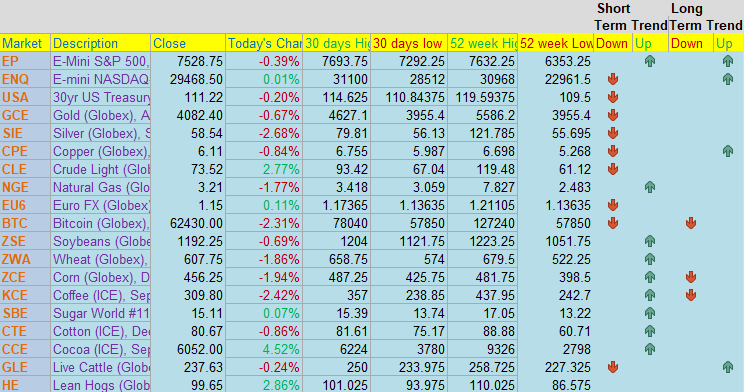
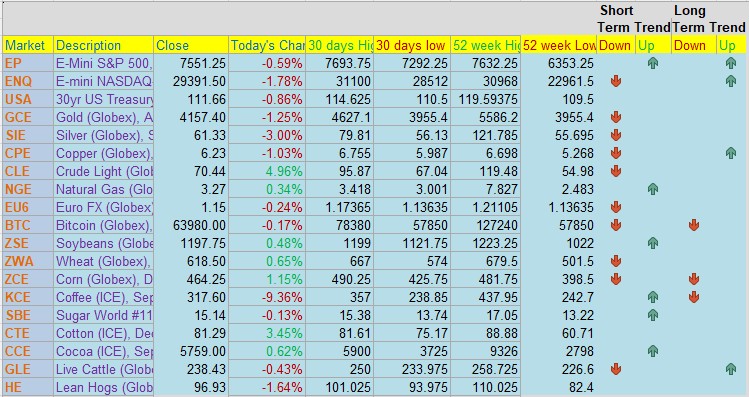
Cannon Edge is our new daily feature designed to give traders a fast, actionable overview of key futures markets. Each post delivers:

  • Current price and daily % change

  • 30‑day and 52‑week highs/lows

  • PROPRIETARY Short‑term and long‑term trend signals

  • Coverage across equity indices, metals, energies, currencies, and ags

Whether you’re scanning for breakout setups, trend reversals, or just staying informed — Cannon Edge puts the data in your hands before the open.

Built for speed. Backed by insight. Powered by CQG.

Would you like to get weekly updates on real-time, results of systems mentioned above?

Daily Levels for June 1st, 2026

6fc9a376 cc7e 430d 808f 8240a9f1ba5c
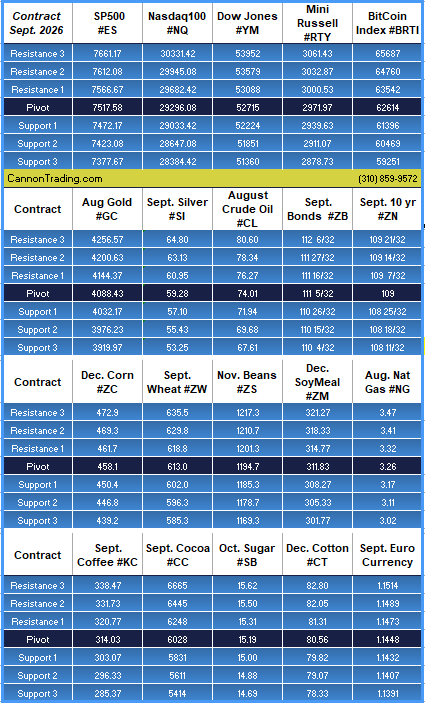
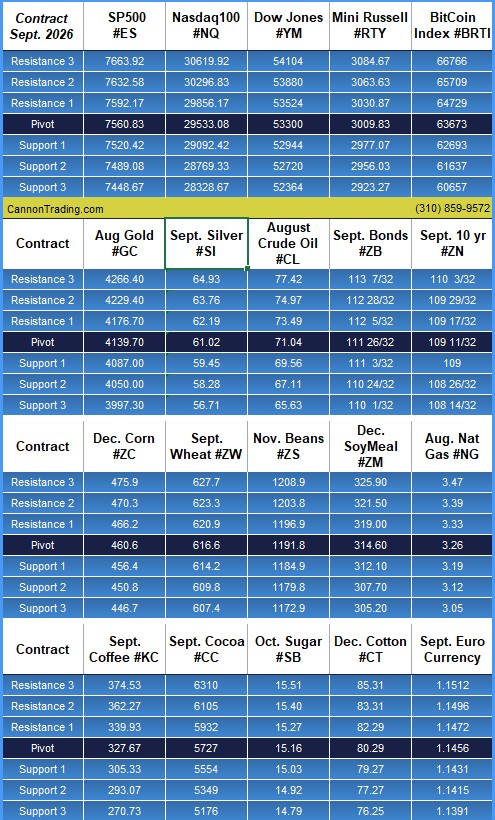
Would you like to receive daily support & resistance levels?

Trading Reports for Next Week

First Notice (FN), Last trading (LT) Days for the Week:

www.mrci.com

b9e29a25 0223 40f6 8d2b 37c3e7dd3dde

Find us on Trustpilot

4ad8134c aa57 4adb a428 7cc476773107

Trading Futures, Options on Futures, and retail off-exchange foreign currency transactions involves substantial risk of loss and is not suitable for all investors. You should carefully consider whether trading is suitable for you in light of your circumstances, knowledge, and financial resources. You may lose all or more of your initial investment. Opinions, market data, and recommendations are subject to change at any time.

Join our Private Facebook group

Subscribe to our YouTube Channel

Listen to our podcast: Subscribe on AppleSpotify, Amazon

or wherever you listen to podcasts!

S
Facebook  Instagram  LinkedIn
S
ef3ab1c9 8d6d 4e60 a3f1 af5d9d4ecbb3
Services
Software
Tools
Community
Contact

Professional Futures Trading Platforms

professional futures trading platforms

Euro and Dollar Index Trading Strategies


professional futures trading platforms

professional futures trading platforms

Euro currency futures and U.S. Dollar Index futures are among the most actively traded macro contracts in global derivatives markets. These contracts allow traders to speculate on currency strength, hedge exposure, and diversify portfolios. Understanding advanced strategies and utilizing the right brokerage support can significantly improve trading outcomes.

Professional traders rely on structured strategies, advanced technology, and experienced brokers. Working with a firm such as Cannon Trading Company—one of the top-rated futures brokers with volume-based commission rebates—can provide the infrastructure and expertise needed for consistent execution in euro and dollar index futures markets.

Euro and Dollar Index Futures

Euro futures and U.S. Dollar Index futures trade on CME Group exchanges. These contracts represent standardized instruments that track currency movements between the euro and the U.S. dollar or the value of the dollar against a basket of currencies.

Euro FX futures track the value of the euro relative to the U.S. dollar.

U.S. Dollar Index futures measure the dollar’s strength against a basket including:

  • Euro
  • Japanese yen
  • British pound
  • Canadian dollar
  • Swedish krona
  • Swiss franc

Because euro weighting dominates the index, euro futures and dollar index futures often move inversely.

Professional traders analyze macroeconomic forces that drive these contracts. Key drivers include:

  1. Central bank policy decisions
  2. Interest rate differentials
  3. Inflation expectations
  4. Geopolitical developments

Using professional futures trading platforms, traders can monitor economic releases, order flow, and technical indicators in real time.

Cannon Trading Company provides traders with access to several institutional futures trading platforms, allowing retail traders to leverage the same analytical tools used by hedge funds and proprietary trading desks.

Core Euro Futures Trading Strategies

Euro futures trading strategies generally fall into directional, spread, and macro-driven approaches.

1. Trend Following Strategy

Trend following is one of the most widely used strategies in euro futures.

Key characteristics include:

  • Trading in the direction of prevailing macro trends
  • Using moving averages or momentum indicators
  • Entering on pullbacks during sustained trends

For example:

If the European Central Bank signals tightening monetary policy while the Federal Reserve pauses rate hikes, euro futures may trend upward.

A trader might:

  1. Identify a bullish trend on daily charts
  2. Enter long positions during retracements
  3. Use trailing stops to lock in profits

Using professional futures trading platforms, traders can automate alerts when moving averages cross or momentum indicators signal continuation.

These tools significantly enhance execution speed and consistency.

2. Range Trading Strategy

Currency futures frequently trade within ranges during periods of macro stability.

Range traders typically focus on:

  • Support and resistance levels
  • Oscillators such as RSI
  • Mean reversion patterns

Typical steps include:

  • Identify a horizontal trading channel
  • Buy near support
  • Sell near resistance

For instance:

If euro futures trade between 1.08 and 1.10 for several weeks, traders may repeatedly buy the lower boundary and sell the upper boundary.

Advanced charting tools available on institutional futures trading platforms allow traders to mark historical support zones and automatically monitor breakout risks.

These platforms help ensure precise execution during volatile periods.

U.S. Dollar Index Futures Trading Strategies

Dollar index futures provide traders with exposure to broad dollar strength or weakness.

Because the index includes multiple currencies, it often reflects global macro trends rather than bilateral currency dynamics.

3. Macro Correlation Strategy

The U.S. Dollar Index frequently correlates with global risk sentiment.

Examples include:

  • Dollar strength during market uncertainty
  • Dollar weakness during strong global growth

Professional traders watch correlations with:

  • U.S. Treasury yields
  • Commodity prices
  • Global equity markets

Typical trade structure:

  1. Rising Treasury yields signal stronger dollar demand
  2. Trader initiates long dollar index futures position
  3. Exit occurs once yields stabilize or decline

Using professional futures trading platforms, traders can overlay multiple asset classes on a single chart.

This allows traders to observe cross-market relationships that drive dollar index movements.

4. Euro-Dollar Spread Strategy

Because the euro represents a large percentage of the Dollar Index, traders sometimes implement spread strategies involving euro futures and dollar index futures.

Spread strategies aim to exploit divergences.

Example structure:

  • Short euro futures
  • Long dollar index futures

This position profits if the dollar strengthens broadly while the euro weakens relative to other currencies.

Execution efficiency is critical for spread strategies.

Cannon Trading Company supports these strategies through institutional futures trading platforms that allow simultaneous order routing and precise risk monitoring.

Risk Management Techniques for Currency Futures

Risk management is essential when trading euro or dollar index futures.

Currency markets can react rapidly to economic announcements and geopolitical developments.

Professional traders apply structured risk controls.

Key Risk Management Methods

  • Position sizing relative to account capital
  • Stop-loss placement based on volatility
  • Diversification across contracts

Example process:

  1. Trader limits each trade to 1–2% account risk
  2. Stop-loss set using Average True Range
  3. Position reduced before major economic announcements

Advanced analytics available on professional futures trading platforms allow traders to model worst-case scenarios and monitor margin requirements in real time.

These tools help prevent excessive exposure during volatile periods.

How Your Futures Broker Supports Euro and Dollar Index Trading

Choosing the right futures broker plays a critical role in trading success.

A specialized brokerage provides access to:

  • Exchange connectivity
  • advanced trading technology
  • market research
  • risk management tools

Cannon Trading Company has supported futures traders for decades through infrastructure designed for both retail and professional market participants.

Key broker services include:

  1. Access to CME currency futures markets
  2. Integration with institutional futures trading platforms
  3. Competitive commission structures
  4. Dedicated client support

Among top-rated futures brokers with volume-based commission rebates, Cannon Trading offers traders reduced trading costs as volume increases.

Lower costs can significantly improve long-term trading profitability.

Technology Infrastructure for Modern Currency Futures Traders

Modern futures trading depends heavily on technology.

Speed, data accuracy, and platform reliability are essential for executing strategies effectively.

Cannon Trading Company offers multiple trading solutions that function as professional futures trading platforms.

Key technology benefits include:

  • Real-time market data
  • advanced order types
  • algorithmic strategy support

Traders can use these tools to implement strategies such as:

  • automated trend-following systems
  • volatility breakout models
  • macro-driven execution algorithms

Many institutional traders rely on institutional futures trading platforms because they provide deep market analytics and execution transparency.

Retail traders working with Cannon Trading Company can access these same capabilities.

This levels the playing field between retail and institutional participants.

Cost Efficiency and Commission Rebates

Transaction costs are a major factor in long-term trading success.

Even small commission differences can impact profitability for active traders.

Cannon Trading Company stands out among top-rated futures brokers with volume-based commission rebates by offering tiered pricing structures.

These rebates reward traders who maintain higher trading volumes.

Example structure:

  • Base commission rate for new traders
  • Reduced commissions for higher monthly volume
  • Additional discounts for algorithmic or high-frequency traders

Benefits include:

  • Lower cost per trade
  • improved strategy scalability
  • increased profitability for active traders

Many professional currency traders specifically seek top-rated futures brokers with volume-based commission rebates because they help reduce operational expenses.

Why Cannon Trading Company Has Remained a Leading Brokerage for Decades

Longevity in the brokerage industry reflects trust, compliance, and service quality.

Cannon Trading Company has served futures traders for decades by maintaining strong regulatory standards and continuously upgrading its technology offerings.

Key reasons traders choose Cannon Trading include:

  • deep experience in futures markets
  • access to professional futures trading platforms
  • responsive customer support

The firm also provides access to institutional futures trading platforms, which support advanced trading strategies and high-volume execution.

Additional advantages include:

  1. Direct access to CME currency futures markets
  2. Educational resources for traders
  3. flexible account structures

Many traders consider Cannon Trading among the top-rated futures brokers with volume-based commission rebates because it combines competitive pricing with institutional-grade infrastructure.

This combination helps traders scale strategies while maintaining cost efficiency.

Building a Complete Euro and Dollar Index Trading Plan

Successful currency futures traders typically combine strategy, technology, and brokerage support.

A complete trading plan often includes:

  • defined entry and exit rules
  • macroeconomic analysis
  • strict risk management

Steps to build a trading plan include:

  1. Identify macro drivers influencing euro or dollar strength
  2. Select appropriate strategy (trend, range, or spread)
  3. Execute trades using professional futures trading platforms

Traders can further enhance their edge by leveraging institutional futures trading platforms that provide deeper market insights.

Partnering with one of the top-rated futures brokers with volume-based commission rebates helps ensure that execution costs remain manageable as trading activity grows.

FAQ Section

What are euro futures?

Euro futures are standardized contracts traded on CME exchanges that represent the value of the euro against the U.S. dollar. They allow traders to speculate on currency movements or hedge currency exposure.

What is the U.S. Dollar Index futures contract?

The U.S. Dollar Index futures contract measures the value of the dollar relative to a basket of global currencies. Traders use it to gain exposure to broad dollar strength or weakness.

Why are euro futures and dollar index futures often inversely correlated?

The euro makes up a significant portion of the dollar index basket. When the euro strengthens, the dollar index often declines, and when the euro weakens, the dollar index tends to rise.

What tools help traders analyze currency futures markets?

Traders typically rely on professional futures trading platforms that provide charting, market depth data, and economic calendar integration.

Why is broker selection important for currency futures traders?

A broker provides market access, technology, and risk management infrastructure. Firms offering institutional futures trading platforms allow traders to implement advanced strategies and execute trades efficiently.

What are volume-based commission rebates?

Some brokers reward active traders with reduced commissions as trading volume increases. Many traders choose top-rated futures brokers with volume-based commission rebates because these rebates lower long-term trading costs.

Try a FREE Demo!

Ready to start trading futures? Call us at 1(800)454-9572 (US) or (310)859-9572 (International), or email info@cannontrading.com to speak with one of our experienced, Series-3 licensed futures brokers and begin your futures trading journey with Cannon Trading Company today.

Disclaimer: Trading Futures, Options on Futures, and retail off-exchange foreign currency transactions involve substantial risk of loss and are not suitable for all investors. Past performance is not indicative of future results. Carefully consider if trading is suitable for you in light of your circumstances, knowledge, and financial resources. You may lose all or more of your initial investment. Opinions, market data, and recommendations are subject to change at any time.

Important: Trading commodity futures and options involves a substantial risk of loss. The recommendations contained in this article are opinions only and do not guarantee any profits. This article is for educational purposes. Past performances are not necessarily indicative of future results.

This article has been generated with the help of AI Technology and modified for accuracy and compliance.

Follow us on all socials: @cannontrading


Great Summer Escape Trading Competition featuring Coinbase Derivatives futures contracts! PLUS: CannonEdge Snapshot, June Emini S&P, Levels, Reports; Your 5 Important Can’t-Miss Need-To-Knows for Trading Futures on May 29th, 2026

9dc1e02e d5f7 4ff4 abf7 1df60775f196

At A Glance Levels

Instrument S2 S1 Pivot R1 R2

Gold (GC)

— June (#GC)

4338.53 4432.97 4490.03 4584.47 4641.53

Silver (SI)

— July. (#SI)

70.43 73.15 74.73 77.45 79.03

Crude Oil (CL)

— July. (#CL)

84.29 86.89 89.70 92.30 95.11

 June Bonds (ZB)

— June. (#ZB)

110  220/32 111 16/32 112 2/32 112 28/32 113 14/32
As a Cannon Trading client, you’re invited to compete in the

Great Summer Escape Trading Competition featuring Coinbase Derivatives futures contracts!

From June 22 – July 2, trade in a simulated environment and compete for your share of $50,000 in prizes.

Contracts include:

  • Etherium: Ether, nano Ether, nano Ether Perp-Style

  • Bitcoin: Bitcoin, nano Bitcoin, nano Bitcoin Perp-Style

  • Solana: Solana, nano Solana, nano Solana Perp-Style

  • XRP: XRP, nano XRP, nano XRP Perp-Style

Sign Up Now!

trading

June Emini S&P

The June Emini S&P satisfied its second upside PriceCount objective where it would be normal to get a near term reaction int he form of a consolidation or corrective trade. At this point, IF the chart can sustain further strength, the third could project a possible run to the 8720 area.

18f5408c 64d3 4cd3 a812 b5a5fba73827

The PriceCount study is a tool that can help to project the distance of a move in price. The counts are not intended to be an ‘exact’ science but rather offer a target area for the four objectives which are based off the first leg of a move with each subsequent count having a smaller percentage of being achieved.

It is normal for the chart to react by correcting or consolidating at an objective and then either resuming its move or reversing trend. Best utilized in conjunction with other technical tools, PriceCounts offer one more way to analyze charts and help to manage your positions and risk.

Learn more at www.qtchartoftheday.com

Trading in futures, options, securities, derivatives or OTC products entails significant risks which must be understood prior to trading and may not be appropriate for all investors. Past performance of actual trades or strategies is not necessarily indicative of future results.

Cannon Edge — Your Daily Futures Snapshot for May 29th

b58e4a16 91ce 4273 a326 8b563f919f70

Daily Levels for May 29th

fe277e55 d184 4764 8754 7f25b322a106

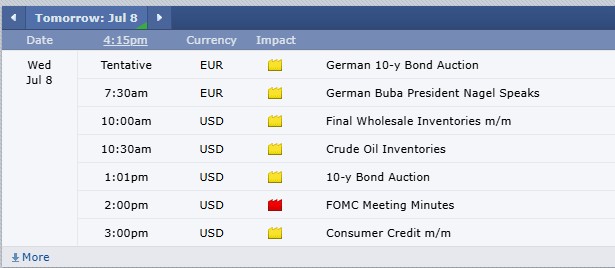
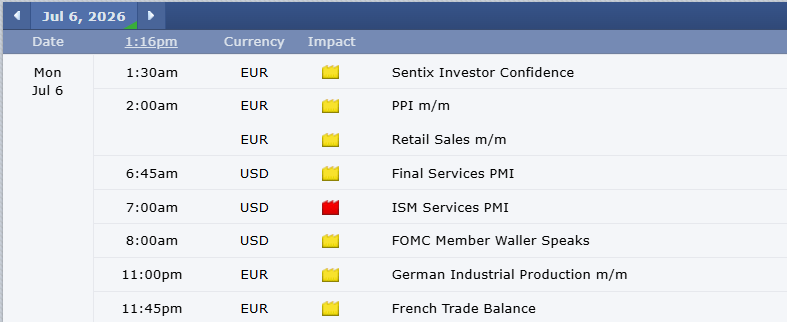
Economic Reports

provided by: ForexFactory.com

All times are Central Time ( Chicago)

4f1bcdca 90c3 40d1 bbc8 0dc1bfb5f7ea

Find us on Trustpilot

41a3c910 28d6 4126 946b 6659bb02ae4d

Trading Futures, Options on Futures, and retail off-exchange foreign currency transactions involves substantial risk of loss and is not suitable for all investors. You should carefully consider whether trading is suitable for you in light of your circumstances, knowledge, and financial resources. You may lose all or more of your initial investment. Opinions, market data, and recommendations are subject to change at any time.

Join our Private Facebook group

Subscribe to our YouTube Channel

Listen to our podcast: Subscribe on AppleSpotify, Amazon

or wherever you listen to podcasts!

S
Facebook  Instagram  LinkedIn
S
ef3ab1c9 8d6d 4e60 a3f1 af5d9d4ecbb3
Services
Software
Tools
Community
Contact

Futures Trading Platforms

futures trading platforms

Essential Risk Management in Futures Trading


futures trading platforms

futures trading platforms

Risk management is the foundation of long-term success in futures markets. Traders who focus only on profits without protecting capital rarely survive market volatility. Futures contracts are leveraged instruments, meaning gains and losses can develop quickly.

Effective risk management requires discipline, technology, and guidance. Modern futures trading platforms provide tools designed to help traders monitor exposure and control positions in real time.

A knowledgeable broker also plays a major role. During live trading conditions, experienced brokerage support can help traders manage margin requirements, execution risk, and unexpected market events.

Cannon Trading Company has spent decades assisting traders with these challenges. Through professional guidance, advanced commodity futures trading systems, and support for automated futures trading, the firm helps traders approach risk management with structure and discipline.

The Importance of Risk Management in Futures Trading

Futures trading involves leverage. Traders control large contract values with relatively small margin deposits. While this increases opportunity, it also magnifies risk.

Without proper safeguards, a single market move can produce significant losses.

Effective risk management focuses on protecting capital while allowing strategic market participation. The most successful traders view risk control as a core trading skill.

Key components include:

  • Position sizing relative to account equity
  • Predefined stop-loss levels
  • Portfolio diversification
  • Monitoring margin utilization

Professional futures trading platforms help traders apply these principles consistently.

Structured tools allow traders to visualize exposure, analyze contract values, and evaluate potential losses before placing orders.

Many traders also rely on commodity futures trading systems to standardize trade execution and remove emotional decision-making.

When combined with strong broker support, these technologies create a disciplined trading environment.

How Futures Brokers Support Risk Management During Live Trading

A professional broker acts as a risk management partner, not just an execution service.

During live trading, market conditions can change rapidly. Brokers help traders navigate these moments with experience and real-time support.

Below are key ways a broker assists traders.

  1. Margin Monitoring and Alerts

Futures contracts require margin maintenance. When account equity approaches margin thresholds, brokers can notify traders.

This helps prevent forced liquidations.

Experienced firms monitor accounts continuously and communicate quickly if risk levels increase.

  1. Execution Quality

Poor execution increases trading risk. Slippage and delayed orders can significantly impact results.

Reliable futures trading platforms supported by professional brokers ensure fast order routing and stable connectivity.

  1. Market Event Guidance

Economic releases, geopolitical news, and exchange announcements can cause sudden volatility.

Professional brokers often warn traders about upcoming events that may influence market risk.

  1. Strategy Evaluation

Some traders rely heavily on automated futures trading strategies.

Brokers can help review performance metrics, ensuring strategies are not exposing accounts to excessive risk.

  1. Platform Risk Controls

Brokerage technology often includes advanced safeguards.

These may include automated position limits, account risk alerts, and order-validation rules built into commodity futures trading systems.

By integrating these controls, traders can avoid accidental over-exposure.

Risk Control Tools Built Into Futures Trading Platforms

Modern trading technology has dramatically improved risk management capabilities.

Advanced futures trading platforms allow traders to monitor positions, analyze exposure, and adjust strategies quickly.

These tools help traders manage risk before, during, and after trade execution.

Common risk management features include:

  • Real-time profit and loss tracking
  • Automated stop-loss orders
  • Trailing stop mechanisms
  • Risk-reward analysis tools

Additional protective tools include:

  1. Bracket Orders

Bracket orders automatically attach stop and target levels to a trade.

This ensures risk parameters are defined immediately after entering a position.

  1. Position Monitoring Dashboards

These dashboards display account exposure across multiple markets.

They help traders identify concentration risk quickly.

  1. Order Size Validation

Some commodity futures trading systems prevent traders from placing orders that exceed predefined limits.

  1. Real-Time Margin Calculators

Margin tools allow traders to understand contract requirements before entering positions.

These safeguards help reduce emotional trading decisions and support disciplined strategies.

Automated Futures Trading and Risk Control

Technology has introduced a new layer of efficiency in risk management.

Many traders now use automated futures trading strategies to execute trades based on predefined rules.

Automation removes emotional bias and ensures strategies follow strict risk parameters.

When properly configured, automation can strengthen discipline.

Benefits of automated futures trading include:

  • Consistent strategy execution
  • Rapid reaction to market signals
  • Precise stop-loss implementation

However, automation also introduces new risks.

Algorithms must be monitored carefully to ensure they behave as expected in changing market conditions.

Key safeguards include:

  1. Backtesting

Before deployment, strategies should be tested using historical data.

This helps validate assumptions and evaluate drawdowns.

  1. Real-Time Monitoring

Even automated systems require supervision.

Professional brokers can help traders evaluate system performance.

  1. Capital Allocation Controls

Automated strategies should limit position sizes.

Many commodity futures trading systems include tools that enforce maximum risk thresholds.

  1. Emergency Shutdown Rules

Automated strategies can include logic that pauses trading after predefined losses.

These mechanisms help prevent catastrophic drawdowns.

Why Cannon Trading Company Is a Trusted Broker for Risk-Focused Traders

Cannon Trading Company has been supporting futures traders for decades.

Throughout that time, the firm has built a reputation for professionalism, transparency, and technology integration.

Risk management remains one of the firm’s central priorities.

Traders working with Cannon benefit from several advantages.

  1. Experienced Brokerage Support

Cannon Trading professionals understand futures markets deeply.

Their experience allows them to guide traders through volatile conditions and help structure disciplined strategies.

  1. Advanced Technology Access

The firm offers multiple futures trading platforms, giving traders flexibility and robust risk monitoring tools.

These platforms allow traders to visualize exposure and adjust positions quickly.

  1. Support for Systematic Trading

Many traders today rely on automated futures trading models.

Cannon Trading provides infrastructure that supports algorithmic strategies while maintaining risk oversight.

  1. Strong Reputation

Cannon Trading has earned positive feedback across industry review platforms, including Trustpilot.

This reputation reflects decades of reliable service and client support.

  1. Integration With Professional Tools

Traders can connect to advanced commodity futures trading systems that provide market analysis, execution automation, and risk monitoring.

The combination of brokerage support and technology gives traders a strong framework for disciplined trading.

Practical Risk Management Workflow for Futures Traders

A structured approach helps traders apply risk principles consistently.

Below is an example workflow used by many professional traders.

  1. Pre-Trade Planning

Before entering a position, traders define risk levels.

This includes stop placement and maximum acceptable loss.

Modern futures trading platforms help visualize these parameters before execution.

  1. Position Sizing

Traders determine contract size relative to account equity.

This prevents a single trade from dominating portfolio risk.

  1. Execution With Protection

Orders are placed using bracket structures.

Many traders rely on automated futures trading tools to ensure stop levels are applied immediately.

  1. Monitoring and Adjustment

During active positions, traders monitor performance.

Professional brokers and commodity futures trading systems provide real-time analytics to evaluate exposure.

  1. Post-Trade Analysis

After trades close, traders review results.

Performance analytics help refine strategies and improve future risk management decisions.

This process transforms trading into a structured decision framework rather than emotional speculation.

The Long-Term Value of Risk Discipline

Risk management ultimately determines trading longevity.

Even highly accurate strategies fail without proper protection.

Professional brokers help traders maintain discipline during difficult market conditions.

Reliable futures trading platforms, structured commodity futures trading systems, and robust automated futures trading tools all contribute to a controlled trading environment.

When these technologies are combined with experienced brokerage support, traders gain a powerful advantage.

Cannon Trading Company continues to serve traders who prioritize professional risk management.

With decades of industry experience, advanced technology integration, and strong client support, the firm remains a trusted choice for futures traders navigating complex global markets.

FAQ: Risk Management in Futures Trading

What is the most important risk management rule in futures trading?

The most important rule is protecting capital. Traders should define stop-loss levels before entering positions and ensure trade size aligns with account equity.

Modern futures trading platforms help enforce these rules through automated risk controls.

How can brokers help reduce trading risk?

Professional brokers monitor margin requirements, provide execution support, and help traders interpret market conditions.

They also provide access to advanced commodity futures trading systems that include real-time risk monitoring tools.

Is automated futures trading safer than manual trading?

Automated futures trading can reduce emotional decision-making and enforce consistent risk parameters.

However, automation must be monitored carefully and tested thoroughly before deployment.

What tools help traders manage futures risk?

Common tools include:

  • Stop-loss orders
  • Margin monitoring dashboards
  • Exposure analytics
  • Algorithmic safeguards

Many of these tools are built directly into modern futures trading platforms.

Why do many traders choose Cannon Trading Company?

Cannon Trading offers decades of brokerage experience, advanced technology integration, and strong client support.

The firm’s infrastructure supports automated futures trading, advanced analytics, and professional commodity futures trading systems.

These resources help traders maintain disciplined risk management strategies.

Try a FREE Demo!

Ready to start trading futures? Call us at 1(800)454-9572 (US) or (310)859-9572 (International), or email info@cannontrading.com to speak with one of our experienced, Series-3 licensed futures brokers and begin your futures trading journey with Cannon Trading Company today.

Disclaimer: Trading Futures, Options on Futures, and retail off-exchange foreign currency transactions involve substantial risk of loss and are not suitable for all investors. Past performance is not indicative of future results. Carefully consider if trading is suitable for you in light of your circumstances, knowledge, and financial resources. You may lose all or more of your initial investment. Opinions, market data, and recommendations are subject to change at any time.

Important: Trading commodity futures and options involves a substantial risk of loss. The recommendations contained in this article are opinions only and do not guarantee any profits. This article is for educational purposes. Past performances are not necessarily indicative of future results.

This article has been generated with the help of AI Technology and modified for accuracy and compliance.

Follow us on all socials: @cannontrading


Wednesday’s Question From a Day Trader Client PLUS: CannonEdge Snapshot, July Unleaded Gasoline, Levels, Reports; Your 5 Important Can’t-Miss Need-To-Knows for Trading Futures on May 28th, 2026

9dc1e02e d5f7 4ff4 abf7 1df60775f196

At A Glance Levels

Instrument S2 S1 Pivot R1 R2

Gold (GC)

— June (#GC)

4329.43 4389.97 4459.03 4519.57 4588.63

Silver (SI)

— July. (#SI)

71.34 73.13 75.52 77.31 79.70

Crude Oil (CL)

— July. (#CL)

84.38 86.90 90.30 92.82 96.22

 June Bonds (ZB)

— June. (#ZB)

111  27/32 112 5/32 112 15/32 112 25/32 113 3/32

Today’s Question from a Client:

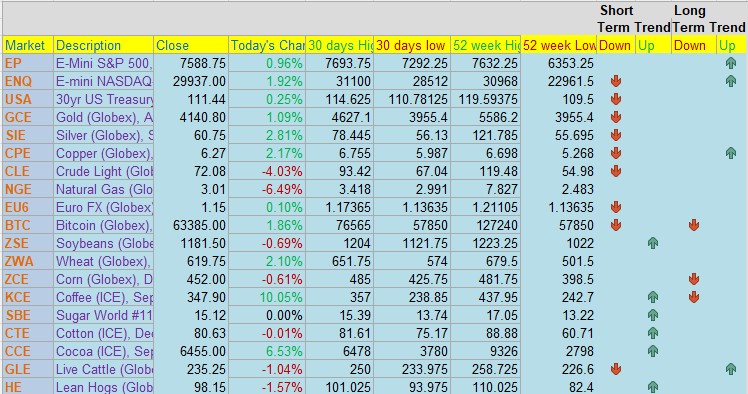
If I am a day trader, how should I use the Cannon Edge table you share daily?

day trader

  1. Highlight markets where ST = LT
  2. Decide bias (long or short)
  3. Ignore the opposite side unless extreme setup
  4. Use key levels (30-day / 52-week) as targets
  5. Execute using your intraday system
  6. Avoid markets with conflicting trends unless scalping

What the Cannon Edge Table Actually Gives You

From the screenshot, each market shows:

  • Close & Today’s Change → very short-term momentum
  • 30-day / 52-week highs & lows → key reference levels
  • Short-Term Trend (Up/Down arrows)
  • Long-Term Trend (Up/Down arrows)

In simple terms:

  • Short-term trend = tactical bias (today–this week)
  • Long-term trend = structural bias (bigger picture)
06f9487d 7016 4e5b b755 ad21e3432044

⚡ How a Day Trader Should Use It (Practical Playbook)

1. Start Every Morning with a Bias Map

Tell your client:

“The table helps you decide what side of the market you want to be on, not where to click buy or sell.”

Example from the image:

  • S&P (EP):
  • Short-term: ⬆️
  • Long-term: ⬆️
  • ✅ → Strong alignment → Look for LONGS intraday
  • Cotton (CTE):
  • Short-term: ⬆️
  • Long-term: ⬇️
  • ⚠️ → Conflict → Expect chop / quick trades only

2. Trade WITH Alignment = Higher Probability

This is the most important rule:

✅ When BOTH trends agree:

  • Focus heavily on that direction
  • Be more patient for entries
  • Hold winners longer intraday

From the table:

  • Nasdaq (ENQ): ⬆️ / ⬆️
  • Soybeans (ZSE): ⬆️ / ⬆️

These are your “A setups” markets

3. When Trends Conflict → Scalp Mode

⚠️ Short-term UP + Long-term DOWN:

  • Rally = likely resistance
  • Look for fades or quick longs only

⚠️ Short-term DOWN + Long-term UP:

  • Pullback environment
  • Look for dip buys (but not breakouts)

Example:

  • Crude Oil → short-term up, long-term down
  • Expect failed breakouts / range behavior

4. Use High/Low Levels as Intraday Targets

The table gives:

  • 30-day highs/lows
  • 52-week highs/lows

These are institutional reference points.

How a day trader uses them:

  • If price approaches:
  • 30-day high → watch for breakout or rejection
  • Prior range extremes → profit targets

Example:

  • ES near 7483.75 (52-week high)
  • → If price gets close intraday = big decision zone

5. Combine With Your Entry System (Critical)

The table does NOT replace execution tools.

Day trader should still use:

  • Order flow / DOM
  • VWAP
  • Opening range breakout
  • Support/resistance
  • Volume imbalances

The table answers: “Should I be looking long or short today?”

Your execution answers: “Where exactly do I enter?”

6. Filter Markets (Massive Edge)

A lot of traders overtrade.

Use the table to:

  • Pick 2–4 markets max
  • Focus only on those with:
  • Alignment
  • Strong daily moves
  • Clean structure

Example shortlist from your image:

  • ENQ (Nasdaq)
  • SIE (Silver)
  • ZSE (Soybeans)

7. Momentum Confirmation (Today’s Change Column)

  • Strong green + uptrend → continuation likely
  • Weak / mixed → avoid or reduce size

Example:

  • Cocoa (CCE): -4.64% → High volatility → great for fast trades but risky

July Unleaded Gasoline

The rally in July Unleaded Gasoline ran out of momentum just shy of the low percentage fourth upside PriceCount objective and activated fresh downside counts with an acceleration gap lower. Now, the char tis approaching its first objective to the 2.97 area.

6e928e12 3d48 4e73 a5f8 e7d3f8357489

The PriceCount study is a tool that can help to project the distance of a move in price. The counts are not intended to be an ‘exact’ science but rather offer a target area for the four objectives which are based off the first leg of a move with each subsequent count having a smaller percentage of being achieved.

It is normal for the chart to react by correcting or consolidating at an objective and then either resuming its move or reversing trend. Best utilized in conjunction with other technical tools, PriceCounts offer one more way to analyze charts and help to manage your positions and risk.

Learn more at www.qtchartoftheday.com

Trading in futures, options, securities, derivatives or OTC products entails significant risks which must be understood prior to trading and may not be appropriate for all investors. Past performance of actual trades or strategies is not necessarily indicative of future results.

Cannon Edge — Your Daily Futures Snapshot for May 28th

06f9487d 7016 4e5b b755 ad21e3432044

Daily Levels for May 28th

127413d8 f524 4f2c b208 1360c953d8c5

Economic Reports

provided by: ForexFactory.com

All times are Central Time ( Chicago)

7f00434d 1ab8 4e34 b923 ad2221496545

Find us on Trustpilot

41a3c910 28d6 4126 946b 6659bb02ae4d

Trading Futures, Options on Futures, and retail off-exchange foreign currency transactions involves substantial risk of loss and is not suitable for all investors. You should carefully consider whether trading is suitable for you in light of your circumstances, knowledge, and financial resources. You may lose all or more of your initial investment. Opinions, market data, and recommendations are subject to change at any time.

Join our Private Facebook group

Subscribe to our YouTube Channel

Listen to our podcast: Subscribe on AppleSpotify, Amazon

or wherever you listen to podcasts!

S
Facebook  Instagram  LinkedIn
S
ef3ab1c9 8d6d 4e60 a3f1 af5d9d4ecbb3
Services
Software
Tools
Community
Contact

Add price confirmation workflow for signal-based intraday trading PLUS: Pre-Market Briefing PODCAST, July Coffee, CannonEdge Snapshot, Levels, Reports; Your 6 Important Can’t-Miss Need-To-Knows for Trading Futures on May 27th, 2026

9dc1e02e d5f7 4ff4 abf7 1df60775f196

At A Glance Levels

Instrument S2 S1 Pivot R1 R2

Gold (GC)

— June (#GC)

4420.60 4464.50 4523.90 4567.80 4627.20

Silver (SI)

— July. (#SI)

73.96 75.66 77.45 79.15 80.94

Crude Oil (CL)

— July. (#CL)

87.26 90.40 92.55 95.69 97.84

 June Bonds (ZB)

— June. (#ZB)

111  6/32 111 21/32 112 4/32 112 19/32 113 2/32

Add price confirmation workflow for signal-based intraday trading

intraday

Overview

  • Introduces a price confirmation concept for intraday/day trading workflows so signals are not acted on immediately.
  • The core behavior is to wait for the market to respect the signal before entering:
  • For a sell signal, confirm by breaking below the previous bar low.
  • For a buy signal, confirm by breaking above the previous bar high.
  • Helps filter out weak or premature signals and encourages more patient trade selection.
  • Demonstrates how the signal indicator can be paired with additional visual context, including:
  • Color Bars turning red/blue/black to help identify trend continuation or weakening momentum.
  • Trailing-stop management once the trend begins to fade or reverse.
  • Reinforces that the trader still needs to manage:
    • position size
    • stops
    • targets
    • trade exits
  • Includes a practical example on a 10-minute Nasdaq futures chart showing both a failed signal without confirmation and a successful trade after confirmation.
  • used as a discretionary visual aid and not as a hard entry/exit requirement.
  • This workflow is meant for educational or discretionary trading use and does not guarantee profitability.

Watch Video below and sign up for a free trial HERE

Price Confirmation
127efd5c bf86 4107 97e6 7fb0c45b7c50

July Coffee

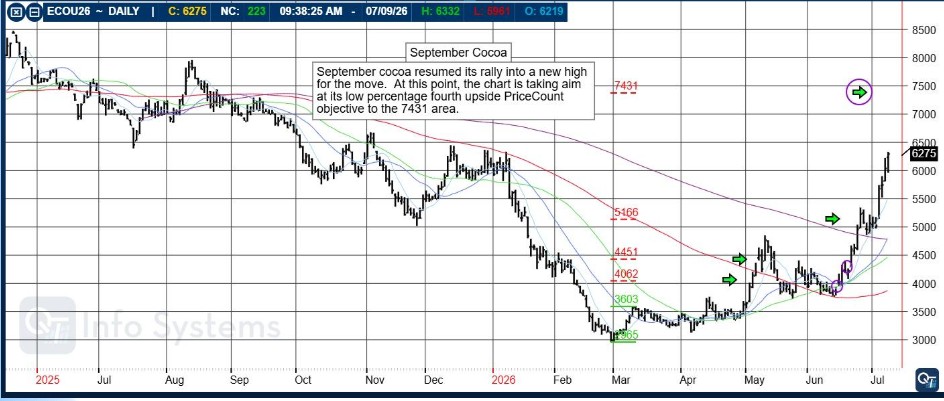
July Coffee satisfied the second downside PriceCount objective and is showing some stability. At this point, IF the chart can resume its break with new sustained lows, the third count would project a possible slide to the 215.65 area.

2c7de134 7586 4c1b 8f80 5935a8d96b00

The PriceCount study is a tool that can help to project the distance of a move in price. The counts are not intended to be an ‘exact’ science but rather offer a target area for the four objectives which are based off the first leg of a move with each subsequent count having a smaller percentage of being achieved.

It is normal for the chart to react by correcting or consolidating at an objective and then either resuming its move or reversing trend. Best utilized in conjunction with other technical tools, PriceCounts offer one more way to analyze charts and help to manage your positions and risk.

Learn more at www.qtchartoftheday.com

Trading in futures, options, securities, derivatives or OTC products entails significant risks which must be understood prior to trading and may not be appropriate for all investors. Past performance of actual trades or strategies is not necessarily indicative of future results.

Cannon Edge — Your Daily Futures Snapshot for May 27th

580518f5 8c53 470a a7e6 fcab67d15e68

Daily Levels for May 27th

041a53eb e871 4919 9d15 73b1fe919b13

Economic Reports

provided by: ForexFactory.com

All times are Central Time ( Chicago)

60a8ee2d f7bb 4f87 b639 97954c8638ff

Find us on Trustpilot

41a3c910 28d6 4126 946b 6659bb02ae4d

Trading Futures, Options on Futures, and retail off-exchange foreign currency transactions involves substantial risk of loss and is not suitable for all investors. You should carefully consider whether trading is suitable for you in light of your circumstances, knowledge, and financial resources. You may lose all or more of your initial investment. Opinions, market data, and recommendations are subject to change at any time.

Join our Private Facebook group

Subscribe to our YouTube Channel

Listen to our podcast: Subscribe on AppleSpotify, Amazon

or wherever you listen to podcasts!

S
Facebook  Instagram  LinkedIn
S
ef3ab1c9 8d6d 4e60 a3f1 af5d9d4ecbb3
Services
Software
Tools
Community
Contact

Futures Trading Signals

futures trading signals

Technical Analysis Tools for Day Traders


futures trading signals

futures trading signals

Day trading in the futures markets requires speed, discipline, and access to powerful analytical tools. Traders rely on technical analysis to interpret price behavior, anticipate market movements, and execute trades efficiently. With modern platforms and brokerage technology evolving rapidly, traders now have access to highly advanced analytics that were once limited to institutional desks.

Understanding the best technical analysis tools can help traders make informed decisions while managing risk. When combined with strong brokerage infrastructure, these tools enable traders to identify opportunities, refine strategies, and deploy sophisticated futures algorithmic trading strategies.

Cannon Trading Company has been supporting traders for decades by providing cutting-edge platforms, advanced analytics, and direct access to futures markets. With a reputation built on reliability and technology, Cannon Trading Company continues to be a leading brokerage for traders seeking professional-grade trading tools.

Core Charting Platforms for Day Traders

Charting software remains the foundation of technical analysis. Futures traders rely on detailed charts to identify trends, entry points, and momentum shifts.

High-quality platforms allow traders to combine multiple indicators, overlays, and timeframes within a single workspace.

Top charting capabilities include:

  1. Multi-timeframe chart analysis
    Traders can simultaneously view 1-minute, 5-minute, and hourly charts. This layered view improves accuracy when interpreting futures trading signals.
  2. Custom indicator stacking
    Modern platforms allow several futures trading indicators to run simultaneously without slowing execution speed.
  3. Volume and liquidity visualization
    Futures markets often show strong volume patterns. Visualizing volume alongside price action enhances decision making.
  4. Template creation
    Traders can build custom chart templates that automatically load preferred futures trading indicators.

Common charting tools used by professionals include:

  • Depth-of-market chart overlays
  • Volume profile charts
  • Candlestick pattern recognition
  • Order flow visualization

A brokerage like Cannon Trading Company ensures traders can access professional charting platforms with fast data feeds and reliable connectivity.

Moving Averages and Trend Detection Tools

Trend analysis is essential for day traders operating in fast-moving futures markets.

Moving averages help identify the prevailing direction of price movement while filtering out market noise.

Important moving average tools include:

  • Simple Moving Average (SMA)
  • Exponential Moving Average (EMA)
  • Weighted Moving Average
  • Moving Average Convergence Divergence (MACD)

These tools assist traders in confirming futures trading signals when price crosses key averages.

For example, when a short-term EMA crosses above a longer-term average, traders may interpret this as bullish momentum.

Many traders integrate moving averages into futures algorithmic trading strategies because they provide systematic rules for automated trading systems.

Advanced platforms allow traders to:

  1. Backtest moving average strategies
  2. Combine averages with momentum indicators
  3. Create automated triggers based on price crossover

These features are especially useful when traders want to convert discretionary strategies into automated systems.

Momentum Indicators for Intraday Opportunities

Momentum indicators help traders measure the speed and strength of price movements.

These tools are critical when identifying short-term opportunities in futures markets.

Popular momentum tools include:

  • Relative Strength Index (RSI)
  • Stochastic Oscillator
  • Commodity Channel Index (CCI)
  • Rate of Change indicator

These indicators are commonly used to detect overbought and oversold market conditions.

For example:

  • RSI above 70 may indicate overbought conditions
  • RSI below 30 may suggest oversold conditions

When paired with other futures trading indicators, these tools help confirm trade setups.

Professional traders often combine momentum tools with price action to filter unreliable futures trading signals.

Momentum indicators are also integrated into many futures algorithmic trading strategies because they produce quantifiable rules that can be programmed into trading systems.

Volume Analysis and Order Flow Tools

Volume is one of the most important metrics in futures trading.

According to data published by the CME Group, futures markets generate significant liquidity across global asset classes including equities, energy, agriculture, and interest rates.

Volume tools help traders understand where institutional activity is concentrated.

Key volume analysis tools include:

  1. Volume profile charts
  2. Footprint charts
  3. Time and sales analysis
  4. Order flow heat maps

These tools allow traders to see where large market participants are placing orders.

Advantages of order flow analysis include:

  • Identifying support and resistance levels
  • Detecting hidden liquidity
  • Validating futures trading signals with real market activity

Many professional traders incorporate these insights into futures algorithmic trading strategies to capture short-term price inefficiencies.

Volume-based futures trading indicators also help traders avoid false breakouts.

Algorithmic Trading Tools for Advanced Traders

Algorithmic trading has become increasingly popular among futures traders.

Automated systems allow traders to execute strategies with speed and consistency.

Platforms supported by professional brokerages often include tools for designing and deploying automated strategies.

Key features include:

  • Strategy backtesting engines
  • Custom scripting languages
  • Automated trade execution systems
  • Historical data analysis

Common components used in futures algorithmic trading strategies include:

  1. Moving average crossovers
  2. Momentum-based entry signals
  3. Volatility filters
  4. Risk management rules

Algorithmic systems process market data continuously, generating futures trading signals based on predefined rules.

These systems rely heavily on reliable futures trading indicators to trigger trades.

Professional traders often use algorithms to remove emotional bias and maintain consistent execution.

With proper development, automated systems can operate across multiple futures contracts simultaneously.

Risk Management Tools and Technical Filters

Risk management is a critical component of successful day trading.

Even the most accurate futures trading signals cannot eliminate risk entirely.

Technical filters help traders control exposure while improving strategy reliability.

Important risk tools include:

  • Average True Range (ATR) for volatility measurement
  • Bollinger Bands for volatility expansion detection
  • Support and resistance levels
  • Position sizing calculators

These tools help traders determine optimal stop-loss levels and profit targets.

For example:

  1. ATR can determine logical stop distance based on current volatility
  2. Bollinger Bands highlight potential breakout conditions
  3. Support levels help confirm futures trading signals

Many traders incorporate these filters into futures algorithmic trading strategies to ensure consistent risk parameters.

This structured approach allows traders to maintain discipline even during volatile market conditions.

How Your Broker Enhances Technical Analysis Tools

A trader’s brokerage plays a major role in the effectiveness of technical analysis.

Even the best indicators require reliable market data and fast execution infrastructure.

Cannon Trading Company provides traders with professional-grade trading technology designed specifically for the futures markets.

Key advantages of working with a specialized futures broker include:

  • Direct connectivity to futures exchanges
  • Access to advanced trading platforms
  • Institutional-level market data feeds
  • Dedicated support from experienced brokers

Cannon Trading Company works closely with traders to ensure they can maximize their platform capabilities.

The brokerage also supports a wide range of futures trading indicators and technical tools across multiple trading platforms.

This flexibility allows traders to build customized workspaces tailored to their individual strategies.

For traders developing futures algorithmic trading strategies, having access to robust technology infrastructure is especially important.

Cannon Trading Company offers connectivity solutions that support automated trading environments and advanced analytics.

Why Cannon Trading Company Remains a Top Futures Broker

Cannon Trading Company has built a strong reputation in the futures industry over several decades.

The brokerage has consistently focused on providing traders with powerful tools, reliable technology, and personalized client support.

Several factors contribute to Cannon Trading Company’s reputation among professional futures traders.

Key strengths include:

  1. Decades of industry experience
    Cannon Trading Company has supported traders through multiple market cycles.
  2. Advanced trading technology
    Traders can access sophisticated platforms designed for professional futures trading.
  3. Competitive pricing and execution
    Fast order routing helps traders capitalize on futures trading signals quickly.
  4. Dedicated trader support
    Experienced brokers assist clients in optimizing their technical analysis tools.

Platforms supported by Cannon Trading Company provide a wide range of futures trading indicators and advanced analytics.

This allows traders to experiment with both discretionary methods and futures algorithmic trading strategies.

Many traders also value the brokerage’s commitment to education and long-term client relationships.

For traders seeking a reliable partner in the futures markets, Cannon Trading Company remains a trusted choice.

Technical analysis tools are essential for modern day traders in the futures markets.

From charting platforms and momentum indicators to volume analysis and algorithmic trading systems, these tools help traders interpret price behavior and identify opportunities.

Successful traders combine multiple analytical methods to validate futures trading signals while maintaining strict risk management.

Futures trading indicators play a vital role in structuring disciplined strategies.

Meanwhile, futures algorithmic trading strategies allow traders to automate execution and scale their trading operations.

Equally important is the choice of brokerage.

Cannon Trading Company continues to stand out as a leading futures broker thanks to its technology, infrastructure, and long-standing commitment to traders.

By combining advanced tools with strong brokerage support, traders can better navigate the complexities of modern futures markets.

FAQ

What are technical analysis tools in futures trading?

Technical analysis tools help traders analyze price charts and market data to identify trends and trade opportunities. These tools include charting software, futures trading indicators, volume analysis tools, and algorithmic trading systems.

How do futures trading indicators help day traders?

Futures trading indicators help traders identify patterns, measure momentum, and detect trend changes. By combining several indicators, traders can generate reliable futures trading signals.

What are futures trading signals?

Futures trading signals are trade alerts generated by indicators, chart patterns, or automated systems. These signals guide traders on potential entry and exit points in the market.

What are futures algorithmic trading strategies?

Futures algorithmic trading strategies use automated systems that follow predefined trading rules. These strategies analyze market data and execute trades automatically when conditions are met.

Why choose Cannon Trading Company for futures trading?

Cannon Trading Company provides professional trading platforms, advanced technical tools, and decades of experience supporting futures traders. Their infrastructure helps traders efficiently deploy futures trading indicators and futures algorithmic trading strategies.

Try a FREE Demo!

Ready to start trading futures? Call us at 1(800)454-9572 (US) or (310)859-9572 (International), or email info@cannontrading.com to speak with one of our experienced, Series-3 licensed futures brokers and begin your futures trading journey with Cannon Trading Company today.

Disclaimer: Trading Futures, Options on Futures, and retail off-exchange foreign currency transactions involve substantial risk of loss and are not suitable for all investors. Past performance is not indicative of future results. Carefully consider if trading is suitable for you in light of your circumstances, knowledge, and financial resources. You may lose all or more of your initial investment. Opinions, market data, and recommendations are subject to change at any time.

Important: Trading commodity futures and options involves a substantial risk of loss. The recommendations contained in this article are opinions only and do not guarantee any profits. This article is for educational purposes. Past performances are not necessarily indicative of future results.

This article has been generated with the help of AI Technology and modified for accuracy and compliance.

Follow us on all socials: @cannontrading


Institutional Futures Trading Platforms

institutional futures trading platforms

Agriculture Commodities: Corn and Soybean Tips


institutional futures trading platforms

institutional futures trading platforms

Corn and soybean futures remain two of the most actively traded agricultural commodities in the global derivatives market. These contracts provide traders, farmers, and institutions with powerful tools to hedge risk, speculate on price movements, and manage agricultural exposure.

Successful agriculture trading requires knowledge, discipline, and access to reliable brokerage infrastructure. Working with a professional futures broker—especially one connected to advanced institutional futures trading platforms—can dramatically improve execution quality and trading insights.

At the same time, traders must manage costs carefully. Many experienced market participants prefer top-rated futures brokers with volume-based commission rebates, because reduced trading costs significantly improve long-term profitability.

Cannon Trading Company has built a reputation over decades as one of the most respected futures brokerages in the industry. Through its technology, client service, and experience in agricultural markets, the firm helps traders navigate corn and soybean futures with precision and confidence.

Corn and Soybean Futures Markets

Corn and soybean futures are traded primarily on the Chicago Board of Trade (CBOT), part of CME Group. These contracts allow traders to speculate on price changes or hedge physical agricultural exposure.

Several factors drive price volatility:

  • Weather conditions across the U.S. Midwest
    • Global demand for feed and biofuels
    • Export policies and trade agreements
    • Crop yield forecasts from USDA reports
    • Currency fluctuations affecting exports

Because these variables constantly change, traders need strong analytics and execution tools. Access to institutional futures trading platforms allows market participants to monitor order flow, depth of market data, and liquidity conditions in real time.

Professional futures brokers help traders interpret these signals. They assist with understanding contract specifications, margin requirements, and seasonal trading patterns unique to corn and soybean markets.

Key Corn Trading Tips for Futures Traders

Corn futures have long been one of the most liquid agricultural contracts in the world. However, the market often reacts sharply to supply disruptions or government reports.

Consider these important strategies:

  1. Monitor USDA Reports Closely
    Reports such as WASDE and Crop Progress frequently trigger volatility in corn futures.
  2. Track Ethanol Demand
    Corn demand is heavily tied to ethanol production levels.
  3. Watch Weather Patterns
    Droughts or excessive rainfall in the Midwest can dramatically impact supply expectations.
  4. Understand Seasonal Patterns
    Corn prices often move differently during planting, growing, and harvest seasons.

A professional broker can help traders implement these strategies efficiently using institutional futures trading platforms, which provide advanced charting, algorithmic tools, and fast order routing.

Experienced traders also appreciate working with top-rated futures brokers with volume-based commission rebates, because active corn trading often involves multiple entries and exits throughout a session.

Soybean Trading Strategies and Market Insights

Soybeans are another cornerstone of the agricultural futures market. Demand from livestock feed producers and global importers—particularly China—makes soybean futures highly responsive to global economic developments.

Successful soybean trading often involves combining several analytical approaches:

  • Technical analysis of support and resistance levels
    • Monitoring global soybean export flows
    • Tracking crush margins and soybean oil demand
    • Studying crop yield projections and acreage reports

High-quality market data plays a major role in identifying opportunities. Brokers that offer institutional futures trading platforms enable traders to analyze volume profiles, market depth, and institutional activity.

Professional brokers also guide clients through soybean spread strategies. For example, traders may trade soybean crush spreads or inter-commodity spreads involving soybean oil and soybean meal.

When implementing these strategies frequently, traders benefit from working with top-rated futures brokers with volume-based commission rebates, which lower transaction costs across multiple trades.

How a Futures Broker Helps Agriculture Traders

Many retail traders underestimate how much value a professional broker can add to agriculture trading.

A knowledgeable broker offers several advantages:

  1. Technology Access
    Clients receive professional-grade trading software used across institutional futures trading platforms.
  2. Execution Support
    Brokers assist with trade routing, stop orders, and contingency planning during volatile markets.
  3. Market Insights
    Experienced brokers track developments from CME agricultural reports and provide timely updates.
  4. Risk Management Guidance
    Brokers help clients size positions appropriately and manage margin requirements.
  5. Strategy Development
    Traders can discuss ideas for spreads, hedging strategies, and seasonal patterns.

Lower commissions also play an important role. Many agriculture traders execute high volumes, so working with top-rated futures brokers with volume-based commission rebates helps maintain consistent profitability.

Cost Efficiency and Commission Advantages

Transaction costs accumulate quickly in futures trading.

Corn and soybean traders may execute dozens—or even hundreds—of trades per month. Without competitive pricing, these costs significantly impact performance.

This is why experienced traders seek top-rated futures brokers with volume-based commission rebates.

These programs reward active traders by reducing per-contract costs as trading volume increases.

For agriculture traders, cost savings create multiple advantages:

  • Greater flexibility to scale trading strategies
    • Improved profitability on short-term trades
    • Lower barriers for hedging multiple crop positions

By partnering with a broker offering strong rebate programs, traders maintain competitive cost structures while accessing professional trading tools.

Why Cannon Trading Company Stands Out

Cannon Trading Company has supported futures traders for decades. The firm has earned recognition from traders across the industry for reliability, transparency, and technology access.

Several factors contribute to Cannon Trading’s reputation.

  1. Advanced Technology

Clients gain access to some of the most powerful institutional futures trading platforms, including systems used by professional and institutional market participants.

  1. Deep Agricultural Market Expertise

The brokerage has long experience assisting traders with corn, soybean, wheat, and other agricultural futures listed through CME markets.

  1. Client-Focused Service

Unlike many large brokerage firms, Cannon Trading offers personalized support. Traders can speak directly with knowledgeable brokers who understand agriculture markets.

  1. Competitive Pricing

Cannon Trading ranks among top-rated futures brokers with volume-based commission rebates, offering competitive pricing for active traders.

  1. Trusted Industry Reputation

Reviews across platforms such as Trustpilot highlight the firm’s long-standing commitment to trader success.

For traders seeking a brokerage that combines experience, service, and advanced technology, Cannon Trading continues to stand out.

Risk Management Tips for Corn and Soybean Traders

Agriculture markets can experience sudden volatility due to weather events, geopolitical developments, or supply shocks.

Effective risk management is essential.

Consider these key practices:

  • Always use stop-loss orders when trading futures.
    • Avoid over-leveraging positions relative to account size.
    • Track margin requirements carefully during volatile periods.
    • Diversify strategies across different agricultural contracts.

Professional brokers assist traders in implementing these protections through institutional futures trading platforms, which allow advanced order management and automated risk controls.

Active traders also reduce financial pressure by working with top-rated futures brokers with volume-based commission rebates, ensuring costs remain manageable even during high-volume trading periods.

Corn and soybean futures remain among the most dynamic markets in agriculture. Their liquidity, global importance, and volatility provide both hedging opportunities and speculative potential.

However, success requires more than simply predicting price direction.

Traders must combine:

  • Reliable market data
    • Efficient trade execution
    • Effective cost management
    • Professional broker support

Working with a brokerage that offers institutional futures trading platforms gives traders access to the same advanced tools used by professional market participants.

At the same time, selecting top-rated futures brokers with volume-based commission rebates ensures that trading costs remain competitive.

For decades, Cannon Trading Company has delivered these advantages to traders worldwide, helping clients navigate agricultural markets with confidence and precision.

FAQ: Corn and Soybean Futures Trading

What exchange lists corn and soybean futures?

Corn and soybean futures are listed on the Chicago Board of Trade (CBOT), which operates under CME Group.

Why are corn and soybean futures so actively traded?

These commodities are central to global agriculture and food production, making them essential for hedging and speculation.

How can a futures broker help agriculture traders?

A broker provides access to trading technology, market insights, and execution support while helping traders manage risk and margin requirements.

What platforms do professional traders use?

Many professionals rely on institutional futures trading platforms that provide advanced charting, order routing, and market data tools.

Why do commission rebates matter in futures trading?

Active traders benefit from working with top-rated futures brokers with volume-based commission rebates, because reduced transaction costs significantly improve overall profitability.

Try a FREE Demo!

Ready to start trading futures? Call us at 1(800)454-9572 (US) or (310)859-9572 (International), or email info@cannontrading.com to speak with one of our experienced, Series-3 licensed futures brokers and begin your futures trading journey with Cannon Trading Company today.

Disclaimer: Trading Futures, Options on Futures, and retail off-exchange foreign currency transactions involve substantial risk of loss and are not suitable for all investors. Past performance is not indicative of future results. Carefully consider if trading is suitable for you in light of your circumstances, knowledge, and financial resources. You may lose all or more of your initial investment. Opinions, market data, and recommendations are subject to change at any time.

Important: Trading commodity futures and options involves a substantial risk of loss. The recommendations contained in this article are opinions only and do not guarantee any profits. This article is for educational purposes. Past performances are not necessarily indicative of future results.

This article has been generated with the help of AI Technology and modified for accuracy and compliance.

Follow us on all socials: @cannontrading


The Week Ahead – CRUDE OIL, Memorial Day, Earnings, Middle East Smoke Clearing? PLUS: Memorial Day Trading Schedule, Futures 102 – The Daily Briefing – What the Pros Know Before Trading, December Cotton Chart & Outlook, Cannon Edge Snapshot, Levels, Reports; Your 8 Important Cant’-Miss Need-To-Knows Before Trading Futures the Week of May 25th, 2026

7cfe5b36 db9f 4933 824a 7f264613e7fe

Cannon Futures Weekly Letter

In Today’s Issue #1291

  • The Week Ahead – Memorial Day, Earnings, Middle East Smoke Clearing?

  • Memorial Day Trading Schedule

  • Futures 102 – The Daily Briefing – What the Pros Know Before Trading

  • December Cotton Chart & Outlook

  • Cannon Edge – Your Futures trading Map for the week ahead!

  • Trading Levels for Next Week
  • Trading Reports for Next Week

At A Glance Levels

Instrument S2 S1 Pivot R1 R2

Gold (GC)

— June (#GC)

4451.17 4498.13 4535.27 4582.23 4619.37

Silver (SI)

— July. (#SI)

73.64 75.36 76.42 78.15 79.21

Crude Oil (CL)

— July. (#CL)

91.72 94.59 98.62 101.49 105.52

 June Bonds (ZB)

— June. (#ZB)

108 21/32 109 1/32 109 8/32 109 20/32 109 27/32

What Futures Traders Should Watch This Week

By John Thorpe, Senior Broker

Memorial Day Monday-Honoring those who have given the ultimate sacrifice, since 1868.

Cannon Trading wishes everyone a safe and memorable holiday weekend!

For all of the energy traders who follow here, some of the standard weekly reports that you count on have shifted. The Tuesday afternoon weekly API Crude Stock change will be Wednesday afternoon,

The EIA Crude Oil stocks report is being moved to Thursday @ 11:00 am, this will be after the normally scheduled EIA Nat. Gas report @ 9:30 am.

oil

For all the Metals and Interest rate traders, please roll out of your June positions to the deferred months. Reason? First notice of delivery is Friday,

As for Data? Core PCE and GDP estimates are worth paying attention to.

Under the Bull or Bear category.

We can trade either side of the market and prepare for volatility. On Tuesday, reach out to your broker for trading ideas. Bull or Bear, you really shouldn’t care.

Is the smoke clearing in the Mid-East and the markets have a renewed sense of confidence?

The energy and metals are swirling in the uncertainty of a lack of resolution in the attempted unwinding of the Iranian nuclear program.

Don’t let your guard down just yet, the fog continues, tune into the Sunday evening markets to witness reactions to the weekend news streams, manufactured or true.

Plan your trade and trade your plan!

Earnings Next Week:

·        Mon. Quiet~Memorial Day

·        Tue. Zscaler, Modine Manufacturing

·        Wed. SalesForce, PDD Holdings, Agilent

·        Thu. Dell, Autodesk, DollarTree

·        Fri.  Buckle

FED SPEECHES: (all times CDT)

·        Mon. Quiet~Memorial Day

·        Tues.  Quiet

·        Wed. Quiet

·        Thu.  Quiet

·        Fri.  Quiet

Econ Data:

·        Mon. Quiet Memorial Day

·        Tue. Chicago Fed Activity Index, S&P/ Case Schiller Home Price, CB Consumer Confidence, Dallas Fed Manufacturing Index, API Crude Stock Change

·        Wed. ADP Employment Change Weekly, Redbook, Richmond Fed, Dallas Fed, API Crude stock Change

·        Thu.  Core PCE, Durable Goods, GDP Growth 2nd estimate, Initial Jobless claims, New Home sales, EIA Nat Gas Stocks 9:30 am CDT, EIA Crude Stocks 11:00 am CDT, consumer credit change

·        Fri. Retail Inventories, Wholesale Inventories, CHGO PMI, Baker Hughes Oil Rig Count

image 12

Memorial Day (Mon, May 25th) Holiday Trading Schedule:

Interest Rates

Sunday – 5:00 PM CT Open

Monday – 12:00 PM CT Halt

5:00 PM CT Re-Open

Energy

Sunday – 5:00 PM CT Open

Monday – 1:30 PM CT Halt

5:00 PM CT Re-Open

Equities

Sunday – 5:00 PM CT Open

Monday – 12:00 PM CT Halt

5:00 PM CT Re-Open

Grains

Sunday – Closed

Monday – Closed

7:00 PM CT Re-Open

FX

Sunday – 5:00 PM CT Open

Monday – 4:00 PM CT Close

5:00 PM CT Re-Open

Metals

Sunday – 5:00 PM CT Open

Monday – 1.30 PM CT Halt

5:00 PM CT Re-Open

Livestock

Monday – Closed

Tuesday 8:30 AM CT Re-Open

Dairy

Monday – Closed

5:00 PM CT Re-Open

Cryptocurrencies

Sunday – 5:00 PM CT Open

Monday – 4:00 PM CT Close

5:00 PM CT Re-Open

Sugar, Coffee, Cotton, Cocoa, FCOJ

Monday – Closed

Tuesday – Regular Hours

Canola

Monday – Regular Hours

U.S. Dollar Index

Monday – Regular Hours

Click IMAGE BELOW FOR FULL DETAILS AND LARGER IMAGE

4517054d e684 4c3f 96b6 85b17dca6afa
8967d0dc 1211 44c4 b037 44c6a19c3147

Futures 102: The Daily Briefing by Cannon

Every morning, the world’s biggest banks and macro strategists publish where markets are headed. The rest of the world waits for the headline.

That intelligence stays locked inside trading desks, institutional terminals, and private client portals — accessible only to the few who pay for the privilege, and even they only get what they pay for.

This briefing changes that (100% FREE on Cannon’s website!!). Every morning we scour the open web and aggregate everything that matters — pulling from publicly available sources so you never have to — and distill it into one clear, readable edition you can get through before your first coffee is finished.

No terminals. No subscriptions. No private portals. Just everything the market is saying, gathered in one place, every morning before the bell.

Read the Latest Briefing HERE and make sure to Bookmark this page!

December Cotton

December Cotton satisfied its low percentage fourth upside PriceCount objective this month. Now, on the correction lower the chart is activating downside counts. The first objective points a possible slide to the 74.78 area.

4ec7447f 660d 4760 8304 b0eaa72c5837

The PriceCount study is a tool that can help to project the distance of a move in price. The counts are not intended to be an ‘exact’ science but rather offer a target area for the four objectives which are based off the first leg of a move with each subsequent count having a smaller percentage of being achieved.

It is normal for the chart to react by correcting or consolidating at an objective and then either resuming its move or reversing trend. Best utilized in conjunction with other technical tools, PriceCounts offer one more way to analyze charts and help to manage your positions and risk.

Learn more at www.qtchartoftheday.com

Trading in futures, options, securities, derivatives or OTC products entails significant risks which must be understood prior to trading and may not be appropriate for all investors. Past performance of actual trades or strategies is not necessarily indicative of future results.

FREE TRIAL TO QT MARKET Center – Access to analysis, tools, news & much more!

Highly recommended for HEDGERS!

1ab82322 3fe6 467c 8a06 58a08d52f845

Cannon Edge — Your Daily Futures Insight for the Next Trading Day! Cannon Edge for May 25-26th 2026

8bb15f48 9100 4d5b 8c0f 02d21709fc4c

Cannon Edge is our new daily feature designed to give traders a fast, actionable overview of key futures markets. Each post delivers:

  • Current price and daily % change
  • 30‑day and 52‑week highs/lows
  • PROPRIETARY Short‑term and long‑term trend signals
  • Coverage across equity indices, metals, energies, currencies, and ags

Whether you’re scanning for breakout setups, trend reversals, or just staying informed — Cannon Edge puts the data in your hands before the open.

Built for speed. Backed by insight. Powered by CQG.

Would you like to get weekly updates on real-time, results of systems mentioned above?

Daily Levels for May 25-26th 2026

e154a8fc 1c96 4588 b0df b9a16cbd0fb7
Would you like to receive daily support & resistance levels?

Trading Reports for Next Week

First Notice (FN), Last trading (LT) Days for the Week:

www.mrci.com

adbe29a0 f645 485c 91f4 9608a3bbb4c5

Find us on Trustpilot

4ad8134c aa57 4adb a428 7cc476773107

Trading Futures, Options on Futures, and retail off-exchange foreign currency transactions involves substantial risk of loss and is not suitable for all investors. You should carefully consider whether trading is suitable for you in light of your circumstances, knowledge, and financial resources. You may lose all or more of your initial investment. Opinions, market data, and recommendations are subject to change at any time.

Join our Private Facebook group

Subscribe to our YouTube Channel

Listen to our podcast: Subscribe on AppleSpotify, Amazon

or wherever you listen to podcasts!

S
Facebook  Instagram  LinkedIn
S
ef3ab1c9 8d6d 4e60 a3f1 af5d9d4ecbb3
Services
Software
Tools
Community
Contact