Recognizing Different Types of Trading Days & Levels 10.22.2014

Hello Traders,

For 2014 I would like to wish all of you discipline and patience in your trading!


Are we done? Was this the correction everyone was afraid of and that’s it?

Only the future can tell but interesting to look at the daily chart below of the mini SP 500. We bounced OVER 100 points from the lows!!! But I still need to see if we can break above the 1946 level marked on the chart….


Another interesting point is that this rally is on much lower volume than the sell off, but then again this has been the story in the “minor corrections” we had during the last several years.


Not sure if this one is any different and we are heading back to test new highs…my “emotions/gut” says this one has a bigger chance of being a more serious correction than the ones we have seen before but my “trading brain” says that statistically odds are in favor of resumption in the rally…

Continue reading “Recognizing Different Types of Trading Days & Levels 10.22.2014”

Crude Oil & Gold Futures Renko Charts; Economic Reports & Levels 10.08.2014

Hello Traders,

For 2014 I would like to wish all of you discipline and patience in your trading!


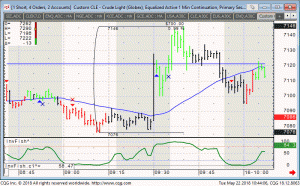
Another two markets I like to touch on when it comes to “other markets to daytrade beside the mini SP 500” are Crude Oil Futures and Gold futures.


More than a few similarities between the two markets.


They are both volatile, can move VERY fast. I have seen some very large moves happen in matter of minutes if not seconds. The “fear & greed” factor really plays a role in these specific two markets.

Both have active trading hours starting with Far East trading around 10 PM est all the way to the next morning until about 3 PM est. Good volume generally speaking but not close to the mini SP or ten year notes. So you may see some slippage on stops but the volume is more than enough to trade size.

Each tick on gold is $10, so every dollar move =$100 against you or in your favor. Crude is similar, each tick = $10. One full $1 move = $1000.

Continue reading “Crude Oil & Gold Futures Renko Charts; Economic Reports & Levels 10.08.2014”

Market News, Futures Level & Economic Reports 10.07.2014

Hello Traders,

For 2014 I would like to wish all of you discipline and patience in your trading!


True to my Monday tradition, I am sharing some of the news/ factors affecting the markets this week:TradeTheNews.com Weekly Market Update: Markets Shake Off Ebola, Hong Kong Flu, and ECB’s Dubious Prescription

The contrast between US economic strength and Europe’s deflationary headache got even stronger this week. On Thursday, ECB President Draghi outlined his asset purchase plan but left investors with the impression that the program would be too little to beat deflation. Draghi said the ECB’s balance sheet would grow back toward €3 trillion compared to near €2 trillion today, suggesting that the potential universe of covered bond and ABS purchases is up to €1 trillion. Meanwhile, the September non-farm payrolls was +248K complemented by a combined 69K in upward revisions to July and August data. The unemployment rate declined from 6.1% in August to 5.9%, the lowest level since July 2008. The only sour notes were that wage growth was still pretty weak and labor force participation slipped lower. In China, the Occupy Central protest movement took over downtown Hong Kong, driving big sequential declines on the Hang Seng early in the week. The bourse closed for two days of holidays, fell 2% in early trading on Friday and then closed higher. There are real fears that Beijing will not tolerate much more unrest in the city. For the week, the DJIA slipped 0.6%, the S&P500 lost 0.8% and the Nasdaq fell 0.8%. Continue reading “Market News, Futures Level & Economic Reports 10.07.2014”

Futures Levels & Economic Reports for 7.17.2014

Connect with Us! Use Our Futures Trading Levels and Economic Reports RSS Feed.

Like us on FacebookFollow us on TwitterView our profile on LinkedInFind us on Google+Cannon Trading Futures Trading Resistance & Support Levels and Economic ReportsFind us on Yelp

1. Market Commentary
2. Futures Support and Resistance Levels – S&P, Nasdaq, Dow Jones, Russell 2000, Dollar Index
3. Commodities Support and Resistance Levels – Gold, Euro, Crude Oil, T-Bonds
4. Commodities Support and Resistance Levels – Corn, Wheat, Beans, Silver
5. Futures Economic Reports for Thursday July 17, 2014

Hello Traders,

For 2014 I would like to wish all of you discipline and patience in your trading!

 In the last few days we witnessed “summer trading” with low volume which encouraged me to share the following with you on the different types of trading days:

  • In my opinion there are 3 main types of trading days.

1. The most common day are two sided trading action with swings up and down – this type of trading day is most suitable for using support and resistance levels along with overbought/oversold indicators.

2. Strong trending days, mostly one directional – this type of trading day is the least common, many times will happen on Mondays and maybe 3-5 times a month at most – this type of trading day is most suitable for using ADX, MACD crossovers and pretty much looking for pullbacks to jump on the trend.

3. Slow and/or choppy trading days – this type of trading day is best suited for taking small profits from the market by looking at volume spikes, using stochastics as possible entry signals and usually wait for a pullback before jumping in.

  • A good question I’ve been asked is how can one asses what type of trading day we will have while the market is still trading….I have been doing some work in finding the answers and will be happy to hear feedback via email but here are some initial observations:
    1. Was the overnight session a wide, two sided trading range? If the answer is yes, good chances for similar trading day during the primary session (primary session is when the cash/stock market is open)
    2. Mondays have the highest chance for trending days
    3. The behavior of the first hour of trading can also suggests the type of action for the rest of the day.
    4. If the first 30 minutes of the trading day have good volume, better chances for type 1 or type 2 trading days.
    5. Low volume during the first 30 minutes can suggest a choppy (type 3 trading day)

Continue reading “Futures Levels & Economic Reports for 7.17.2014”

Futures Market update and Economic Reports 7.01.2014

Connect with Us! Use Our Futures Trading Levels and Economic Reports RSS Feed.

Like us on FacebookFollow us on TwitterView our profile on LinkedInFind us on Google+Cannon Trading Futures Trading Resistance & Support Levels and Economic ReportsFind us on Yelp

1. Market Commentary
2. Futures Support and Resistance Levels – S&P, Nasdaq, Dow Jones, Russell 2000, Dollar Index
3. Commodities Support and Resistance Levels – Gold, Euro, Crude Oil, T-Bonds
4. Commodities Support and Resistance Levels – Corn, Wheat, Beans, Silver
5. Futures Economic Reports for Tuesday July 1, 2014

Hello Traders,

For 2014 I would like to wish all of you discipline and patience in your trading!

 Wishing everyone great trading month in July!

TradeTheNews.com Weekly Market Update: Summer Doldrums Arrive Early

– The second quarter still has one session left to go on Monday, however there was very little quarter-end repositioning driving trading volumes or volatility any higher this week. The final reading of first quarter US GDP came in much lower at -2.9%, however markets ignored this well-trodden story to concentrate on more recent, more positive numbers: the May Markit manufacturing PMI reading pushed out to 61, its highest level since May 2010; May new home sales surged 18.6% from April to an adjusted rate of 504K, the highest level since 2008; and May core PCE at 1.5%. Similarly positive data were seen out of China and Japan, while European indicators held steady at a low level of growth and inflation. The S&P500 made an all-time intraday high on Tuesday and then edged lower, while European bourses moved lower all week. For the week, the DJIA dropped 0.6%, the S&P500 fell 0.1% and the Nasdaq gained 0.7.

– The annualized May core PCE, the Fed’s preferred measure of inflation, grew 1.5%, right in line with consensus expectations. This is the highest rate of growth in the measure since February 2013, and the overall reaction to the data among analysts and the Fed was very measured this week. The headline PCE was a bit higher, at 1.8%. Fed dove Bullard said PCE inflation would not get above 2% until 2015 but warned that the Fed is much closer to achieving its goals and the economy is doing much better than most people realize. While Bullard also reiterated his view that rate hikes would not be appropriate until the first quarter of 2015, Bullard’s firm tone helped force equity markets lower on Thursday morning. Fed hawk Lacker said the recent inflation data was not just “noise” and that inflation measures would head higher this year. Lacker also warned it would be a mistake to allow inflation to get out of control before the Fed started raising rates. Recall that last week, Fed Chair Yellen said “…recent readings on, for example, the CPI index have been a bit on the high side, but I think the data we’re seeing is noisy.”

– The final revision of the weather-impacted US first quarter GDP missed expectations and sank much lower, to -2.9% from the -1.0% preliminary figure. This was the fastest rate of decline since the Great Recession and the largest drop recorded since the end of World War II that wasn’t part of an official recession. However, nearly every component of the final reading was very modestly adjusted with the exception of imports and exports (which more or less cancelled each other out), and the services PCE, which was revised to +1.5% from +4.3% in the preliminary data, driven entirely by updated estimates of health care spending. The feds had assumed medical services would be up sharply due to expanded access under the ACA, but the latest quarterly services survey showed few signs of acceleration. After the data, Barclays adjusted its call to +2.9% from +4% in its prior view, to reflect a more modest rebound in Q2 consumption growth. TD Ameritrade cut its Q2 GDP view to +3.0% from +3.6% prior.

– Oil prices spiked higher on Tuesday on reports the Obama administration had cleared the way for the first exports of US crude oil in 40 years. Federal officials informed two energy firms – Pioneer Natural Resources and Enterprise Products Partners – they can legally export ultra-light oil condensate, which is a product of shale drilling. The front-month WTI crude contract traded as high as $107.50 before the Commerce Department clarified that there had been no broad change in policy. Commerce said that the two companies were granted permission to export shale condensate only after it had been run through a distillation tower to become a petroleum product and only because of a large oversupply of condensate, clarifying that the move had no larger implications for crude exports. Nevertheless, refiners tanked on Wednesday, with Valero down 10% or so on the week.

– On Friday Ukraine signed the historic free-trade agreement with the European Union that has been at the heart of months of violence and upheaval in the country, drawing an immediate threat of “grave consequences” from Russia. Ukraine President Poroshenko declared a unilateral ceasefire for the week, however hostilities continued, with both sides exchanging fire on several occasions. The tentative ceasefire is expected to extend through Monday to allow of an attempt at peace talks. Western powers reiterated they stand ready to impose more sanctions if Russia fails to make a good faith effort de-escalate the tensions and return full control of Ukraine’s border to the Kiev government.

– The US Supreme Court ruled against Barry Diller’s Aereo streaming television service, calling it a broad violation of broadcaster copyrights. The sweeping and definitive ruling was split 6 to 3, and the majority opinion went out of its way to call out Aereo as the equivalent of a cable company, not merely an equipment provider. They also emphasized that the ruling does not endanger other technologies, including cloud computing technology. Mr. Diller said the ruling was the end of the road for Aereo, calling the ruling a big loss for consumers.

– In earnings, shares of Nike gained ground on impressive fourth quarter numbers, beating on the top and bottom line. Futures orders were up 11%, while even China – previously a soft spot – appears to have made a fully recovery from its inventory adjustment with a 4% rise in sales. Walgreen missed bottom-line expectations in its third quarter, but bevenue was up 6% y/y and met consensus views while Rx comps were up 6.3%. Walgreen also said it was considering reincorporating in Switzerland for tax reasons as part of its combination with Alliance Boots. Monsanto beat earnings expectations in its third quarter results and authorized a big new share buyback program. Note that earnings were down 5% y/y and revenue missed expectations, dragged lower by a 16% y/y decline in sales of genetically-engineered corn seeds. Homebuilders Lennar and KB Homes reported very strong quarterly results, with robust gains in new home sales and strong growth in backlogs.

– In M&A news, France’s Alstom accepted General Electric’s $13.5 billion offer to acquire the firm’s power generation and grid businesses, with the additional caveat that GE enter three JVs with Alstom for grid infrastructure, renewable power equipment and nuclear power. The deal comes after the French government got an option to buy as much as 20% of Alstom from Bouygues following the closing of the deal, giving the government the guarantee it needed that Alstom will remain a French firm. Oracle reached a deal to acquire Micros Systems for $68/share in cash, in a total deal valued at $5.3B. This is the company’s biggest buy since acquiring Sun Microsystems for $7.4 billion back in 2009. Midwest utilities Wisconsin Energy and Integrys Energy entered an all-stock merger valued at $9.1 billion.

– FX markets remained locked in tight ranges for yet another week as volatility declined even further. Analysts noted as long as US bond yields were in retreat and the US yield curve continued its bullish steepening, the greenback should stay offered, pushing volatility even lower and keeping the carry trade in play. Volatility in the EUR/USD pair matched all-time lows at 4.55%. GBP/USD saw a little profit-taking after failing to close above the pivotal 1.7050 weekly chart point. USD/JPY slid lower, dropping below its 200-day moving average to end the week around 101.34 largely due to US rates. Key support is at 100.70 and could ignite downside momentum if broken.

– China HSBC flash manufacturing PMI for June returned to expansionary territory for the first time in six months, signaling the “targeted mini-stimulus” measures orchestrated by policymakers are starting to gain some traction. The data showed an upward inflection in input prices and improvement in the employment component, although growth in new export orders slowed. HSBC chief China economist said he expects continued accommodative policy until the recovery is sustained. China Beige Book assessment of Q2 was more measured, indicating fewer companies had access to credit amid weakening investment environment. Shanghai Composite ended the week up 0.5%.

– Trading in Tokyo was decidedly more bearish as Nikkei225 fell 1.7%, weighed down by firmer Yen and even more fodder for the BOJ to stick to its guns on policy. May unemployment rate fell to a 17-year low of 3.5%, while job-to-applicant ratio hit a 22-year high of 1.09x. Inflation figures also maintained their upward trend, with core Japan-wide CPI reaching its highest point since 1982. Japan PM Abe formally unveiled his “3rd arrow” plans early in the week, announcing plans to cut the corporate tax rate from current 35%+ to below 30% over the next few years, enact portfolio management reforms for pension funds, and revise the tax system with intent on promoting the number of women in the workforce.


If you like the information we share? We would appreciate your positive reviews on our new yelp!! Continue reading “Futures Market update and Economic Reports 7.01.2014”

Futures Trading Advice for Beginners Infographics

Do you often find yourself overwhelmed by the game of numbers that dictates the nerves of the markets? Are you often perplexed by the amusing gains and losses that investors count their wealth by? Here is an interesting way to understand commodities and trading, for all those who are inquisitive about the art of investment. In case you think commodities can be your ticket to extra earnings, the infographic presents some hard facts that you ought to rote before you fall in the temptation of trading. That said, once you have the basics by your side and the facts by your fingers, trading in commodities can be another asset class to consider.

The infographic that Cannon presents, is a graphic insight into how investing in commodities through futures should be done. It also establishes certain general tips one can follow when trading futures. The infographic uses basic examples from day to day life to explain difficult concepts of trading, a matter that generally requires expert intervention or hours of discussion so as to understand thoroughly. The basic features of futures trading have also be highlighted in the simplest possible manner, through this infographic made by Cannon Trading.


Futures Trading Infographics
This Infographic created by:: Cannon Trading

Continue reading “Futures Trading Advice for Beginners Infographics”

Benefits of Trading Futures Online

Full-service walk-in brokerage firms have been the traditional institution trusted within the investment world. Currently, a new way of trading has been edging its way to the forefront – online futures trading. Trading online has provided many new possibilities for would-be investors, and in today’s day and age, there is almost a necessity to find more comprehensive, faster, real-time ways to interact within the commodities markets.

The internet puts any given market and its activity into electronic format, which gives investors quicker access to trading positions. Futures trading, particularly, is a type of trade in which an investor takes a position on a contract with a set price of an underlying commodity, and agrees to either buy or sell the underlying asset in raw or currency form at a set future date. Below is a comprehensive explanation of the specific benefits of trading futures contracts with these added benefits. By taking them into consideration with an investor’s knowledge of various markets, traders can put their strategies into context and take unique positions with their investments.

  • Reduced Commissions: Brokers put a tremendous amount of work into studying market trends, negotiating trades, and processing orders for clients, so it comes as no surprise that their invested time and effort costs the investor a great deal. By trading online, traders can cut commission costs by fifty to seventy-five percent. An investor can expect to pay out five to ten dollars per trade while trading futures online, as opposed to the forty to seventy dollars per trade with a full-service broker. There is also an option for broker assisted accounts in which an investor pays a slightly higher rate of fifteen to twenty dollars per trade with trading advice and broker suggestions. Either way, the savings over time are valuable.
  • Learning Curve: An investor can learn a great deal through online trading by taking more control in day to day decisions. Many brokers can assist a trader with the basics of futures trading, however the ability to take a more proactive approach to trading futures is an investor’s biggest asset. If an investor makes a bad trading decision, albeit costly, the decision can acclimate a trader to market temperaments and provide valuable experience as to the responsibility involved in reaching their trading goals.

Continue reading “Benefits of Trading Futures Online”

Futures Trading Rules & Unemployment Reports 04.04.2014

Connect with Us! Use Our Futures Trading Levels and Economic Reports RSS Feed.

Like us on FacebookFollow us on TwitterView our profile on LinkedInFind us on Google+Cannon Trading Futures Trading Resistance & Support Levels and Economic ReportsFind us on Yelp

1. Market Commentary
2. Futures Support and Resistance Levels – S&P, Nasdaq, Dow Jones, Russell 2000, Dollar Index
3. Commodities Support and Resistance Levels – Gold, Euro, Crude Oil, T-Bonds
4. Commodities Support and Resistance Levels – Corn, Wheat, Beans, Silver
5. Futures Economic Reports for Friday April 4, 2014


Hello Traders,

For 2014 I would like to wish all of you discipline and patience in your trading!

Today I must share an observation that may help many of you.

So many times as a broker I see clients who know how to make money… I see it in the daily statements, good winning %, consistent profits UNTIL….something happens. Either the client who is normally a day-trader decides to carry his/hers losing position and make it into a swing trade…..OR the trader is down and refuses to accept the fact it may be a losing day and decides to double down and get more aggressive because if this trade is a winner he will have another winning day….the examples go on and no I am not referring to anyone specific although many of you probably think I am talking about them.

I have done it before as a trader. It is the inability to accept a loss that creates this snow ball.

I am to a psychologist not a professional writer ( English is my second language if you did not tell by now (-:

What I am hoping for is that by writing this I may help the “good voice” inside your head that tells you DON’T double down OR just keep the stop win over that bad voice that is whispering to you to go ahead and reverse the position and double it when it is clearly not in your game plan… Trading is tough mentally, financially and emotionally, help yourself be a better trader by being a more disciplined trader.

ON A SIMILAR NOTE:

Monthly unemployment figures come out tomorrow morning. That would be a great time to excessive discipline and control of what is written above…..

Continue reading “Futures Trading Rules & Unemployment Reports 04.04.2014”

How Crude Oil Prices Affect Gas Prices

There are a few different aspects that factor into how crude oil prices affect what consumers pay at the pump. Oil is directly affected by geopolitical events, weather patterns, distribution costs, supply, demand and State and Federal taxes, to name a few. As the aforementioned forces are unpredictable and as they become more volatile, so becomes crude oil. Understanding each factor and the role it plays with respects to the rise and fall in prices, may help someone understand how to utilize the information to make better trading decisions.

Supply

First and foremost supply is affected by various socioeconomic and political factors within and around the region of origin. Also, OPEC, an organization commenced in 12 of the top oil producing companies and producing just fewer than 50% of the world’s oil supply, regulate their portion of crude oil produced. Often OPEC will be in positions to sell or barter away the oil they produce in exchange for currency or other assets that will benefit their interests. The United States itself houses around 700 million barrels in its Strategic Petroleum Reserves for use in the event of political dissensions with oil producing nations, as well as for emergencies such as natural disaster affected regions of the country.

Demand

The driving forces behind the demand for crude oil can be a number of factors. The most obvious, of course, is the rate and amount of oil each country uses. According to the CIA World Fact book, the United States tops of the market at 21%, the EU uses 15% of the world’s oil and China consumes 11%. As countries develop, particularly within their middle class infrastructure, this creates more consumers and more consumers using vehicles, driving the demand higher. On the back end of developments like this, oil refineries must adjust production to suit the growing need, which also incurs a higher cost in that production.

Continue reading “How Crude Oil Prices Affect Gas Prices”

How Discount Brokers Work?

Discount Futures Brokerage is formatted to provide a more cost effective way of trading futures for experienced traders who are comfortable placing trades over the internet , using their personal computer..

Discount Futures Brokers typically offer lower service fees and take a more minimal role in daily trading decisions. What you are essentially using a broker since then, is to place orders and for representation on the exchange floor. It is true that futures trading, or any trading market for that matter, could not operate without market participants and market professionals representing those participants. With commodities markets being so risky, regardless of cost it is clear that qualified brokers are vital to the success of participants of various markets.

What’s The Difference?

The biggest difference with discount brokers is the client’s ability to be more self-directed with their trading profile. The risk associated with futures trading disclaims that there is no guarantee of profit no matter who manages your money. No matter the level of involvement, brokers still represent the interests of every client and are likewise as valuable.  The need for Futures Trading Brokers will never become obsolete, so the emphasis on discount brokerage need be on discounted commissions and fees, not discounted service.

Below is a list of lesser or excluded fees associated with a discount futures brokerage:

  • Account Maintenance Fees
  • Platform Fees
  • DataFeed Fees (Online/E-Trading)
  • Low Margin Investments
  • Broker Support Fees

Another difference with discount brokerage is the type of platform often used for this type of futures brokerage service; online. Online Futures Trading is in some cases synonymous with a discount futures brokerage. The reason this is, is due to lower costs associated with online platforms that allow you to do most of the monitoring of real time market data. A wide selection of online futures companies provide the software you can download to use to trade and build a profile. When one places orders online, he doesn’t need to call his broker and place orders via phone. That saves the time of the broker and allow for lower, discounted fees.

Continue reading “How Discount Brokers Work?”