Benefits of Trading Futures Online

Full-service walk-in brokerage firms have been the traditional institution trusted within the investment world. Currently, a new way of trading has been edging its way to the forefront – online futures trading. Trading online has provided many new possibilities for would-be investors, and in today’s day and age, there is almost a necessity to find more comprehensive, faster, real-time ways to interact within the commodities markets.

The internet puts any given market and its activity into electronic format, which gives investors quicker access to trading positions. Futures trading, particularly, is a type of trade in which an investor takes a position on a contract with a set price of an underlying commodity, and agrees to either buy or sell the underlying asset in raw or currency form at a set future date. Below is a comprehensive explanation of the specific benefits of trading futures contracts with these added benefits. By taking them into consideration with an investor’s knowledge of various markets, traders can put their strategies into context and take unique positions with their investments.

  • Reduced Commissions: Brokers put a tremendous amount of work into studying market trends, negotiating trades, and processing orders for clients, so it comes as no surprise that their invested time and effort costs the investor a great deal. By trading online, traders can cut commission costs by fifty to seventy-five percent. An investor can expect to pay out five to ten dollars per trade while trading futures online, as opposed to the forty to seventy dollars per trade with a full-service broker. There is also an option for broker assisted accounts in which an investor pays a slightly higher rate of fifteen to twenty dollars per trade with trading advice and broker suggestions. Either way, the savings over time are valuable.
  • Learning Curve: An investor can learn a great deal through online trading by taking more control in day to day decisions. Many brokers can assist a trader with the basics of futures trading, however the ability to take a more proactive approach to trading futures is an investor’s biggest asset. If an investor makes a bad trading decision, albeit costly, the decision can acclimate a trader to market temperaments and provide valuable experience as to the responsibility involved in reaching their trading goals.

Continue reading “Benefits of Trading Futures Online”

How to Trade Copper Futures

Copper Futures Trading is one of the most popular vehicles in the industrial metals market. Copper is used in a wide variety of markets such as construction, plumbing, manufacturing and architecture. With such a wide array of usages, trading copper offers many opportunities for gain. More and more investors are looking to raw commodities as trading vehicles as they provide more liquidity and volatility within their respective markets. Trading raw commodities as futures contracts also allows for better price transparencies.

Copper is usually a great indicator of economic growth within a region. As the demand for copper rises, the more valuable the commodity becomes given its vital contributions to industrial and urban development. Worldwide copper consumption has been on the steady rise since 2011, with China being the world’s top copper consumer. Industrial copper producing companies use the futures market to hedge against losses and for price mitigation. Investors generally use the copper futures market to leverage their capital against price fluctuations to generate returns on their investments.

A copper futures contract represents 25,000 pounds of copper. Standard trading hours operate from Sunday through Friday beginning at 6:00 p.m. until 5:15 p.m. the following day Central Standard Time, allowing a 23 hour trading platform. The 45 minute break allows for the close out on the previous day’s results. Trading in copper futures requires paying close attention to market fluctuations and remaining active on developing markets. Because copper moves within the market at high volatility, neglecting a position for even a short period of the day can be very costly. Below are a few of the most popular exchanges copper futures trade on:

Continue reading “How to Trade Copper Futures”

Futures Levels & Economic Reports 3.27.2014

Connect with Us! Use Our Futures Trading Levels and Economic Reports RSS Feed.

Like us on FacebookFollow us on TwitterView our profile on LinkedInFind us on Google+Cannon Trading Futures Trading Resistance & Support Levels and Economic ReportsFind us on Yelp

1. Market Commentary
2. Futures Support and Resistance Levels – S&P, Nasdaq, Dow Jones, Russell 2000, Dollar Index
3. Commodities Support and Resistance Levels – Gold, Euro, Crude Oil, T-Bonds
4. Commodities Support and Resistance Levels – Corn, Wheat, Beans, Silver
5. Futures Economic Reports for Thursday March 27, 2014

Hello Traders,

For 2014 I would like to wish all of you discipline and patience in your trading!

Option Strategies for Both Hedgers and Speculators going into the March Prospective Plantings report.

http://www.cmegroup.com/education/files/hightower-report-2014-03-24.pdf

Continue reading “Futures Levels & Economic Reports 3.27.2014”

Futures Levels & Economic Reports 3.25.2014

Connect with Us! Use Our Futures Trading Levels and Economic Reports RSS Feed.

Like us on FacebookFollow us on TwitterView our profile on LinkedInFind us on Google+Cannon Trading Futures Trading Resistance & Support Levels and Economic ReportsFind us on Yelp

1. Market Commentary
2. Futures Support and Resistance Levels – S&P, Nasdaq, Dow Jones, Russell 2000, Dollar Index
3. Commodities Support and Resistance Levels – Gold, Euro, Crude Oil, T-Bonds
4. Commodities Support and Resistance Levels – Corn, Wheat, Beans, Silver
5. Futures Economic Reports for Tuesday March 25, 2014

Hello Traders,

For 2014 I would like to wish all of you discipline and patience in your trading!

Day-Trading Emini Index Futures – 9 Key Trading Concepts by TradingEmini.com

Tradingemini.com’s 9 Rules to help keep you in the 10% winning club Vs 90% of traders who lose money.

Trading is inherently risky but by following eight fundamental money management rules you can keep your capital safer while building your trading experience.

1. Look for high volume markets with a thin spread, so orders are filled quickly and it has high volatility, so there are opportunities for 2 to 4 good trades during the day. The Emini S&P500 Index Future is a good example of this type of market (Each point is worth $50, split into 4 ticks of $12.50 and there are 4 contracts a year, traded on the Chicago Mercantile Exchange).

2. Only risk 1% of your capital per trade, then your capital can absorb 100 consecutive bad trades. Even the best systems can expect 20% loosing trades, so the 1% rule gives you room to maneuver.

3. $10-$15k is the minimum recommended risk capital you should have per Emini S&P500 contract traded – then if you lose $1000-$1500 it only represents 10% of you capital, which is recoverable compared to a $3k account where the same loss equals 50% of your account, consequently you are more likely to lose the remainder of your capital rather than recover the loss.

4. Limit the hours you trade – we prefer the first 60-90 minutes, when typically there is a good trend before the lunch time chop – many professional traders trade this time period.

5. Limit the number of trades you make per day – 2-6 is good as the Emini usually has up to 3 trends per day and you should aim to catch 1-2 out of the 3. Overtrading racks up commission fees and increases the risk of revenge trading. A few ticks loss per trade quickly mounts up – 4 trades fired like a machine gun can easily become four losers, at 8 tick stops, that’s $400 loss, 4% of a $10k account. Patience is key, stalk trades.

6. On any one day stop trading when losses hit 5-10% of capital, which is recoverable, and indicates you are reading the market wrong, so stop, evaluate your errors and record them in your Trading Journal.

Continue reading “Futures Levels & Economic Reports 3.25.2014”

Mini Russell 2000 Chart, Futures Levels & Economic Reports 2.20.2014

Connect with Us! Use Our Futures Trading Levels and Economic Reports RSS Feed.

Like us on FacebookFollow us on TwitterView our profile on LinkedInFind us on Google+Cannon Trading Futures Trading Resistance & Support Levels and Economic ReportsFind us on Yelp

1. Market Commentary
2. Futures Support and Resistance Levels – S&P, Nasdaq, Dow Jones, Russell 2000, Dollar Index
3. Commodities Support and Resistance Levels – Gold, Euro, Crude Oil, T-Bonds
4. Commodities Support and Resistance Levels – Corn, Wheat, Beans, Silver
5. Futures Economic Reports for Thursday March 20, 2014

Hello Traders,

For 2014 I would like to wish all of you discipline and patience in your trading!

As expected and forewarned in this blog….very quiet, tight trading until the announcement and then HIGH volatility. I personally, do not like to trade this way as I feel the risk is greater than reward, however there are certain type of traders who can’t wait for the big reports to trade….

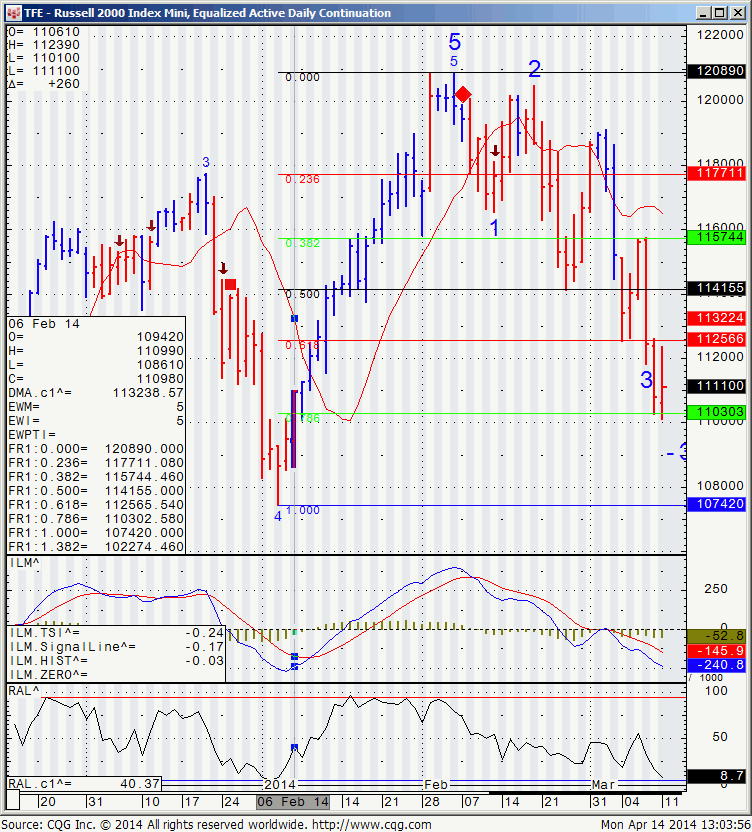
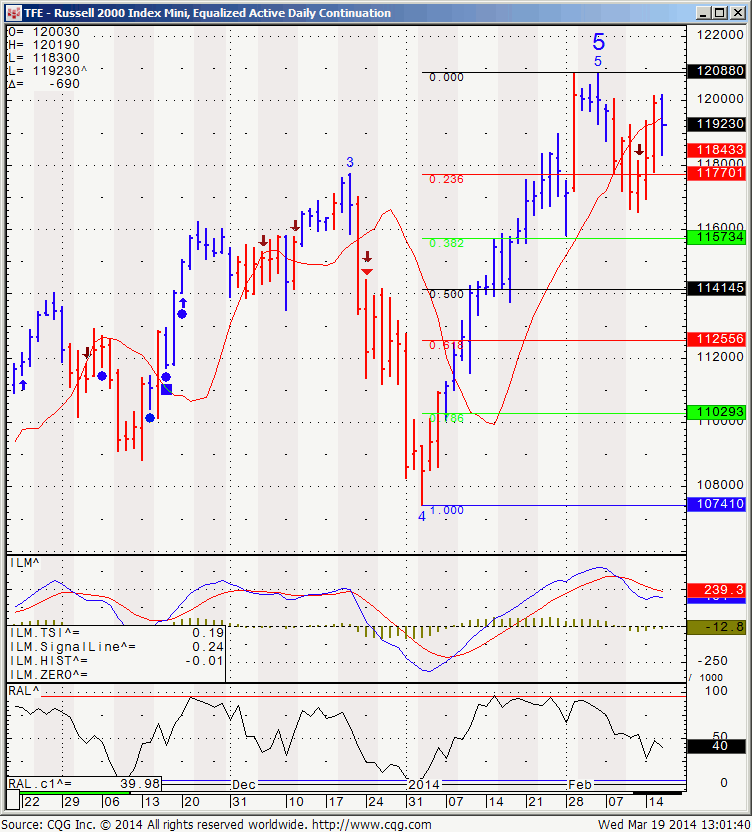
Here is what the daily chart of the Mini Russell 2000 looks like after today. June is front month now for stock indices, currencies and financials.

TFE - Russell 2000 Index Mini, Equalized Active Daily Continuation
TFE – Russell 2000 Index Mini, Equalized Active Daily Continuation

Continue reading “Mini Russell 2000 Chart, Futures Levels & Economic Reports 2.20.2014”

How Crude Oil Prices Affect Gas Prices

There are a few different aspects that factor into how crude oil prices affect what consumers pay at the pump. Oil is directly affected by geopolitical events, weather patterns, distribution costs, supply, demand and State and Federal taxes, to name a few. As the aforementioned forces are unpredictable and as they become more volatile, so becomes crude oil. Understanding each factor and the role it plays with respects to the rise and fall in prices, may help someone understand how to utilize the information to make better trading decisions.

Supply

First and foremost supply is affected by various socioeconomic and political factors within and around the region of origin. Also, OPEC, an organization commenced in 12 of the top oil producing companies and producing just fewer than 50% of the world’s oil supply, regulate their portion of crude oil produced. Often OPEC will be in positions to sell or barter away the oil they produce in exchange for currency or other assets that will benefit their interests. The United States itself houses around 700 million barrels in its Strategic Petroleum Reserves for use in the event of political dissensions with oil producing nations, as well as for emergencies such as natural disaster affected regions of the country.

Demand

The driving forces behind the demand for crude oil can be a number of factors. The most obvious, of course, is the rate and amount of oil each country uses. According to the CIA World Fact book, the United States tops of the market at 21%, the EU uses 15% of the world’s oil and China consumes 11%. As countries develop, particularly within their middle class infrastructure, this creates more consumers and more consumers using vehicles, driving the demand higher. On the back end of developments like this, oil refineries must adjust production to suit the growing need, which also incurs a higher cost in that production.

Continue reading “How Crude Oil Prices Affect Gas Prices”

Mini Russell 2000 Chart, Futures Levels & Economic Reports 3.4.2014

Connect with Us! Use Our Futures Trading Levels and Economic Reports RSS Feed.

Like us on FacebookFollow us on TwitterView our profile on LinkedInFind us on Google+Cannon Trading Futures Trading Resistance & Support Levels and Economic ReportsFind us on Yelp

1. Market Commentary
2. Futures Support and Resistance Levels – S&P, Nasdaq, Dow Jones, Russell 2000, Dollar Index
3. Commodities Support and Resistance Levels – Gold, Euro, Crude Oil, T-Bonds
4. Commodities Support and Resistance Levels – Corn, Wheat, Beans, Silver
5. Futures Economic Reports for Tuesday March 04, 2014

Hello Traders,

For 2014 I would like to wish all of you discipline and patience in your trading!

Here are the current front months, active months for the more popular futures contracts. I will send a separate, special notice before stock index futures roll over in two weeks:


  • Stock index ( mini SP, mini Russell etc.) MARCH
  • Financials ( bonds, 10 years etc.) JUNE
  • Crude oil, Natural gas other energies: APRIL
  • Gold: APRIL
  • Silver, copper: MAY
  • Beans, wheat, corn and other grains: MAY
  • Currencies ( euro, yen, Swiss etc.) MARCH
  • Coffee, Cocoa, Sugar, Cotton: MAY
  • Meats ( cattle, hogs) APRIL


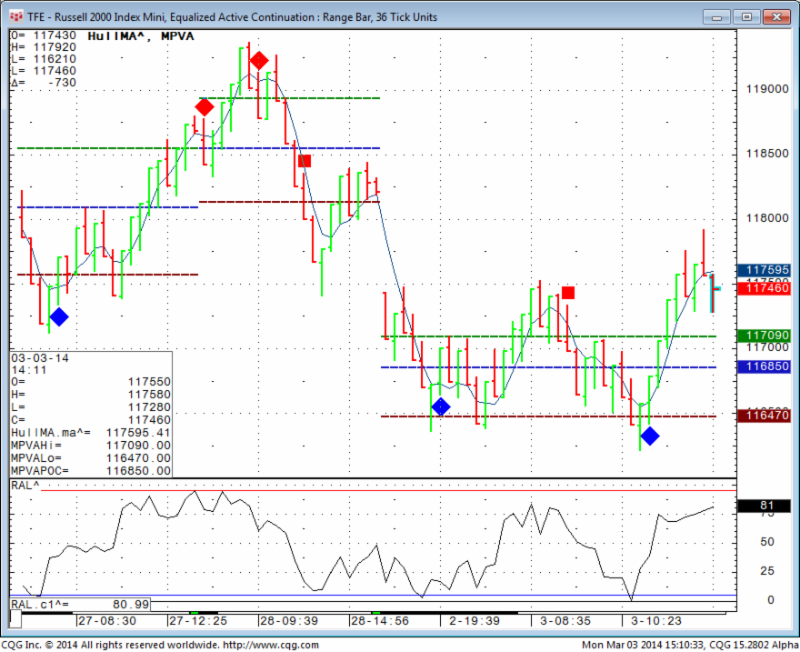
On a different note, below is my mini Russell chart from the last few days:

TFE - Russell 2000 Index Mini, Equalized Active Continuation: Range Bar, 36 Tick Units
TFE – Russell 2000 Index Mini, Equalized Active Continuation: Range Bar, 36 Tick Units

Would you like to have access to my DIAMOND and TOPAZ ALGOs as shown above and be able to apply for any market and any time frame on your own PC?  You can now have a three weeks free trial where I enable the ALGO along with few studies for your own sierra/ ATcharts and/or CQG Q trader.

Continue reading “Mini Russell 2000 Chart, Futures Levels & Economic Reports 3.4.2014”

Futures Trading Levels & Economic Reports 2.27.2014

Connect with Us! Use Our Futures Trading Levels and Economic Reports RSS Feed.

Like us on FacebookFollow us on TwitterView our profile on LinkedInFind us on Google+Cannon Trading Futures Trading Resistance & Support Levels and Economic ReportsFind us on Yelp

1. Market Commentary
2. Futures Support and Resistance Levels – S&P, Nasdaq, Dow Jones, Russell 2000, Dollar Index
3. Commodities Support and Resistance Levels – Gold, Euro, Crude Oil, T-Bonds
4. Commodities Support and Resistance Levels – Corn, Wheat, Beans, Silver
5. Futures Economic Reports for Friday February 28, 2014

Hello Traders,

For 2014 I would like to wish all of you discipline and patience in your trading!

Here are the current front months, active months for the more popular futures contracts. I will send a separate, special notice before stock index futures roll over in two weeks:


  • Stock index ( mini SP, mini Russell etc.) MARCH
  • Financials ( bonds, 10 years etc.) JUNE
  • Crude oil, Natural gas other energies: APRIL
  • Gold: APRIL
  • Silver, copper: MAY
  • Beans, wheat, corn and other grains: MAY
  • Currencies ( euro, yen, Swiss etc.) MARCH
  • Coffee, Cocoa, Sugar, Cotton: MAY
  • Meats ( cattle, hogs) APRIL

Continue reading “Futures Trading Levels & Economic Reports 2.27.2014”