How Discount Brokers Work?

Discount Futures Brokerage is formatted to provide a more cost effective way of trading futures for experienced traders who are comfortable placing trades over the internet , using their personal computer..

Discount Futures Brokers typically offer lower service fees and take a more minimal role in daily trading decisions. What you are essentially using a broker since then, is to place orders and for representation on the exchange floor. It is true that futures trading, or any trading market for that matter, could not operate without market participants and market professionals representing those participants. With commodities markets being so risky, regardless of cost it is clear that qualified brokers are vital to the success of participants of various markets.

What’s The Difference?

The biggest difference with discount brokers is the client’s ability to be more self-directed with their trading profile. The risk associated with futures trading disclaims that there is no guarantee of profit no matter who manages your money. No matter the level of involvement, brokers still represent the interests of every client and are likewise as valuable.  The need for Futures Trading Brokers will never become obsolete, so the emphasis on discount brokerage need be on discounted commissions and fees, not discounted service.

Below is a list of lesser or excluded fees associated with a discount futures brokerage:

  • Account Maintenance Fees
  • Platform Fees
  • DataFeed Fees (Online/E-Trading)
  • Low Margin Investments
  • Broker Support Fees

Another difference with discount brokerage is the type of platform often used for this type of futures brokerage service; online. Online Futures Trading is in some cases synonymous with a discount futures brokerage. The reason this is, is due to lower costs associated with online platforms that allow you to do most of the monitoring of real time market data. A wide selection of online futures companies provide the software you can download to use to trade and build a profile. When one places orders online, he doesn’t need to call his broker and place orders via phone. That saves the time of the broker and allow for lower, discounted fees.

Continue reading “How Discount Brokers Work?”

Mini S&P Chart, Futures Levels and Economic Reports 2.19.2014

Connect with Us! Use Our Futures Trading Levels and Economic Reports RSS Feed.

Like us on FacebookFollow us on TwitterView our profile on LinkedInFind us on Google+Cannon Trading Futures Trading Resistance & Support Levels and Economic ReportsFind us on Yelp

1. Market Commentary
2. Futures Support and Resistance Levels – S&P, Nasdaq, Dow Jones, Russell 2000, Dollar Index
3. Commodities Support and Resistance Levels – Gold, Euro, Crude Oil, T-Bonds
4. Commodities Support and Resistance Levels – Corn, Wheat, Beans, Silver
5. Futures Economic Reports for Wednesday February 19, 2014

Hello Traders,

For 2014 I would like to wish all of you discipline and patience in your trading!

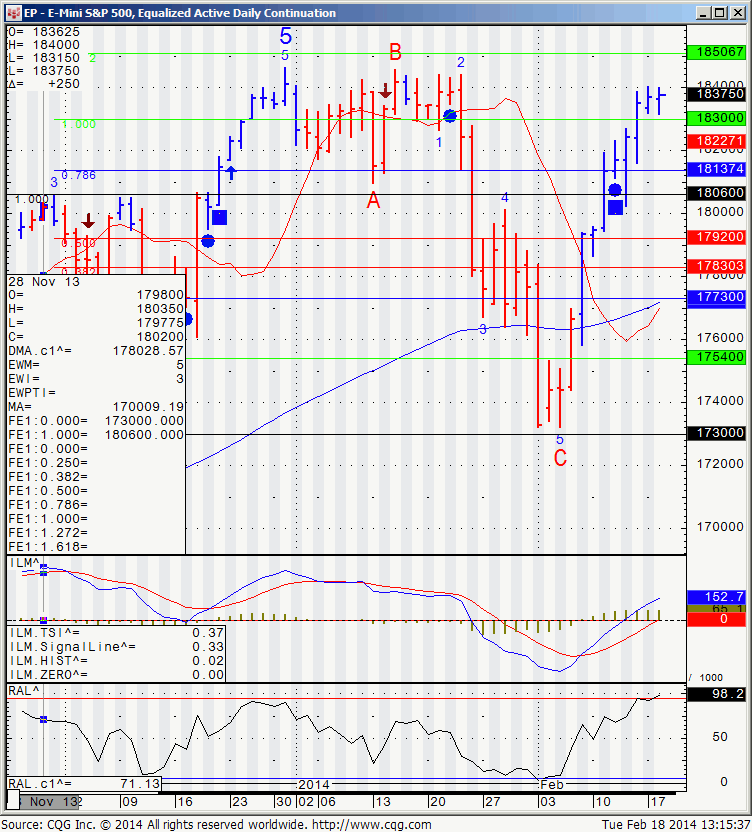
Back after a long weekend and tomorrow we have Fed minutes, which can either provide the market with some power to move to the next level up or perhaps show us that the market ran out of gas….Here is the way my daily SP chart looks like:

EP - E Mini S&P 500, Equalized Active Daily Continuation

Crude Oil and Gold Futures Chart, Futures Levels and Economic Reports 2.12.2013

Connect with Us! Use Our Futures Trading Levels and Economic Reports RSS Feed.

Like us on FacebookFollow us on TwitterView our profile on LinkedInFind us on Google+Cannon Trading Futures Trading Resistance & Support Levels and Economic ReportsFind us on Yelp

1. Market Commentary
2. Futures Support and Resistance Levels – S&P, Nasdaq, Dow Jones, Russell 2000, Dollar Index
3. Commodities Support and Resistance Levels – Gold, Euro, Crude Oil, T-Bonds
4. Commodities Support and Resistance Levels – Corn, Wheat, Beans, Silver
5. Futures Economic Reports for Wednesday February 12, 2014

Hello Traders,

For 2014 I would like to wish all of you discipline and patience in your trading!


Trader Planet


Voted Best Blog 2013 by Trader Planet

Thanks everyone who voted!! Appreciate your help in winning the #1 blog for futures trading by Trader Planet!! Please feel free to forward our daily blog to friends and other fellow traders who might be interested.

Another two markets I like to touch on when it comes to “other markets to daytrade beside the mini SP 500” are crude Oil and Gold futures.

More than a few similarities between the two markets.

They are both volatile, can move VERY fast. I have seen some very large moves happen in matter of minutes if not seconds. The “fear & greed” factor really plays a role in these specific two markets.

Both have active trading hours starting with Far East trading around 10 PM est all the way to the next morning until about 3 PM est. Good volume generally speaking but not close to the mini SP or ten year notes. So you may see some slippage on stops but the volume is more than enough to trade size.

Each tick on gold is $10, so every dollar move =$100 against you or in your favor. Crude is similar, each tick = $10. One full $1 move = $1000.

Both markets were quiet today relatively speaking but even on a quiet day, the range on gold was  $21 or = $2100 wide using one futures contract. Crude ranges today was less than $1 or about $890 between hi/lo.

I like using overbought/ oversold indicators on the two markets as well as using range / Renko charts.

If you never traded these markets before, I highly recommend exploring in simulation/ demo mode. get a feel for the explosiveness, volatility, personality for a few weeks before trying in live mode.

As always, any questions, please feel free to email me.

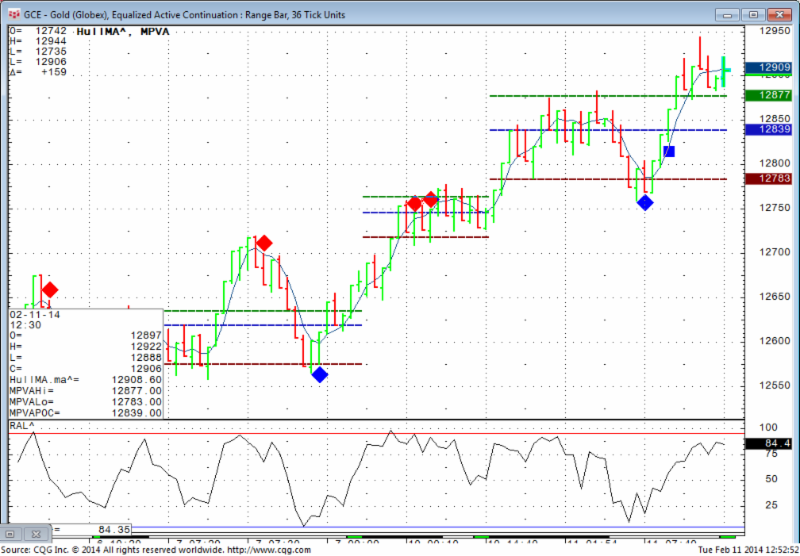
Two charts from today’s session of gold and crude for your review below ( if you like to try the charts I am using along with indicators displayed, send me an email):


Crude 18 ticks range bar Feb. 11th 2014

CLE - Crude Lights (Globex), Equalized Active Continuation - Range Bar 18 Ticks Units

Gold, 36 ticks range bar Feb. 11th 2014


GCE - Gold (Globex), Equalized Active Continuation - Range Bar =, 18 Ticks Units
GCE – Gold (Globex), Equalized Active Continuation – Range Bar =, 18 Ticks Units

Continue reading “Crude Oil and Gold Futures Chart, Futures Levels and Economic Reports 2.12.2013”

Futures Levels & Economic Reports 2.11.2014

Connect with Us! Use Our Futures Trading Levels and Economic Reports RSS Feed.

Like us on FacebookFollow us on TwitterView our profile on LinkedInFind us on Google+Cannon Trading Futures Trading Resistance & Support Levels and Economic ReportsFind us on Yelp

1. Market Commentary
2. Futures Support and Resistance Levels – S&P, Nasdaq, Dow Jones, Russell 2000, Dollar Index
3. Commodities Support and Resistance Levels – Gold, Euro, Crude Oil, T-Bonds
4. Commodities Support and Resistance Levels – Corn, Wheat, Beans, Silver
5. Futures Economic Reports for Tuesday February 11, 2014

Hello Traders,

For 2014 I would like to wish all of you discipline and patience in your trading!

RECAP OF LAST WEEK AND A PEAK AHEAD INTO THIS WEEKS TRADING BY TRADETHENEWS.COM

TradeTheNews.com Weekly Market Update: The Correction Corrects

Fri, 07 Feb 2014 16:09 PM EST- The week began with a massive sell-off, as the DJIA and S&P500 fell more than 2% a piece on Monday and closed at their lows, while the DJIA also fell below its 200-day moving average for the first time since October. The declines came after a bad slide on the prior Friday and were exacerbated by another discouraging Chinese PMI reading. On Tuesday, the Nikkei saw a 4% slump, but global markets bottomed out mid-week and then recouped all of their losses. In Europe, healthy-looking PMI data helped limit losses, while the mixed US jobs report did not damage the bounce-back on Friday. Emerging market currencies stabilized this week following the recent round of rate hikes. For the week, the DJIA rose 0.6%, the S&P500 gained 0.8% and the Nasdaq added 0.5%.- The January US non-farm payrolls figure widely missed expectations and the December figure was revised higher by a mere 1K, making for the weakest two-month period of job growth in three years. However, investors are looking past this to find some pretty good news in the numbers. The lack of upward revisions in December data was still blamed on harsh weather, and the November payroll gains were revised higher again to 274K from 241K. More significantly, unemployment rate fell again to 6.6% while the labor force participation rate edged up to 63%, and employment measured by the household survey increased by 616K, complemented by a huge decline in part-time employment.

– Janet Yellen was officially sworn in as the new Fed chairman this week. Nearly everyone expects a pretty smooth transition, with Yellen very unlikely to make any changes to the course charted by helicopter Ben. She will have to deal with policy contradictions now that unemployment is nearly at the Fed’s 6.5% threshold while job growth remains anemic. At the December meeting, the Fed extended its forward guidance by stressing that low rates will likely remain appropriate “well past” reaching the 6.5% threshold, however market rates are still creeping higher. Next week will see Yellen’s first big policy statement, during Congressional testimony on the economic outlook and monetary policy. Several Fed officials this week, both hawks and doves, affirmed that tapering was still on track and that it would take a significant change in the data to force them the reconsider it.

– Despite the week-long Lunar New Year holiday on the mainland, China released the official PMI figures for the month of January on Monday. Much like the disappointing HSBC final PMI readings, the government figures described more deterioration with manufacturing PMI falling to 50.5, a six-month low, and non-manufacturing falling to 53.4, a 23-month low. Perhaps most notable among components, the employment reading in the manufacturing sector fell to an 11-month low. Meanwhile, the China Commence Ministry reported 2014 Lunar New Year “golden week” retail sales that were up a mere +13.3% y/y, the slowest pace of growth on record for the key holiday retail period.

– Shares of Twitter were down as much as 24% on Wednesday after the firm released its first quarterly report as a publically traded company. Twitter’s headline EPS and revenue numbers were much better than expected, but traders and analysts insist that slowing user growth and weaker engagement trends seen in metrics bode ill for the firm. In addition, the first round of lock-up expirations arrives on February 15th, followed by another round on May 7th. Cult tech names Pandora and LinkedIn saw losses as well in the wake of problematic quarterly results. Both firms disclosed decent fourth-quarter results but offered guidance that widely missed consensus estimates.

– Time Warner reported strong fourth-quarter results. Analysts focused on the company’s decision to break out separate HBO revenue figures for the first time. HBO took in $1.26B compared to $1.19B y/y, citing the consolidation of Asia and certain European operations for the 4% gain. This compares to Netflix’s $1.18B in revenue in the quarter.

– On Thursday, Apple disclosed that it has repurchased $14B in common stock over the last two weeks, amounting to 3.1% of its market cap. Over the last 12 months, the company said it has bought back $40B in stock, an all-time record for Apple or any company. CEO Cook said that the company had been surprised by the 8% decline on Jan 28th that came after reporting quarterly results. He also pledged to return $100B to shareholders by the end of 2015.

Continue reading “Futures Levels & Economic Reports 2.11.2014”

Australian Dollar Chart, Futures Levels & Economic Reports 1.22.2014

Connect with Us! Use Our Futures Trading Levels and Economic Reports RSS Feed.

Like us on FacebookFollow us on TwitterView our profile on LinkedInFind us on Google+Cannon Trading Futures Trading Resistance & Support Levels and Economic ReportsFind us on Yelp

1. Market Commentary
2. Futures Support and Resistance Levels – S&P, Nasdaq, Dow Jones, Russell 2000, Dollar Index
3. Commodities Support and Resistance Levels – Gold, Euro, Crude Oil, T-Bonds
4. Commodities Support and Resistance Levels – Corn, Wheat, Beans, Silver
5. Futures Economic Reports for Wednesday January 22, 2014

Hello Traders,

For 2014 I would like to wish all of you discipline and patience in your trading!

I need your help!

I have gotten and getting great feedback from many of you and would appreciate if you can take a couple of seconds to vote at:

Traders Planet Awards


There are more than a few markets one can daytrade beside stock indices….

Today I would like to talk a little about the currency futures markets. I personally prefer currency futures over FOREX any day. More than a few reasons but the main ones are: currency futures trade on one, regulated main exchange ( CME) while FOREX trades through different interbanks and other means of transactions that are not necessarily regulated. FOREX are “commission free” but in reality there is a spread built in that dealer marks up each time you buy or sell which makes FOREX more expensive than futures.

The main ones I like to follow are:

The Euro, The Yen, The British Pound, The Australian. All are paired versus the US$.

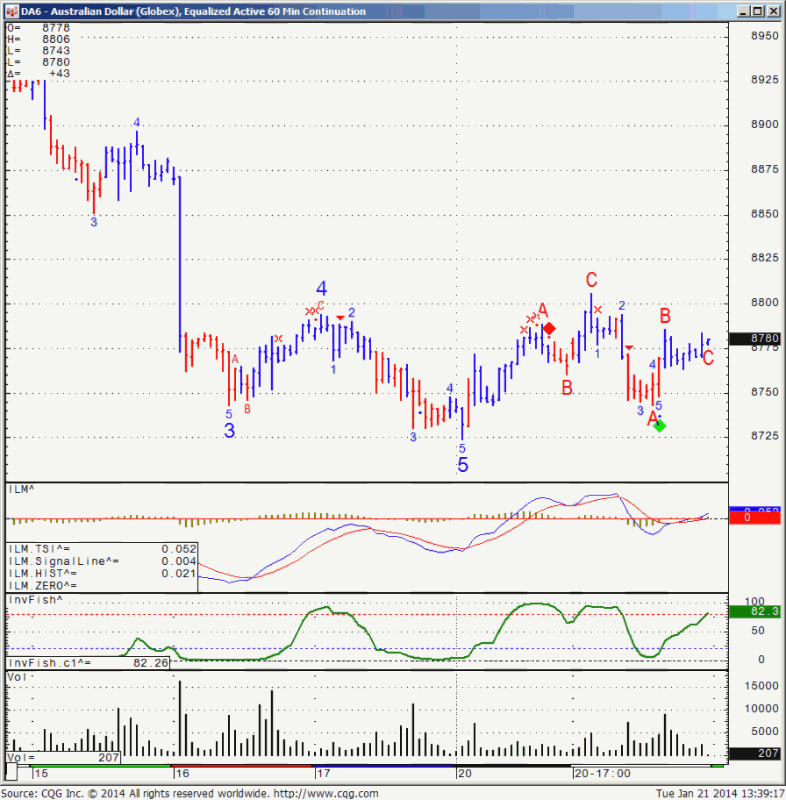
Each market will have different times of higher volume which can allow for traders in all time zones to pick their market. Simply open an hourly chart, like the example i am showing below of the Australian $ and add the volume indicator to observe what times the market has the most action.

  • 1 Euro tick is $12.50
  • 1 Yen tick is $12.50
  • 1 Aussie tick is $10
  • 1 British tick is $6.25

Currency futures will often trend better than other segments and will experience different levels of volatility during economic reports in the different parts of the world.

Another point is that currencies also have MICRO contracts, which may be a great transition from demo mode to LIVE mode, as these contracts are pretty small ( one tenth of the normal size)

If you plan on following any currencies, start in demo mode, know what reports are coming that affect the specific currency you are trading, take a look at the daily, weekly charts to get a feel and monitor the action for a while.

Any questions and i will be happy to assist.


DA 6 - Australian Dollar (Globex), Equalized Active 60 Min Continuation
DA 6 – Australian Dollar (Globex), Equalized Active 60 Min Continuation

3 Risks of Using a Discount Futures Broker

With the advent of technology, the means to communicate clear objectives, or with any human, drives most people to ignore full-service futures brokers. Why? It is a spirit of independence. Computers have created a superhighway of trading, and accelerated the pace at which commodities, stocks, in short the financial market operates. These various methods have raised barriers between clients and full-service brokers, but given rise to- discount futures brokers. In reality, what the future of the financial markets beckons, is a direct and honest appraisal of the quick and easy model, versus the client and broker relationship. If the “Great Recession” taught us all anything, if you are not vigilant, or the means to track your investment, there is an inherent risk.

Knowledge vs. Education

Brain to Understanding is to hat on a head, both are useful, if absolutely used for maximum benefits to create larger profits to debt losses. Most experienced futures brokers understand the full scope of the financial market, and this long range vision gives insight into the behaviors of certain commodities. Conversely, when opting out of choosing a full-service futures broker, you are presented with limited tools, vision and insight.

Vision, in the entrepreneurial sense, is the act or power of anticipating what will come to be. If you are a newcomer, choosing discount futures brokers, may lead to a lack discernment or experience to sell or buy at appropriate times to gain the maximum profit, while minimizing the loss. This vital quality reigns supreme on experienced traders in the financial sector. However, the key to having a strong vision is insight.

Insight varies to vision, in that you see both near and far and eventually the end result of a business decision. Good judgment plays an integral part in evaluating leverage metrics, whether using gold as a hedge, or evident world events that will signal either a sharp decline or increase in the markets.

Overall, vision and insight, help with the learning curve in the futures market. In addition, being green in this market can cost you a great deal of time and money. Adding vision and insight to your expansive market toolbox can aid in shortening common investment mistakes, with the aid of the seasoned futures broker as your guide. Conversely, selecting a discount futures broker, they may not have the ability to reign in your decision making. Bad decisions – loss of profit. Consequently, bucking traditional wisdom, you could lose larger returns, and run into dangerous investment decisions.

Continue reading “3 Risks of Using a Discount Futures Broker”

ROLLOVER + Futures Trading Levels & Economic Reports 12.12.2013

Connect with Us! Use Our Futures Trading Levels and Economic Reports RSS Feed.

Like us on FacebookFollow us on TwitterView our profile on LinkedInFind us on Google+Cannon Trading Futures Trading Resistance & Support Levels and Economic ReportsFind us on Yelp

1. Market Commentary
2. Futures Support and Resistance Levels – S&P, Nasdaq, Dow Jones, Russell 2000, Dollar Index
3. Commodities Support and Resistance Levels – Gold, Euro, Crude Oil, T-Bonds
4. Commodities Support and Resistance Levels – Corn, Wheat, Beans, Silver
5. Futures Economic Reports for Thursday December 12, 2013

Hello Traders,

For 2013 I would like to wish all of you discipline and patience in your trading! 

Rollover Notice for Stock Index Futures

Important Notice: For those of you trading any stock index futures contracts, i.e., the E-mini S&P, E-mini NASDAQ, E-mini Dow Jones, the “Big” pit-traded S&P 500, etc., it is extremely important to remember that tomorrow, Thursday, December 12th, is rollover day.

Starting December13th, the March 2014 futures contracts will be the front month contracts. It is recommended that all new positions be placed in the March 2014 contract as of December 13th. Volume in the December 13 contracts will begin to drop off until its expiration on Friday December 20th.

The month code for March is H4.

Traders with electronic trading software should make sure that defaults reflect the proper contract as of Thursday morning.

Please close any open December Currency positions by the close on Friday the 13th.Should you have any further question please contact your broker.

Continue reading “ROLLOVER + Futures Trading Levels & Economic Reports 12.12.2013”

Futures Trading Systems, Futures Levels & Economic Reports 12.11.13

Connect with Us! Use Our Futures Trading Levels and Economic Reports RSS Feed.

Like us on FacebookFollow us on TwitterView our profile on LinkedInFind us on Google+Cannon Trading Futures Trading Resistance & Support Levels and Economic ReportsFind us on Yelp

1. Market Commentary
2. Futures Support and Resistance Levels – S&P, Nasdaq, Dow Jones, Russell 2000, Dollar Index
3. Commodities Support and Resistance Levels – Gold, Euro, Crude Oil, T-Bonds
4. Commodities Support and Resistance Levels – Corn, Wheat, Beans, Silver
5. Futures Economic Reports for Wednesday December 11, 2013

Hello Traders,

For 2013 I would like to wish all of you discipline and patience in your trading! 

A quick note about trading systems.

I know most of you are what i consider self directed traders. You like to make your own decisions of when to buy/ sell/ markets etc.

Some of you may have tried different automated trading systems in the past and some may be currently trading some systems. i think that if one has the risk capital and does the due diligence, there are some good systems out there which can be used as diversification to your own trading and/ or as a form of more aggressive investment.

I do want to bring to your attention two trading systems I personally really like and have been impressed with the results.

One is a medium term system/model that works with seasonal spreads. We have clients in this office who been trading these spreads for years and will be more than happy to share additional details for those of you who are interested.

The second is a day trading system that finishes each day flat. It does not trade often, avg of about 2 trades a day. it picks trades from about 20 different futures markets and is offered as auto trade here at cannon trading. Again, I am quite impressed with the results so far and will be happy to share more with interested clients prospects.

Please email me with any questions/ interest on the topic above and I will be happy to assist!

Continue reading “Futures Trading Systems, Futures Levels & Economic Reports 12.11.13”

5 Mistakes of Commodity Trading & Futures Levels & Economic Reports 12.05.2013

Connect with Us! Use Our Futures Trading Levels and Economic Reports RSS Feed.

Like us on FacebookFollow us on TwitterView our profile on LinkedInFind us on Google+Cannon Trading Futures Trading Resistance & Support Levels and Economic ReportsFind us on Yelp

1. Market Commentary
2. Futures Support and Resistance Levels – S&P, Nasdaq, Dow Jones, Russell 2000, Dollar Index
3. Commodities Support and Resistance Levels – Gold, Euro, Crude Oil, T-Bonds
4. Commodities Support and Resistance Levels – Corn, Wheat, Beans, Silver
5. Futures Economic Reports for Thursday December 5, 2013

Hello Traders,

For 2013 I would like to wish all of you discipline and patience in your trading! 

5 Common Mistakes of Commodity Trading by Joe Easton Senior Commodity Broker with Cannon Trading

As a broker who serves different types of clients with different backgrounds, risk capital and risk appetite, I have observed the following 5 common mistakes traders make, in hopes you can learn and avoid!

  1. Trading with lagging indicators. As a Broker, I get to see the whole range, from traders making their first trade, to traders making their last trade, and everything in between. The beginner traders almost always start along the same path. Using MACD, Williams %R, Stochastic, RSI and most other indicators you can find to predict price is a very common mistake. These indicators often follow price movement, not predict future price movement. Sure when looking at a chart in hindsight, they match up great, but in real time they are lagging. This style of trading will more than likely lead to losses.
  2. Trading Undercapitalized. This mistake should be placed in the premarket (before opening an account) because an account shouldn’t even be opened without proper capitalization. Assuming you did open an account, trade within limits. Each Trader has different risk tolerance, but across the board, no one should be trading with funds they cannot afford to lose. When trading with limited funds or overleveraged 1 day can end your trading career before it began. Cannon offers aggressive day trading margins, as do our competitors, but by no means do we endorse taking advantage of all that leverage. In futures trading some markets are leveraged 100:1 or even more. Meaning you are controlling a lot more capital then you may think. For example: The ES is trading at 1695 right now. You are controlling 1695*50= $84,750.00 with a mere $500 or approximately 170:1 leverage. With all that leverage account balances can fluctuate rapidly. When Trader’s take losses psychology shifts, when a shift in psychology meets lack of funds or overleveraged trading decisions are affected. Trading on low balance or outside reasonable limits is a sure recipe for losses.
  3. Overtrading. This mistake is common among beginner and advanced traders. Until it is overcame, significant profits will be lost to commissions. More importantly, your trading profit potential will be limited. Whether trading 1 lot or 1000 lots per order there is still only so many moves a market can make in a given trading period. Intraday trading typically results in three moves or less. Sure there are days that bounce between the high and the low all day, but that is one move, sideways. Other days include trend days (one direction), or 3 move days, which I believe to be most common. A 3 move day is up then down (usually a retracement) then up, or down then up then down. A two move day would be up then down or down then up. If most days fall under these formats, what reason would a 1 lot trader have to make 100 trades? Not a good one, I’ll tell you that.
  4. Losing Days. About every Trader has losing days, it is part of the business. The key is to limit losses, similarly to trading. You should monitor your account balance like you monitor your trades. When you see it going the wrong way, you should become impatient and look to cut it short. There are infinite factors why you are having a losing day, the fact is you are and you need to know in advance where the bleeding stops. Many skilled and professional traders regularly take profits from the market day in and day out only to blow the account up the one day the market doesn’t react the way they expect. Often ego or anger can block rational thoughts and averaging in and reversing is all too easy. Having hard rules like maximum lot size and maximum daily loss can preserve your capital and prevent losing days from burying your account.
  5. Chasing the market. There are so many mistakes, it is hard to only choose five, but chasing the market will conclude this list. Markets do not move in straight lines. Aside from major news there are very few large moves without retracements. Depending on the market a “big” move can be calculated by taking the average daily range and multiplying by 2 or 3. Market conditions are constantly changing, but in all circumstances, when a market makes a big move, it is more likely to retrace or reverse before continuing. Traders that buy the ES after 15 points up or sell gold after a $50 move down are behind the ball and more times than not will be stopped out with a loss. Wait for the retracement or play the other side, this will help limit loses by chasing.

Continue reading “5 Mistakes of Commodity Trading & Futures Levels & Economic Reports 12.05.2013”