30 Year Treasury Notes (ZB) 120min Chart & Futures Levels 12.03.2020

_________________________________________________

Voted #1 Blog and #1 Brokerage Services on TraderPlanet for 2016!!  

_________________________________________________

Dear Traders,

Like us on FaceBook!
Get Real Time updates and market alerts on Twitter!
Each market has a different personality, different behavior along with different times of the day when it is most active. If you are finding that the ES (mini SP) is not giving you enough risk/opportunities then start monitoring a couple of other markets and perhaps explore them in demo / simulated mode.
I think that there are more than a few markets that are suitable for day-trading. Below you will find some observations, tips along with what are unique about these markets, personality and most active trading hours (interest rates, mostly the ten year and 30 year).
In most platforms, the symbols are ZB for 30 year bonds and ZN for 10 year notes.
Product Symbol
ZB
Contract Size
The unit of trading shall be U.S. Treasury Bonds having a face value at maturity of one hundred thousand dollars ($100,000) or multiples thereof
Price Quotation
Points ($1,000) and 1/32 of a point. For example, 134-16 represents 134 16/32. Par is on the basis of 100 points.
Product Symbol
ZN
Underlying Unit
One U.S. Treasury note having a face value at maturity of $100,000.
Deliverable Grades
U.S. Treasury notes with a remaining term to maturity of at least six and a half years, but not more than 10 years, from the first day of the delivery month. The invoice price equals the futures settlement price times a conversion factor, plus accrued interest. The conversion factor is the price of the delivered note ($1 par value) to yield 6 percent.
Price Quote
Points ($1,000) and halves of 1/32 of a point. For example, 126-16 represents 126 16/32 and 126-165 represents 126 16.5/32. Par is on the basis of 100 points.
Tick Size
(minimum fluctuation)
One-half of one thirty-second (1/32) of one point ($15.625, rounded up to the nearest cent per contract), except for intermonth spreads, where the minimum price fluctuation shall be one-quarter of one thirty-second of one point ($7.8125 per contract).
Contract Months
The first five consecutive contracts in the March, June, September, and December quarterly cycle.
These contracts are often affected by many of the economic reports that come out at 8:30 AM Eastern and there is very active volume between the hours of 8 AM EST and 3 PM EST
Volume on both contracts is very good. Ten years will often have 1 million contracts traded per day (might be the second most active US futures market after the mini SP 500) and the bonds will avg. around 300,000 contracts.
These markets can experience very volatile movements during and right after different reports but then will often trade smooth or in an intraday trend the rest of the day.
Spread traders may find some interesting strategies trading the ZB/ZN spread or what I refer to as the 30/10 and some call NOB spread ( notes over bonds).
120 minute chart of the ZB or 30 yr bonds for observation below.
7d506575 0831 4be9 a8a3 437fad17c28a

Good Trading

Trading Futures, Options on Futures, and retail off-exchange foreign currency transactions involves substantial risk of loss and is not suitable for all investors.  You should carefully consider whether trading is suitable for you in light of your circumstances, knowledge, and financial resources. You may lose all or more of your initial investment. Opinions, market data, and recommendations are subject to change at any time when it comes to Futures Trading.


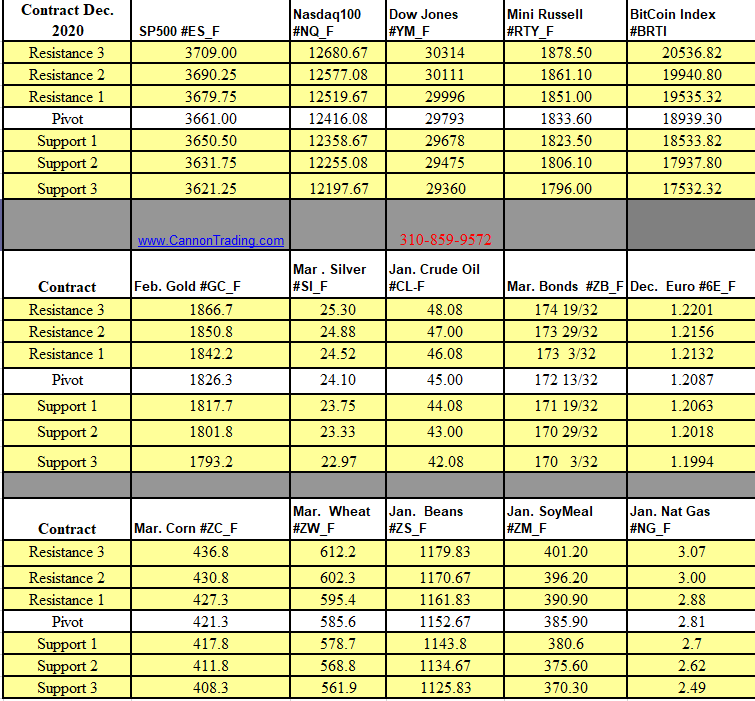
Futures Trading Levels

12-03-2020

9b39af4c 2053 4a58 b21f ffa6fec356c3

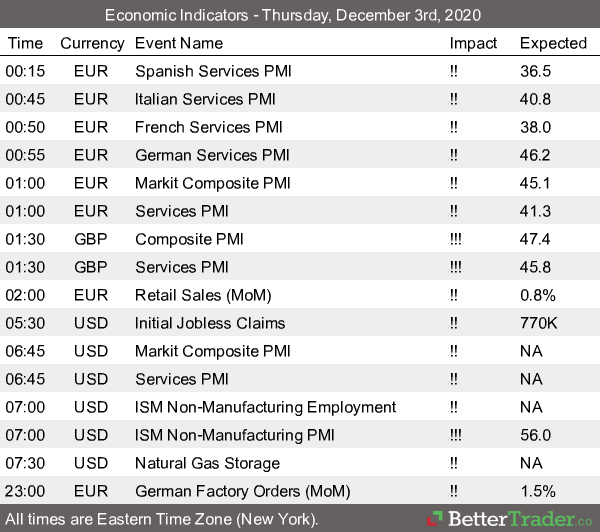
Economic Reports, source: 

 www.BetterTrader.co

9678618a 9013 4ff1 a0ce ab962b46bea8


This is not a solicitation of any order to buy or sell, but a current market view provided by Cannon Trading Inc. Any statement of facts here in contained are derived from sources believed to be reliable, but are not guaranteed as to accuracy, nor they purport to be complete. No responsibility is assumed with respect to any such statement or with respect to any expression of opinion herein contained. Readers are urged to exercise their own judgement in trading.

COVID-19 Impact on Futures Trading

Futures Trading


The sweep of the coronavirus around the world ranks as one of the most impactful events in decades. Due in large part to sweeping lockdowns of businesses, travel and social activities, global markets, particularly commodity markets, have experienced price disruptions on an unprecedented scale. Recall earlier this year, the front month crude oil futures contract (May) traded at a value below $0.00 per barrel and at the close of trading one day, its price settled at a negative value. Conversely, gold’s December futures contract recently reached an all-time high above $2,000 per ounce. These price moves and similar ones – in silver, copper, stock indexes like the S&P 500, Nasdaq & Dow Jones, lumber and others – can be at least partly attributed to abrupt changes in supply & demand patterns during this international health crisis and its effects on producers’ and consumers’ behavior.

In this environment, the case could be made to review trading strategies and make adjustments – in market selection (think “full-sized” vs. mini- or micro- contracts), risk parameters – both in terms of dollar value and price toleration – market selection/allocation, trade frequency and for automated systems, adjustments to algorithms. All this would be to expect a continuation of the last several months’ market movement/volatility.

As part of a strategy review, it would be a good idea to also be aware of any price limits or circuit breakers in place for the markets you’re trading. A price limit is the maximum price range allowed for a futures contract for a trading session. At those price limits, trading may halt for a period of time and an expanded price limit is set, or it may be stopped for the day. Circuit breakers are price limits that when hit, set a timer within which the market is restricted from moving beyond the price limit. In some markets, price limits and circuit breakers are based on percentage moves from the prior day’s closing price and thus are recalculated each day.

Grains and livestock futures contracts, for example, have daily price limits that remain in place for an entire trading session. Stock indexes have both price limits that remain in place for an entire trading session and several circuit breakers: ones that are in place overnight and others that work only during the day. During high volatility periods of time, if markets trade to circuit breakers or price limits, orders placed during at that time can be rejected by the exchange. In summary, knowing these price parameters is especially important.

For more information on how CME Group price limits and circuit breakers work, visit this link.

For specific CME Group price limits and circuit breakers, visit this link.

During this time, it’s more important than ever to be informed, aware and prepared. One of the best means available to help you is access to an experienced, knowledgeable broker. Not only do they have answers to questions regarding the items discussed above, they can look at your situation specifically and offer strategy guidance as well as educational material and information sources you may have overlooked, couldn’t find, or were unaware even existed. Contact Cannon Trading Company.

COVID-19 Impact on Futures Trading

  • Increased volatility and risk
  • New traders needed to understand limit down/ limit up
  • Wild overnight swings
  • Wild moves both ways
  • MICROS are a valid tool
  • Twitter is now a factor
  • More than ever an experienced broker is an asset

Disclaimer – Trading Futures, Options on Futures, and retail off-exchange foreign currency transactions involves substantial risk of loss and is not suitable for all investors. Past performance is not indicative of future results. You should carefully consider whether trading is suitable for you in light of your circumstances, knowledge, and financial resources. You may lose all or more of your initial investment. Opinions, market data, and recommendations are subject to change at any time.

 

Interest Rate Futures, Real Estate and Mortgage Rates

By John Thorpe, Senior Broker


Over the course of the last 45 years, whether you own a small monopoly of commercial buildings or a condo on Oak street U.S.A. your investments are subjected to the actions of the Federal Reserve Bank.


The Federal Reserve Bank seeks to provide stability in the largest world economy through interest rate regulation. Its mandate is to use financial tools to satisfy two congressional mandates, 1: Full Employment and 2: Moderate Inflation to a 2% annualized rate; Move too far too fast in any direction with policy shifts and financial perils for all! may be in the offing. The economy could move too fast in the wrong direction or too fast in the right direction which can lead to an overheating and a bursting of an economic bubble. Look no further than Savings and Loan crisis in the 1980’s and 90’s, the Japanese housing market collapse in 1989 (Japan is currently still struggling with a zero interest rate environment 30 years later) the Dot Com bubble after Y2K and most recently , the housing market collapse, which began with the bankruptcy of Iceland, no one paid attention, then the bankruptcy of Ireland, again, no one paid attention, then the bankruptcy of Bear Stearns,  some paid attention  (what did any of these entities have to do with the value of our homes, we thought) then Lehman brothers collapsed in September of 2008 and everyone paid attention as our home prices collapsed.

Use Google, DuckDuckGo, Bing or any of your favorite search engines and type in

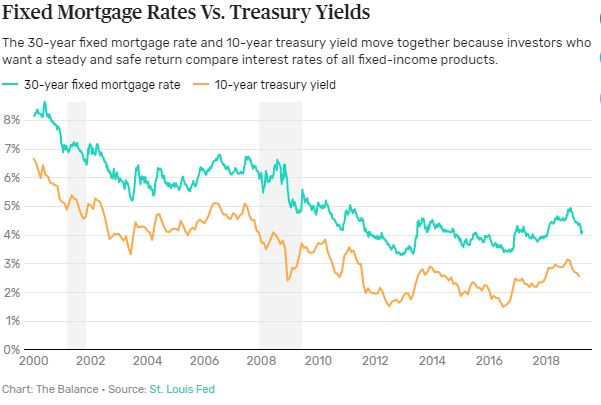
10 yr. correlation with mortgage rates


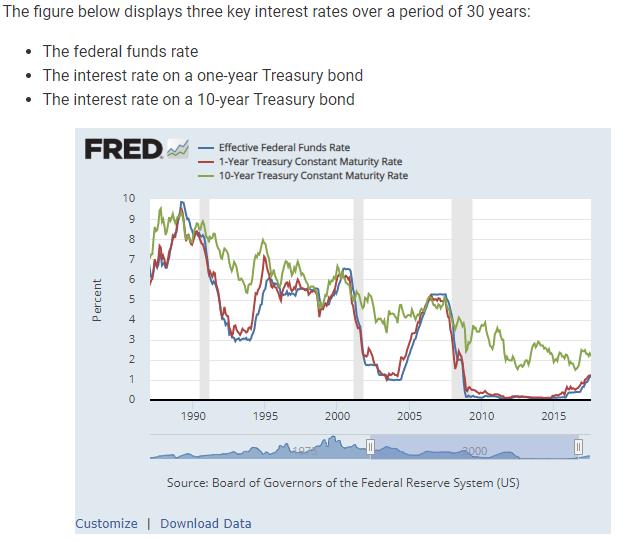
You will find search pages full of information about the importance of interest rate policy and its effect on mortgage rates, specifically the Fedfunds rate.

FedFundsVS10


Whether you have a 30 yr fixed, a 15 yr fixed or a 5/1 ARM  (usually capped after 5 years) you need to protect your largest investments by first understanding the tools available to the public to monitor these markets and second, knowing you can contact a professional to discuss the myriad of ways to hedge your real estate portfolio and be ready when you need to by utilizing the futures markets to protect your investments.


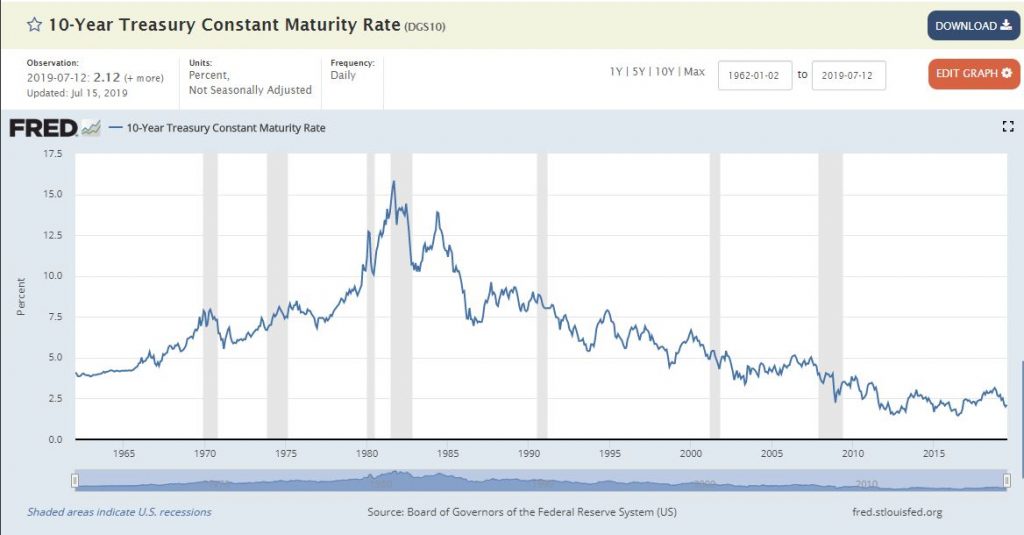
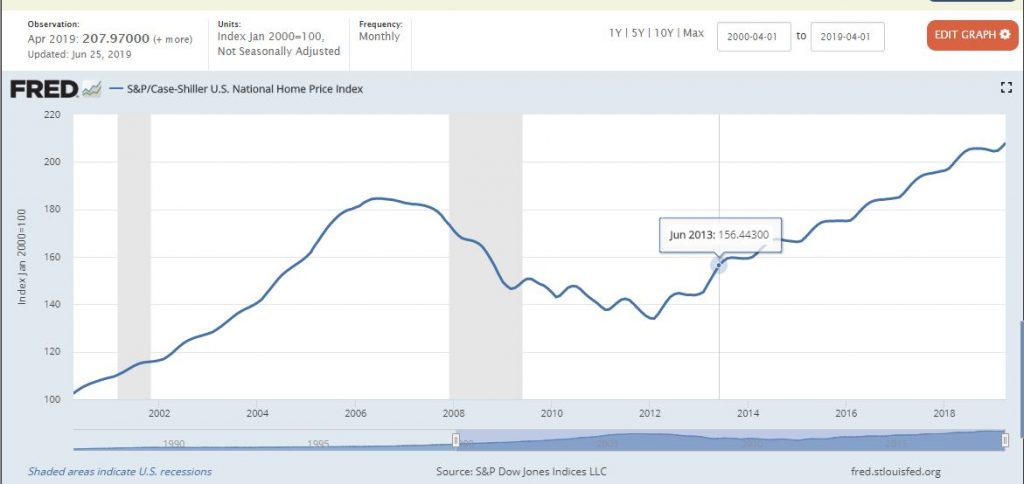
The hypothesis:  Generally speakingand largely from region to region diversity, when interest rates go lower, home prices go higher. Lower interest rates lead to increases in the value of real assets. Mortgage rates are sensitive to changes in Fed Policy, the 10yr note being the reference financial instrument moves in response to market reactions to Fed policy shifts.


When interest rates go higher, a definite time lag exists in the long run may make  home prices move lowerand real asset prices lower.


Watch futures market prices in the interest rate futures. Get comfortable watching the interest rate futures contracts.


I am by no means offering a pure hedge or even a short-term hedge in my analysis.

I believe what you will see and get a sense of the ebbs and flows of these markets from a visual perspective  while you are learning about the base currency (US Dollar) valuation of real assets changing and thereby affecting not only the value of the real assets you hold but also the cost to maintain those assets. The interest rate futures markets give you the clearest picture of how policy equates to real rates for you, the mortgage holder. 10yr Note Futures prices and chart


Major trends that are a serious harbinger of future housing price changes are important to understand so you may act to preserve, maintain and profit from potential shifts in policy.


MortgageVSTreasury


FRED


Between 2008 and 2012 during the last recession, a major fed policy tool used was a series of fed fund rate reductions (net effect is the cost of money becomes cheaper relative to real asset prices), these calculated moves lowered the interest rate on longer term debt obligations  10Yr. Note Futures Prices and Chart as well as all dollar denominated Treasuries.


As you can see, Mortgage rates, I mean the 10yr Treasury Note rates (Freudian slip, sorry), are still at or near all-time lows.

Treasury

In Summary, Familiarizing yourself with the interrelationships among Mortgage rates, 10 year treasuries and fed fund policy shifts are an important starting point for a conversation with a professional about protecting your family’s biggest investment.


A Cannon Trading professional is available between 8:30am to 5:00pm Eastern to answer your questions Call Now


Disclaimer – Trading Futures, Options on Futuresand retail off-exchange foreign currency transactions involves substantial risk of loss and is not suitable for all investors. Past performance is not indicative of future results. You should carefully consider whether trading is suitable for you in light of your circumstances, knowledgeand financial resources. You may lose all or more of your initial investment. Opinions, market dataand recommendations are subject to change at any time.


Selling Future Options Premium

Futures Options Writing


Have you ever wondered who sells the futures options that most people buy? These people are known as the option writers/sellers. Their sole objective is to collect the premium paid by the option buyer. Option writing can also be used for hedging purposes and reducing risk. An option writer has the exact opposite to gain as the option buyer. The writer has unlimited risk and a limited profit potential, which is the premium of the option minus commissions. When writing naked futures options your risk is unlimited, without the use of stops. This is why we recommend exiting positions once a market trades through an area you perceived as strong support or resistance. So why would anyone want to write an option? Here are a few reasons:

  1. Most futures options expire worthless and out of the money. Therefore, the option writer is collecting the premium the option buyer paid.


  1. There are three things that happen to the underlying price of the option: Price goes up, goes down or stays the same. If when the option expires, the market price was at or below your strike price you collect all the premium if two of those things happen Time decay is the option writer’s friend.


  1. The writer believes the futures contract will not reach a certain strike price by the expiration date of the option. This is known as naked option selling.


  • To hedge against a futures position. For example: someone who goes long cocoa at 850 can write a 900 strike price call option with about one month of time until option expiration. This allows you to collect the premium of the call option if cocoa settles below 900, based on option expiration. It also allows you to make a profit on the actual futures contract between 851 and 900. This strategy also lowers your margin on the trade, and should cocoa continue lower to 800, you at least collect some premium on the option you wrote. Risk lies if cocoa continues to decline, because you only collect a certain amount of premium and the futures contract has unlimited risk the lower it goes. So you should trade with a stop on the futures contract. You can read on different strategies using options on futures here:


https://www.cannontrading.com/tools/education-futures-options-trading-101


Cannon offers SPAN margins for options sellers.

Many brokers will restrict or increase the margins required for options sellers, or traders who like to “collect premium”, but here at Cannon we can find you the best set up utilizing the multiple clearing arrangements we have with more than a few FCMs.

How much margin is required to sell a futures option?

That is a question we get asked often. The exact number is an output of SPAN margins. SPAN deserves a post on its own, but what it stands for is: Standard Portfolio Analysis of Risk. The formula takes into consideration volatility, time value, distance of strike price from current underlying future, and more.

Outright options may be easier to “guesstimate” margin than more complex strategies and spreads, but our free platform, E-Futures Int’l (https://www.cannontrading.com/software/e-futures-international )has a margin calculator built in so you can calculate the margin you will need for different strategies.

Commission for selling options on futures?

Commissions will vary based on the following:

Are you trading online or with a broker?

Trading volume

Account size

Risk responsibility.

The rates for selling options will vary from as low as $0.25 per side + fees for HIGH VOLUME, institutional accounts to $30 per side + fees for retail, broker assisted accounts.


Selling options is NOT for newcomers as it involves higher risk than buying options.

However, selling options and trading option spreads may offer an edge if done with proper risk management. No guarantees are made here.

Our strength at Cannon is our ability to offer CUSTOMIZED trading solutions, so contact a broker at:

https://www.cannontrading.com/company/contact

and learn more about risks and opportunities in futures trading (https://www.cannontrading.com/riskopportunity), what software you can use, consult with a broker on margin, commissions and strategy questions and much more!


Trading Futures, Options on Futures, and retail off-exchange foreign currency transactions involves substantial risk of loss and is not suitable for all investors.  You should carefully consider whether trading is suitable for you in light of your circumstances, knowledge, and financial resources. You may lose all or more of your initial investment. Opinions, market data, and recommendations are subject to change at any time.
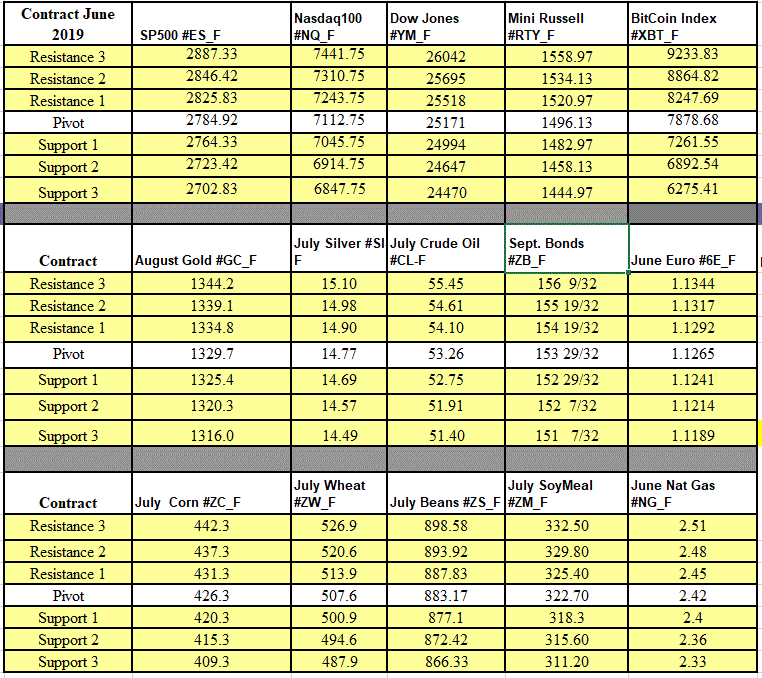
Rollover Notice for Stock Index Futures & Futures Levels 6.13.2019

____________________________________________________________________

Voted #1 Blog and #1 Brokerage Services on TraderPlanet for 2016!!  

____________________________________________________________________

Dear Traders,

Like us on FaceBook!
Get Real Time updates and market alerts on Twitter!
Rollover Notice for Stock Index Futures
Important notice: For those of you trading any stock index futures contracts, i.e., the E-mini S&P, E-mini NASDAQ, E-mini Dow Jones etc., it is extremely important to remember that we are now rolling over and trading the September 2019 contract.
Starting June 13th, the September 2019 futures contracts will be the front month contracts. It is recommended that all new positions be placed in the September 2019 contract as of June 13th.
Volume in the June 2019 contracts will begin to drop off until its expiration on Friday June 21st.
The month code for September is U19
In between, 30 min chart of the mini NASDAQ for your review below, on the short term, market can decline some more if we stay below the 7500 level.
a1955f8e ad6d 4b27 aba9 a40afcfb7a28
bdf6db09 7692 48a4 8450 9a8d7d5f2d31

Good Trading

Trading Futures, Options on Futures, and retail off-exchange foreign currency transactions involves substantial risk of loss and is not suitable for all investors.  You should carefully consider whether trading is suitable for you in light of your circumstances, knowledge, and financial resources. You may lose all or more of your initial investment. Opinions, market data, and recommendations are subject to change at any time.

 

Futures Trading Levels

06-13-2019

139cbb5a 75e5 4388 bb35 89ab6ea978fd


Economic Reports, source: 

bettertrader.co

570133a7 b3f4 486a 9cbd f86d4c4ca73f


This is not a solicitation of any order to buy or sell, but a current market view provided by Cannon Trading Inc. Any statement of facts here in contained are derived from sources believed to be reliable, but are not guaranteed as to accuracy, nor they purport to be complete. No responsibility is assumed with respect to any such statement or with respect to any expression of opinion herein contained. Readers are urged to exercise their own judgement in trading.

Weekly Futures Silver Chart & Trading Level 6.07.2019

____________________________________________________________________

Voted #1 Blog and #1 Brokerage Services on TraderPlanet for 2016!!  

____________________________________________________________________

Dear Traders,

Like us on FaceBook!
Get Real Time updates and market alerts on Twitter!
Is the silver market finally waking up?
A look at weekly chart below.
Are you tired of day-trading and getting stopped out?
  1. As a hedge, no need for stops
  2. As a pure speculation. A relatively inexpensive way to speculate on market direction in a time frame that can be for minutes, hours or a few days without the need to use stops.
Briefly, the definition of an option contract from the National Futures Association is: An investment vehicle which gives the option buyer the right—but not the obligation—to buy or sell a particular futures contract at a stated price at the specified expiration date. There are two separate and distinct types of options: calls and puts. These weekly options are European Style, Exercisable to the nearest futures contract at 3pm Central time on Friday. If in the money by any amount, the exercise is automatic.
d5829c2a 4fbe 4f67 8a1e 79afe357f03a
bdf6db09 7692 48a4 8450 9a8d7d5f2d31

Good Trading

Trading Futures, Options on Futures, and retail off-exchange foreign currency transactions involves substantial risk of loss and is not suitable for all investors.  You should carefully consider whether trading is suitable for you in light of your circumstances, knowledge, and financial resources. You may lose all or more of your initial investment. Opinions, market data, and recommendations are subject to change at any time.
 

Futures Trading Levels

06-07-2019

705b08f8 8d23 4684 8805 fcceba0b740f


Economic Reports, source: 

bettertrader.co

727afdd1 3cef 4043 aac5 914212963140

This is not a solicitation of any order to buy or sell, but a current market view provided by Cannon Trading Inc. Any statement of facts here in contained are derived from sources believed to be reliable, but are not guaranteed as to accuracy, nor they purport to be complete. No responsibility is assumed with respect to any such statement or with respect to any expression of opinion herein contained. Readers are urged to exercise their own judgement in trading.

June Crop Outlook & Futures Levels 6-04-2019

____________________________________________________________________

Voted #1 Blog and #1 Brokerage Services on TraderPlanet for 2016!!  

____________________________________________________________________

Dear Traders,

Like us on FaceBook!
Get Real Time updates and market alerts on Twitter!
Market Movers Video
June Crop Report Market Outlook
Will weather conditions and resulting planting delays create a historic month for the corn market?
In this video, Dave Hightower, Founding Principal of The Hightower Report, and Dan Basse, President of AgResource Company, discuss how mother nature may impact the upcoming crop season.
ce0f5864 fe35 40f2 9314 60d4b6144bd5
bdf6db09 7692 48a4 8450 9a8d7d5f2d31

Good Trading

Trading Futures, Options on Futures, and retail off-exchange foreign currency transactions involves substantial risk of loss and is not suitable for all investors.  You should carefully consider whether trading is suitable for you in light of your circumstances, knowledge, and financial resources. You may lose all or more of your initial investment. Opinions, market data, and recommendations are subject to change at any time.
 

Futures Trading Levels

06-05-2019


c0687f5d 9993 4d06 9db8 8cccca401b0e


Economic Reports, source: 

bettertrader.co

3b0501b5 8fac 49da 854b 339ae7180fb2

This is not a solicitation of any order to buy or sell, but a current market view provided by Cannon Trading Inc. Any statement of facts here in contained are derived from sources believed to be reliable, but are not guaranteed as to accuracy, nor they purport to be complete. No responsibility is assumed with respect to any such statement or with respect to any expression of opinion herein contained. Readers are urged to exercise their own judgement in trading.

Trading Videos+ Trading Levels for June 4th

______________________________________________________________

Voted #1 Blog and #1 Brokerage Services on TraderPlanet for 2016!!  

____________________________________________________________________

Dear Traders,

Like us on FaceBook!
Get Real Time updates and market alerts on Twitter!
Trading 101: Trading videos on bollinger bands, Parabolics, Trading levels, Range Bars and more!
Watch the latest trading videos we have posted and shared with our clients!
In this week’s newsletter we are sharing two videos, each a few minutes long. The videos discuss practical tips for trading and sharing our experience with you
1. Using bollinger Bands as a possible tool for exiting trades
2. One way you can use the Parabolics study ( also known as PSAR) to manage current positions, possibly as a trailing stop
3. Different ways traders can utilize support and resistance levels in their trading.
4. Entering trades on a stop, using “price confirmation”.
5. Utilizing Range Bar charts for shorter term trading as a way to try and filter out some noise.
logo
stars

Good Trading

Trading Futures, Options on Futures, and retail off-exchange foreign currency transactions involves substantial risk of loss and is not suitable for all investors.  You should carefully consider whether trading is suitable for you in light of your circumstances, knowledge, and financial resources. You may lose all or more of your initial investment. Opinions, market data, and recommendations are subject to change at any time.
 

Futures Trading Levels

06-03-2019

c0cd9d79 f227 438b 9abe 909d01d157d5


Economic Reports, source: 

bettertrader.co

S
31ebd27e bd58 4a19 ba72 df1d71fa6fd0


This is not a solicitation of any order to buy or sell, but a current market view provided by Cannon Trading Inc. Any statement of facts here in contained are derived from sources believed to be reliable, but are not guaranteed as to accuracy, nor they purport to be complete. No responsibility is assumed with respect to any such statement or with respect to any expression of opinion herein contained. Readers are urged to exercise their own judgement in trading.

How to Trade Futures With Cannon Trading

How to Trade Futures

Beginning your portfolio in the futures market can be a daunting, if ultimately rewarding, task. While there are many factors that determine a trader’s success, the most profitable portfolios are built by traders who are thoughtful and strategic from the outset. Therefore, it is important to know the steps a successful trader takes when beginning in the market.

The first step for any successful trader is to find a qualified professional broker. At minimum this means someone who works at a brokerage that is registered with the CFTC and member of the NFA, is willing to display a public profile and has a verifiable track record of expertise. Transparency is key in any broker-client relationship, and a qualified broker should be up front about all the ways in which they can help you reach your highest potential in the futures market.

Once you’ve determined these basic qualities in a potential broker, it is important to assess your needs and goals in the market and identify which brokers will best help you meet them. Begin familiarizing yourself with the various market exchanges, analyze your own assets and financial goals, and specify your strengths and weaknesses as a new trader. Once you have a basic idea of what you will need from your broker, go through your options and see which brokerages offer the help that you need. What types of trading platforms are offered by the broker? How available are they on a daily basis, both during and after trading hours? What do they consider their specialty in futures trading? What commission rates do they offer? These are all important questions to ask when interviewing a potential broker. Ideally, as a first-time futures trader, you will find a broker who is available both during and after trading hours, offers a variety of platforms, and has a broad range of experience in the field. And remember, a low commission rate is only a factor, and not the whole of selecting a trader, bargain basement rates often accompany poor broker service.

After selecting a broker, you will be set up on a trading platform that you both have determined is best for your needs. Every trading platform should offer a demo period. It is important to trade in the demo mode for 3 to 4 weeks to get comfortable with the platform and begin identifying your trading strategy. One important thing to remember is to follow the trend. Every futures market follows a certain trend with set guidelines that determine the market’s direction. As you take your demo time to become more familiar with your chosen area of the futures market, your trading should reflect the trend of this market. Another important rule of thumb is: don’t overplay a market. It is easy to be overcome by a series of successful trades, but it important to stay on task, trade objectively and avoid frequent entrances and exits into any given market. When in the trial period, try to journal the ebbs and flows of your given market every day. Seeing the market volatility laid out from your trial run will help you stay calm when you’re ready to trade, thus avoiding rash, and often costly, decisions.

After your trial run, it is time to go live. Do not get caught living in demo mode, if you have done your research and followed your demo run closely, you will be ready to go into the live market with confidence in your strategy, and trust in your broker to help you through the more challenging trading days. Start off by trading one contract, and communicate with your broker frequently to confirm that they are available when you need them. As you expand your portfolio, spread out your risk capital by diversifying your portfolio into a few different markets. Continue to follow your strategy, journal the trends, and stay in close communication with your broker.

At Cannon Trading, our brokers are experienced, transparent, knowledgeable, and available. For over thirty-years we have provided top-quality individual service to our clients. We offer a variety of trading platforms and work with several introducing brokers, making it easy for us to customize our services to your trading needs. Our trade desk is available 24/7, and our brokers answer the phones right away during trading hours. Our clients not only benefit from our experienced brokers, but also access to our daily newsletter and frequent articles summarizing the market trends, outlining tips and tricks, and taking our clients step-by-step through the process of conquering the futures market. We also offer competitive commission rates to new clients. As a new trader to the futures market, working with a brokerage you can trust is paramount, and our clients have trusted us to be their market allies for decades.

Disclaimer – Trading Futures, Options on Futures, and retail off-exchange foreign currency transactions involves substantial risk of loss and is not suitable for all investors. Past performance is not indicative of future results. You should carefully consider whether trading is suitable for you in light of your circumstances, knowledge, and financial resources. You may lose all or more of your initial investment. Opinions, market data, and recommendations are subject to change at any time.
How to Select a Commodities & Futures Broker

Futures Broker

Selecting the ideal futures broker is one of the most important steps a trader can take. Whether you are brand new to futures trading, or an experienced trader looking to expand your portfolio, the futures broker you choose will undoubtedly be integral to your trading success. It is important to weight your options and select a broker that will meet your needs at a firm that offers you the maximum value for that support.

The first decision you will want to make is whether to hire a Transactional or Relationship-Based Broker. Transactional brokerage firms offer clearing services and of course, access to exchanges. However, transactional firms will not assign you a personal broker and therefore can only offer base level support. It is truly a “one size fits all” approach.

Relationship-based brokers are highly involved in their traders’ progress. These brokers provide one-on-one service to each account, and will do everything in their power to ensure their traders are equipped for success. Relationship-based brokers work with their clients to evaluate their needs, provide them with the proper technology and support for trading, and communicate frequently to reevaluate and renovate accounts for maximum success.

After a trader has determined which of these two types of brokers will most benefit them, the next step is to evaluate how much support the trader will need. There are a few basics to choose from when it comes to broker support, the first is 24-hour vs. business hour support, and the next is access to a support team vs. access to a dedicated futures broker.

Even experienced brokers usually choose a firm that offers access to 24-hour trading support from a dedicated Futures broker. The futures markets run all day, and therefore the need for 24-hour support is probable. However, not all firms offer 24-hour support, and some that do only offer access to a support team, not a dedicated broker. While a support team can be helpful in low-stakes scenarios, it is possible to get caught in a high-stakes situation in which a dedicated broker would be more helpful.

When making the decision between 24-hour and business-hour support, and a support team vs. a dedicated Futures broker, a trader should consider their experience level and how comfortable they would be in a risky market situation on their own.

Another factor a trader should consider when choosing the support level that best meets their trading needs is execution services. Execution is the completion of a buy or sell, and there are many kinds. Some traders prefer self-directed execution through online trading, others prefer Futures broker assistance, still others opt for strategy execution, in which an automated system completes the execution based on a specific guided strategy. There is also newsletter execution, options execution, and managed futures. Some brokerage firms only offer one of these types of execution, others offer two or three, and still other offer all to their clients to pick and choose as they see fit. When selecting a broker, it is important to first determine which of these types of execution will work best for you, and make sure the brokers you are interested in offer them.

Once you have determined a brokerage offers the support level that is right for you, the next thing you will want to consider are the tools offered by the firm the help you with your trading. These include trading technology, research and reports, and access to futures commission merchants that specialize in the aspects of the markets that match your needs.

In today’s markets, having access to the latest and best technology is essential. Fast, stable, and reliable direct market access are the bare minimum features you should look for in a trading platform. While some brokerage firms only provide access to one trading platform, many offer access to a multitude, so that each client can choose the platforms that best suit their needs. It is important to ask a potential Futures broker which platform they believe will work best for you, a good broker will be direct about this. Keep in mind that a broker at a firm with only one trading platform is obligated to sell you on that platform, and not choose something specific to you. A good broker-assistance platform will also give you access to quotes and charts. You may not always need these resources, but they’re great to have around to improve your trading skills.

A good brokerage firm will also offer fundamental and technical research and a variety of reports to all of its clients. These include news reports and a calendar of major releases. Traders do not want to be caught without up-to-the-minute information regarding the markets. Brokerage firms worth pursuing will provide this information frequently and in detail.

The final tool that a trader should look for in a brokerage firm is access to a variety of Futures Commissions Merchants (FCMs) that specialize in aspects of the commodity futures markets that are relevant to that trader. Every FCM is different, and none of them specialize in everything, so a broker that offers options is key. You will want to talk to your potential broker about the clearing firms they offer, and what the advantages and disadvantages are of each FCM they offer. A good broker will be honest about the disadvantages of every FCM, that’s why they offer more than one!

Once you have determined that a few firms offer everything you need, it is time to look at value. It is important to have a clear understanding of each brokerage’s commission rates and all additional fees that are charged. Do not be afraid to talk to potential brokers about these rates, and read any material on their website or in contracts thoroughly. Another way to determine the firm with the best value is to look at Margins and Leverage. While the overnight margin will remain the same no matter what broker you choose, some brokers will offer special rates for certain types of trading. A good brokerage will also offer $500 margins to a day trader as long as that privilege is not abused. A transactional firm will allow a trader to use a $500 margin to ruin, but a relationship-based broker firm will insist that traders be safe and smart with their funds.

It is important to remember that low margins and high leverage are not the only factors you should be looking at in a brokerage firm. Ask the brokers how they manage risk, monitor leverage, and what maximum leverage they would recommend to you as a client. Some Futures broker even offer risk controls on your account, to protect you when you have reached a maximum leverage level.

Selecting a futures broker can be a daunting process, but the prepared and inquisitive trader will find an ideal match. Knowing your needs, your experience, your knowledge, and your financial health will help you not only find a brokerage firm that’s right for you, but also help your broker create a trading plan to maximize your success. You don’t need to find the most expensive firm for great results, many excellent firms are also great values. And you also don’t want to go straight to the lowest-cost provider, many bargain basement firms offer little to no guidance to their clients. Take your time selecting a Futures broker, get on the phone, ask questions, be direct and detailed, and find a broker who you trust to get you where you need to go.

Disclaimer – Trading Futures, Options on Futures, and retail off-exchange foreign currency transactions involves substantial risk of loss and is not suitable for all investors. Past performance is not indicative of future results. You should carefully consider whether trading is suitable for you in light of your circumstances, knowledge, and financial resources. You may lose all or more of your initial investment. Opinions, market data, and recommendations are subject to change at any time.