How to Trade Futures With Cannon Trading

How to Trade Futures

Beginning your portfolio in the futures market can be a daunting, if ultimately rewarding, task. While there are many factors that determine a trader’s success, the most profitable portfolios are built by traders who are thoughtful and strategic from the outset. Therefore, it is important to know the steps a successful trader takes when beginning in the market.

The first step for any successful trader is to find a qualified professional broker. At minimum this means someone who works at a brokerage that is registered with the CFTC and member of the NFA, is willing to display a public profile and has a verifiable track record of expertise. Transparency is key in any broker-client relationship, and a qualified broker should be up front about all the ways in which they can help you reach your highest potential in the futures market.

Once you’ve determined these basic qualities in a potential broker, it is important to assess your needs and goals in the market and identify which brokers will best help you meet them. Begin familiarizing yourself with the various market exchanges, analyze your own assets and financial goals, and specify your strengths and weaknesses as a new trader. Once you have a basic idea of what you will need from your broker, go through your options and see which brokerages offer the help that you need. What types of trading platforms are offered by the broker? How available are they on a daily basis, both during and after trading hours? What do they consider their specialty in futures trading? What commission rates do they offer? These are all important questions to ask when interviewing a potential broker. Ideally, as a first-time futures trader, you will find a broker who is available both during and after trading hours, offers a variety of platforms, and has a broad range of experience in the field. And remember, a low commission rate is only a factor, and not the whole of selecting a trader, bargain basement rates often accompany poor broker service.

After selecting a broker, you will be set up on a trading platform that you both have determined is best for your needs. Every trading platform should offer a demo period. It is important to trade in the demo mode for 3 to 4 weeks to get comfortable with the platform and begin identifying your trading strategy. One important thing to remember is to follow the trend. Every futures market follows a certain trend with set guidelines that determine the market’s direction. As you take your demo time to become more familiar with your chosen area of the futures market, your trading should reflect the trend of this market. Another important rule of thumb is: don’t overplay a market. It is easy to be overcome by a series of successful trades, but it important to stay on task, trade objectively and avoid frequent entrances and exits into any given market. When in the trial period, try to journal the ebbs and flows of your given market every day. Seeing the market volatility laid out from your trial run will help you stay calm when you’re ready to trade, thus avoiding rash, and often costly, decisions.

After your trial run, it is time to go live. Do not get caught living in demo mode, if you have done your research and followed your demo run closely, you will be ready to go into the live market with confidence in your strategy, and trust in your broker to help you through the more challenging trading days. Start off by trading one contract, and communicate with your broker frequently to confirm that they are available when you need them. As you expand your portfolio, spread out your risk capital by diversifying your portfolio into a few different markets. Continue to follow your strategy, journal the trends, and stay in close communication with your broker.

At Cannon Trading, our brokers are experienced, transparent, knowledgeable, and available. For over thirty-years we have provided top-quality individual service to our clients. We offer a variety of trading platforms and work with several introducing brokers, making it easy for us to customize our services to your trading needs. Our trade desk is available 24/7, and our brokers answer the phones right away during trading hours. Our clients not only benefit from our experienced brokers, but also access to our daily newsletter and frequent articles summarizing the market trends, outlining tips and tricks, and taking our clients step-by-step through the process of conquering the futures market. We also offer competitive commission rates to new clients. As a new trader to the futures market, working with a brokerage you can trust is paramount, and our clients have trusted us to be their market allies for decades.

Disclaimer – Trading Futures, Options on Futures, and retail off-exchange foreign currency transactions involves substantial risk of loss and is not suitable for all investors. Past performance is not indicative of future results. You should carefully consider whether trading is suitable for you in light of your circumstances, knowledge, and financial resources. You may lose all or more of your initial investment. Opinions, market data, and recommendations are subject to change at any time.

How to Invest in Commodities With a Futures Contract

Futures Contract

If you are new to investing, you probably started with or have experience in stocks. Stocks are an excellent way to gain experience in investing, and grow your investment portfolio. With your newly gained experience, you may be ready to take on some more sophisticated asset classes, such as commodities which can often be more complicated and more risky, but yield a much higher return. At Cannon Trading, we will walk you through everything you need to know about how to invest in commodities effectively for the highest overall return, and pair you with your own professional broker to achieve your trading goals.

If we are going to learn how to invest in commodities, first, let’s begin by defining what a commodity is. A commodity is defined as a select group of basic goods in demand all across the globe. This includes harvested goods such as wheat, corn and flour, as well as energy sources and metals such as oil, gas, gold and aluminum. Since it is such a vast category, commodities are divided into two groups: hard and soft. Hard commodities such as metals and gas require mining or drilling while soft commodities are things that are grown and require harvesting. These commodities are global, and as such, is a good idea to invest in them. Since these are global assets, people often don’t care, or don’t think about where they come from, or if there is any brand name attached to it making it wise to invest in commodities.

Beginning in the 1800’s, finding a trader willing to take a position in a forward contract was an easy task, but much more difficult to find a trader at the time of contract settlement. As a result, the Chicago Board of Trade created futures contracts. The objective of futures contracts is to minimize the risk of fluctuating prices by putting up and maintaining fixed original margins. When investing in commodities, this fixed pricing is vital. Commodities trading began shortly after with the trading of agricultural goods. As the market place expanded, it began to involve financial contracts such as government backed securities, foreign currency, metals, energies, and more. With these resources being naturally occurring, investing in commodities may seem like a safe option. However, it is this trait that makes them prone to supply and demand, and the risk control became necessary for farmers.  

This is where learning how to invest in commodities becomes risky. Commodities are naturally occuring, making investing in them an often volatile practice due to the nature of supply and demand. Depending on the individual product’s relationship with supply and demand will make investing in some commodities more risky than others. For example, a bountiful harvest of wheat crops in a season will increase our supply of wheat causing its price to fall. However, in the event of a naturally occurring threat such as a drought or flood, prices of wheat may go up for lack of future supplies. How can you choose which commodity to invest in? It is important to note that some commodities are more volatile than others. At certain times, hard commodities like gold can be less volatile than soft commodities like wheat or corn, and other times the opposite is true. When learning how to invest in commodities, it helps to imagine which commodity will be more consistent, and which will involve a higher risk/reward ratio when basing your decision.

When learning how to invest in commodities, it is important to know your options. Given commodities are mostly physical goods, there are several options you can take. The first is investing this your commodity directly by buying the actual physical product. You can also buy shares of stock in companies producing your commodity or exchange-traded funds specializing in your commodity. If you are looking for an alternative, you may want to look into a futures contract. A commodities futures contract specifically is an agreement between a buyer or end user and a seller to make or take delivery of a commodity at an agreed upon price at a designated date. A futures contract will help to mitigate unforeseen fluctuation in the value of commodities and ensure that the transaction is honored by all those involved.  

Any successful financial portfolio requires diversification. Your financial portfolio should be filled with diverse asset classes and commodities that will react differently to the financial world around them. Investing solely in soft commodities in one area may lead to financial hardship in the event of a low supply yield. Investing in solely hard commodities such as gold and crude oil can be cumbersome and hinder your diversification. Cannon Trading offers more information and helpful resources on how to invest in commodities. You and your broker will work together to achieve your trading goals and grow your portfolio. You will also have access to tools and valuable market information to help you begin diversifying your portfolio with valuable commodities. In an impersonal world, having a good relationship with a high quality broker can make all the difference.

Disclaimer – Trading Futures, Options on Futures, and retail off-exchange foreign currency transactions involves substantial risk of loss and is not suitable for all investors. You should carefully consider whether trading is suitable for you in light of your circumstances, knowledge, and financial resources.  

How to Select a Commodities & Futures Broker

Futures Broker

Selecting the ideal futures broker is one of the most important steps a trader can take. Whether you are brand new to futures trading, or an experienced trader looking to expand your portfolio, the futures broker you choose will undoubtedly be integral to your trading success. It is important to weight your options and select a broker that will meet your needs at a firm that offers you the maximum value for that support.

The first decision you will want to make is whether to hire a Transactional or Relationship-Based Broker. Transactional brokerage firms offer clearing services and of course, access to exchanges. However, transactional firms will not assign you a personal broker and therefore can only offer base level support. It is truly a “one size fits all” approach.

Relationship-based brokers are highly involved in their traders’ progress. These brokers provide one-on-one service to each account, and will do everything in their power to ensure their traders are equipped for success. Relationship-based brokers work with their clients to evaluate their needs, provide them with the proper technology and support for trading, and communicate frequently to reevaluate and renovate accounts for maximum success.

After a trader has determined which of these two types of brokers will most benefit them, the next step is to evaluate how much support the trader will need. There are a few basics to choose from when it comes to broker support, the first is 24-hour vs. business hour support, and the next is access to a support team vs. access to a dedicated futures broker.

Even experienced brokers usually choose a firm that offers access to 24-hour trading support from a dedicated Futures broker. The futures markets run all day, and therefore the need for 24-hour support is probable. However, not all firms offer 24-hour support, and some that do only offer access to a support team, not a dedicated broker. While a support team can be helpful in low-stakes scenarios, it is possible to get caught in a high-stakes situation in which a dedicated broker would be more helpful.

When making the decision between 24-hour and business-hour support, and a support team vs. a dedicated Futures broker, a trader should consider their experience level and how comfortable they would be in a risky market situation on their own.

Another factor a trader should consider when choosing the support level that best meets their trading needs is execution services. Execution is the completion of a buy or sell, and there are many kinds. Some traders prefer self-directed execution through online trading, others prefer Futures broker assistance, still others opt for strategy execution, in which an automated system completes the execution based on a specific guided strategy. There is also newsletter execution, options execution, and managed futures. Some brokerage firms only offer one of these types of execution, others offer two or three, and still other offer all to their clients to pick and choose as they see fit. When selecting a broker, it is important to first determine which of these types of execution will work best for you, and make sure the brokers you are interested in offer them.

Once you have determined a brokerage offers the support level that is right for you, the next thing you will want to consider are the tools offered by the firm the help you with your trading. These include trading technology, research and reports, and access to futures commission merchants that specialize in the aspects of the markets that match your needs.

In today’s markets, having access to the latest and best technology is essential. Fast, stable, and reliable direct market access are the bare minimum features you should look for in a trading platform. While some brokerage firms only provide access to one trading platform, many offer access to a multitude, so that each client can choose the platforms that best suit their needs. It is important to ask a potential Futures broker which platform they believe will work best for you, a good broker will be direct about this. Keep in mind that a broker at a firm with only one trading platform is obligated to sell you on that platform, and not choose something specific to you. A good broker-assistance platform will also give you access to quotes and charts. You may not always need these resources, but they’re great to have around to improve your trading skills.

A good brokerage firm will also offer fundamental and technical research and a variety of reports to all of its clients. These include news reports and a calendar of major releases. Traders do not want to be caught without up-to-the-minute information regarding the markets. Brokerage firms worth pursuing will provide this information frequently and in detail.

The final tool that a trader should look for in a brokerage firm is access to a variety of Futures Commissions Merchants (FCMs) that specialize in aspects of the commodity futures markets that are relevant to that trader. Every FCM is different, and none of them specialize in everything, so a broker that offers options is key. You will want to talk to your potential broker about the clearing firms they offer, and what the advantages and disadvantages are of each FCM they offer. A good broker will be honest about the disadvantages of every FCM, that’s why they offer more than one!

Once you have determined that a few firms offer everything you need, it is time to look at value. It is important to have a clear understanding of each brokerage’s commission rates and all additional fees that are charged. Do not be afraid to talk to potential brokers about these rates, and read any material on their website or in contracts thoroughly. Another way to determine the firm with the best value is to look at Margins and Leverage. While the overnight margin will remain the same no matter what broker you choose, some brokers will offer special rates for certain types of trading. A good brokerage will also offer $500 margins to a day trader as long as that privilege is not abused. A transactional firm will allow a trader to use a $500 margin to ruin, but a relationship-based broker firm will insist that traders be safe and smart with their funds.

It is important to remember that low margins and high leverage are not the only factors you should be looking at in a brokerage firm. Ask the brokers how they manage risk, monitor leverage, and what maximum leverage they would recommend to you as a client. Some Futures broker even offer risk controls on your account, to protect you when you have reached a maximum leverage level.

Selecting a futures broker can be a daunting process, but the prepared and inquisitive trader will find an ideal match. Knowing your needs, your experience, your knowledge, and your financial health will help you not only find a brokerage firm that’s right for you, but also help your broker create a trading plan to maximize your success. You don’t need to find the most expensive firm for great results, many excellent firms are also great values. And you also don’t want to go straight to the lowest-cost provider, many bargain basement firms offer little to no guidance to their clients. Take your time selecting a Futures broker, get on the phone, ask questions, be direct and detailed, and find a broker who you trust to get you where you need to go.

Disclaimer – Trading Futures, Options on Futures, and retail off-exchange foreign currency transactions involves substantial risk of loss and is not suitable for all investors. Past performance is not indicative of future results. You should carefully consider whether trading is suitable for you in light of your circumstances, knowledge, and financial resources. You may lose all or more of your initial investment. Opinions, market data, and recommendations are subject to change at any time.

Asset Classes for Futures and Commodities Trading

commodities trading

When we talk about the available  commodities tradings markets, we tend to group them into categories or sectors or asset classes based on their likeness and similarity.

Below we’ll highlight the main asset classes, include some of the more well-known commodity trading futures contracts as examples as well as some other information useful for traders.

Currencies:  With all the different types of currency being exchanged in this world as a means of making transactions, some are so widely used – and trusted – there are also available specific currency futures contracts as a means of trading large blocs of that particular currency.  Some of the more prominent futures contracts are the Euro (equal to trading €12,500), the Japanese Yen (equal to trading ¥12,500,000) and the British Pound (equal to trading £62,500). Other important currency futures contracts include the Swiss Franc, Australian & Canadian dollars and Mexican Peso.  These markets are traded on the Chicago Mercantile Exchange 23 hours a day, from 5:00 P.M. around the clock to 4:00 P.M, Central Time.

Energies: While there are hundreds and hundreds of energy futures contracts listed on the NYMEX exchange – sub-categorized under asset classes like coal, electricity, ethanol, crude oil, natural gas and refined products – hands down the all-time trading leaders in terms of daily volume number just five: West Texas Crude Oil, Brent Crude Oil, Reformulated Unleaded Gas, Henry Hub Natural Gas and Ultra-Low Sulphur Diesel, more commonly known as Heating Oil.  Like all futures contracts, energy futures are leveraged products. For example, one Crude Oil futures contract controls 1,000 barrels of the product. Energy products influence every facet of our lives. Not surprisingly, they are some of the most widely traded futures contracts in the world.

Financials: Financial Futures are associated with those futures contracts whose underlying assets are interest-bearing instruments.  Those traded on U.S. exchanges include futures contracts whose underlying assets have longer-term maturities, like the 30-yr. Treasury Bond and the 10-yr. Treasury Note (traded on the Chicago Board of Trade).  Futures contracts whose underlying assets have short-term maturities include the Eurodollar (90 days), traded on the Chicago Mercantile Exchange. Its underlying asset is a 90-day deposit of 1 million U.S. dollars in banks outside the United States – in Europe, Tokyo or Beijing.  The Eurodollar is largest futures contract in the world. Prior to the electronic trading, the Eurodollar trading pit at “the Merc” was the largest trading pit ever, nearly the size of a football field.

Metals:  Futures contracts whose underlying assets are certain metals include Gold, Silver, Copper, Platinum and Palladium, all traded on the COMEX Exchange.   As was the case as far back as 4,000 B.C. – the age of the oldest-known adorned artifacts – gold still takes the top prize in terms of futures market trading interest.  These days, apart from its intrinsic value, gold’s attractiveness is also derived from its standing as a “safe haven” asset, as well as an inflation hedge. Given the nick name “Dr. Copper,” for its honorary degree in economics, the Copper futures contract’s underlying asset is 250,000 pounds of the metal first used by humans.  It’s so widely used – being a good conductor of electricity, attractive for a wide range industrial applications and relatively inexpensive compared to other metals – its futures contract’s price is seen as a global economic indicator.

Grains:  Of all the futures contracts traded on U.S. exchanges whose underlying assets are tangible commodities, as opposed to those that are “cash settled” (more on those later), grain futures are the hallmark asset class.  It was this commodities trading that spurred the creation of a central marketplace; farmers and buyers could sell and buy corn under established procedures for weighing and grading their crops. As farmers and buyers began making early-year commitments to conduct transactions later in the crop year, the futures contracts as we know them evolved.  Agreed-upon contracts could now change hands before the agreed-upon date with and between other participants- essentially during the entire crop year. Today, wheat, corn, oats, soybeans and its main by-products soybean oil and soybean meal are enormous markets. And with the vicissitudes of weather (temperature, precipitation) and its effects on crop quality being a major factor in determining prices, grain futures can be some of the most volatile markets traded today.

Meats: Alas, when we talk about livestock futures, the one contract widely considered the iconic commodity in popular culture – Pork Bellies – is now a distant memory.  Delisted in 2011, in its hey days in the late ‘70’s and early 80’s the “bellies” pit was the center of excitement on the Chicago Mercantile Exchange. Today, Lean Hogs is the futures contract for the pork trader.  For beef interests, Live Cattle and Feeder Cattle trade.

Indices:  Some of the more heavily traded futures contracts among speculative traders are stock index futures contracts and not surprisingly.  Among all subjects financial in nature we think of in the world, stock indexes like the Dow Jones Industrial Average, the S&P 500 and Nasdaq Composite – and the stocks that make them – are the most often discussed, analyzed and reported on.   Oddly, stock index futures were a rather late arrival, with the S&P 500 and Nasdaq futures contracts first introduced in 1982. It wasn’t until 1997, in the interest of increasing accessibility through a reduced multiplier, that the E-mini line of futures was introduced.  All indexes’ prices are a multiplier of the value of the prices of all the stocks within their individual indexes. And unlike other futures contracts, stock index futures contracts do not involve physical delivery; you can’t actually conduct a transaction of little slices of the 500 stocks in the S&P 500, for example.  Instead, the contracts are cash settled, so the buyer and seller receive the cash difference (credited or debited depending on the outcome of the trade) on the last day of the contract’s life. Today, stock index futures are traded all over the world. Their underlying assets are some of the most well-known entities in finance: Hong Kong’s Hang Seng, Japan’s Nikkei, the United Kingdom’s “Footsie” (FTSE),  Germany’s DAX, France’s CAC 40.

Softs:  Cocoa, coffee, cotton, orange juice (who doesn’t remember the famous scene in Trading Places), and sugar.  These futures contracts’ underlying assets make up some of the oldest futures contracts traded. They represent staple products we all consume and they’re worthy opportunities for allocating risk.  Some of the longest-remembered bull and bear markets – and some of the most volatile – in all commodities trading have involved these markets. Weather’s beneficial and adverse effects on these commodities’ crops have made for some historical moves.

Disclaimer – Trading Futures, Options on Futures, and retail off-exchange foreign currency transactions involves substantial risk of loss and is not suitable for all investors.  Past performance is not indicative of future results. You should carefully consider whether trading is suitable for you in light of your circumstances, knowledge, and financial resources. You may lose all or more of your initial investment. Opinions, market data, and recommendations are subject to change at any time.

Crude Oil Futures Trading Updates for February 2019

Crude Oil Futures Trading Updates for February 2019

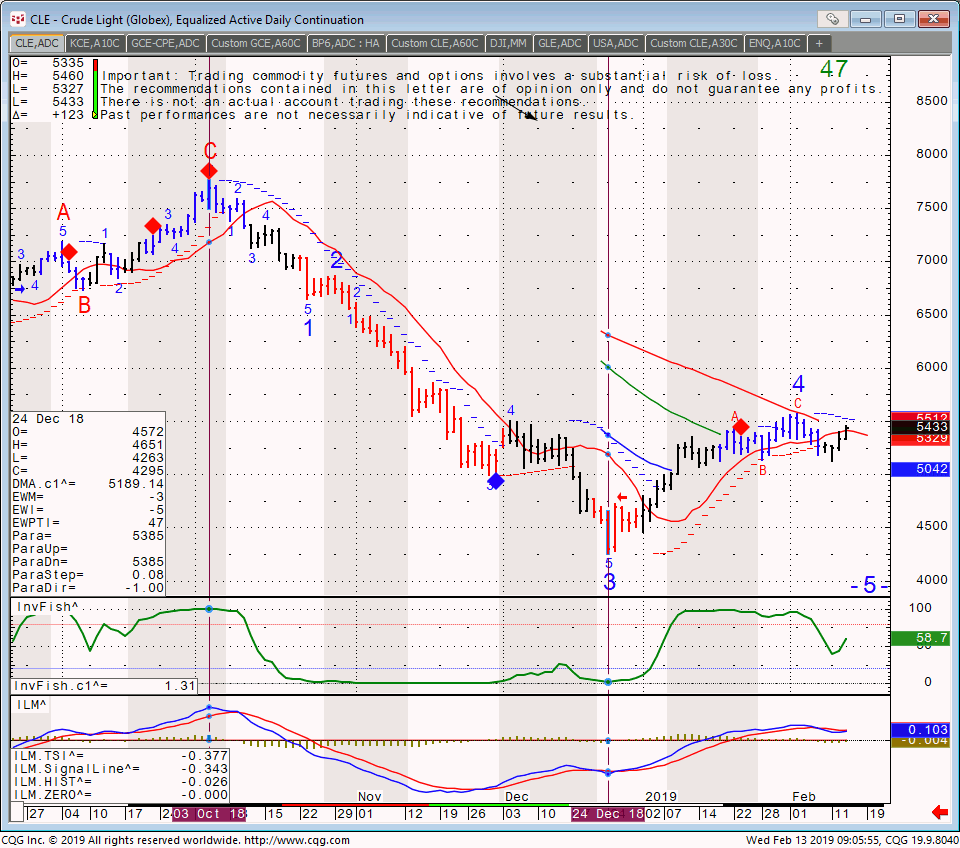
Crude oil futures experienced one of the strongest sell offs to finish 2018. The market sold from the mid 70’s into the mid 40’s in a matter of 7 weeks.

See daily chart below:

CrudeOilChart21319


There were many reasons for the sell off. US China trade talks or lack off, OPEC production, US $ strength and much more but all this is old news at this point and the main focus of futures traders going forward is ”what next?” Before I try to answer that, lets take a look at some key factors that are general in nature to futures trading and crude oil futures trading:

Crude Oil is part of the energy sector along with “it’s” brothers “RBOB – Unleaded gas” and heating oil and cousin, natural gas. All traded on the NYMEX/GLOBEX exchange.

Crude Oil Futures Specs
Hours: 5:00 PM to 4:00 PM next day PM Central Time
Margins: $3410 initial, $3100 Maint. ( as of the date of this newsletter)
Point Value: full point = $1000 ( Example: 71.80 to 72.80 ). Min fluctuation is 0.1 = $10 ( Example: 71.80 to 71.81)
Settlement: Physical, deliverable commodity

Months: Monthly cycle, All Months

Weekly Options: YES
Crude Oil is one of my favorite markets for Day Trading because of the intraday volatility and movements. Be careful, these factors can work against you or in your favor.

Some of the basic fundamentals to keep in mind when you are considering a trade in the crude oil as well as other energies

  1. Longer term view of current market prices
  2.  Dates and times of important reports. Namely, Tuesday afternoon report (API) and the DOE report on Wednesday mornings at 10:30 Am EST
  3. Weather and Seasonality
  4. Correlation to US Dollar prices
  5. Inflationary prospects
  6. Geopolitical Stability
  7. U.S. Fiscal and Monetary Stability

Keep in mind that the GLOBEX/NYMEX also offers the mini Crude oil contract which is half the size and may be a good alternative for smaller/ begginer traders.

MINI Crude Oil Futures Specs
Hours: 5:00 PM to 4:00 PM next day PM Central Time
Margins: $1705 initial, $1550 Maint. ( as of the date of this newsletter)
Point Value: full point = $500 ( Example: 62.80 to 63.80 ). Min fluctuation is 0.25 = $12.5 ( Example: 61.80 to 61.825)
Settlement: Cash Settled commodity one day prior to the Big Contract

Months: Monthly cycle, All Months

So just like when you are trading any commodity or futures contract, one has to ask themselves the following questions in my opinion:

  • What time frame are you trading / looking at? Seconds and minutes? Hours and days or maybe even weeks and months? The answer can definitely impact the type of strategy you will use
  • Do you have a view of the market? Is it going higher? Going lower? Range bound? Is there a trend?
  • What is your personal preference? Risk capital? How much time do you have for following the markets?
  • Are you experienced enough to take a go at it on your own or would you like to chat/ discuss, dissect the markets with a commodity broker, a series 3 licensed futures broker?

If your goal is to scalp and day trade crude oil futures, then take a look at what I consider a timeless piece I wrote a few years back on how to utilize fear and greed to day-trade crude oil futures.

This article has some chart examples and specific trading set ups using crude oil futures trading: Crude Oil Day Trading

Now back to the “million dollar question” – What is next for Crude Oil Futures in the next few weeks?

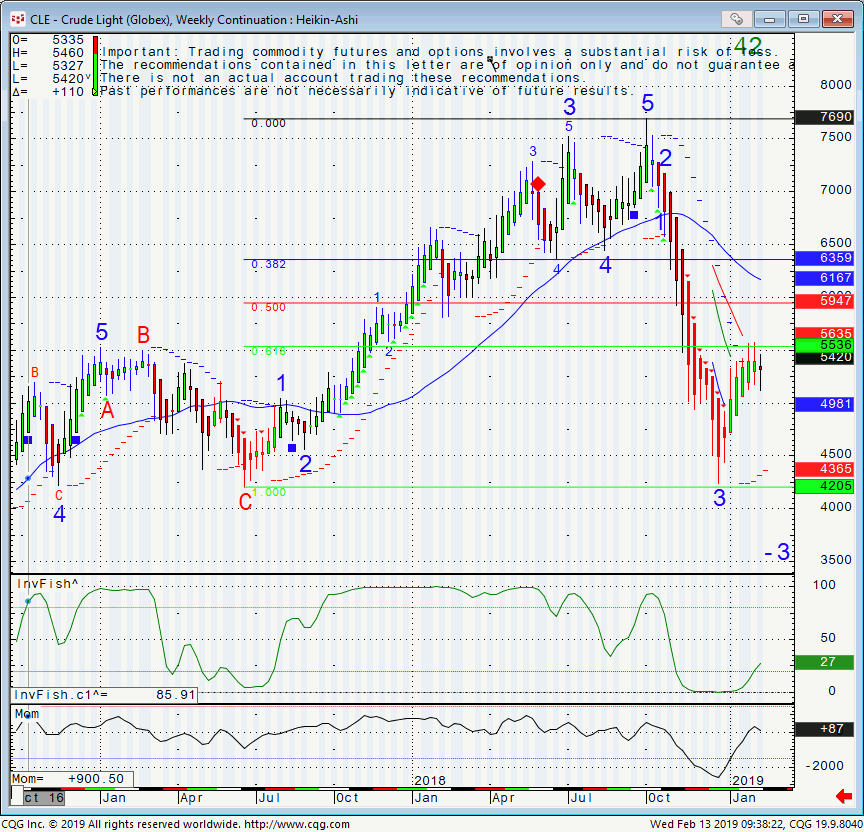
In order to answer that I will look at the daily chart above and then take a look at the weekly chart below:

CrudeOilChart21319weekly

Based on the fact that we had a major sell off that stopped on support levels, the fact that we are bouncing since then and the opinion I hold that crude oil longer term pressure is still down, my current view for this market is that we will see expanded range bound trading. I am looking for the market to trade between $48 and $59 ( hence the word expanded) over the next few weeks and perhaps more BEFORE it may attempt to take another stab at the down side.

“Well, what good is that you may say to yourself…..” If I am right and you are willing to speculate with risk capital, then this information can be valuable.

My preferred method would be to try and sell call options spread ( vertical call spreads) when the market rallies and sell vertical put spreads when the market sells off. Selling options is a risky strategy!! It is not for new commers and you can learn much more here.

The main theory behind selling the calls and the puts is to take advantage of the time decay of options.

As many of us know, geo political events affect the markets in general and crude oil futures in specific. No one can tell what news, wars, events will take place and that is obviously the unknown factor.

I tell my clients many times on different occasions that entering a trade is only the first part of the equation, the main and even more important part is: how to manage the trade? Where do I exit if I am correct? Where should I exit if I am wrong? Should I use multiple contracts? How much am I willing to risk on the trade?

Many ways to trade any market, many ways to lose money in any market and only very few ways to lock in gains – this one is not different. If you need help creating a trading plan, visit our broker assist services.

Disclaimer – Trading Futures, Options on Futures, and retail off-exchange foreign currency transactions involves substantial risk of loss and is not suitable for all investors. Past performance is not indicative of future results. You should carefully consider whether trading is suitable for you in light of your circumstances, knowledge, and financial resources. You may lose all or more of your initial investment. Opinions, market data, and recommendations are subject to change at any time.

Getting Started in Commodity Futures Trading

Getting Started in Commodity Futures Trading


Since 1851, futures trading has been a cornerstone of the U.S. financial markets. However, despite its long history, trading in the futures commodities market has remained elusive to most investors. But it doesn’t have to be, trading in futures poses large risks but also substantial rewards to the level headed and well-studied trader.

The futures market deals in commodities. Originally, these commodities were agricultural, but in today’s market they have expanded to include the basic materials that make up most consumer products. Examples of commodities traded on the futures market are: gas, aluminum, currencies, cotton, gold, wheat, bonds, and oil. A futures contract is essentially a contract between a buyer and seller of one of these commodities, to buy or sell at a specified date and price.
In order to take advantage of the opportunities offered on the futures market, a trader must educate himself in supply and demand analysis. It is crucial to research the market trends of the commodities one wishes to trade in as well as seasonal cycles. Only with thorough research and preparation will a trader be fully positioned to capitalize on the trends of their chosen market.

Helpfully, the advent of electronic trading has leveled the playing field and given traders at home essentially equal access to those on the market floor. Electronic trading platforms allow all investors to guide their own portfolios, while maintaining access to licensed brokers who can assist them.

When beginning in the futures market, it is important to use a demo electronic trading platform before going live into the market. Demos allow traders to fully familiarize themselves with the pace of the market, experiencing the fast rise and fall of daily trends without the risk of actual investment. It is advisable to begin one’s futures portfolio with only 2 or 3 commodities, and demo for at least four weeks before going live. This period of time allows a trader to develop important strategies that will carry him through the market’s storms.

After four weeks of demo trading, a trader should feel confident entering the live market. It is a pitfall to get stuck in demo trading and never jump into a live account, so it’s important to remember that as long as a trader has done his research and closely monitored his demo trades, he should feel more confident in using his live account.

Once live, the most important two things for investors to remember are to trust their research over their emotions, and to avoid overtrading. Futures trading can be extremely volatile, a cool head and moderate hand will get a trader out of trouble.

Futures trading is definitely advanced work, but with the right research, a good strategy, and an ability to stay focused and level headed, a trader can conquer their fears of the market. To get started with futures trading, contact the experts at Cannon Trading!


Disclaimer – Trading Futures, Options on Futures, and retail off-exchange foreign currency transactions involves substantial risk of loss and is not suitable for all investors. Past performance is not indicative of future results. You should carefully consider whether trading is suitable for you in light of your circumstances, knowledge, and financial resources. You may lose all or more of your initial investment. Opinions, market data, and recommendations are subject to change at any time.

How Discount Futures Brokers Saves Your Time and Money

You’ve just decided that it’s time to open a trading account. Maybe you’ve already spent time studying the markets and mapping out your trade strategy – or you’ve put it on your to-do list.

However much time you plan on devoting to this task, or how intently you plan on concentrating on it, you’ll also have another important thing to consider – seriously: who to use as your futures broker. At the most basic level, trading is putting your money at risk – in the hands of a brokerage house responsible for handling your funds and executing/clearing your trades. Those trades will incur commissions and require margin to hold in your account – and all these components call for their own analysis.

If you’ve decided to open an account with a discount broker, it’s presumed you’ll be selecting a trading platform with which you’ll place your own trades, unassisted. As the name implies, commissions for trades placed through a discount broker are less – often meaningfully – than full-service brokers. Commissions are that main fixed cost of trading, so the more trades you make, the higher your fixed costs, the greater the impact on your account’s bottom line. So, certainly you want to be mindful of this aspect of your trading. And to that end, make sure you understand how commissions are quoted, the several elements of a commission and how they’re presented to you overall.

Futures commissions are almost always charged on a per-trade basis and are quoted as “per side.” Two sides – a buy and a sell (in either order) constitute a “round turn. ”The elements of a commission include the exchange fee, the National Futures Association (NFA) fee, the brokerage fee and possibly other fees (routing fees, platform fees, etc.) The bottom line when you’re doing your shopping: understand the total per side / per round turn commission – not leaving out any of its elements – so that you have an accurate assessment of this cost to your trading, so you can compare among those firms with which you’re considering opening your account.

To quote Warren Buffet, “Price is what you pay; value is what you get.” When opening a futures trading account, this translates to: know what you want/need to be the trader you want to be: the features of your trading platform, the availability of your broker, the support the clearing firm provides, the clearing firm’s day-trading margins, whether the clearing firm is staffed with an overnight desk, etc. Find what you want, become comfortable with its costs, open your account, plan your trade and trade your plan.

One last word regarding trading platforms: there’s no argument that placing trades via an online trading platform with instantaneous access to the futures markets is by far the most efficient means of trade execution – compared to dialing up a futures broker, providing verbal trade instructions that the broker needs to listen to, repeat back to you to make sure the order is understood and then place the trade on your behalf. So, look for a trading platform you’re comfortable using. There is a fairly wide range of choices available for you to single out for yourself. Almost all FCM’s offer their own proprietary platforms and they support the many third-party ones available as well.


Trading Futures, Options on Futures, and retail off-exchange foreign currency transactions involves substantial risk of loss and is not suitable for all investors.  You should carefully consider whether trading is suitable for you in light of your circumstances, knowledge, and financial resources. You may lose all or more of your initial investment. Opinions, market data, and recommendations are subject to change at any time.

Trading Crude Oil Futures

Tips for day trading NYMEX crude oil futures

By Ilan Levy-Mayer, VP Cannon Trading Co, Inc.

When it comes to day trading futures contracts, crude oil futures are assumed one of the leading positions as far as trading volume.


During the month of May 2018,  crude oil futures averaged around 1 Million contracts traded per day! That actually surpasses contracts like the ten-year notes, mini SP, mini Nasdaq and others who have traditionally been leaders’ in terms of volume.


Part of the growth in crude oil futures is attributed to day trader participation. Day traders, by definition, will enter and exit their positions during the same trading day. This adds volume to the market traded.


Some of the tips I am sharing below can be applied to most futures contracts as well as other financial products that are traded like stocks, forex, bonds and others. Some of the advice I am sharing is very specific to the crude oil futures trading field.


  1. Know the product you are trading:


  1. Just like a trader who trades a stock like Facebook knows what Facebook does, when its earning reports are due and other factors, so does a crude oil futures day trader needs to know a few facts about crude oil:


  • Contract Size: Crude Oil Futures consist of 1,000 barrels. For the trader this means that each full $1 move in crude futures = $1,000 against you or in your favor.


For example:  A move from 72.10 to 73.10 = $1,000 and a move from 72.10 to 72.11 = $10 (the minimum fluctuation size or the tick size). Be aware that the CME also offers the mini crude contract,  which is half the size.


  • Trading Hours: Crude oil futures trade on the Globex terminal between the hours of 5:00 PM CST the DAY BEFORE to 4:00 PM CST the following day. Which means 23 hours of straight trading. It is important to know that most of the volume will trade between the hours of 8:00 AM CST and 1:30 PM CST, as these hours correspond to the “pit session” of the old trading floor.


Another key aspect to remember is that crude oil is a deliverable commodity and the “front month” will change every 30 days or so. For example: since May 22nd 2018 we have been trading July crude oil.


  • Reports: There are more than a few reports that will affect crude oil future prices indirectly. These include monthly unemployment, the FOMC rate decision, and a few others.


However, there are two major reports that move crude oil futures and its by-products (unleaded gasoline and heating oil) sharply: The API report, which comes out at 3:30 PM CST every Tuesday, and the DOE (Dept. of Energy) inventory numbers, which come out almost every Wednesday at 9:30AM CST.


Take a look at this one-minute chart from Wednesday, May 16th right around the report time below to understand the volatility involved.

chart1

As you can see above, the market made a move of $700 per ONE contract in a matter of minutes, perhaps even seconds! That type of risk and opportunity is one of the factors attracting day-traders into the crude oil market.


  • Geo Political Events: Middle East tensions, the Iran nuclear deal, tensions between Iraq and its neighbors…these are all examples of events that affect crude oil prices. Not to mention OPEC meetings!


  1. Trading Personality:


In my opinion crude oil (like many other markets) will have one of the following 3 modes: trending, two-sided volatility, or Choppy/quiet/range bound trading.


My experience is that crude will more often fall into the first 2 categories:  strong trend or two-sided volatility.  This leads me to my next point below, different trading set-ups.


  1. Trading Set-Ups:


My preferred methods for trading crude are either breakout concept in an attempt to catch a strong move up or down once the market broke some key support or resistance levels, AND/OR counter trend methods to take advantage of when the market is oversold or overbought. Crude does seem to bring more fear and greed out of traders. So looking at RSI levels, for example, and using moving averages ON the RSI to try and get a feel for market reversals are methods worth exploring.


  1. Keep a journal:


Like with any other trading, keep a journal. Take notes on how the market reacted to certain reports, how the markets traded during certain times of the day, and action you took and emotions you had that either helped or hurt you while trading. These notes will help you going forward.


In summary, crude oil futures volume has increased significantly these past few years. The crude oil futures offer traders certain dynamics that other markets may not at certain times. Volatility, fear and greed are key traits for this market. Remember that trading crude oil futures specifically and futures and options in general carries a large degree of risk and is not suitable for all investors. Make sure you consult with a series 3 broker if you never traded this market before. As always, I wish you Good Trading!


Important: Trading commodity futures and options involves a substantial risk of loss.

The recommendations contained in this letter are of opinion only and do not guarantee any profits.

There is not an actual account trading these recommendations.

Past performances are not necessarily indicative of future results.

Trade Systems Results 5.09.2018

____________________________________________________________________

Voted #1 Blog and #1 Brokerage Services on  TraderPlanet   for 2016!!

____________________________________________________________________

Dear Traders,
The Iran nuclear agreement “event” caused quite a bit of intraday volatility in the markets, mostly in crude oil and related energies but also in equities and gold.
As a trader, you must know which reports, events are scheduled and the possible effects they may have on the markets you trade.
keeping a trade journal WILL help.
On a different note:
Browse and view ACTUAL trading results from different trading systems offered at Cannon Trading Co, Inc.
If you like to set up a time and chat/ evaluate any system with a licensed series 3 broker, please contact us.

Continue reading “Trade Systems Results 5.09.2018”

List of First Notice and Last Trading Days for May 5.08.2018

____________________________________________________________________

Voted #1 Blog and #1 Brokerage Services on  TraderPlanet   for 2016!!

____________________________________________________________________

Dear Traders,
Heads up with upcoming first notice and last trading days for various commodities below. Please contact us with any questions:
 
First Notice Day
Contract Month
Contract
1-May
May
ICE Sugar
1-May
May
Orange Juice
1-May
May
London Coffee
30-May
June
Long Gilt (Liffe)
31-May
June
2-Yr. & 5-Yr. Notes
31-May
June
10-Yr. Notes & 30-Yr. Bonds
31-May
June
COMEX & ICE Metals
Last Trading Day
Contract Month
Contract
1-May-18
April
Milk III & Butter
8-May-18
May
Cotton
10-May-18
May
Orange Juice
14-May-18
May
CME Eurodollar
14-May-18
May
Wheat (CBOT, KC, MN)
14-May-18
May
CBOT Corn & Oats
14-May-18
May
Lean Hogs
14-May-18
May
CBOT Soybeans
14-May-18
May
CBOT Soybean Meal & Oil
14-May-18
May
CBOT Rice
14-May-18
May
Canola
15-May-18
May
ICE Cocoa
15-May-18
May
Lumber
15-May-18
May
London Cocoa
18-May-18
May
ICE Coffee
22-May-18
June
NYMEX Crude Oil
24-May-18
May
Feeder Cattle
29-May-18
May
COMEX & ICE Metals
29-May-18
June
NYMEX Natural Gas
29-May-18
June
Live Cattle
30-May-18
May
Milk III & Butter
31-May-18
May
30-Day Fed Funds
31-May-18
June
NYMEX RBOB & Heating Oil
31-May-18
July
ICE Brent Crude Oil
31-May-18
May
London Coffee

Continue reading “List of First Notice and Last Trading Days for May 5.08.2018”