Important Notices – Israel, Iran, PCE Report & More
Futures 101 – The Role of Speculators in Futures Trading
Hot Market of the Week – July Coffee
Broker’s Trading System of the Week – NQ intraday System
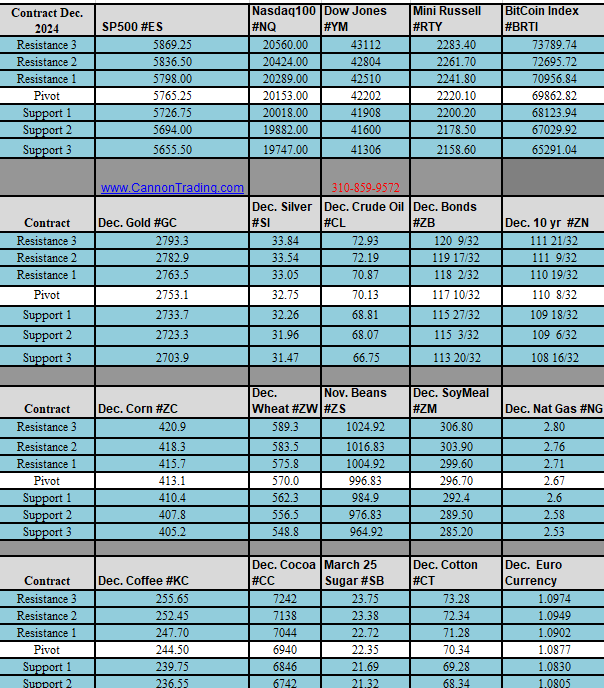
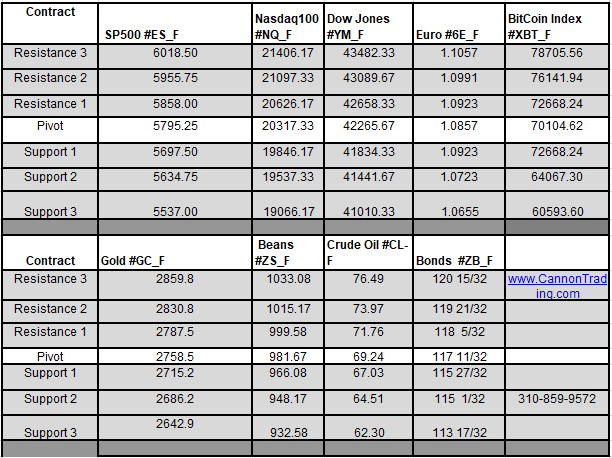
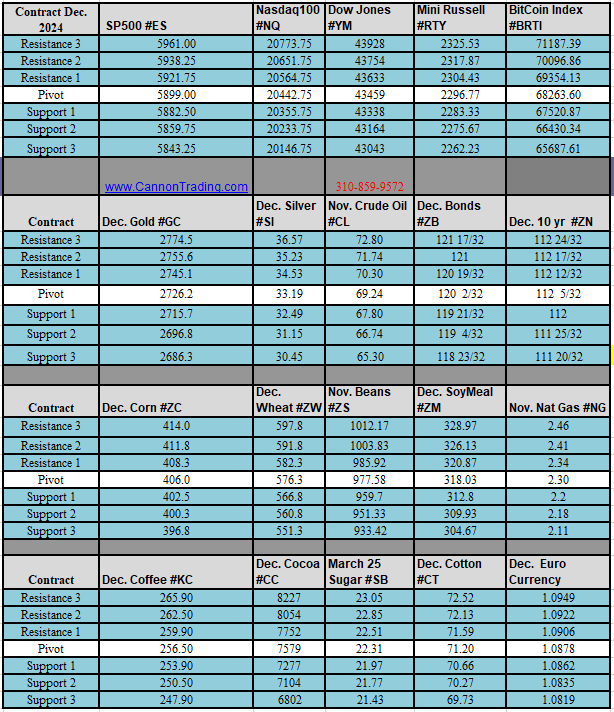
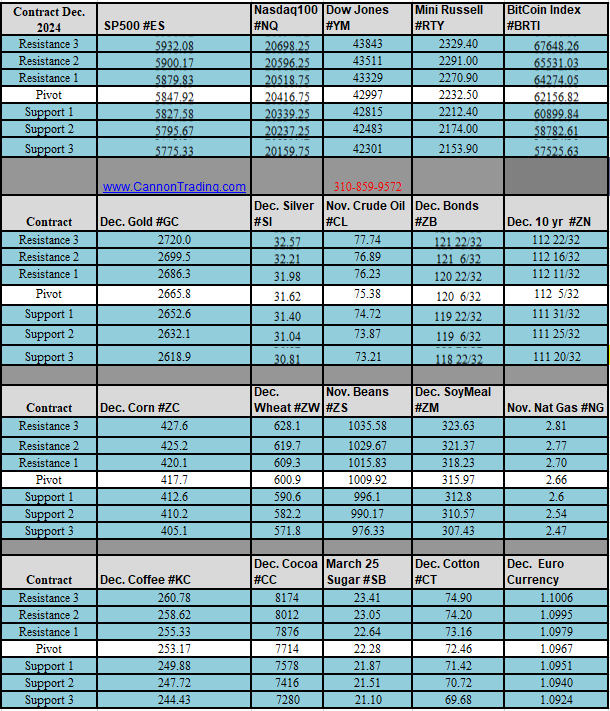
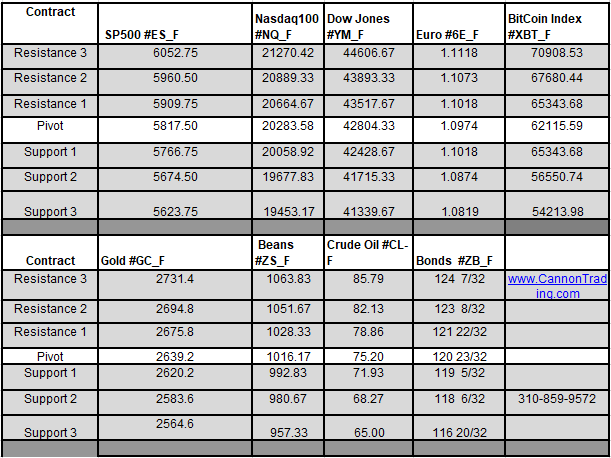
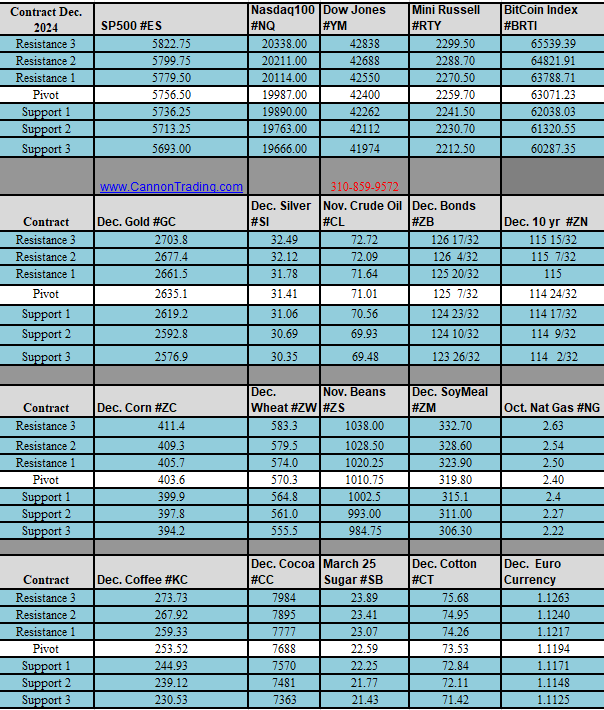
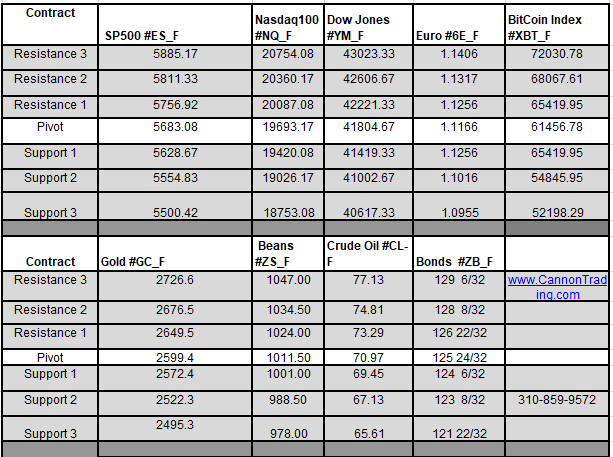
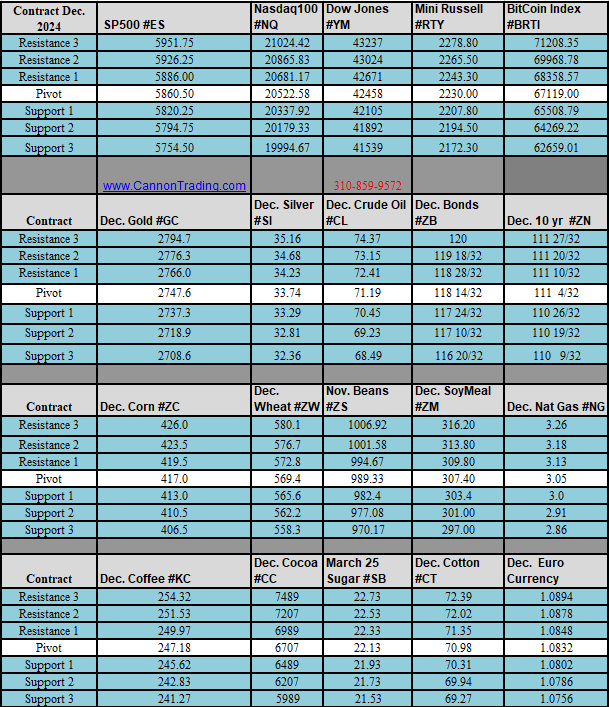
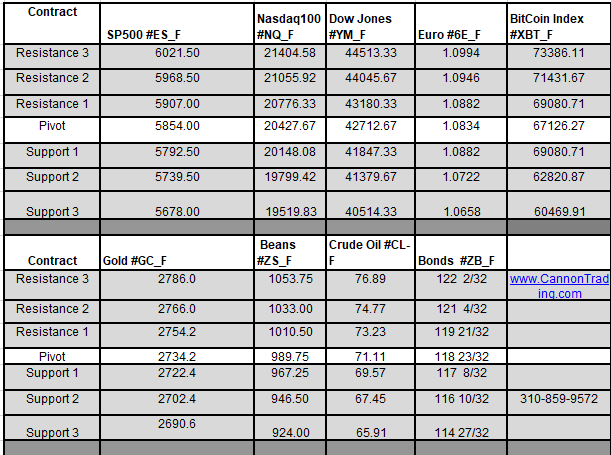
Trading Levels for Next Week
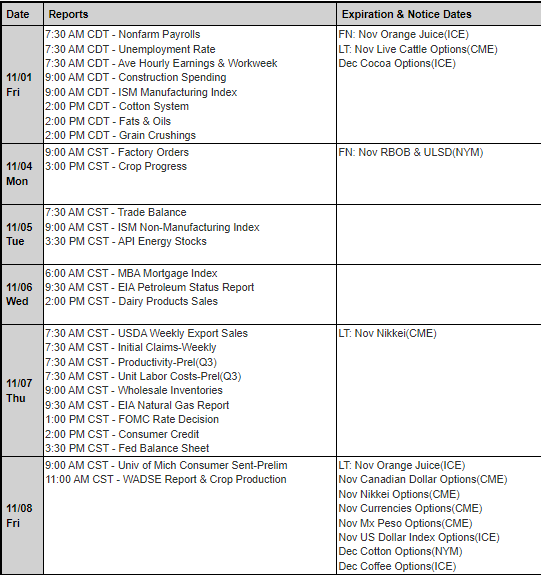
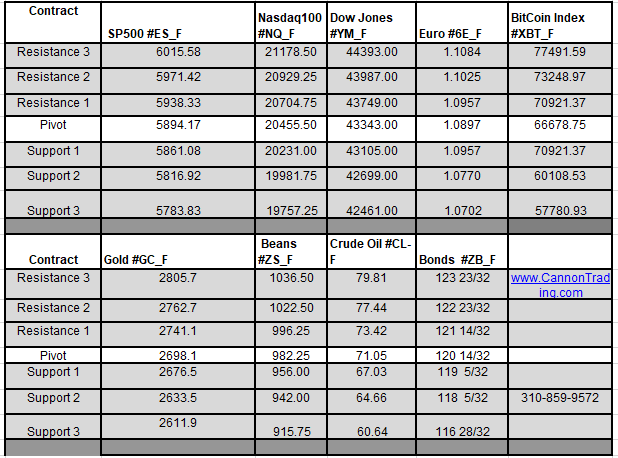
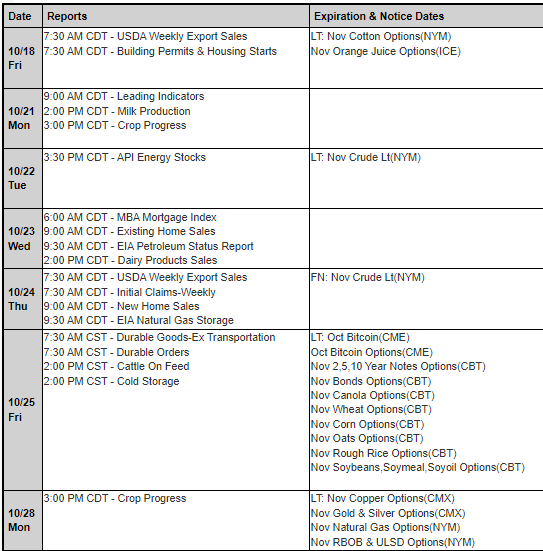
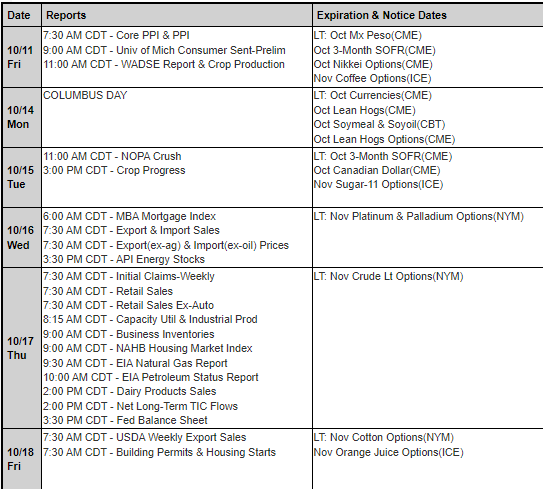
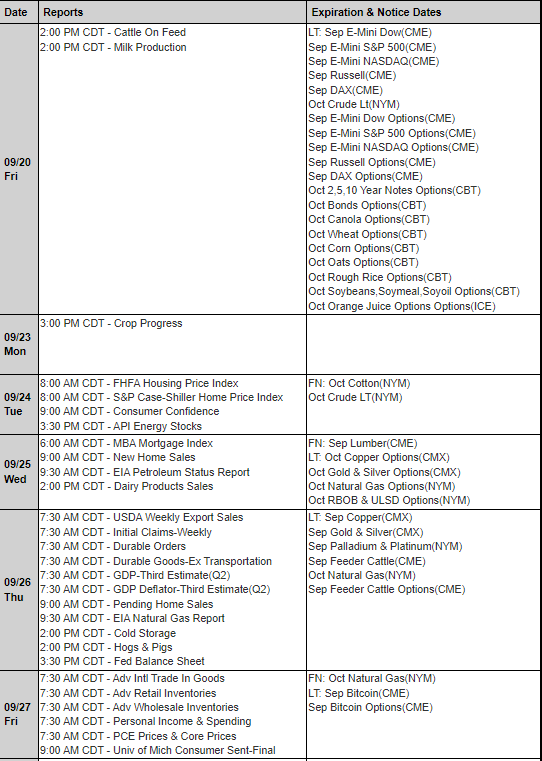
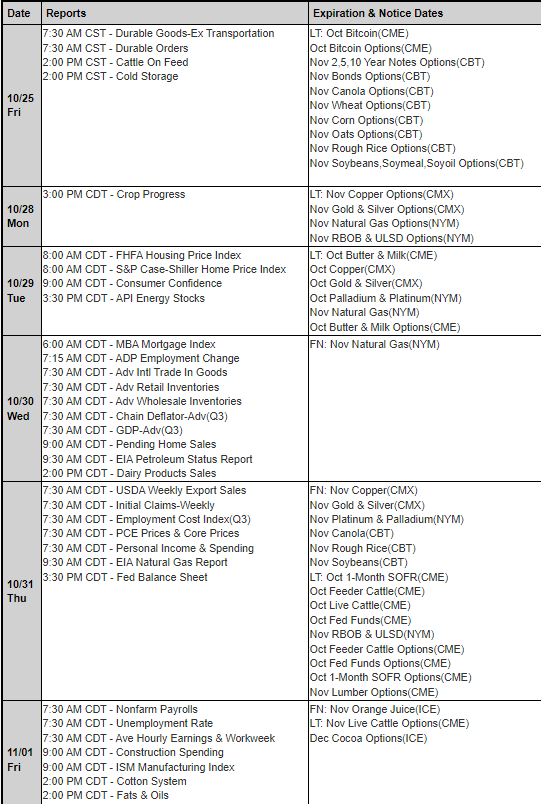
Trading Reports for Next Week
Important Notices –
The situation in the Middle East will loom over the markets next week. More on that below.
Keep an eye on these potential futures market movers:
It was hardly unexpected, but Israel’s missile strike on Iran Friday may foreshadow a dangerous series of tit-for-tat retaliation between the Middle East powers – and unsettle world markets. At the same time, the limited scale of the attack and Iran’s muted response appears so far to signal a successful effort by diplomats who have been working to avert all-out war.
At the outset of Israel’s offensive last night, volatility amplified in key futures markets – stock indexes (S&P 500, Dow, Nasdaq), currencies, energies (crude oil), metals (gold), financials (30-yr. bonds, 10-yr. notes). Into late evening and on into today, there has been a virtual across-the-board drop-off in the inflated price fluctuation seen when news broke of the military action.
GDP and PMI along with homes sales, durable goods and overall a packed week with economic reports.
PCE Friday will provide additional clues as to the future of interest rates
big earnings week MSFT, GOOG, META, XOM, Visa, TSLA
Volatility in Cocoa and Coffee continues. Copper broke higher.
Trading Resource of the Week: Understanding the Role of Speculators
What Are Speculators?
Speculators are primary participants in the futures market. A speculator is any individual or firm that accepts risk in order to make a profit. Speculators can achieve these profits by buying low and selling high. But in the case of the futures market, they could just as easily sell first and later buy at a lower price.
Obviously, this profit objective is easier said than done. Nonetheless, speculators aiming to profit in the futures market come in a variety of types. Speculators can be individual traders, proprietary trading firms, portfolio managers, hedge funds or market makers.
Individual Traders
For individuals trading their own funds, electronic trading has helped to level the playing field by improving access to price and trade information. The speed and ease of trade execution, combined with the application of modern risk management, gives the individual trader access to markets and strategies that were once reserved for institutions.
Proprietary Trading Firms
Proprietary trading firms, also known as prop shops, profit as a direct result of their traders’ activity in the marketplace. These firms supply their traders with the education and capital required to execute a large number of trades per day. By using the capital resources of the prop shop, traders gain access to more capital than they would if they were trading on their own account. They also may have access to the same type of research and strategies developed by larger institutions.
Portfolio or Investment Managers
A portfolio or investment manager is responsible for investing or hedging the assets of a mutual fund, exchange-traded fund or closed-end fund. The portfolio manager implements the fund’s investment strategy and manages the day-to-day trading. Futures markets are often used to increase or decrease the overall market exposure of a portfolio without disrupting the delicate balance of investments that may have taken a significant effort to build.
Hedge Funds
A hedge fund is a managed portfolio of investments that uses advanced investment strategies to maximize returns, either in an absolute sense or relative to a specified market benchmark. The name hedge fund is mostly historical, as the first hedge funds tried to hedge against the risk of a bear market by shorting the market. Today, hedge funds use hundreds of different strategies in an effort to maximize returns. The diverse and highly liquid futures marketplace offer hedge funds the ability to execute large transactions and either increase or decrease the market exposure of their portfolio.
Market Makers
Market makers are trading firms that have contractually agreed to provide liquidity to the markets, continually providing both bids and offers, usually in exchange for a reduction in trading fees. Market makers are important to the trading ecosystem as they help facilitate the movement of large transactions without effecting a substantial change in price. Market makers often profit from capturing the spread, the small difference between the bid and offer prices over a large number of transactions, or by trading related futures markets that they view as being priced to provide opportunity.
Conclusion
All types of speculators bring liquidity to the market place. Providing liquidity is a crucial market function that enables individuals to easily enter or exit the market. Though speculative trading activity generates considerable liquidity, all market players benefit. In contrast to speculators who aim to profit by assuming market risk, some buyers and sellers have a vested interest in the underlying asset of each contact. These market participants aim to offset or eliminate risk and are referred to as hedgers.
Hot Market of the Week – July Coffee
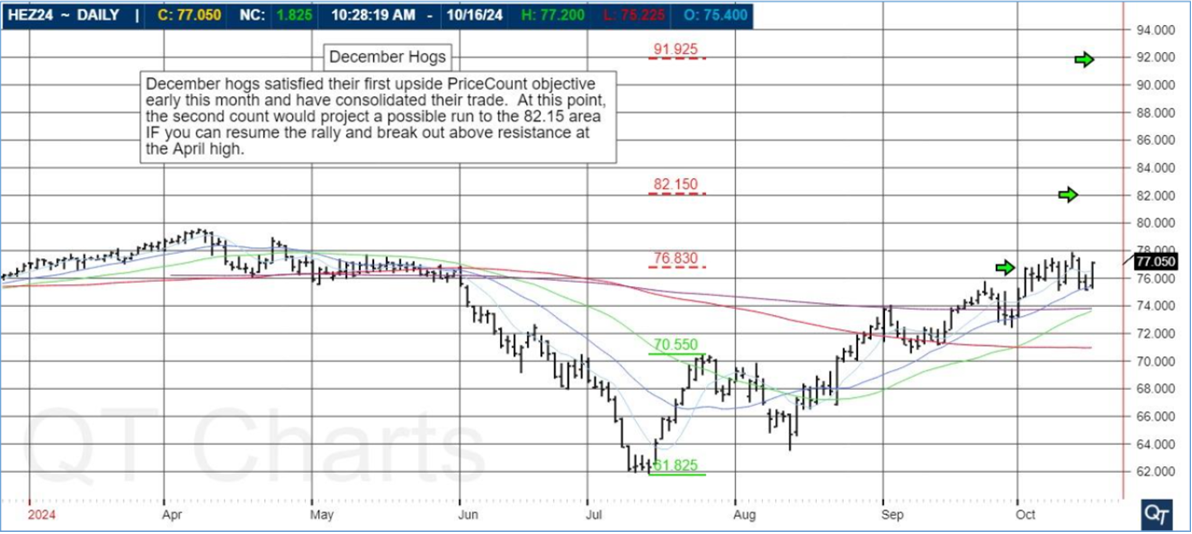
Hot market of the week is provided by QT Market Center, A Swiss army knife charting package that’s not just for Hedgers, Cooperatives and Farmers alike but also for Spread traders, Swing traders and shorter time frame application for intraday traders with a unique proprietary indicator that can be applied to your specific trading needs.
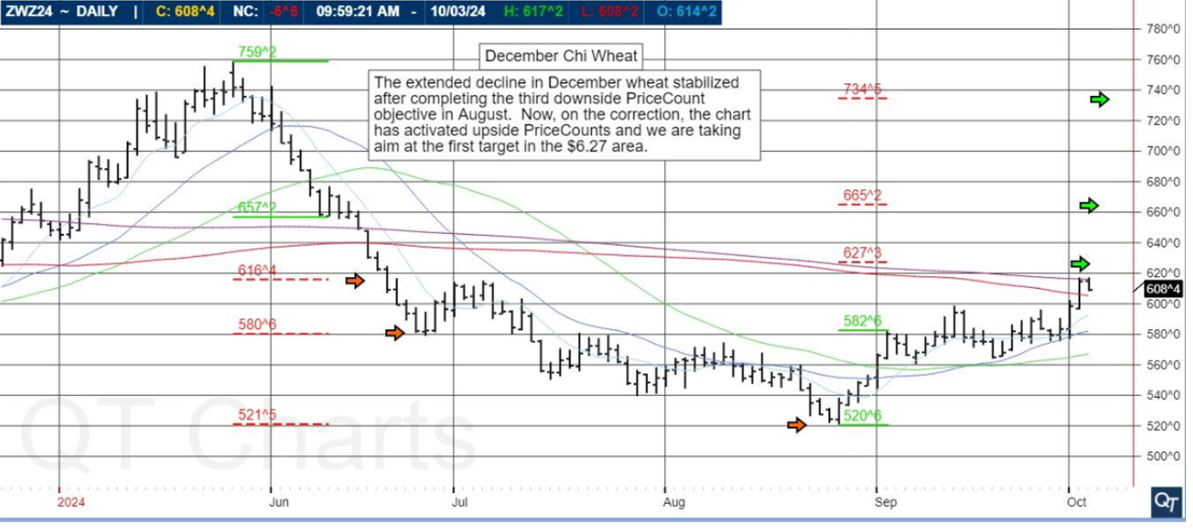
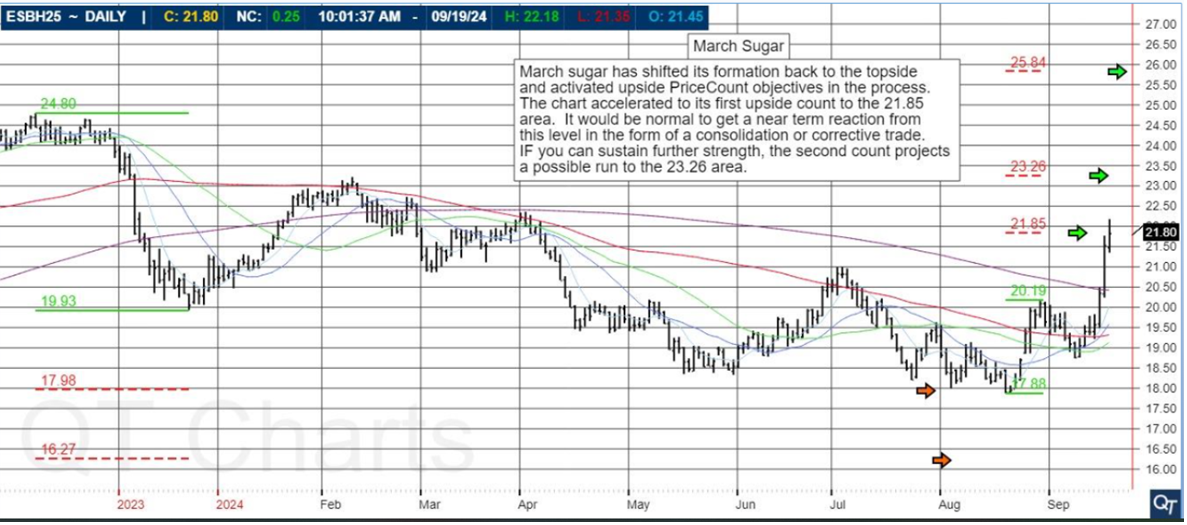
July Coffee satisfied its third upside PriceCount objective in where it would be normal to get a near term reaction in the form of a consolidation or corrective trade, at least. At this point, IF the chart can sustain additional upside we are left with thelow percentage fourth count to aim for just above $300.
PriceCounts – Not about where we’ve been , but where we might be going next!
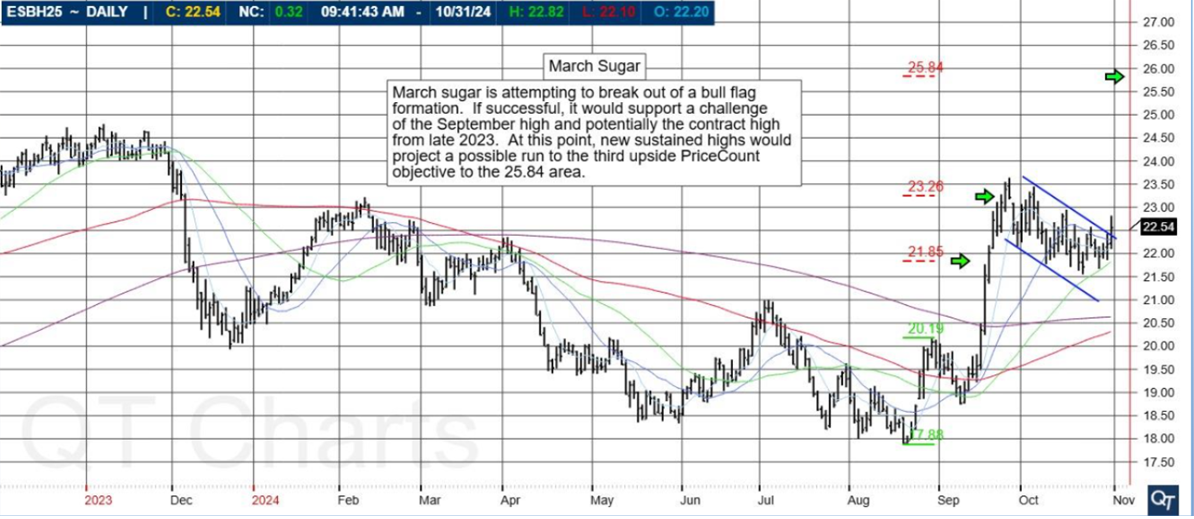
The PriceCount study is a tool that can help to project the distance of a move in price. The counts are not intended to be an ‘exact’ science but rather offer a target area for the four objectives which are based off the first leg of a move with each subsequent count having a smaller percentage of being achieved. It is normal for the chart to react by correcting or consolidating at an objective and then either resuming its move or reversing trend. Best utilized in conjunction with other technical tools, PriceCounts offer one more way to analyze charts and help to manage your positions and risk. Learn more at www.qtchartoftheday.com
Trading in futures, options, securities, derivatives or OTC products entails significant risks which must be understood prior to trading and may not be appropriate for all investors. Past performance of actual trades or strategies is not necessarily indicative of future results.
Broker’s Trading System of the Week
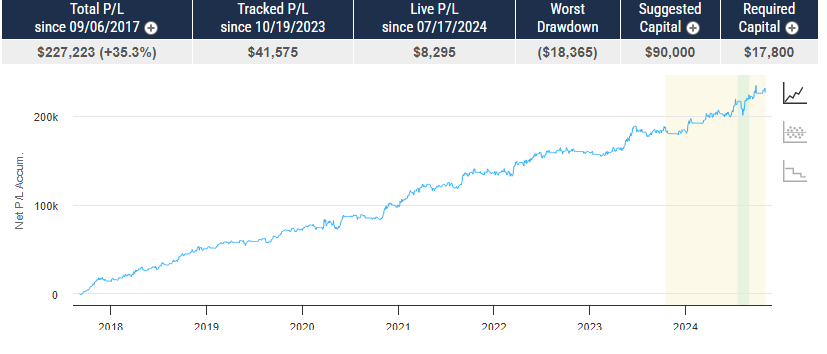
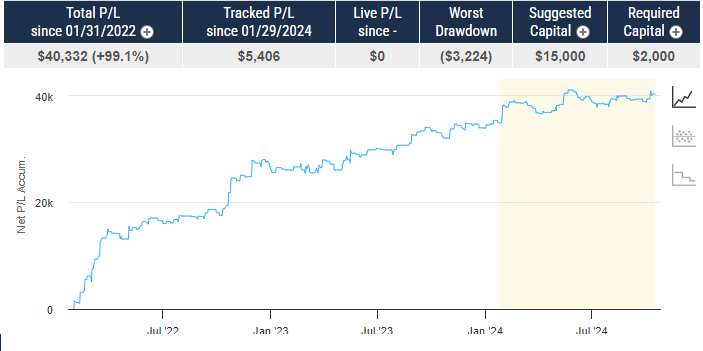
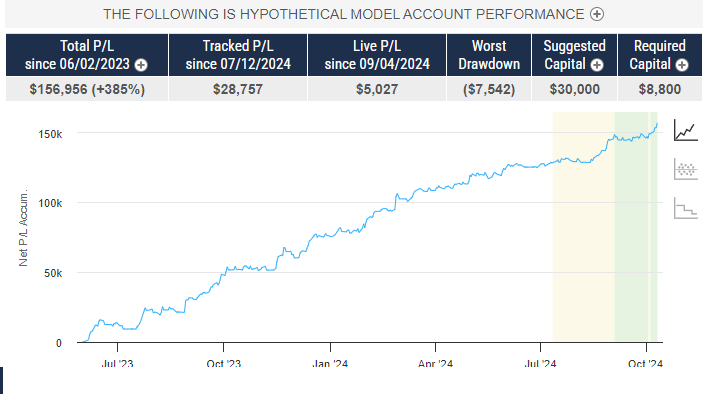
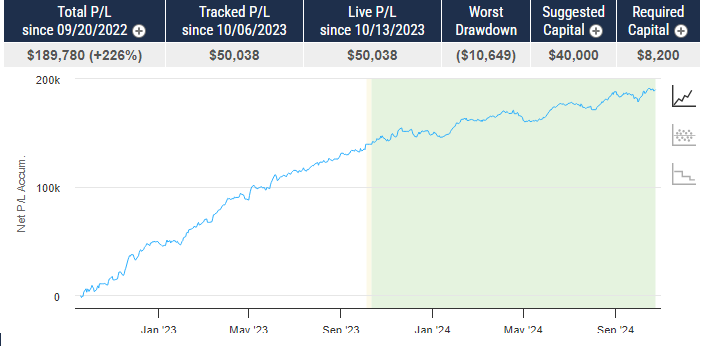
With algorithmic trading systems becoming more prevalent in portfolio diversification, the following system has been selected as the broker’s choice for this month.
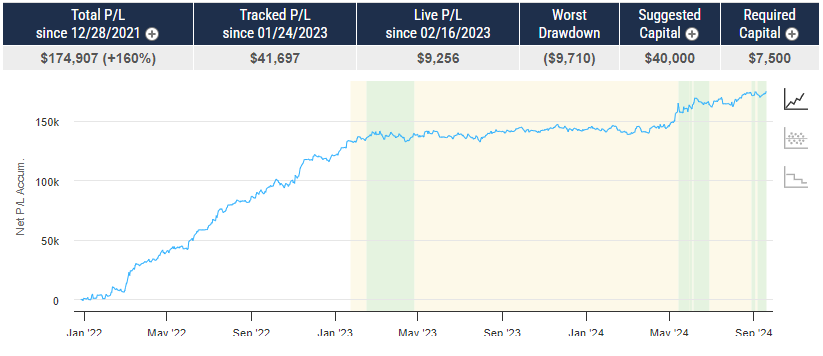
The performance shown above is hypothetical in that the chart represents returns in a model account. The model account rises or falls by the average single contract profit and loss achieved by clients trading actual money pursuant to the listed system’s trading signals on the appropriate dates (client fills), or if no actual client profit or loss available – by the hypothetical single contract profit and loss of trades generated by the system’s trading signals on that day in real time (real‐time) less slippage, or if no real time profit or loss available – by the hypothetical single contract profit and loss of trades generated by running the system logic backwards on back adjusted data. Please read full disclaimer HERE.
Would you like to receive daily support & resistance levels?
* This is not a solicitation of any order to buy or sell, but a current market view provided by Cannon Trading Inc. Any statement of facts here in contained are derived from sources believed to be reliable, but are not guaranteed as to accuracy, nor they purport to be complete. No responsibility is assumed with respect to any such statement or with respect to any expression of opinion herein contained. Readers are urged to exercise their own judgement in trading.

Econ Data Mon- Retail Sales , Tues Housing Starts, Bldg Permits , Thu. Jobless claims, Existing home sales..
quiet on the fed speaker front
No Congressional action to speak of
The U.S. dollar index this morning forged another higher high and reached the highest level since early November.
With the June gold futures contract breaking a string of new all-time highs (eight straight days) yesterday, the market is facing the first definitive corrective environment since the middle of last month.
The bearish sentiment in financial futures (30-yr. T-bond, 10-yr. T-note) is escalating dramatically and could become overdone soon with some chatter in the market suggesting there might not be a single rate cuts this year.
Crude oil may see support this week from renewed talk of an imminent Iranian retaliation (as per U.S. officials) for the Israeli attack in Syria. U.S. officials have openly suggested Iranian retaliation against Israel is likely soon. Fears of disrupted supply remain front and center.
Trading Resource of the Week: Trading Videos, Instant Viewing
Watch a series of short videos, where our VP, Ilan Levy-Mayer shares his personal preferences and opinions on different trading topics.
· Ever wondered when to exit a trade? Take a look at what Ilan has to share on Bollinger Bands and a study called PARABOLICS
· Some common uses you can make of support and resistance levels.
Hot market of the week is provided by QT Market Center, A Swiss army knife charting package that’s not just for Hedgers, Cooperatives and Farmers alike but also for Spread traders, Swing traders and shorter time frame application for intraday traders with a unique proprietary indicator that can be applied to your specific trading needs.
The March 20th Chart of the Day highlighted May crude oil had completed its first upside PriceCount objective. Now, the chart is consolidating after satisfying its second upside PriceCount objective. A this point, IF the chart can sustain further gains, the third count would project a possible run to the 94.82 area.
PriceCounts – Not about where we’ve been , but where we might be going next!
The PriceCount study is a tool that can help to project the distance of a move in price. The counts are not intended to be an ‘exact’ science but rather offer a target area for the four objectives which are based off the first leg of a move with each subsequent count having a smaller percentage of being achieved. It is normal for the chart to react by correcting or consolidating at an objective and then either resuming its move or reversing trend. Best utilized in conjunction with other technical tools, PriceCounts offer one more way to analyze charts and help to manage your positions and risk. Learn more at www.qtchartoftheday.com
Trading in futures, options, securities, derivatives or OTC products entails significant risks which must be understood prior to trading and may not be appropriate for all investors. Past performance of actual trades or strategies is not necessarily indicative of future results.
Broker’s Trading System of the Week
With algorithmic trading systems becoming more prevalent in portfolio diversification, the following system has been selected as the broker’s choice for this month.
The performance shown above is hypothetical in that the chart represents returns in a model account. The model account rises or falls by the average single contract profit and loss achieved by clients trading actual money pursuant to the listed system’s trading signals on the appropriate dates (client fills), or if no actual client profit or loss available – by the hypothetical single contract profit and loss of trades generated by the system’s trading signals on that day in real time (real‐time) less slippage, or if no real time profit or loss available – by the hypothetical single contract profit and loss of trades generated by running the system logic backwards on back adjusted data. Please read full disclaimer HERE.
Would you like to receive daily support & resistance levels?
* This is not a solicitation of any order to buy or sell, but a current market view provided by Cannon Trading Inc. Any statement of facts here in contained are derived from sources believed to be reliable, but are not guaranteed as to accuracy, nor they purport to be complete. No responsibility is assumed with respect to any such statement or with respect to any expression of opinion herein contained. Readers are urged to exercise their own judgement in trading.
Important Notices – Earnings Season Starts April 12th
Trading Resource of the Week – About Contract Notional Value
Hot Market of the Week – May Copper
Broker’s Trading System of the Week – RBOB Swing System
Trading Levels for Next Week
Trading Reports for Next Week
Important Notices –
Market Moving Data Wed. /Thur. CPI and PPI respectively , w/Jobless Claims Thur. as well
1 Fed discussion RE: new BASEL lll requirements Wed. AM (raises min. Cap Req from 2% to 4.5% for all banks)
AG WASDE Thur.
Q1 Earnings Season Begins Fri. the 12th Bank Earnings, JPM, C, WFC, BLK all report on this day.
Trading Resource of the Week : About Contract Notional Value by CMEgroup.com
Contract Unit
The contract unit is a standardized size unique to each futures contract and can be based on volume, weight, or a financial measurement, depending on the contract and the underlying product or market.
For example, a single COMEX Gold contract unit (GC) is 100 troy ounces, which is measured by weight.
A NYMEX WTI Crude Oil contract unit (CL) is 1,000 barrels of oil, measured by volume.
The E-mini S&P 500 contract unit (ES) is a financial calculation based on a fixed multiplier times the S&P 500 Index.
Contract Notional Value
Contract notional value, also known as contract value, is the financial expression of the contract unit and the current futures contract price.
Determining Notional Value
Assume a Gold futures contract is trading at price of $1,000. The notional value of the contract is calculated by multiplying the contract unit by the futures price.
Contract unit x contract price = notional value
100 (troy ounces) x $1,000 = $100,000
If WTI Crude Oil is trading at $50 dollars and the contract unit is 1000 barrels, the notional would be;
$50 x 1,000 = $50,000
Now assume E-mini S&P 500 futures are trading at 2120.00. The multiplier for this contract is $50.
$50 x 2120.00 = $106,000
Hot Market of the Week – May Copper
Hot market of the week is provided by QT Market Center, A Swiss army knife charting package that’s not just for Hedgers, Cooperatives and Farmers alike but also for Spread traders, Swing traders and shorter time frame application for intraday traders with a unique proprietary indicator that can be applied to your specific trading needs.
May copper is completing its third upside PriceCount objective that is consistent with a challenge of the contract high. It would be normal to get a reaction in the form of a near term consolidation or corrective trade, at least, from this level. From here, IF the chart can sustain further gains, we are left with the low percentage fourth upside count to the 4.94 area to aim for (not shown here for presentation purposes).
PriceCounts – Not about where we’ve been , but where we might be going next!
The PriceCount study is a tool that can help to project the distance of a move in price. The counts are not intended to be an ‘exact’ science but rather offer a target area for the four objectives which are based off the first leg of a move with each subsequent count having a smaller percentage of being achieved. It is normal for the chart to react by correcting or consolidating at an objective and then either resuming its move or reversing trend. Best utilized in conjunction with other technical tools, PriceCounts offer one more way to analyze charts and help to manage your positions and risk. Learn more at www.qtchartoftheday.com
Trading in futures, options, securities, derivatives or OTC products entails significant risks which must be understood prior to trading and may not be appropriate for all investors. Past performance of actual trades or strategies is not necessarily indicative of future results.
Broker’s Trading System of the Week
With algorithmic trading systems becoming more prevalent in portfolio diversification, the following system has been selected as the broker’s choice for this month.
The performance shown above is hypothetical in that the chart represents returns in a model account. The model account rises or falls by the average single contract profit and loss achieved by clients trading actual money pursuant to the listed system’s trading signals on the appropriate dates (client fills), or if no actual client profit or loss available – by the hypothetical single contract profit and loss of trades generated by the system’s trading signals on that day in real time (real‐time) less slippage, or if no real time profit or loss available – by the hypothetical single contract profit and loss of trades generated by running the system logic backwards on back adjusted data. Please read full disclaimer HERE.
Would you like to receive daily support & resistance levels?
* This is not a solicitation of any order to buy or sell, but a current market view provided by Cannon Trading Inc. Any statement of facts here in contained are derived from sources believed to be reliable, but are not guaranteed as to accuracy, nor they purport to be complete. No responsibility is assumed with respect to any such statement or with respect to any expression of opinion herein contained. Readers are urged to exercise their own judgement in trading.
6 Data releases: New home sales, Durable Goods, Consumer Confidence, GDP (Q4 final), Jobless Claims, Chicago PMI
Grain traders! Big Prospective plantings report Thursday Morning.
Night Traders, WATCHOUT for volatility Wednesday and Sunday. Fed Speaker Waller: Econ. Outlook 6PM EDT. Jerome Powell Friday Morning 11:30 EDT @SF Monetary Policy Conference.
Trading Resource of the Week : Understanding Margins by CMEgroup.com
Understanding Margin
Securities margin is the money you borrow as a partial down payment, up to 50% of the purchase price, to buy and own a stock, bond, or ETF. This practice is often referred to as buying on margin.
Futures margin is the amount of money that you must deposit and keep on hand with your broker when you open a futures position. It is not a down payment and you do not own the underlying commodity.
Futures margin generally represents a smaller percentage of the notional value of the contract, typically 3-12% per futures contract as opposed to up to 50% of the face value of securities purchased on margin.
Margins Move with the Markets
When markets are changing rapidly and daily price moves become more volatile, market conditions and the clearinghouses’ margin methodology may result in higher margin requirements to account for increased risk.
When market conditions and the margin methodology warrant, margin requirements may be reduced.
Types of Futures Margin
Initial margin is the amount of funds required by CME Clearing to initiate a futures position. While CME Clearing sets the margin amount, your broker may be required to collect additional funds for deposit.
Maintenance margin is the minimum amount that must be maintained at any given time in your account.
If the funds in your account drop below the maintenance margin level, a few things can happen:
You may receive a margin call where you will be required to add more funds immediately to bring the account back up to the initial margin level.
If you do not or can not meet the margin call, you may be able to reduce your position in accordance with the amount of funds remaining in your account.
Your position may be liquidated automatically once it drops below the maintenance margin level.
Summary
Futures margin is the amount of money that you must deposit and keep on hand with your broker when you open a futures position. It is not a down payment, and you do not own the underlying commodity.
The term margin is used across multiple financial markets. However, there is difference between securities margins and futures margins. Understanding these differences is essential, prior to trading futures contracts.
Hot Market of the Week – May Bean Meal
Hot market of the week is provided by QT Market Center, A Swiss army knife charting package that’s not just for Hedgers, Cooperatives and Farmers alike but also for Spread traders, Swing traders and shorter time frame application for intraday traders with a unique proprietary indicator that can be applied to your specific trading needs.
May meal satisfied its first upside PriceCount objective and is correcting lower. At this point, IF the chart can resume its rally with new sustained highs, the second count would project a possible run to the 356.5 area.
PriceCounts – Not about where we’ve been , but where we might be going next!
The PriceCount study is a tool that can help to project the distance of a move in price. The counts are not intended to be an ‘exact’ science but rather offer a target area for the four objectives which are based off the first leg of a move with each subsequent count having a smaller percentage of being achieved. It is normal for the chart to react by correcting or consolidating at an objective and then either resuming its move or reversing trend. Best utilized in conjunction with other technical tools, PriceCounts offer one more way to analyze charts and help to manage your positions and risk. Learn more at www.qtchartoftheday.com
Trading in futures, options, securities, derivatives or OTC products entails significant risks which must be understood prior to trading and may not be appropriate for all investors. Past performance of actual trades or strategies is not necessarily indicative of future results.
Broker’s Trading System of the Week
With algorithmic trading systems becoming more prevalent in portfolio diversification, the following system has been selected as the broker’s choice for this month.
The performance shown above is hypothetical in that the chart represents returns in a model account. The model account rises or falls by the average single contract profit and loss achieved by clients trading actual money pursuant to the listed system’s trading signals on the appropriate dates (client fills), or if no actual client profit or loss available – by the hypothetical single contract profit and loss of trades generated by the system’s trading signals on that day in real time (real‐time) less slippage, or if no real time profit or loss available – by the hypothetical single contract profit and loss of trades generated by running the system logic backwards on back adjusted data. Please read full disclaimer HERE.
Would you like to receive daily support & resistance levels?
* This is not a solicitation of any order to buy or sell, but a current market view provided by Cannon Trading Inc. Any statement of facts here in contained are derived from sources believed to be reliable, but are not guaranteed as to accuracy, nor they purport to be complete. No responsibility is assumed with respect to any such statement or with respect to any expression of opinion herein contained. Readers are urged to exercise their own judgement in trading.
Trading Resource of the Week – Understanding Price Limits and Banding
Hot Market of the Week – May Bean Oil
Broker’s Trading System of the Week – Gold Swing System
Trading Levels for Next Week
Trading Reports for Next Week
Important Notices –
FOMC Meeting next week. Announcement on Wednesday.
Light data most of the week. Housing sales
Very few earnings
June is front month for indices, currencies and financials.: M = June
USA is on daylight savings time – most international countries have NOT changed yet.
Trading Resource of the Week : What are Price Limits and Price Banding? by CMEgroup.com
As a trader, you want to know that there are mechanisms in place to ensure an orderly market. A regulated marketplace like CME Group provides this order by setting price limits and price banding.
Price Limits
Price limits are the maximum price range permitted for a futures contract in each trading session. These price limits are measured in ticks and vary from product to product. When markets hit the price limit, different actions occur depending on the product being traded. Some markets may temporarily halt until price limits can be expanded or trading may be stopped for the day based on regulatory rules. Different futures contracts will have different price limit rules; i.e. Equity Index futures have different rules than Agricultural futures.
Example
Equity Indexes futures have a three level expansion: 7%, 13% and 20% to the downside, and a 7% limit up and down in overnight trading.
When price reaches any of those levels the market will go limit up or limit down.
Calculating Price Limits
Price limits are re-calculated daily and remain in effect for all trading days except in certain physically-deliverable markets, where price limits are lifted prior to expiration so that futures prices are not prevented from converging on prices for the underlying commodity.
Typically, Agricultural futures will go limit up or down most often compared to Equity Index futures which very rarely if ever go limit up or down. When trading a specific product, it is important to be aware of price limits and the mechanisms that occur when limits are hit. Traders also know that it is possible for limits to be reached for more than one session in a row, however the expansion of limit thresholds over the last few years have reduced this occurrence.
Price Banding
Price banding is a similar mechanism which subjects all orders to price validation and rejects orders outside the given band to maintain orderly markets. Bands are calculated dynamically for each product based on the last price, plus or minus a fixed band value. Thus, if markets quickly move in one direction, the price bands dynamically adjust to accommodate new trading ranges.
Conclusion
The rules for each market can be found on cmegroup.com.
It is important to note that traders can place trades outside the daily price limits. These trades will be executed when price limits and price bands move within the specified range. So, traders still have the ability to place good-til-canceled or good-til-date orders inside and outside daily price limits.
In the last few years there are fewer and fewer times that markets will actually go limit up or down, but it is important to be aware of these pricing rules when you trade.
Hot Market of the Week – May Bean Oil
Hot market of the week is provided by QT Market Center, A Swiss army knife charting package that’s not just for Hedgers, Cooperatives and Farmers alike but also for Spread traders, Swing traders and shorter time frame application for intraday traders with a unique proprietary indicator that can be applied to your specific trading needs.
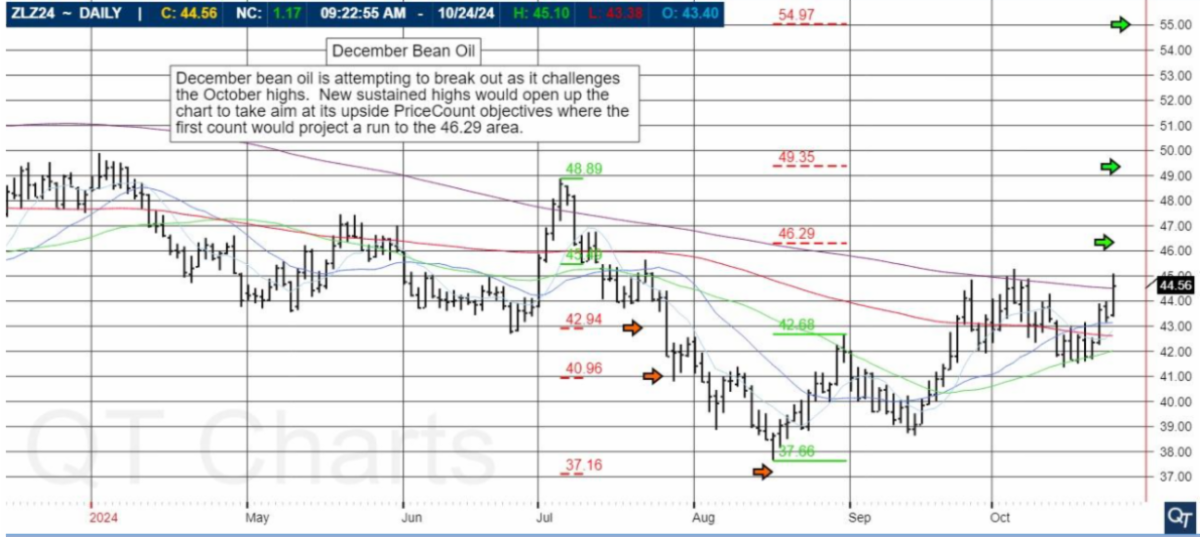
The rally in May soybean oil accelerated to its second upside PriceCount objective and now the chart is correcting. At this point, IF you can resume the rally with new sustained highs, the third count would project a possible run to the 50.87 area.
PriceCounts – Not about where we’ve been , but where we might be going next!
The PriceCount study is a tool that can help to project the distance of a move in price. The counts are not intended to be an ‘exact’ science but rather offer a target area for the four objectives which are based off the first leg of a move with each subsequent count having a smaller percentage of being achieved. It is normal for the chart to react by correcting or consolidating at an objective and then either resuming its move or reversing trend. Best utilized in conjunction with other technical tools, PriceCounts offer one more way to analyze charts and help to manage your positions and risk. Learn more at www.qtchartoftheday.com
Trading in futures, options, securities, derivatives or OTC products entails significant risks which must be understood prior to trading and may not be appropriate for all investors. Past performance of actual trades or strategies is not necessarily indicative of future results.
Broker’s Trading System of the Week
With algorithmic trading systems becoming more prevalent in portfolio diversification, the following system has been selected as the broker’s choice for this month.
The performance shown above is hypothetical in that the chart represents returns in a model account. The model account rises or falls by the average single contract profit and loss achieved by clients trading actual money pursuant to the listed system’s trading signals on the appropriate dates (client fills), or if no actual client profit or loss available – by the hypothetical single contract profit and loss of trades generated by the system’s trading signals on that day in real time (real‐time) less slippage, or if no real time profit or loss available – by the hypothetical single contract profit and loss of trades generated by running the system logic backwards on back adjusted data. Please read full disclaimer HERE.
Would you like to receive daily support & resistance levels?
* This is not a solicitation of any order to buy or sell, but a current market view provided by Cannon Trading Inc. Any statement of facts here in contained are derived from sources believed to be reliable, but are not guaranteed as to accuracy, nor they purport to be complete. No responsibility is assumed with respect to any such statement or with respect to any expression of opinion herein contained. Readers are urged to exercise their own judgement in trading.
Trading Resource of the Week – Trade Alerts Via Email/Text
Hot Market of the Week – May Wheat
Broker’s Trading System of the Week – MidCap SP Swing System
Trading Levels for Next Week
Trading Reports for Next Week
Important Notices –
FED Blackout Period Begins Sat. 9th, lasts for 9 business days
A smattering of earnings. Mostly Microcap to Midcap: Adobe Reports
Tuesday and Thursday Data: CPI, Jobless claim , Retail sales and PPI
Begin Trading June indices if you haven’t already: M = June
Spring your Clocks forward for those countries that subscribe to Daylight Savings.
Trading Resource of the Week : Understanding Open Interest by CMEgroup.com
Understanding Open Interest
Open interest is the total number of futures contracts held by market participants at the end of the trading day. It is used as an indicator to determine market sentiment and the strength behind price trends.
Unlike the total issued shares of a company, which typically remain constant, the number of outstanding futures contracts varies from day to day.
Open interest is calculated by adding all the contracts from opened trades and subtracting the contracts when a trade is closed.
For example, Sharon, Cynthia and Kurt are trading the same futures contract. If Sharon buys one contract to enter a long trade, open interest increases by one. Cynthia also goes long and buys six contracts, thereby increasing open interest to seven. If Kurt decides to short the market and sells three contracts, open interest again increases to 10.
Open interest would remain at 10 until the traders exit their positions, at which point open interest declines. For example, open interest declines to nine when Sharon sells one contract. When Kurt decides to exit his position, he buys back his three contracts and brings open interest down to six. At this point, until Cynthia decides to sell her six contracts, open interest will remain constant at six.
Open interest and volume are related concepts, one key difference is that volume counts all contracts that have been traded, while open interest is a total of contracts that remain open in the market.
Traders can think of open interest as the cash flowing to the market. As open interest increases, more money is moving into the futures contract and as open interest declines money is moving out of the futures contract.
CME Group products with the largest open interest include Eurodollars, Treasuries and stock index futures.
Open Interest Analysis
Analysts typically use open interest to confirm the strength of a trend. Increasing open interest is typically a confirmation of the trend whereas decreasing open interest can be a signal that the trend is losing strength.
The idea is that traders are supporting the trend by entering the market that increases the open interest. As traders lose faith in the trend they exit the market and open interest declines.
Open interest data is published at the end of each day. Additionally, every Friday afternoon, the CFTC publishes a report called the Commitment of Traders.
This report details open interest from different classes of market participants and whether they are holding a long or short position. This breakdown offers valuable insights into what producers, merchants, processors, users, swap dealers and money managers are doing in the market for a futures contract.
Open interest is one variable that many futures traders use in their analysis of the markets used in conjunction with other analysis to support trade decisions. Large changes in open interest can be an indicator when certain participants are entering or leaving the market and may give clues to market direction.
Hot Market of the Week – May Wheat
Hot market of the week is provided by QT Market Center, A Swiss army knife charting package that’s not just for Hedgers, Cooperatives and Farmers alike but also for Spread traders, Swing traders and shorter time frame application for intraday traders with a unique proprietary indicator that can be applied to your specific trading needs.
May wheat in Chicago broke down into a new contract low yesterday where the chart satisfied its third downside PriceCount objective. It would be normal to get a near term reaction from this level in the form of a consolidation or corrective trade, at least. At this point, IF you can sustain further weakness, we are left with the low percentage fourth objective to aim for around $4.20.
PriceCounts – Not about where we’ve been , but where we might be going next!
The PriceCount study is a tool that can help to project the distance of a move in price. The counts are not intended to be an ‘exact’ science but rather offer a target area for the four objectives which are based off the first leg of a move with each subsequent count having a smaller percentage of being achieved. It is normal for the chart to react by correcting or consolidating at an objective and then either resuming its move or reversing trend. Best utilized in conjunction with other technical tools, PriceCounts offer one more way to analyze charts and help to manage your positions and risk. Learn more at www.qtchartoftheday.com
Trading in futures, options, securities, derivatives or OTC products entails significant risks which must be understood prior to trading and may not be appropriate for all investors. Past performance of actual trades or strategies is not necessarily indicative of future results.
Broker’s Trading System of the Week
With algorithmic trading systems becoming more prevalent in portfolio diversification, the following system has been selected as the broker’s choice for this month.
The performance shown above is hypothetical in that the chart represents returns in a model account. The model account rises or falls by the average single contract profit and loss achieved by clients trading actual money pursuant to the listed system’s trading signals on the appropriate dates (client fills), or if no actual client profit or loss available – by the hypothetical single contract profit and loss of trades generated by the system’s trading signals on that day in real time (real‐time) less slippage, or if no real time profit or loss available – by the hypothetical single contract profit and loss of trades generated by running the system logic backwards on back adjusted data. Please read full disclaimer HERE.
Would you like to receive daily support & resistance levels?
* This is not a solicitation of any order to buy or sell, but a current market view provided by Cannon Trading Inc. Any statement of facts here in contained are derived from sources believed to be reliable, but are not guaranteed as to accuracy, nor they purport to be complete. No responsibility is assumed with respect to any such statement or with respect to any expression of opinion herein contained. Readers are urged to exercise their own judgement in trading.
Watch an Example below using Sierra Charts from February 21st.
You will see the predicted TURNING POINTS marked on the ES intraday chart.
Hot Market of the Week – July Wheat
Hot market of the week is provided by QT Market Center, A Swiss army knife charting package that’s not just for Hedgers, Cooperatives and Farmers alike but also for Spread traders, Swing traders and shorter time frame application for intraday traders with a unique proprietary indicator that can be applied to your specific trading needs.
July wheat satisfied its third downside PriceCount objective and reacted with a key reversal with follow through to start today. At this point, IF the chart can resume its break with new sustained lows, we are left with only the low percentage fourth count to aim for in in the $4.62 area.
PriceCounts – Not about where we’ve been , but where we might be going next!
The PriceCount study is a tool that can help to project the distance of a move in price. The counts are not intended to be an ‘exact’ science but rather offer a target area for the four objectives which are based off the first leg of a move with each subsequent count having a smaller percentage of being achieved. It is normal for the chart to react by correcting or consolidating at an objective and then either resuming its move or reversing trend. Best utilized in conjunction with other technical tools, PriceCounts offer one more way to analyze charts and help to manage your positions and risk. Learn more at www.qtchartoftheday.com
Trading in futures, options, securities, derivatives or OTC products entails significant risks which must be understood prior to trading and may not be appropriate for all investors. Past performance of actual trades or strategies is not necessarily indicative of future results.
Broker’s Trading System of the Week
With algorithmic trading systems becoming more prevalent in portfolio diversification, the following system has been selected as the broker’s choice for this month.
The performance shown above is hypothetical in that the chart represents returns in a model account. The model account rises or falls by the average single contract profit and loss achieved by clients trading actual money pursuant to the listed system’s trading signals on the appropriate dates (client fills), or if no actual client profit or loss available – by the hypothetical single contract profit and loss of trades generated by the system’s trading signals on that day in real time (real‐time) less slippage, or if no real time profit or loss available – by the hypothetical single contract profit and loss of trades generated by running the system logic backwards on back adjusted data. Please read full disclaimer HERE.
Would you like to receive daily support & resistance levels?
* This is not a solicitation of any order to buy or sell, but a current market view provided by Cannon Trading Inc. Any statement of facts here in contained are derived from sources believed to be reliable, but are not guaranteed as to accuracy, nor they purport to be complete. No responsibility is assumed with respect to any such statement or with respect to any expression of opinion herein contained. Readers are urged to exercise their own judgement in trading.
Trading Resource of the Week : Real Time Email Alerts Directly to your Phone!
Self-Study Guide to Hedging with Grain and Oilseed Futures and Options. Regardless if you are a farmer, rancher or simply looking to trade grains and livestock futures, this guide will help you understand the ins and outs of trading and hedging using futures and options.
You will receive an email each time there is an entry or exit in a simple language along with the current price for that specific market.
A licensed series 3 broker at your fingertips
Email alerts available to US and Canada and Int’l clients
Hot market of the week is provided by QT Market Center, A Swiss army knife charting package that’s not just for Hedgers, Cooperatives and Farmers alike but also for Spread traders, Swing traders and shorter time frame application for intraday traders with a unique proprietary indicator that can be applied to your specific trading needs.
April crude oil activated upside PriceCounts last month but has continued to struggle with resistance around $78. If the chart can extend its rally with a sustained trade above $78, the first count would project a run to the 81.98 area.
PriceCounts – Not about where we’ve been , but where we might be going next!
The PriceCount study is a tool that can help to project the distance of a move in price. The counts are not intended to be an ‘exact’ science but rather offer a target area for the four objectives which are based off the first leg of a move with each subsequent count having a smaller percentage of being achieved. It is normal for the chart to react by correcting or consolidating at an objective and then either resuming its move or reversing trend. Best utilized in conjunction with other technical tools, PriceCounts offer one more way to analyze charts and help to manage your positions and risk. Learn more at www.qtchartoftheday.com
Trading in futures, options, securities, derivatives or OTC products entails significant risks which must be understood prior to trading and may not be appropriate for all investors. Past performance of actual trades or strategies is not necessarily indicative of future results.
Broker’s Trading System of the Week
With algorithmic trading systems becoming more prevalent in portfolio diversification, the following system has been selected as the broker’s choice for this month.
The performance shown above is hypothetical in that the chart represents returns in a model account. The model account rises or falls by the average single contract profit and loss achieved by clients trading actual money pursuant to the listed system’s trading signals on the appropriate dates (client fills), or if no actual client profit or loss available – by the hypothetical single contract profit and loss of trades generated by the system’s trading signals on that day in real time (real‐time) less slippage, or if no real time profit or loss available – by the hypothetical single contract profit and loss of trades generated by running the system logic backwards on back adjusted data. Please read full disclaimer HERE.
Would you like to receive daily support & resistance levels?
* This is not a solicitation of any order to buy or sell, but a current market view provided by Cannon Trading Inc. Any statement of facts here in contained are derived from sources believed to be reliable, but are not guaranteed as to accuracy, nor they purport to be complete. No responsibility is assumed with respect to any such statement or with respect to any expression of opinion herein contained. Readers are urged to exercise their own judgement in trading.

Important Notices – 1099 Forms, Valentines Day, Chinese New year
Trading Resource of the Week – Trade Alerts via Text/email
Hot Market of the Week – March SoyMeal
Broker’s Trading System of the Week – Unleaded Gasoline Swing Trading System
Trading Levels for Next Week
Trading Reports for Next Week
Important Notices –
1099 forms will be generated for all futures trading accounts held by US clients that placed any trades during the 2023 calendar year. Traders should expect to receive their 1099 forms via mail, email or through their portal in early February.
1099 forms will be provided directly from the FCM to the client.
Important Events Coming Up:
Chinese New Year
CPI
Valentines day
Earnings
Fed Speakers
More Data including PPI
Trading Resource of the Week : Real Time Email Alerts Directly to your Phone!
Self-Study Guide to Hedging with Grain and Oilseed Futures and Options. Regardless if you are a farmer, rancher or simply looking to trade grains and livestock futures, this guide will help you understand the ins and outs of trading and hedging using futures and options.
You will receive an email each time there is an entry or exit in a simple language along with the current price for that specific market.
A licensed series 3 broker at your fingertips
Email alerts available to US and Canada and Int’l clients
Hot market of the week is provided by QT Market Center, A Swiss army knife charting package that’s not just for Hedgers, Cooperatives and Farmers alike but also for Spread traders, Swing traders and shorter time frame application for intraday traders with a unique proprietary indicator that can be applied to your specific trading needs.
March soymeal resumed its slide where the chart is approaching its third downside PriceCount objective in the $340 area. It would be normal to get a reaction after completing the objective in the form of a near term consolidation or corrective trade, at least. The low percentage fourth count to $231 is not shown here for relevancy but the weekly chart shows significant downside potential remains on a longer term basis.
PriceCounts – Not about where we’ve been , but where we might be going next!
The PriceCount study is a tool that can help to project the distance of a move in price. The counts are not intended to be an ‘exact’ science but rather offer a target area for the four objectives which are based off the first leg of a move with each subsequent count having a smaller percentage of being achieved. It is normal for the chart to react by correcting or consolidating at an objective and then either resuming its move or reversing trend. Best utilized in conjunction with other technical tools, PriceCounts offer one more way to analyze charts and help to manage your positions and risk. Learn more at www.qtchartoftheday.com
Trading in futures, options, securities, derivatives or OTC products entails significant risks which must be understood prior to trading and may not be appropriate for all investors. Past performance of actual trades or strategies is not necessarily indicative of future results.
Broker’s Trading System of the Week
With algorithmic trading systems becoming more prevalent in portfolio diversification, the following system has been selected as the broker’s choice for this month.
The performance shown above is hypothetical in that the chart represents returns in a model account. The model account rises or falls by the average single contract profit and loss achieved by clients trading actual money pursuant to the listed system’s trading signals on the appropriate dates (client fills), or if no actual client profit or loss available – by the hypothetical single contract profit and loss of trades generated by the system’s trading signals on that day in real time (real‐time) less slippage, or if no real time profit or loss available – by the hypothetical single contract profit and loss of trades generated by running the system logic backwards on back adjusted data. Please read full disclaimer HERE.
Would you like to receive daily support & resistance levels?
* This is not a solicitation of any order to buy or sell, but a current market view provided by Cannon Trading Inc. Any statement of facts here in contained are derived from sources believed to be reliable, but are not guaranteed as to accuracy, nor they purport to be complete. No responsibility is assumed with respect to any such statement or with respect to any expression of opinion herein contained. Readers are urged to exercise their own judgement in trading.
Important Notices – 1099 Forms, CME Fees, FN & LT Days
Trading Resource of the Week – Futures Hedging Self Study Guide
Hot Market of the Week – March Copper
Broker’s Trading System of the Week – ES Day Trading System
Trading Levels for Next Week
Trading Reports for Next Week
Important Notices –
1099 forms will be generated for all futures trading accounts held by US clients that placed any trades during the 2023 calendar year. Traders should expect to receive their 1099 forms via mail, email or through their portal in early February.
1099 forms will be provided directly from the FCM to the client.
CME Fees Increase Update:
In a Special Executive Report released by the CME Group, it was announced that effective February 1, 2024, a number of transaction fees will see amended (increased) exchange / transaction fees.
Effective February 1, the CME Group is raising the exchange fees for a number of futures contracts.
For the COMEX metals products: Gold (GC), Silver (SI), Copper (HG) and Platinum (PL) fees are going up by 5 cents, from $1.55 to $1.60
For the COMEX E-mini metals products: miNY gold (QO), miNY silver (QI), miNY copper (QC) fees are going up by 25 cents, from $0.75 to $1.00
566 earnings reports next week
WASDE Report
Below are the contracts which are entering First Notice or Last Trading Day for the upcoming month. Be advised, for contracts that are deliverable, it is requested that all LONG positions be exited two days prior to First Notice and ALL positions be exited the day prior to Last Trading Day.
Trading Resource of the Week : Futures Hedging Self Study Guide!
Self-Study Guide to Hedging with Grain and Oilseed Futures and Options. Regardless if you are a farmer, rancher or simply looking to trade grains and livestock futures, this guide will help you understand the ins and outs of trading and hedging using futures and options.
Hot market of the week is provided by QT Market Center, A Swiss army knife charting package that’s not just for Hedgers, Cooperatives and Farmers alike but also for Spread traders, Swing traders and shorter time frame application for intraday traders with a unique proprietary indicator that can be applied to your specific trading needs.
March copper completed its first upside PriceCount objective and has settled into a range bound trade. IF the chart can resume its rally with new sustained highs, it would project a possible run to the second count in the 4.03 area, consistent with a challenge of the August high.
PriceCounts – Not about where we’ve been , but where we might be going next!
The PriceCount study is a tool that can help to project the distance of a move in price. The counts are not intended to be an ‘exact’ science but rather offer a target area for the four objectives which are based off the first leg of a move with each subsequent count having a smaller percentage of being achieved. It is normal for the chart to react by correcting or consolidating at an objective and then either resuming its move or reversing trend. Best utilized in conjunction with other technical tools, PriceCounts offer one more way to analyze charts and help to manage your positions and risk. Learn more at www.qtchartoftheday.com
Trading in futures, options, securities, derivatives or OTC products entails significant risks which must be understood prior to trading and may not be appropriate for all investors. Past performance of actual trades or strategies is not necessarily indicative of future results.
Broker’s Trading System of the Week
With algorithmic trading systems becoming more prevalent in portfolio diversification, the following system has been selected as the broker’s choice for this month.
The performance shown above is hypothetical in that the chart represents returns in a model account. The model account rises or falls by the average single contract profit and loss achieved by clients trading actual money pursuant to the listed system’s trading signals on the appropriate dates (client fills), or if no actual client profit or loss available – by the hypothetical single contract profit and loss of trades generated by the system’s trading signals on that day in real time (real‐time) less slippage, or if no real time profit or loss available – by the hypothetical single contract profit and loss of trades generated by running the system logic backwards on back adjusted data. Please read full disclaimer HERE.
Would you like to receive daily support & resistance levels?
* This is not a solicitation of any order to buy or sell, but a current market view provided by Cannon Trading Inc. Any statement of facts here in contained are derived from sources believed to be reliable, but are not guaranteed as to accuracy, nor they purport to be complete. No responsibility is assumed with respect to any such statement or with respect to any expression of opinion herein contained. Readers are urged to exercise their own judgement in trading.
RISK DISCLOSURE: Past results are not necessarily indicative of future results. The risk of loss in futures trading can be substantial, carefully consider the inherent risks of such an investment in light of your financial condition.