Weekly Market Update
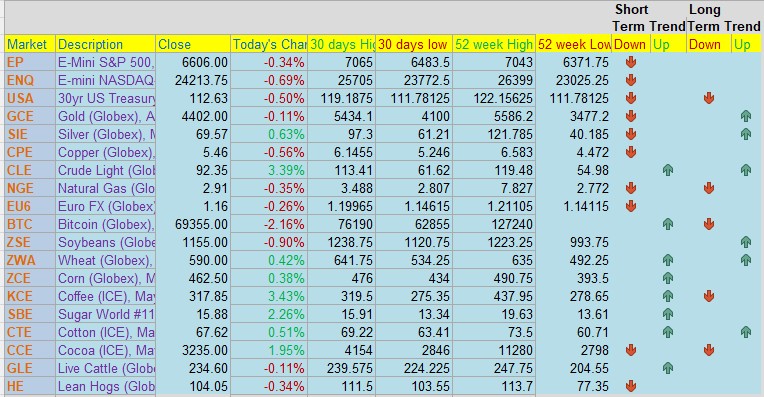
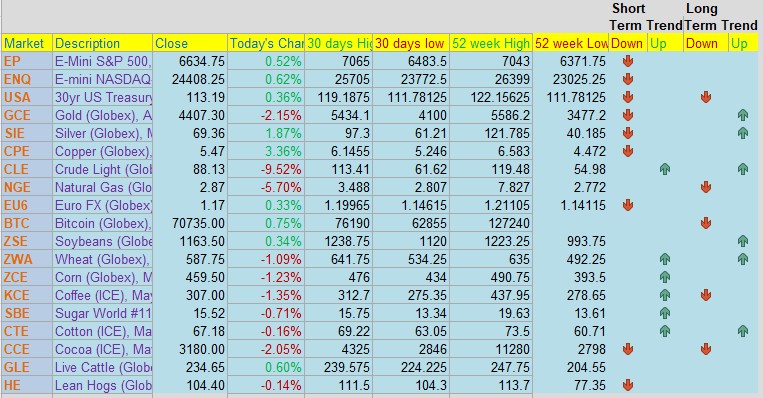
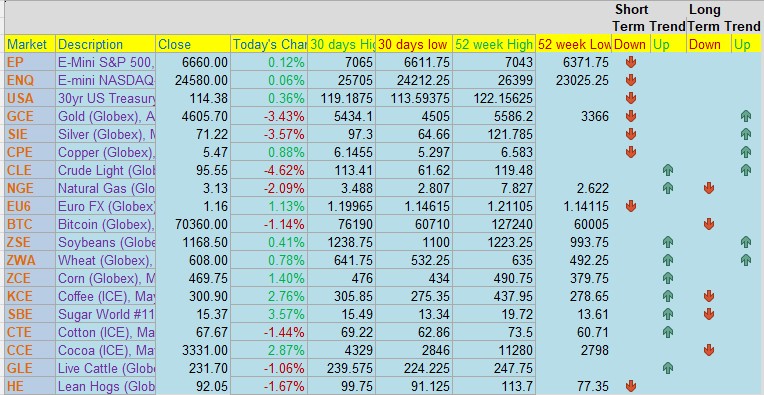
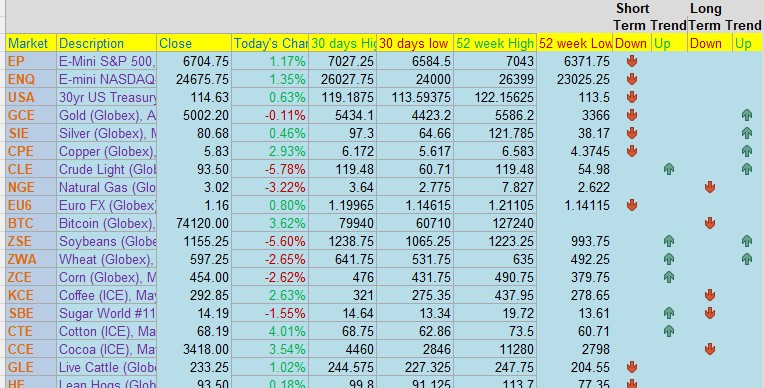
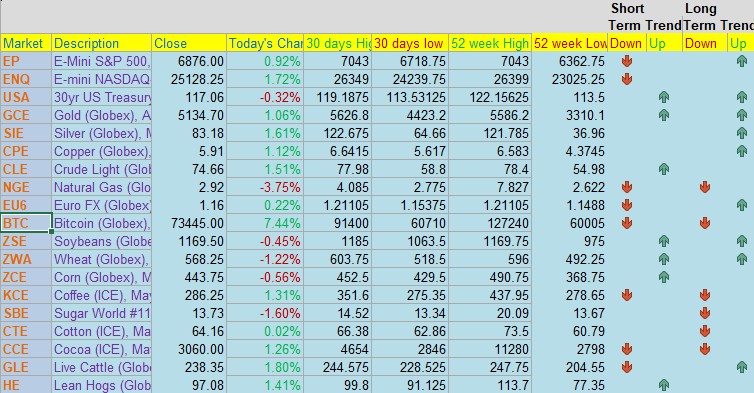
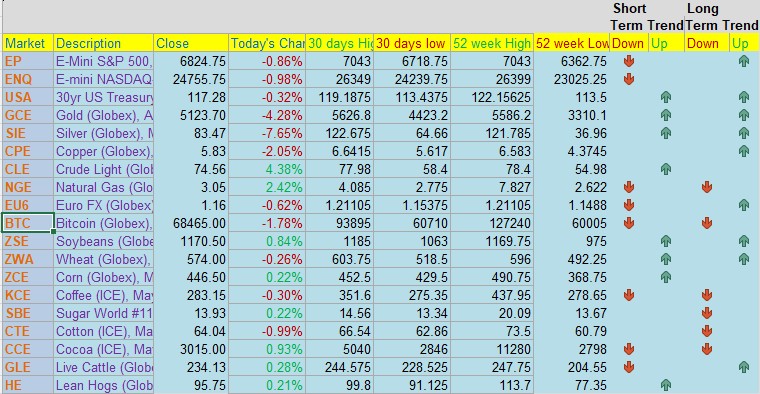
Yields screaming higher. Gold posts worst week since 1983. S&P breaks below 200-day MA. Four straight losing weeks.
March 23, 2026 · For clients & subscribers · Eli G Levy · Cannon Trading Company
Weekly Overview — 01
The Trend Has Changed — We Are Bleeding Down
Two weeks ago I wrote there is so much volatility — just when you think the index has corrected enough it keeps on correcting both to the downside and upside. This past week I noticed the trend changing: we’re bleeding down with little bounces to the upside. That’s not to say that we can’t get a sudden news alert that the Strait of Hormuz will open and we may see a sharp reaction to the upside.
There is a lot going on. Markets are trending toward thresholds and decision points people didn’t want to see breached. This downtrend has been going on a while now — we have done damage to the long-term trend. Average stocks have really pulled back quite a bit, not so much on the major indices. If we get any news of de-escalation and relief on energy, we are due for some kind of a snapback. That was the issue going into the weekend: everyone wanted to be hedged up.
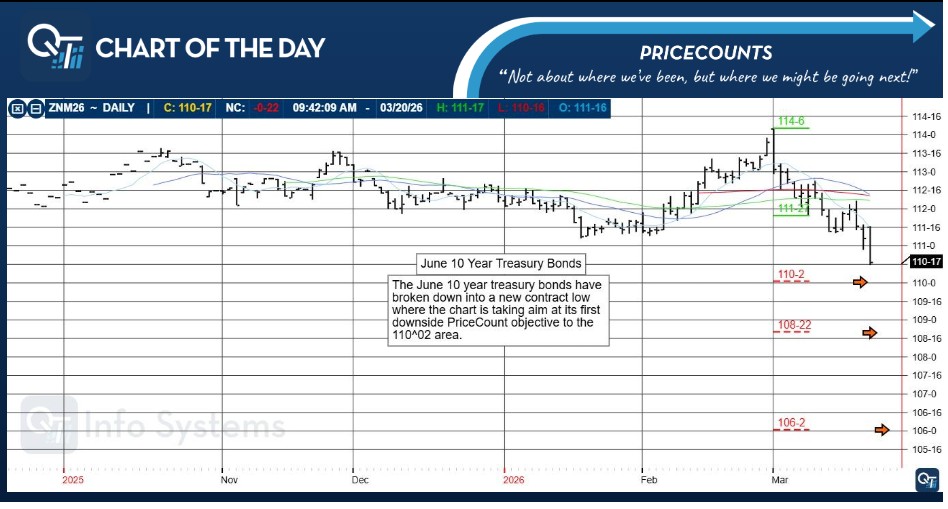
If you look at yields, they are screaming higher — that was my chart of the week last week and it remains so. If we’re worried about credit, investment-grade spreads are at 90 basis points over Treasuries; above 1% over Treasuries it gets dicey. Given all of this, we’re down around 6% on the S&P and that is actually somewhat surprising.
The overall narrative changed from the beginning of the year, when we said we’re going to run this economy hot, get rate cuts, and the AI boom would continue. All of those scenarios have now been unwound. Yields are driving the story now. We’re trading at a 20x forward P/E — we were at 23x at the beginning of the year.
XLF (financials) is down. Less than 30% of S&P 500 stocks are above their 50-day moving average — the lowest since April 2025. The breadth of poor performance in financials is a real issue. Out of 70 financial stocks in the S&P 500, only 5 of them are up this year. Until you get the big banks to stabilize, the market will be on shaky footing.
“There is little evidence that the downtrend is over.”
— Jonathan Krinsky, BTIG Chief Market Technician
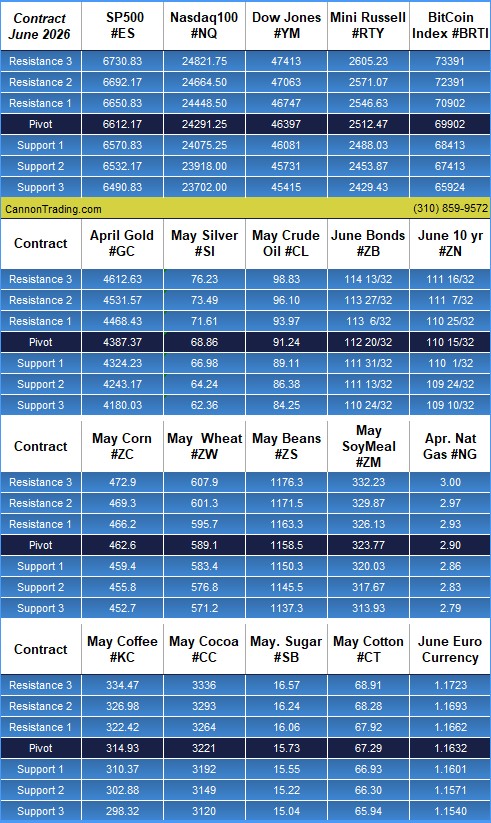
Jonathan Krinsky at BTIG said last week: buckle up. The 200-DMA, which is now at 6,615, looks unlikely to hold. He thinks a move toward 6,000 has a decent probability, and that barring a close back above 6,900, the bears maintain the upper hand.
There is some dispositioning from the expectation of improving margins from the implementation of AI. I hear wealth managers asking: where do you hide in this environment? Energy is the only sector that is positive this month. Most investors are underexposed to energy given its relatively small weighting in the S&P. If you’re sitting in cash, yields aren’t bad these days.
Dubravko Lakos at J.P. Morgan cut his S&P 500 year-end target to 7,200 from 7,500. There is growing talk of the Fed raising rates rather than lowering them. Micron had a blowout quarter and the stock went down — it was very extended. NVDA had a great quarter as well and also went down.
Technical Analysis — 02
S&P 500 Breaks Below the 200-Day Moving Average
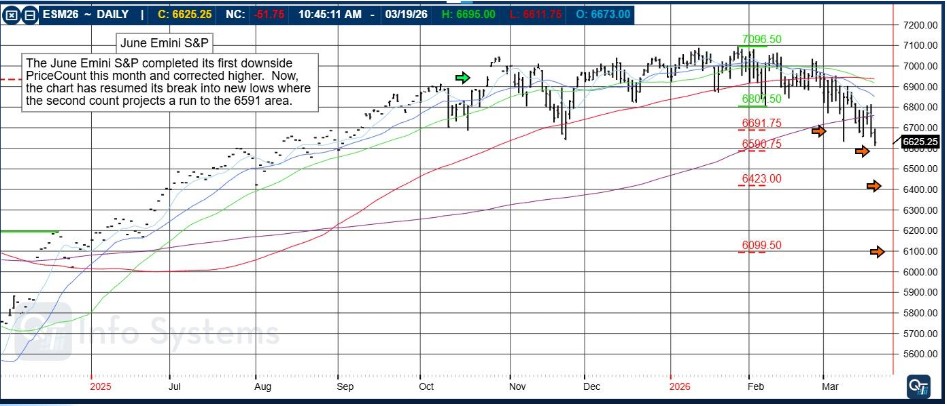
Last week I flagged three scenarios for the SPX at the 200-day moving average. The answer came Thursday: the index closed below the 200-day MA — below 6,619 for the first time since May 2025. The dip-buying that came so reliably at the 50-day and 100-day moving averages earlier this year has been largely absent since the war began. The candlestick patterns on the charts have been shifting — from dip-buying eagerness in early March to consistently closing at or near the session lows.
KEY TECHNICAL LEVEL BREACHED
The S&P 500 closed below its 200-day MA (6,619) for the first time since May 2025. The Nasdaq Composite is already below its 200-day. The Dow is testing its own 200-day. If oil pushes higher and all three major indices lose their 200-day SMAs, additional technical selling pressure could accelerate the move lower.
The trend continues to be one of opening lower, getting a bounce, and then closing at or near the lows. Fridays in particular have seen investors grow cautious — nobody wants to take new long positions into a weekend when war headlines can move markets violently. Jonathan Krinsky’s target of 6,000 would represent roughly another 8% decline from current levels. The technical damage done to the market over the past four weeks is meaningful and will take time to repair even if the geopolitical situation improves.
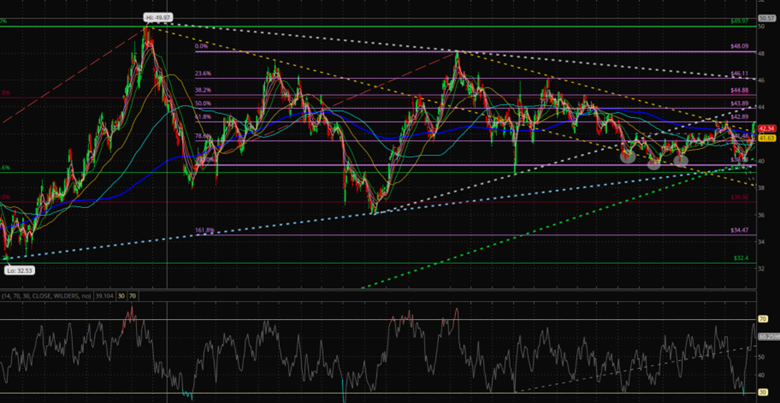
Chart of the Week — 10-Year Treasury Yield
Last week I pointed out my chart of the week is the 10-year yield: the breakout is continuing out of the yellow channel but is now approaching some resistance levels. Yields are the dominant driver of cross-asset performance right now — watch this chart closely.
Oil & The Middle East — 03
Oil
Oil remains the most important chart to watch, but after last week’s extreme volatility, price action has begun to stabilize — at least for now. West Texas Intermediate and Brent crude have pulled back from their panic highs, with prices consolidating as the market digests both geopolitical risk and the potential policy response.
While the initial shock from disruptions around the Strait of Hormuz drove a vertical move higher, this week has been more about assessing whether that disruption becomes prolonged or begins to ease. So far, flows have not fully normalized, but there is a growing expectation that partial workarounds and international pressure could prevent a worst-case supply shock from fully materializing.
At the same time, the macro backdrop is starting to matter more. Higher oil prices are feeding directly into inflation expectations, which is contributing to rising yields and reinforcing the more hawkish tone from the Federal Reserve. This creates a feedback loop: elevated energy prices tighten financial conditions, which in turn weigh on demand expectations.
That tension is now showing up in price action, with oil no longer moving in a straight line higher but instead becoming more sensitive to both headlines and macro data. The key question has shifted from “how high can oil go?” to “how long can prices stay elevated before demand destruction kicks in?”
From a market perspective, oil is still acting as the primary driver of cross-asset volatility. Equity rallies continue to struggle when crude pushes higher, while any signs of stabilization or pullback in oil are being met with relief across risk assets. As long as oil remains elevated, the risk of slower growth and tighter financial conditions stays front and center.
For now, this is a market transitioning from panic-driven pricing to a more balanced — but still fragile — equilibrium. The next major move will likely depend on whether supply disruptions persist or begin to meaningfully resolve.
Macro — Fed & Stagflation — 04
Stagflation Risk Grows — The Fed Stays Hawkish
The stagflation narrative continued to build this week as new data reinforced the same uncomfortable mix of slowing growth and persistent inflation. The latest Producer Price Index came in hot for the second consecutive month — up 0.7% in February against an expectation of 0.3% — signaling that pipeline inflation remains firm even before the full impact of higher energy prices feeds through the system.
Notably, this PPI data was collected prior to the escalation of the Iran situation. That means underlying inflation pressures are not purely event-driven — they are more embedded in the system.
The Federal Reserve concluded its FOMC meeting Wednesday with a tone that leaned more hawkish than many expected. The Fed held rates unchanged at 3.50%–3.75% and the updated dot plot still projects just one 25-basis-point cut in 2026 — unchanged from December — but four or five committee members moved from expecting two cuts to one.
Chair Powell acknowledged stronger growth forecasts while also nudging inflation projections upward, with the 2026 PCE forecast raised to 2.7% from 2.5%.
“The forecast is that we will be making progress on inflation. Not as much as we had hoped, but some progress on inflation.”
— Fed Chair Jerome Powell, FOMC Press Conference, March 18, 2026
What’s notable is that this inflation pressure is now colliding with tightening financial conditions. Treasury yields have continued to push higher, and elevated oil prices are beginning to act as a tax on the consumer. The combination of rising energy costs, firm PPI data, and a Fed that is in no rush to ease is reinforcing concerns that inflation could reaccelerate in the coming months.
Powell pushed back on the “stagflation” label specifically — noting that “that was a 1970s term, at a time when unemployment was in double figures and inflation was really high.” But whether you call it stagflation or not, the macro backdrop for risk assets is significantly more challenging.
FED WATCH — POWELL TERM & SUCCESSION
Powell confirmed he will remain as chair on a “pro tempore” basis if Kevin Warsh is not confirmed by the time his term expires in May. He also stated he has no intention of leaving the board until the Trump administration’s investigation into the Fed’s headquarters renovation is “well and truly over.” Warsh is viewed as more hawkish; his confirmation — or lack thereof — is another layer of uncertainty for markets.
Russell 2000
Small caps continued to underperform, and for the same reasons as last week. Higher oil raises input costs and compresses margins, while elevated Treasury yields make financing more expensive for smaller companies that rely more heavily on debt. The 10-year Treasury yield climbed further — until we see a reversal in oil and yields, we can expect the Russell to continue lagging the large-cap indices.
Gold — 05
Gold Had Its Worst Week Since 1983
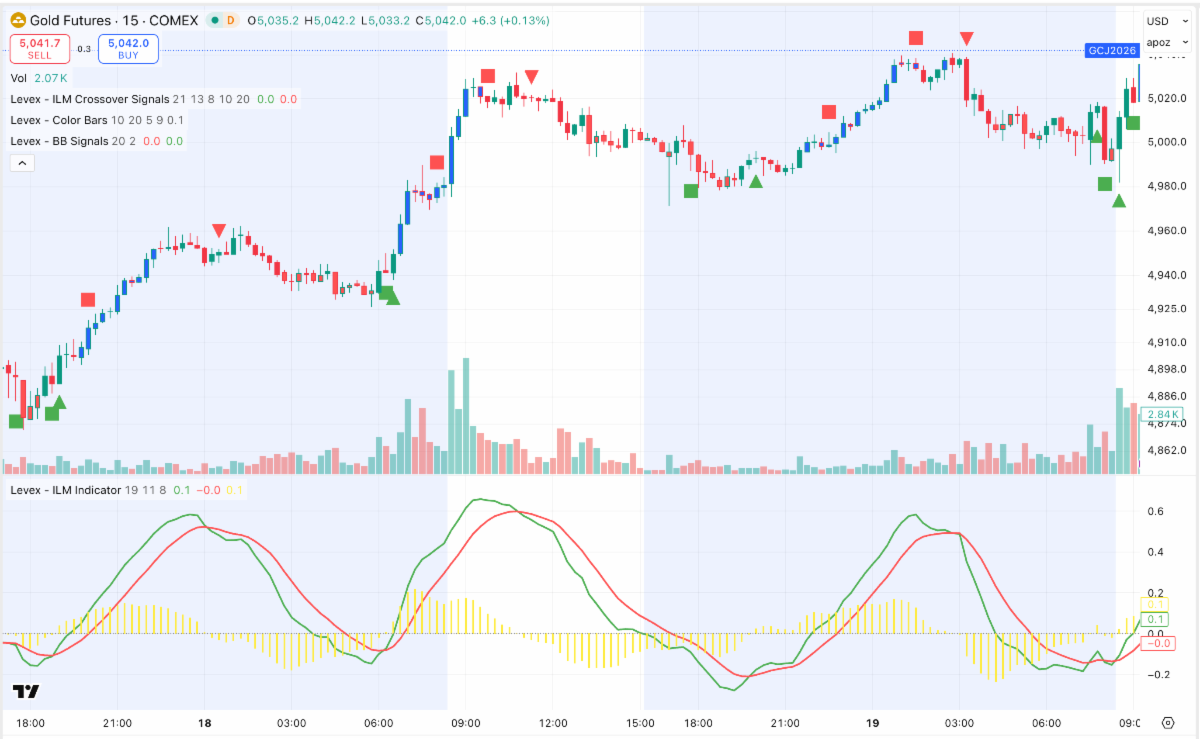
Gold dropped roughly 11% this week, posting its biggest weekly loss since 1983 — and is now down more than 14% since the war began. This is one of the great paradoxes of this market. Gold should theoretically be the biggest beneficiary of an active Middle East war, rising inflation, and mounting U.S. government debt. Instead, it is being punished by the very war it should be rallying on.
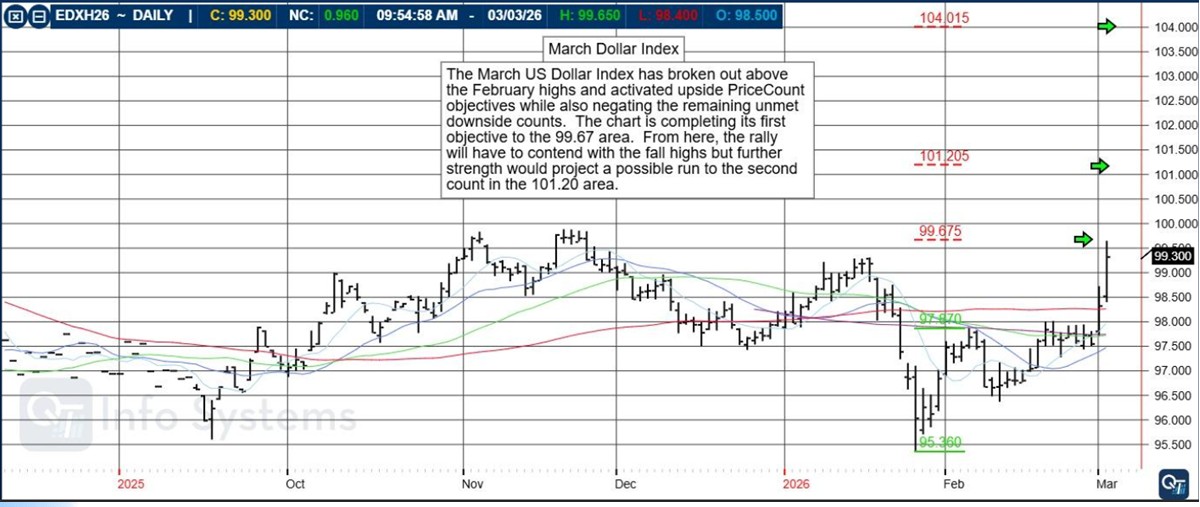
The mechanism is clear: the Iran conflict has reignited inflation and forced the Fed to stay hawkish. Higher oil means higher inflation, higher-for-longer rates — and gold, which pays no yield, suffers when real yields rise and the dollar strengthens. The 10-year yield climbed above 4.39% and the Dollar Index pushed toward 99.9, creating a double headwind for the precious metal. Leveraged funds that had built large embedded gains were forced to liquidate, adding to the selling pressure.
Despite the current sell-off, major Wall Street banks have not yet revised their year-end targets. J.P. Morgan maintains a $6,300 target; Deutsche Bank stands at $6,000. Ed Yardeni, who had a $6,000 target, said this week he is considering lowering it to $5,000 if gold continues to defy expectations. The structural case for gold — central bank diversification, geopolitical uncertainty, mounting U.S. debt — has not disappeared. But for now, the dollar and the hawkish Fed are winning the argument.
Private Credit & AI — 06
Private Credit
Private credit continued to generate headlines. Last week Blackstone’s BCRED hit record redemption requests; this week BlackRock said it is limiting withdrawals from one of its private credit funds following a surge in redemption requests — investors sought roughly $1.2 billion in redemptions but only $620 million was paid out. I continue to monitor bond prices of private credit issuers as a leading stress indicator. This is a slow-developing story but one that warrants close attention.
AI Buildout
Deutsche Bank upgraded software to overweight and raised its rating on tech overall to neutral from overweight, citing software stocks’ outperformance — even amid the broader turmoil — as a sign that the group may have finally bottomed after months of AI disruption concerns weighing on valuations.
Nvidia’s GTC conference this week was a highlight: CEO Jensen Huang said he expects $1 trillion in orders for Blackwell and Vera Rubin systems, doubling year-ago projections.
Morgan Stanley reiterated overweight on NVDA, noting the company laid out a “winning strategy.” Despite this, the stock went down — which tells you something about the macro environment we’re in. I continue to watch the bonds and stocks of the major AI infrastructure investors as a barometer of confidence in the buildout thesis — particularly ORCL and SoftBank.
Cryptocurrency — 07
Cryptocurrency Market Update
The Bloomberg Galaxy Crypto Index is up roughly 1% week-over-week, with Bitcoin down about 1% and Ethereum up around 2% as of Friday. Earlier in the week, Bitcoin briefly pushed to $76,000 following a short squeeze in the futures market, but those gains faded after the release of a hotter-than-expected Producer Price Index (PPI) and a more hawkish tone from the Federal Open Market Committee, both of which pressured risk assets and tightened financial conditions as Treasury yields moved higher.
On the regulatory side, the Securities and Exchange Commission and Commodity Futures Trading Commission provided additional clarity on how federal securities laws apply to crypto assets, outlining what constitutes a security and introducing a framework that categorizes digital assets into areas such as commodities, stablecoins, and securities, while also addressing staking, airdrops, and wrapped assets; with limited progress on broader legislation like the CLARITY Act, this development is a constructive step for the industry.
Looking at prior cycles, including the 2018 and 2022 bottoms, Bitcoin historically leads the early phase of recovery, often finding support near its 200-week moving average and cost of production, and if February’s low near $60,000 holds, the current recovery is tracking a similar path, with altcoin outperformance likely to remain short-lived until sustained momentum in Bitcoin returns and broader market confidence is fully rebuilt.
The Week Ahead — 08
March 23–27, 2026
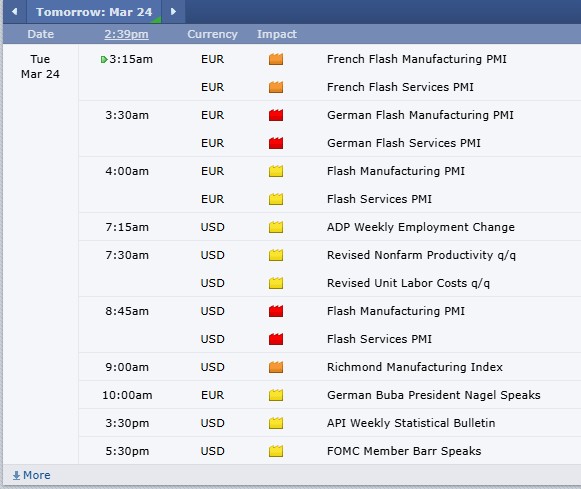
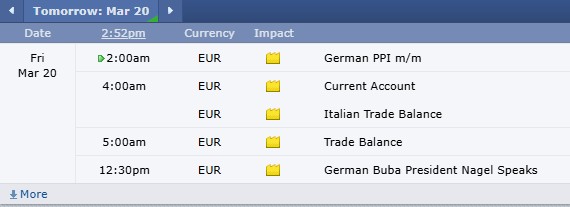
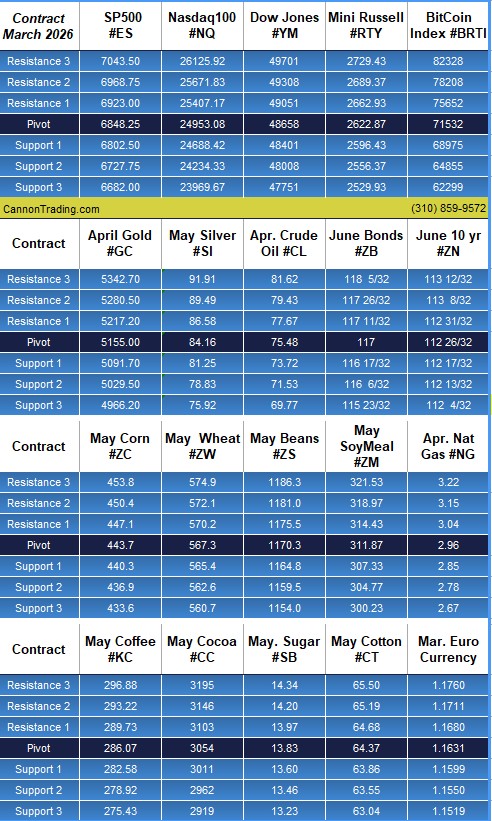
The main event this week is Friday’s data deluge — final Q4 GDP estimate, PCE prices, Personal Income and Spending, and University of Michigan Consumer Sentiment Final. These data points will give the market the most comprehensive look yet at how the economy entered this oil shock. Any further downward revision to GDP or upside surprise in PCE will fan the stagflation narrative further. Keep watching oil and the Strait of Hormuz above all else.
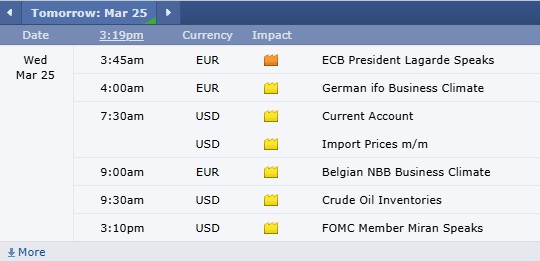
Economic Calendar
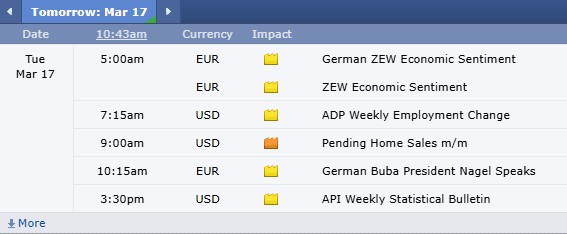
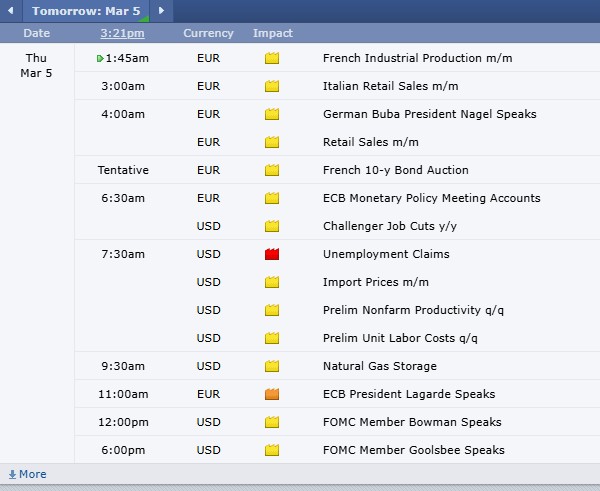
• Monday, Mar. 23: Construction Spending
• Tuesday, Mar. 24: New Home Sales
• Wednesday, Mar. 25: Current Account Balance · Durable Orders · EIA Crude Oil Inventories · Export & Import Prices · Mortgage Applications Index
• Thursday, Mar. 26: Continuing Claims · EIA Natural Gas Inventories · Initial Claims
• Friday, Mar. 27: ⛑ GDP – 3rd Estimate · PCE Prices · Personal Income & Spending · University of Michigan Consumer Sentiment (Final) · Advanced Trade in Goods · Advanced Retail & Wholesale Inventories
Earnings Calendar
Monday, Mar. 23: ABVX · AGBK · ALTI · CMCL · DBVT · LAR · WRD
Tuesday, Mar. 24: AIR · CNTA · CNXC · CNM · GME · HSAI · KBH · NGD · SFD · TE · WOR
Wednesday, Mar. 25: ALMS · CELC · CHWY · CTAS · FUL · JEF · JKS · KRMN · ONDS · PAYX · PDD · WGO
Thursday, Mar. 26: AGX · BCAX · CMC · KOD · LMRI · PONY · SA · TMC
Friday, Mar. 27: AUTL · CCL · HUMA · LGN · SBC
BOTTOM LINE — WEEK OF MARCH 23
The narrative that was driving markets at the start of 2026 — run the economy hot, rate cuts coming, AI boom continuing — has been completely unwound. Yields are now driving the story. We are down 6% on the S&P, below the 200-day moving average, with Jonathan Krinsky’s 6,000 target in the conversation. The single most important thing remains what it has been for four weeks: any credible signal that the Strait of Hormuz reopens. Until then, keep watching yields, keep watching oil, and stay hedged heading into weekends.
Disclaimer: Trading Futures, Options on Futures, and retail off-exchange foreign currency transactions and other financial instruments involve substantial risk of loss and are not suitable for all investors. Past performance is not indicative of future results. Carefully consider if trading is suitable for you in light of your circumstances, knowledge, and financial resources. You may lose all or more of your initial investment.
Opinions, market data, and recommendations are subject to change at any time. The author is registered solely as a commodities broker. Any references, recommendations, and information contained in this article are of opinion only, should not be considered investment advice, and do not guarantee any profits. |