|
- Bitcoin Futures (107)
- Charts & Indicators (293)
- Commodity Brokers (584)
- Commodity Trading (840)
- Corn Futures (64)
- Crude Oil (227)
- Currency Futures (102)
- Day Trading (658)
- Day Trading Webinar (61)
- E-Mini Futures (162)
- Economic Trading (166)
- Energy Futures (127)
- Financial Futures (177)
- Future Trading News (3,138)
- Future Trading Platform (326)
- Futures Broker (661)
- Futures Exchange (347)
- Futures Trading (1,261)
- futures trading education (443)
- Gold Futures (108)
- Grain Futures (101)
- Index Futures (271)
- Indices (233)
- Metal Futures (123)
- Nasdaq (79)
- Natural Gas (40)
- Options Trading (191)
- S&P 500 (142)
- Trading Guide (410)
- Trading Webinar (60)
- Trading Wheat Futures (45)
- Uncategorized (26)
- Weekly Newsletter (215)
Category: Future Trading News
As a high risk trading type, futures trading is not for someone who is faint-hearted. Though there are a number of different ways of investing in futures , it is important to stick to what you know. Treading into unknown waters is not something that you should do when dealing in futures.
From managing margins to ordering trades to doing market analysis and more if you want to, you can do that all by yourself – but you may betaking double the risk. Therefore, when trading in futures, it may be better to seek advice from a professional trader.
Professional trading experts at Cannon Trading can help you with your futures trading. We are also there to keep you updated with the latest on futures trading and market news. All the news and latest articles on futures trading are published on our site under the category Archive Futures Trading News, which you are currently browsing through. Read more and the latest here and keep updated.
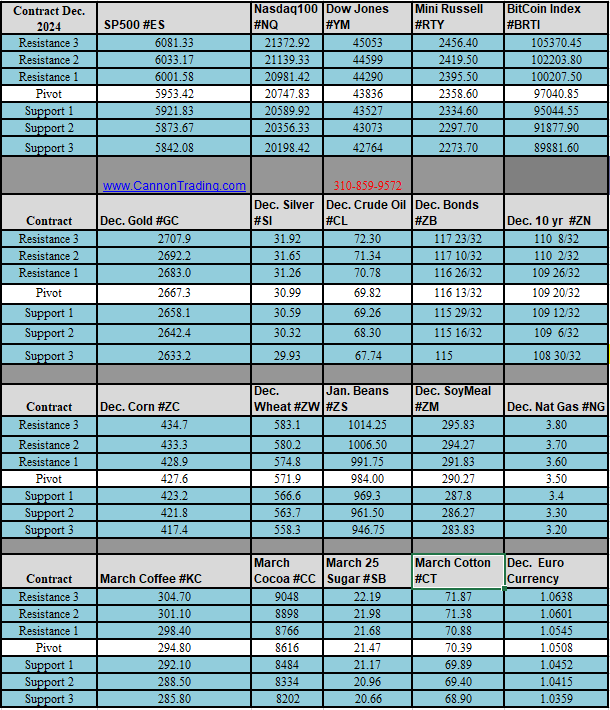
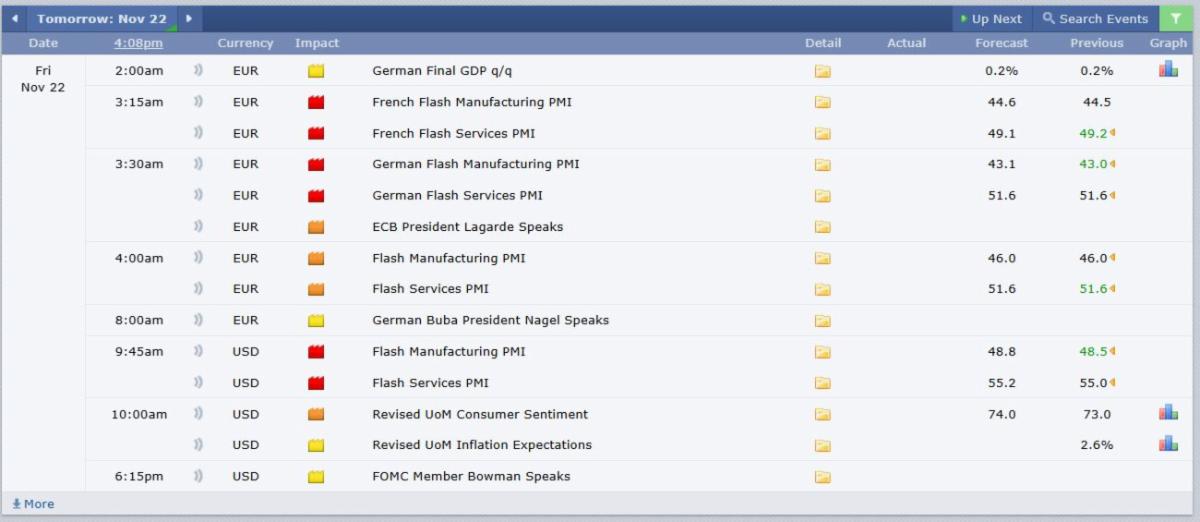
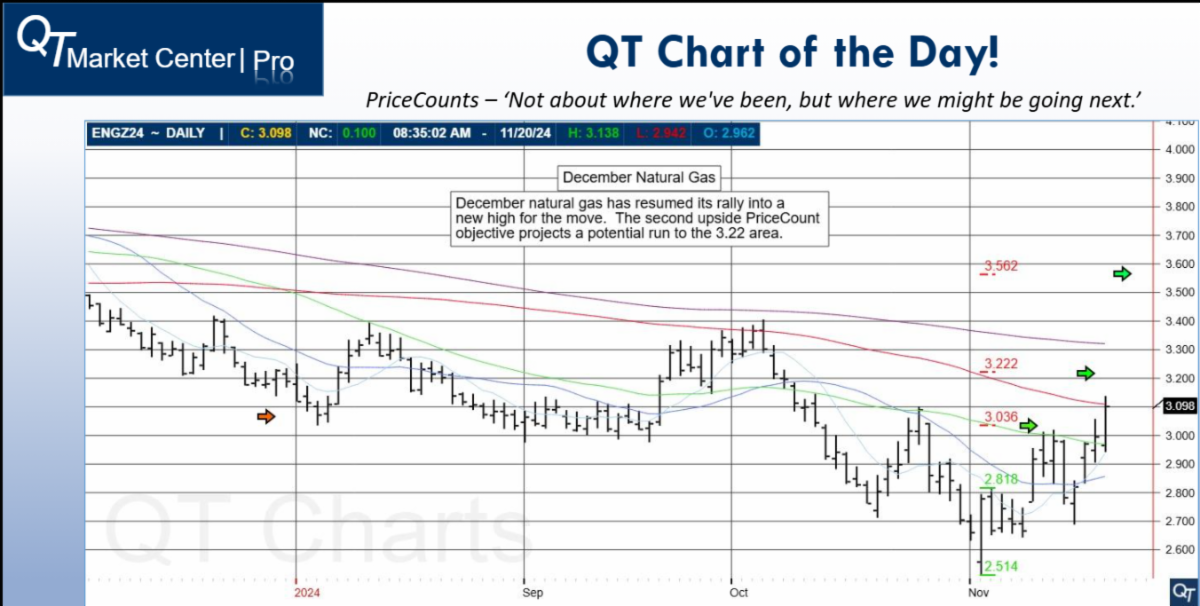
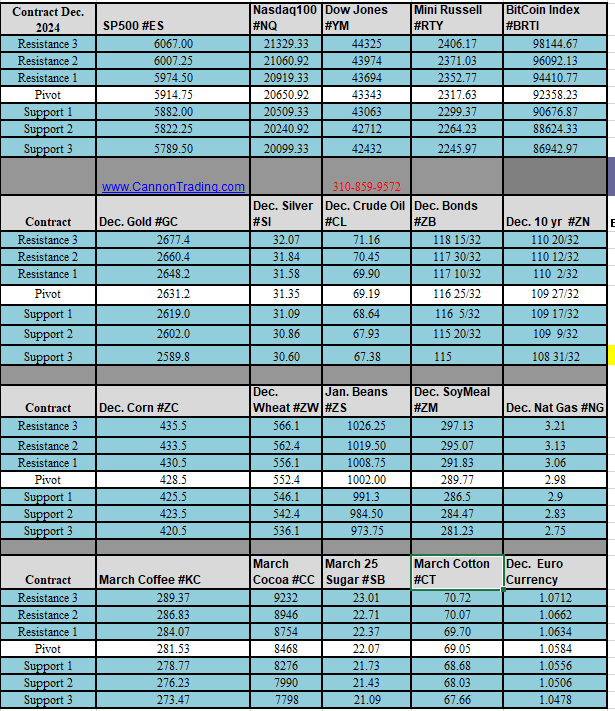
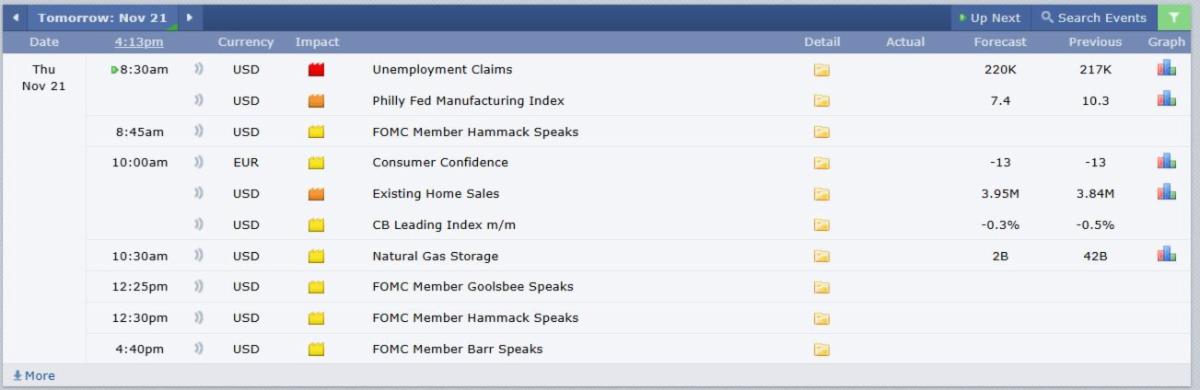
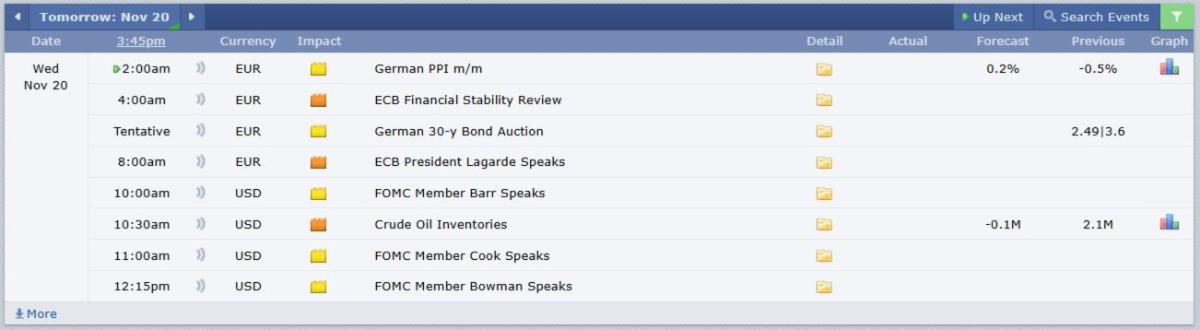
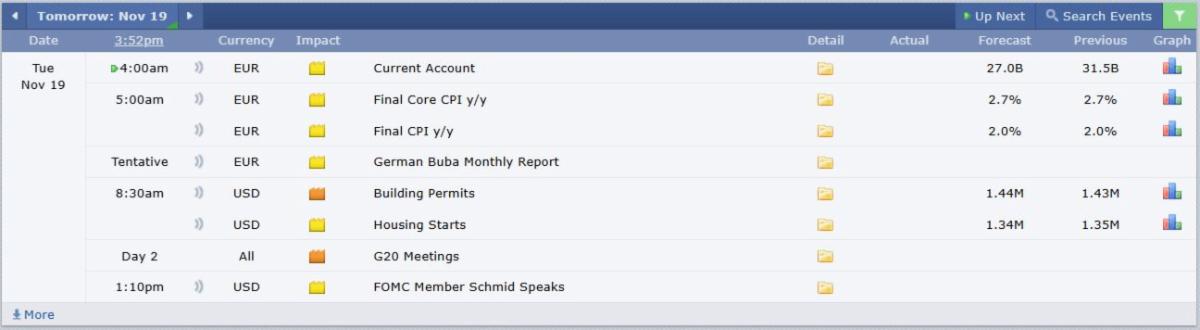
Tomorrow’s Market Lineup: Existing Home Sales, Beige Book, and Crude Oil Reports
|
|
Introduction to Futures SP
Futures SP
Introduction to Futures SP
Standard & Poor’s 500 index futures, commonly referred to as SP futures, are financial contracts that allow traders to speculate on the future value of the S&P 500 Index, one of the most widely followed benchmarks of the U.S. stock market. These contracts are used by a diverse group of market participants, ranging from individual investors to institutional traders and hedgers. The S&P 500 Index itself consists of 500 of the largest publicly traded companies in the U.S., representing a wide array of industries, making it a comprehensive reflection of the U.S. economy.
The creation of S&P 500 futures contracts was revolutionary because it allowed for easier, more flexible participation in the market, enabling traders to leverage the value of the index to hedge against market volatility or speculate on market movements. Over time, several variations of these contracts have been introduced to cater to different trading needs and scales. This article will explore the various SP futures contracts, who trades them, and why they remain critical instruments in the futures market. Furthermore, we will discuss Cannon Trading Company, Inc., a futures brokerage firm known for its stellar reputation, and why institutional traders and hedgers should consider them as a top choice.
Types of SP Futures Contracts
Several variations of S&P 500 futures are traded on futures exchanges like the Chicago Mercantile Exchange (CME). These contracts differ in size, trading hours, and utility but serve the same purpose: allowing market participants to trade on the future direction of the S&P 500 Index. The main SP futures contracts include:
- Standard S&P 500 Futures (SP)
The standard S&P 500 futures contract, known by its ticker symbol “SP,” was the largest and most widely traded version of the contract. Each contract was valued at 250 times the value of the S&P 500 Index. For example, if the S&P 500 Index is trading at 4,000, the value of one SP contract would be 250 x 4,000 = $1,000,000. This large notional value made the contract more suited for institutional traders, hedge funds, and large portfolio managers who need to hedge substantial stock portfolios or make significant market moves. This contract no longer exists because its value was too large since the S&P was moving higher and higher. The new contracts are below: - E-mini S&P 500 Futures (ES)
E-mini futures were introduced to make futures trading more accessible to a broader range of traders. The E-mini S&P 500 futures contract (ES) is a smaller version of the standard S&P 500 futures, with a contract value of 50 times the index value. So, if the S&P 500 Index is trading at 4,000, the value of one E-mini contract would be 50 x 4,000 = $200,000. This smaller size makes the contract more accessible to individual traders and smaller institutions while still offering the same benefits as the standard futures contract.The E-mini contract has become one of the most popular futures contracts globally, offering high liquidity, tight spreads, and around-the-clock trading hours. Its popularity stems from its flexibility, allowing traders to easily enter and exit positions with smaller capital requirements than the full-sized SP contract. - Micro E-mini S&P 500 Futures (MES)
In 2019, CME introduced the Micro E-mini S&P 500 futures contract to cater to retail traders and smaller investors. The Micro E-mini contract (MES) is one-tenth the size of the E-mini contract, with a contract value of just 5 times the index. If the S&P 500 Index is trading at 4,000, the value of one Micro E-mini contract would be 5 x 4,000 = $20,000.The Micro E-mini futures provide a way for traders with limited capital to gain exposure to the S&P 500 Index with less risk compared to the E-mini and standard contracts. Additionally, they are ideal for those who want to scale into positions gradually or hedge smaller portfolios. - S&P 500 Total Return Index Futures (SPXT)
The S&P 500 Total Return Index (SPXT) futures are designed to track the total return performance of the S&P 500 Index, including dividends. These contracts appeal to institutional investors looking for a more comprehensive measure of the index, as they consider both price changes and the income generated from dividends. While less popular than the SP or ES contracts, SPXT futures provide a unique opportunity for those specifically interested in dividend-inclusive performance. - S&P 500 Dividend Index Futures
This futures contract allows investors to trade based on the dividends of the S&P 500 companies. While not as widely traded as the price-based futures contracts, these contracts are valuable for income-focused institutional investors and portfolio managers seeking to hedge dividend exposures or speculate on future dividend changes. - S&P 500 VIX Futures
Although not directly based on the S&P 500 Index, VIX futures are closely related as they track market volatility and are often used in conjunction with S&P 500 futures. VIX futures allow traders to hedge or speculate on the future level of market volatility, which tends to be inversely correlated with the S&P 500 Index itself.
Why Trade SP Futures?
SP futures provide several key benefits that make them attractive to a wide range of market participants:
- Liquidity SP futures are among the most liquid futures contracts in the world, especially the E-mini and Micro E-mini contracts. High liquidity ensures tight bid-ask spreads, meaning traders can enter and exit positions with minimal cost and slippage. This liquidity is particularly valuable for institutional traders managing large positions and for high-frequency traders executing numerous trades daily.
- Leverage One of the main attractions of futures contracts is the ability to trade with leverage. With SP futures, traders only need to post a fraction of the total contract value as margin, enabling them to control large positions with relatively little capital. This leverage magnifies both potential gains and losses, making SP futures a high-risk, high-reward investment vehicle.
- Hedging SP futures are popular among institutional investors, portfolio managers, and hedgers due to their effectiveness in managing risk. By holding long or short positions in SP futures, investors can protect their portfolios from adverse market movements. For example, if an institution expects a market downturn, it can short S&P 500 futures to offset potential losses in its equity holdings.
- Speculation Many traders use SP futures to speculate on the direction of the S&P 500 Index. Since the S&P 500 is a broad market index, SP futures offer a straightforward way to bet on the overall performance of the U.S. economy. Traders can go long if they expect the market to rise or short if they anticipate a decline. The leverage offered by futures contracts enhances the potential for profit (or loss), making SP futures a popular choice for speculative traders.
- Portfolio Diversification Futures contracts based on broad market indices, such as the S&P 500, provide a way to diversify portfolios across different asset classes. Institutional investors often allocate a portion of their portfolios to SP futures to balance equity exposure or to implement specific trading strategies that reduce correlation with other assets.
Who Trades Futures SP?
SP futures are traded by a diverse group of market participants, each with unique objectives and strategies. The main groups include:
- Institutional Investors Institutional investors, such as hedge funds, pension funds, and mutual funds, are some of the largest participants in the SP futures market. They use these contracts primarily for hedging purposes, to offset risks in their equity portfolios, or to speculate on market movements.
- Hedge Funds Hedge funds, in particular, are active traders of SP futures due to their ability to utilize leverage. These funds often employ complex strategies involving long and short positions, arbitrage, and other derivatives. SP futures allow them to execute large trades efficiently and adjust portfolio exposure quickly.
- Retail Traders Retail traders, ranging from day traders to longer-term speculators, frequently trade the E-mini and Micro E-mini contracts. These contracts are more accessible to individual traders due to their smaller size and lower margin requirements. Retail traders often use SP futures to capitalize on short-term market movements, taking advantage of volatility to generate profits.
- Market Makers Market makers provide liquidity in the SP futures market by continuously quoting bid and ask prices. They facilitate trading by ensuring that there is always a counterparty for those wishing to buy or sell contracts. Market makers typically earn profits from the spread between the bid and ask prices and are crucial for maintaining market liquidity.
- Arbitrageurs Arbitrageurs exploit price discrepancies between the S&P 500 Index and its futures contracts, or between different SP futures contracts. By taking advantage of these small inefficiencies, arbitrageurs contribute to market efficiency while earning low-risk profits.
Cannon Trading Company, Inc.: The Broker of Choice
Established in 1988, Cannon Trading Company, Inc. has been a leader in the futures brokerage industry for over three decades. With a stellar 5 out of 5-star rating on TrustPilot, Cannon Trading has earned its reputation for providing top-tier service, reliability, and expertise in the futures market. The firm has consistently catered to a wide range of traders, from retail investors to institutional hedgers and professional traders. Here’s why Cannon Trading is considered a top choice, especially for institutional traders and hedgers:
- Experience and Expertise With over 35 years of experience in the industry, Cannon Trading has built a deep understanding of the futures market. The firm’s brokers are seasoned professionals who offer valuable insights and personalized advice to clients, helping them navigate the complexities of futures trading. Their expertise is particularly valuable for institutional traders, who require sophisticated strategies and execution to manage large positions and complex portfolios.
- Tailored Services for Institutional Traders Cannon Trading excels in providing tailored services for institutional traders, offering customized solutions that meet the specific needs of hedge funds, asset managers, and large financial institutions. The firm understands the unique challenges faced by institutional clients, such as the need for precise execution, risk management, and access to deep liquidity. By offering direct market access and advanced trading platforms, Cannon Trading enables institutional traders to execute large orders with minimal slippage and maximum efficiency.
- Trust and Transparency Cannon Trading has built a reputation for trust and transparency in an industry where these qualities are critical. The firm’s commitment to clear communication and ethical business practices has earned it the loyalty of clients over the years. Institutional traders and hedgers, in particular, value a broker they can trust with large sums of capital and complex transactions, making Cannon Trading a reliable partner for high-stakes trading.
- Technological Excellence In the fast-paced world of futures trading, having access to cutting-edge technology is essential. Cannon Trading offers state-of-the-art trading platforms that provide direct market access, advanced charting tools, real-time data, and automated trading capabilities. These platforms are designed to meet the needs of both retail and institutional traders, ensuring that clients have the tools they need to succeed in today’s competitive market environment.
- Outstanding Customer Support One of the standout features of Cannon Trading is its commitment to customer support. The firm’s brokers are available to assist clients at all stages of the trading process, from account setup to trade execution and beyond. Institutional clients benefit from dedicated account managers who provide personalized service and ensure that their trading needs are met. This high level of support is reflected in the firm’s top ratings on platforms like TrustPilot.
- Focus on Education Cannon Trading is committed to empowering its clients through education. The firm offers a wide range of educational resources, including webinars, trading guides, and market analysis, designed to help traders improve their skills and make informed decisions. Institutional traders and hedgers appreciate this focus on education, as it enhances their ability to manage risk and execute sophisticated strategies.
- Regulatory Compliance Cannon Trading is a fully licensed and regulated futures brokerage firm, adhering to strict regulatory standards set by the Commodity Futures Trading Commission (CFTC) and the National Futures Association (NFA). Institutional traders and hedgers require a broker that operates with the highest levels of integrity and compliance, and Cannon Trading consistently meets these expectations.
SP futures, including the standard, E-mini, and Micro E-mini contracts, offer a versatile and powerful tool for traders of all types. Whether you’re an institutional investor looking to hedge a large portfolio or a retail trader speculating on short-term market movements, SP futures provide liquidity, leverage, and flexibility.
Cannon Trading Company, Inc. stands out as a premier broker for trading SP futures, particularly for institutional traders and hedgers. With decades of experience, a stellar reputation, and a commitment to delivering tailored services, advanced technology, and unparalleled customer support, Cannon Trading has earned its place as a trusted partner for those navigating the futures market.
For more information, click here.
Ready to start trading futures? Call us at 1(800)454-9572 – Int’l (310)859-9572 (International), or email info@cannontrading.com to speak with one of our experienced, Series-3 licensed futures brokers and begin your futures trading journey with Cannon Trading Company today.
Disclaimer: Trading Futures, Options on Futures, and retail off-exchange foreign currency transactions involve substantial risk of loss and are not suitable for all investors. Past performance is not indicative of future results. Carefully consider if trading is suitable for you in light of your circumstances, knowledge, and financial resources. You may lose all or more of your initial investment. Opinions, market data, and recommendations are subject to change at any time.
Important: Trading commodity futures and options involves a substantial risk of loss. The recommendations contained in this article are opinions only and do not guarantee any profits. This article is for educational purposes. Past performances are not necessarily indicative of future results.
This article has been generated with the help of AI Technology and modified for accuracy and compliance.
Follow us on all socials: @cannontrading

AI: The Next Gold Mine or Money Pit? Insights on Markets, Earnings, and Economic Trends
|
Weekly Newsletter: Hogs Outlook, Mini Russell System+ Trading Levels for Oct. 21st
Cannon Futures Weekly Letter Issue # 1213
In this issue:
- Important Notices – Earnings & Fed Speakers
- Futures 101 – Ask a Broker: Day trading Futures? Margins?
- Hot Market of the Week – December Hogs
- Broker’s Trading System of the Week – Mini Russell Day Trading System
- Trading Levels for Next Week
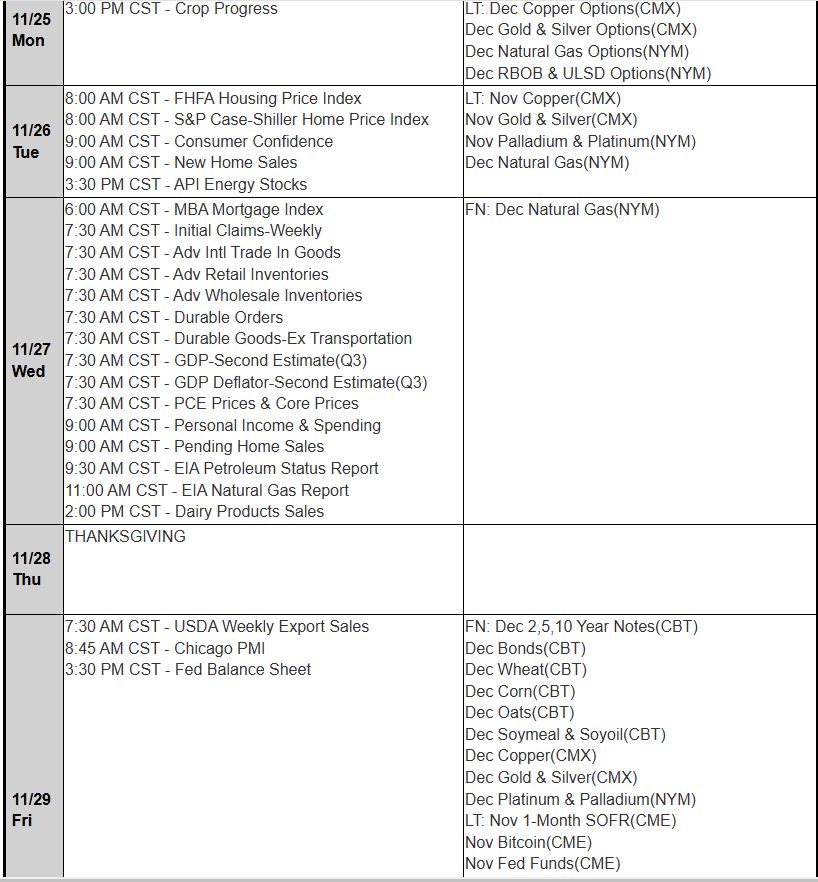
- Trading Reports for Next Week
Important Notices – Next Week Highlights:
The Week Ahead
By John Thorpe, Senior Broker
A fair amount of Speakers, Data and Earnings .
Just 2 ½ weeks to the U.S. Presidential Election. Nov 5th.
Economic Data:
Mon. CB Leading Indicators
Tue. Redbook, Richmond Fed
Wed. Mortgage Index
Thu. Chicago Fed Activity Index, Weekly Initial Jobless Claims, New Home Sales
Fri. Durable Goods, Michigan Consumer Sentiment.
Fed and ECB Speakers:
Mon. Logan, Kashkari, Schmid
Tue. 9A.M. Central ECB President Lagarde, Harker
Wed. Bowman, LaGarde 9 A.M. Central, Barkin
Thu. Hammack
Fri. quiet
Earnings: 608 3rd QTR. Reports this week
Prominent Companies reporting
Wed. Tesla, IBM, Coca-Cola
- Thu. UPS
|
|
|
|
“Trading Around Key Economic Reports” FREE SHORT Course you will learn:
- What is GDP?
- About the Retail Sales Report
- What is NFP ( non farm payroll) Report?
- Understanding US housing Data
- FOMC
- Understanding Oil Data Report
- Importance of Consumer Confidence Survey
-
- Hot Market of the Week – December Hogs
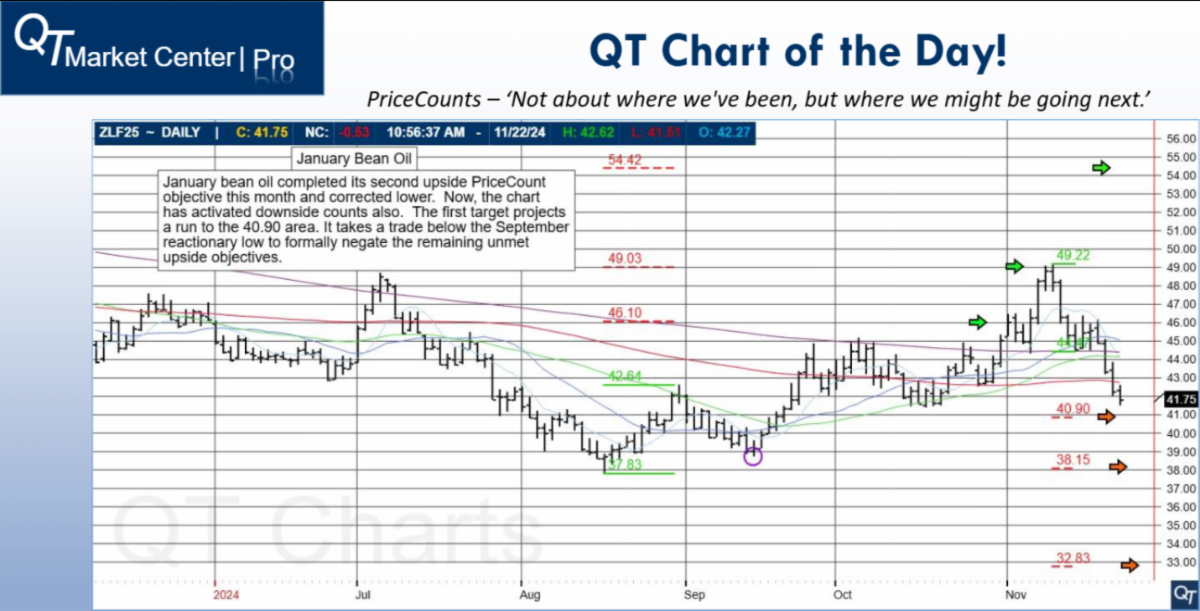
Hot market of the week is provided by QT Market Center, A Swiss army knife charting package that’s not just for Hedgers, Cooperatives and Farmers alike but also for Spread traders, Swing traders and shorter time frame application for intraday traders with a unique proprietary indicator that can be applied to your specific trading needs.
December Hogs
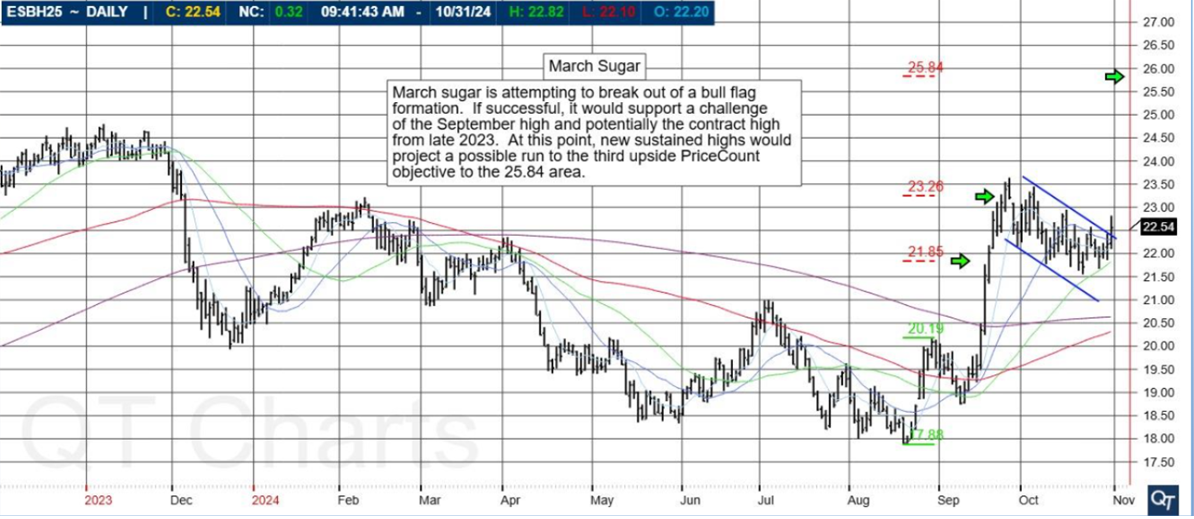
December hogs satisfied their first upside PriceCount objective early this month and have consolidated their trade. At this point, the second count would project a possible run to the 82.15 area IF you can resume the rally and break out above resistance at the April high.
PriceCounts – Not about where we’ve been , but where we might be going next!

Broker’s Trading System of the Week
With algorithmic trading systems becoming more prevalent in portfolio diversification, the following system has been selected as the broker’s choice for this month.
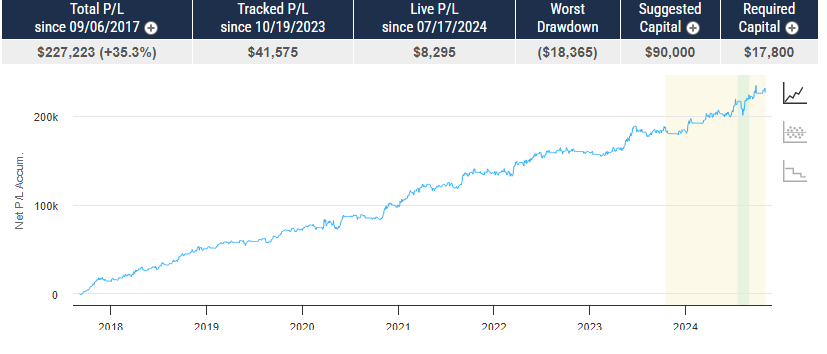
MVA 998 RTY 208
PRODUCT
RTY – Mini Russell 2000
SYSTEM TYPE
Day Trading
Recommended Cannon Trading Starting Capital
$10,000
COST
USD 80 / monthly
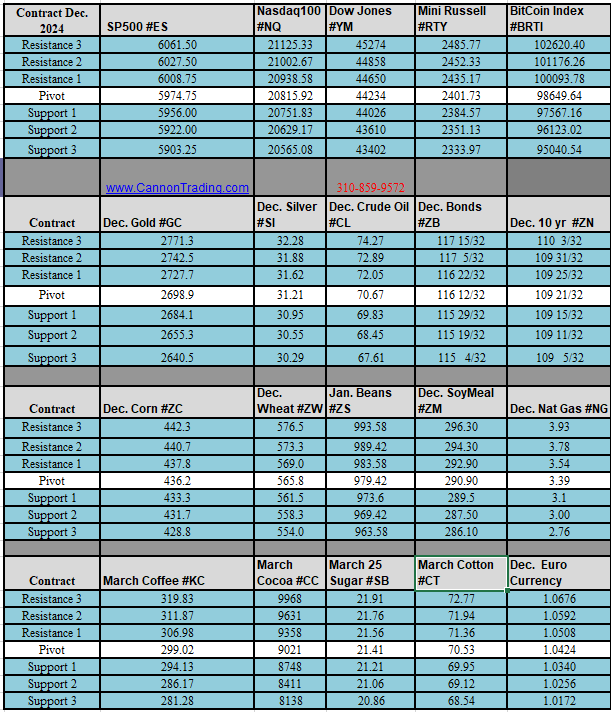
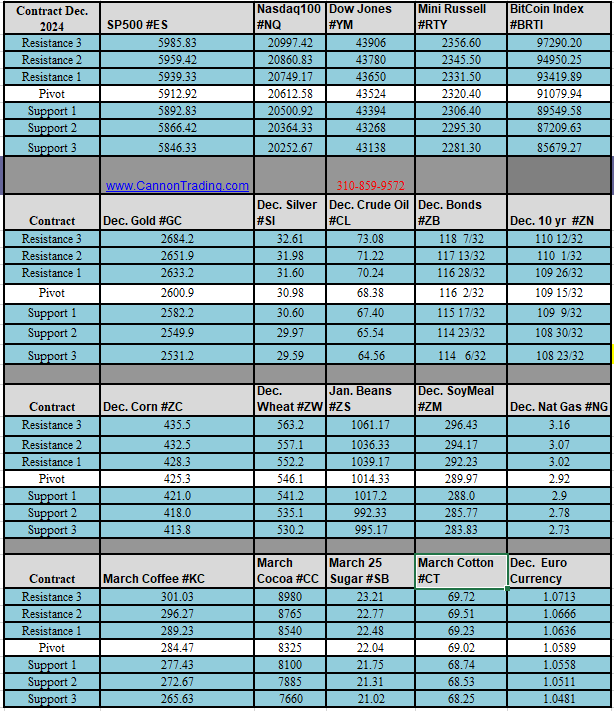
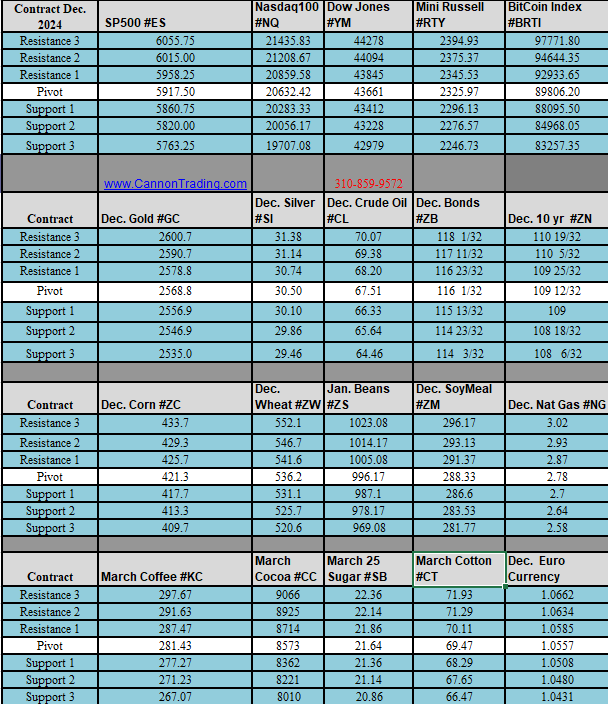
Daily Levels for October 21st, 2024

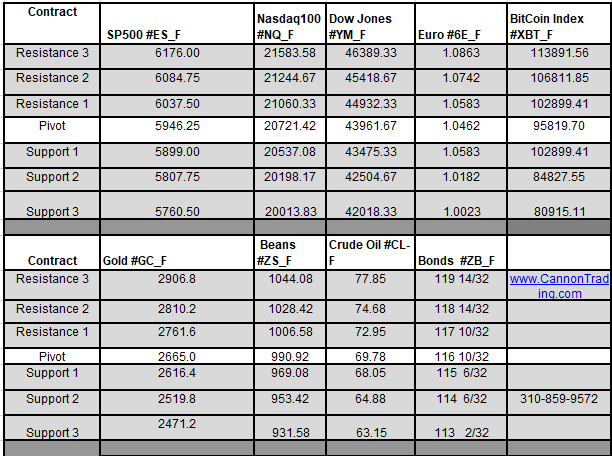
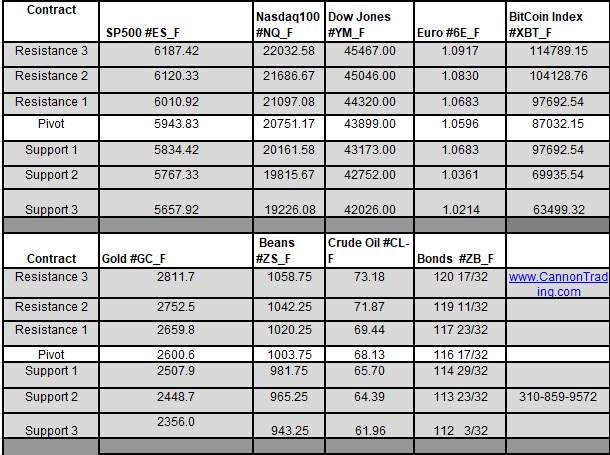
Weekly Levels for the week of October 21st, 2024


Improve Your Trading Skills
Get access to proprietary indicators and trading methods, consult with an experienced broker at 1-800-454-9572.
Explore trading methods. Register Here
* This is not a solicitation of any order to buy or sell, but a current market view provided by Cannon Trading Inc. Any statement of facts here in contained are derived from sources believed to be reliable, but are not guaranteed as to accuracy, nor they purport to be complete. No responsibility is assumed with respect to any such statement or with respect to any expression of opinion herein contained. Readers are urged to exercise their own judgement in trading.
Gold Futures Hit All-Time Highs: Margin Updates and Chart Review
|
|
Action-Packed Thursday: Key Economic Data & Energy Reports; CME Increases Impact Day Trading Margin Requirements
|
|
Futures SP and its Smaller Contracts
S&P 500 Futures – A Futures Trading Guide
Futures contracts have become a fundamental tool for market participants looking to hedge risk or speculate on price movements. Among the many futures contracts available, the S&P 500 Futures (commonly referred to as futures SP, Standard & Poor’s 500 Index Futures, or SP500 Index Futures) are some of the most widely traded. The S&P 500 Futures contracts, along with their smaller counterparts like the E-Mini S&P 500 and the Micro S&P 500, offer a unique and efficient way to trade the broader U.S. stock market. They serve as key financial instruments for both institutional and retail traders, providing liquidity and exposure to the U.S. equity markets.
This article will explore the various aspects of futures SP, delve into the intricacies of the smaller-sized contracts like the E-Mini S&P 500 and Micro S&P 500, discuss where these contracts are traded, explain why institutional investors and hedgers use them, and highlight the motivations of retail traders who speculate on these futures.
-
What are Futures SP?
The term futures SP refers to the Standard & Poor’s 500 Index Futures, which are derivatives contracts that track the performance of the S&P 500 Index. The S&P 500 Index is one of the most widely followed benchmarks of U.S. equities, representing the performance of 500 of the largest publicly traded companies in the United States. It is often seen as a barometer for the overall health of the U.S. economy and stock market.
S&P 500 futures contracts are agreements to buy or sell the S&P 500 Index at a predetermined future date and price. The contracts are standardized, meaning that the terms are set by the exchange on which they are traded. Traders can use these contracts to gain exposure to the broader stock market without owning the individual stocks that comprise the S&P 500.
- Where are S&P 500 Futures Traded?
S&P 500 futures are traded primarily on the CME Group’s Chicago Mercantile Exchange (CME). The CME is one of the largest and most prominent derivatives exchanges in the world, offering a wide range of futures and options contracts across various asset classes, including equities, commodities, and currencies. The S&P 500 futures contracts can be traded electronically via CME’s Globex platform, making them accessible to traders around the globe, 23 hours a day, five days a week.
- Understanding the Smaller Contracts: E-Mini S&P 500 and Micro S&P 500
In addition to the standard S&P 500 Futures contract, there are smaller versions that have been introduced to accommodate different types of traders:
E-Mini S&P 500 Futures
The E-Mini S&P 500 Futures contract (ticker symbol: ES) was introduced in 1997 by the CME Group to make futures trading more accessible to a broader audience. The E-Mini contract represents 1/5th the size of the standard S&P 500 Futures contract, making it more affordable for individual traders and smaller institutions.
Key features of the E-Mini S&P 500 include:
- Each contract represents a notional value of $50 times the S&P 500 Index.
- The contract trades electronically on the CME’s Globex platform, providing liquidity and tight bid-ask spreads.
- The smaller contract size allows traders to participate in the S&P 500 market with less capital than is required for the standard contract.
Micro S&P 500 Futures
In 2019, the Micro E-Mini S&P 500 Futures contract (ticker symbol: MES) was launched as a further reduction in contract size. The Micro S&P 500 Futures contract is just 1/10th the size of the E-Mini S&P 500 contract, making it an even more accessible product for retail traders.
Key features of the Micro S&P 500 Futures include:
- Each contract represents a notional value of $5 times the S&P 500 Index.
- Like the E-Mini, the Micro S&P 500 Futures trades electronically on the CME Globex platform.
- This contract enables traders with smaller accounts to participate in the movements of the S&P 500 with a lower level of financial commitment and risk.
The introduction of the E-Mini and Micro S&P 500 Futures has dramatically increased participation in the S&P 500 Index Futures market, allowing retail traders and smaller institutions to engage in the futures market without the large capital outlay required for the full-sized contract.
- Why Do Hedgers and Institutions Use S&P 500 Futures?
Institutional investors, fund managers, and large corporations often use S&P 500 futures to hedge their positions and manage risk. The Standard & Poor’s 500 Index Futures provide a cost-effective way to gain or reduce exposure to the U.S. equity market. Below are the primary reasons why hedgers and institutions use S&P 500 futures:
Portfolio Hedging
Many institutional investors hold large portfolios of U.S. equities. By using S&P 500 futures, these investors can hedge against market downturns without having to sell their individual stock holdings. For example, if an investor believes that the market may decline in the short term, they can short SP500 Index Futures to offset potential losses in their portfolio. This is an effective way to protect against downside risk without liquidating core stock positions.
Efficient Market Exposure
For institutions looking to gain quick and efficient exposure to the U.S. stock market, S&P 500 futures offer a highly liquid and cost-effective solution. Instead of buying hundreds of individual stocks, institutions can simply buy S&P 500 futures contracts to achieve the same exposure. This can be particularly useful for pension funds, hedge funds, and mutual funds that need to adjust their market exposure rapidly.
Leverage
One of the key advantages of trading Standard and Poor’s 500 futures is leverage. Futures contracts allow traders to control a large notional value of the underlying asset (the S&P 500 Index) with a relatively small amount of capital. This leverage can enhance returns for institutions but also increases risk, which is why it must be used with caution.
- Why Retail Clients Speculate on Futures SP?
Retail traders are increasingly drawn to S&P 500 futures, especially the smaller E-Mini S&P 500 and Micro S&P 500 contracts, as they offer several advantages for speculating on the direction of the stock market. The following are some of the reasons why retail clients speculate on futures SP:
Liquidity
The SPX Index Futures market is one of the most liquid futures markets in the world. High liquidity means that traders can enter and exit positions with ease, even during volatile market conditions. For retail traders, liquidity is crucial because it ensures that they can execute trades quickly and at favorable prices.
Low Capital Requirements
The smaller-sized contracts like the E-Mini S&P 500 and Micro S&P 500 have lower capital requirements, making them ideal for retail traders who want to speculate on the direction of the broader stock market. The lower margin requirements mean that traders can open positions with a fraction of the capital required for traditional stock trading.
Leverage and Margin
Retail traders are often attracted to the leverage offered by S&P 500 futures. Futures contracts allow traders to control a significant amount of the underlying index with a small amount of margin. For example, a retail trader can use leverage to potentially amplify returns, though it is important to note that this also increases the risk of losses.
24/5 Trading
SP500 Index Futures trade almost around the clock, giving retail traders the ability to react to news and events as they happen, even outside of regular stock market hours. This extended trading window is particularly appealing to those who want to trade during off-hours or in response to global market movements.
Short-Selling Opportunities
Unlike traditional stock trading, where short-selling can involve additional complexity, futures contracts are inherently designed for both long and short positions. This allows retail traders to speculate on both rising and falling markets without the need for additional borrowing or fees, making S&P 500 futures an attractive choice for those looking to take advantage of bearish market conditions.
Diversification
S&P 500 futures provide retail traders with exposure to a diversified portfolio of 500 of the largest companies in the United States. This diversification reduces the risk associated with trading individual stocks, as the performance of the index reflects a broad cross-section of the economy.
The Standard & Poor’s 500 Index Futures are some of the most important and widely traded financial instruments in the world. They offer institutional and retail traders alike an efficient way to gain exposure to the U.S. equity markets, hedge portfolios, and speculate on market movements. With the introduction of smaller contracts like the E-Mini S&P 500 and Micro S&P 500, these futures have become even more accessible, enabling a wide range of market participants to engage in futures trading.
For institutional investors, S&P 500 futures provide an efficient and cost-effective means of managing risk and adjusting market exposure. For retail traders, the liquidity, leverage, and low capital requirements of SP500 Index Futures and their smaller counterparts make them ideal for speculative trading.
Whether you’re a hedger looking to protect a portfolio or a speculator aiming to profit from market movements, S&P 500 futures offer a versatile and powerful tool for navigating the complexities of the financial markets. The combination of liquidity, leverage, and broad market exposure makes them a cornerstone of modern trading strategies.
For more information, click here.
Ready to start trading futures? Call us at 1(800)454-9572 – Int’l (310)859-9572 (International), or email info@cannontrading.com to speak with one of our experienced, Series-3 licensed futures brokers and begin your futures trading journey with Cannon Trading Company today.
Disclaimer: Trading Futures, Options on Futures, and retail off-exchange foreign currency transactions involve substantial risk of loss and are not suitable for all investors. Past performance is not indicative of future results. Carefully consider if trading is suitable for you in light of your circumstances, knowledge, and financial resources. You may lose all or more of your initial investment. Opinions, market data, and recommendations are subject to change at any time.
Important: Trading commodity futures and options involves a substantial risk of loss. The recommendations contained in this article are opinions only and do not guarantee any profits. This article is for educational purposes. Past performances are not necessarily indicative of future results.
This article has been generated with the help of AI Technology and modified for accuracy and compliance.
Follow us on all socials: @cannontrading
Oil Slumps on OPEC Demand Downgrade, Metals Rally as Fed Rate Cut Hopes Grow
|
|
Fed Easing Cycle Fuels Market Rally Amid Earnings Season and Economic Uncertainty
|
|
- December 2025
- November 2025
- October 2025
- September 2025
- August 2025
- July 2025
- June 2025
- May 2025
- April 2025
- March 2025
- February 2025
- January 2025
- December 2024
- November 2024
- October 2024
- September 2024
- August 2024
- July 2024
- June 2024
- May 2024
- April 2024
- March 2024
- February 2024
- January 2024
- December 2023
- November 2023
- October 2023
- September 2023
- August 2023
- July 2023
- June 2023
- May 2023
- April 2023
- March 2023
- February 2023
- January 2023
- December 2022
- November 2022
- October 2022
- September 2022
- August 2022
- July 2022
- June 2022
- May 2022
- April 2022
- March 2022
- February 2022
- January 2022
- December 2021
- November 2021
- October 2021
- September 2021
- August 2021
- July 2021
- June 2021
- May 2021
- April 2021
- March 2021
- February 2021
- January 2021
- December 2020
- November 2020
- October 2020
- September 2020
- August 2020
- July 2020
- June 2020
- May 2020
- April 2020
- March 2020
- February 2020
- January 2020
- December 2019
- November 2019
- October 2019
- September 2019
- August 2019
- July 2019
- June 2019
- May 2019
- April 2019
- March 2019
- February 2019
- January 2019
- December 2018
- November 2018
- October 2018
- September 2018
- August 2018
- July 2018
- June 2018
- May 2018
- April 2018
- March 2018
- February 2018
- January 2018
- December 2017
- November 2017
- October 2017
- September 2017
- August 2017
- July 2017
- June 2017
- May 2017
- April 2017
- March 2017
- February 2017
- January 2017
- December 2016
- November 2016
- October 2016
- September 2016
- August 2016
- July 2016
- June 2016
- May 2016
- April 2016
- March 2016
- February 2016
- January 2016
- December 2015
- November 2015
- October 2015
- September 2015
- August 2015
- July 2015
- June 2015
- May 2015
- April 2015
- March 2015
- February 2015
- January 2015
- December 2014
- November 2014
- October 2014
- September 2014
- August 2014
- July 2014
- June 2014
- May 2014
- April 2014
- March 2014
- February 2014
- January 2014
- December 2013
- November 2013
- October 2013
- September 2013
- August 2013
- July 2013
- June 2013
- May 2013
- April 2013
- March 2013
- February 2013
- January 2013
- December 2012
- November 2012
- October 2012
- September 2012
- August 2012
- July 2012
- June 2012
- May 2012
- April 2012
- March 2012
- February 2012
- January 2012
- December 2011
- November 2011
- October 2011
- September 2011
- August 2011
- July 2011
- June 2011
- May 2011
- April 2011
- March 2011
- February 2011
- January 2011
- December 2010
- November 2010
- October 2010
- September 2010
- August 2010
- July 2010
- June 2010