|
|||||||||||||||||||||||||||||||||||||||||||||||||||||
|
|||||||||||||||||||||||||||||||||||||||||||||||||||||
|
- Bitcoin Futures (107)
- Charts & Indicators (297)
- Commodity Brokers (588)
- Commodity Trading (842)
- Corn Futures (64)
- Crude Oil (229)
- Currency Futures (102)
- Day Trading (658)
- Day Trading Webinar (61)
- E-Mini Futures (162)
- Economic Trading (166)
- Energy Futures (127)
- Financial Futures (177)
- Future Trading News (3,149)
- Future Trading Platform (326)
- Futures Broker (663)
- Futures Exchange (347)
- Futures Trading (1,263)
- futures trading education (446)
- Gold Futures (108)
- Grain Futures (101)
- Index Futures (271)
- Indices (233)
- Metal Futures (126)
- Nasdaq (79)
- Natural Gas (40)
- Options Trading (191)
- S&P 500 (143)
- Trading Guide (415)
- Trading Webinar (60)
- Trading Wheat Futures (45)
- Uncategorized (26)
- Weekly Newsletter (219)
Category: Futures Trading
Futures trading is done by two main parties, one of which is the hedger and the other one is the speculator. Where a speculator is there to trade for either their own accounts or that of their clients, a hedger always uses futures as a possible protection from losses. Hedgers can also be described as individuals or business owners who are more risk averse. Speculators and hedgers are likely to benefit from futures trading if the trader has a strong ability to analyze the markets and understands that future behavior. Though futures can behigh risk, they offer an equally high return and are thus very tempting.
In case you are new to futures trading you need to understand how things work. We at Cannon Trading are there to help with your understanding of all the elements of futures trading and also counsel and advise you with the same. Our knowledge base featured on our website, is a store house of information. In order to know every aspect of futures trading, you must read through these articles that have been listed in this category archive. Go through it and get better informed!
API Futures Trading
API Trading

API futures trading has moved from a niche practice among quant desks to a mainstream toolset used by independent traders, prop firms, hedge funds, and broker clients. If you’ve ever wondered how trading bots place orders on CME or ICE without touching a mouse, or how a risk engine can cancel hundreds of orders in milliseconds, the answer is usually the same: an application program interface that lets software talk directly to a broker or exchange.
This guide explains what api trading means in the futures world, where it came from, who uses it, and how it has reshaped modern market structure. Along the way, it highlights practical workflows, real examples, and the specific advantages and risks that come with automation.
What Is API Futures Trading?
At its simplest, api futures trading is the practice of trading futures contracts through code that connects to a trading venue via an application program interface (often shortened to API). The “interface” part matters: it’s a standardized set of rules that allows one program (your trading system) to request data and send instructions to another program (your broker’s or platform’s servers).
When you use api trading, you are not clicking “buy” in a charting window. Instead, your code sends an order message: contract symbol, side, quantity, price, order type, time-in-force, and any special flags. The broker or platform validates it, routes it to the exchange, and streams execution reports back to your software. The same interface can also stream live prices, market depth, historical bars, account balances, and positions.
In practice, the most common futures APIs are offered by:
- Broker APIs (e.g., CQG, Rithmic, Interactive Brokers, TT, Tradovate, etc.) that route to multiple exchanges.
- Exchange-native APIs (e.g., CME iLink for members) used by large firms with direct access.
- Platform wrapper APIs (e.g., Python, C#, JavaScript SDKs) that simplify order management and data consumption.
All of these are designed to give you programmatic control over the “three pillars” of futures operations: market data, order entry, and account/risk management.
Key Components of an Application Program Interface for Futures
A futures-focused application program interface typically exposes several categories of endpoints or message types:
- Market data
- Real-time quotes (bid/ask, last trade).
- Level II depth and order book updates.
- Derived data (VWAP, settlement, implied spreads).
- Reference data (tick size, margin rates, trading hours).
- Order management
- New order placement for limit, market, stop, stop-limit, iceberg, bracket, and algorithmic order types.
- Order modification and cancellation.
- OCO and OSO logic (one-cancels-other, order-sends-order).
- Exchange acknowledgments and rejection messages.
- Trade and position reporting
- Fill notifications and partial fills.
- Current positions by contract and strategy.
- Trade history for reconciliation.
- Risk controls
- Pre-trade checks (max order size, fat-finger limits).
- Intraday margin monitoring.
- Kill switches and global cancels.
- Connectivity and authentication
- API keys, OAuth tokens, certificates, or session logins.
- Session heartbeat and reconnect logic.
Understanding these pieces helps explain why api trading is so powerful: it is not only about sending orders faster, but also about designing a complete automated trading lifecycle.
Origins: How API Trading Emerged in Futures Markets
To understand api futures trading today, you need a quick tour of how futures moved from pit trading to screens.
The open-outcry era
For most of the 20th century, futures trading was physical. Traders stood in exchange pits, shouting bids and offers, using hand signals, and relying on runners to carry order tickets. Speed mattered, but “speed” meant walking faster or having a better spot in the pit.
Early electronic markets
In the 1970s–1990s, exchanges began experimenting with electronic systems. Chicago exchanges developed early matching engines, and Europe’s LIFFE and Eurex went electronic earlier than some U.S. venues. These systems needed standardized electronic order messages. At first, they were proprietary protocols used by member firms, not public APIs. Still, this was the seed of modern api trading: a machine-readable order book and a documented message format.
FIX and the first “interfaces”
The Financial Information eXchange (FIX) protocol, introduced in the early 1990s, allowed brokers and institutions to communicate orders and fills across systems. Fix wasn’t futures-only, but it became a backbone for multi-asset connectivity. Many futures brokers still support FIX gateways, and for some firms, FIX was their first real application program interface for algorithmic execution.
Direct market access and co-location
Late 1990s and early 2000s brought direct market access (DMA), where buy-side firms could send orders straight to exchanges through broker risk filters. Co-location—placing servers inside or near exchange data centers—reduced latency dramatically. APIs evolved to reduce overhead, using binary protocols rather than text-based messaging. This is where api futures trading started to diverge based on user type: ultra-low-latency APIs for HFT, more flexible APIs for systematic and discretionary traders.
Retail APIs
By the 2010s, retail futures traders wanted automation too. Brokers and platform vendors began offering documented APIs, sample code, and developer communities. This democratized api trading, letting small teams build strategies that previously required institutional infrastructure.
In short, api futures trading is the product of four decades of market electrification: once the pit became an engine, interfaces became inevitable.
Evolution Into Today’s API Futures Trading Ecosystem
Modern api futures trading sits at the intersection of high-speed execution, cloud computing, and data science. Here are the biggest evolutionary steps.
From manual “rules” to full algorithmic systems
Early users might have coded a simple auto-trader: “If price crosses moving average, buy one contract.” Today, strategies can span dozens of instruments, multiple timeframes, and portfolio-level risk constraints. APIs now support complex order types, server-side triggers, and conditional workflow management. The interface is no longer an accessory; it’s the trading venue itself.
Better data and event-driven design
Early APIs pushed snapshots of prices every few seconds. Today they stream tick-by-tick events and full depth updates. That shift made event-driven architectures standard: rather than polling for data, strategies react instantly to new information.
Interoperability and language support
Python became common for research; C++ and Java stayed dominant in execution; C# and JavaScript rose for platform scripting. Brokers began offering SDKs across languages, plus websocket or REST layers for lighter use. This “stack” approach is why api trading is now accessible without a PhD in networking.
More robust risk tooling
After crashes like 2010’s Flash Crash, exchanges and brokers tightened risk controls. Most futures APIs now include throttles, order-rate limits, and protective checks. Kill switches are built into gateways. That means api futures trading can scale without turning into a runaway-order disaster.
Cloud and containerization
Teams now deploy strategies on Kubernetes, serverless functions, or managed cloud VMs. Some brokers allow cloud-hosted connections; others require on-prem or co-located stacks for latency. Either way, APIs are built to support distributed, resilient execution.
Shift toward “smart order routing” and multi-venue access
Futures are mostly centralized per contract, but spreads, options, and cross-exchange products benefit from intelligent routing. Platforms use APIs to pull in liquidity from multiple venues and manage legged orders automatically.
These steps together created today’s environment: API-first trading where software defines the edge.
Who Uses API Futures Trading the Most?
Different trader profiles gravitate to api trading for different reasons.
High-frequency trading (HFT) and market makers
These firms care about microseconds. Their application program interface is usually binary, low-level, and co-located. They perform:
- Market making in liquid contracts (ES, NQ, CL, ZN).
- Statistical arbitrage across correlated futures.
- Spread and calendar-roll capture.
Their advantage comes from speed, order book modeling, and inventory management.
Systematic macro and trend funds
CTAs and quant macro funds use api futures trading to execute large, diversified portfolios. They tend to trade:
- Equity index futures.
- Rates (Treasuries, Eurodollars/SOFR).
- Energy and metals.
- Agricultural contracts.
They care more about robustness, slippage control, and risk parity than nanosecond latency.
Proprietary trading firms
Prop firms use APIs to standardize execution for many traders. They blend discretionary signals with automated risk and order placement, often running:
- Intraday momentum strategies.
- Options-on-futures hedging.
- Cross-market arbitrage.
Their systems emphasize monitoring, compliance, and rapid iteration.
Advanced retail and semi-pro traders
A growing base of individuals uses api trading to automate repeatable ideas:
- Overnight carry or mean-reversion systems.
- Breakout and pullback entries on micro contracts.
- Automated trade management (brackets, trailing stops).
They value ease of integration with charting tools, plus stable data feeds.
Corporate hedgers and commercial users
Large commodity producers and consumers use application program interface links to hedge exposures automatically. Instead of calling a broker, their treasury systems can:
- Rebalance hedge ratios.
- Roll positions near expiry.
- Monitor margin usage.
This is less “speculative” but still very much api futures trading.
How API Trading Has Changed the Futures Industry
API connectivity didn’t just change how individual traders operate; it changed futures market structure.
Faster price discovery
When many participants trade through software, information is absorbed quickly. Arbitrage loops (cash-futures, inter-commodity, inter-exchange) tighten spreads. While that can reduce some discretionary opportunities, it improves overall efficiency.
Thinner “human” liquidity, deeper algorithmic liquidity
Open-outcry provided deep liquidity via human judgment. In electronic markets, most displayed depth comes from algorithms that can cancel quickly. API-driven quoting creates liquidity that is real but more fleeting, which is why futures order books can appear deep yet move abruptly during stress.
Rise of complex spreads and synthetic products
Calendar spreads, inter-commodity spreads, and options-on-futures combos are now often traded through automated legging algorithms. APIs allow rapid creation and management of multi-leg positions, which increased volume in spreads and reduced execution friction.
Democratization and competition
Retail-access APIs reduced barriers to entry. Talented small teams can now compete with larger firms in some strategy classes (not HFT), especially in medium-frequency and swing horizons. That pushed brokers to innovate on fees, latency, and API tooling.
More emphasis on risk controls and surveillance
Since API errors can scale fast, brokers and exchanges invested heavily in pre-trade risk checks, messaging limits, and post-trade surveillance. The industry became more “systems-engineering” oriented.
New forms of alpha
As basic patterns got automated away, alpha shifted toward:
- Better data (alternative signals, order flow, cross-asset context).
- Better execution (adaptive limit placement, smart sizing).
- Better portfolio construction (dynamic risk budgets).
All of these are easiest to implement through api futures trading pipelines.
Benefits of API Futures Trading
- Speed and precision
- Orders can be placed and adjusted in milliseconds.
- Reduced human error in sizing and entry.
- Consistency
- Rules execute the same way every time.
- Emotional noise is removed from routine tasks.
- Scalability
- One system can trade many contracts and accounts.
- Easy to add new markets if data and margins allow.
- Advanced order logic
- Brackets, OCOs, trailing stops, and execution algos.
- Automated roll and hedging workflows.
- Research-to-production workflow
- Strategies tested in code can be deployed with minimal translation.
- Performance analytics feed directly into revisions.
These advantages explain why api trading keeps spreading across the futures landscape.
Risks and Challenges
API access is powerful, but not magic. Key challenges include:
- Connectivity risk: Internet outages or server crashes can leave orders unmanaged. Redundancy and watchdogs matter.
- Latency sensitivity: Even medium-frequency strategies can be hurt by slow data or order routing. You must measure end-to-end delay.
- Overfitting: Easy backtesting can produce fragile strategies. Use robust validation, walk-forward testing, and regime awareness.
- Operational complexity: Logs, monitoring, and version control become part of trading.
- Regulatory and compliance: Some jurisdictions require registration once automation reaches certain thresholds; firms must follow exchange messaging limits and broker rules.
Good api futures trading includes engineering discipline, not just clever signals.
A Practical Picture: Typical API Trading Workflow
Here’s how many traders implement api trading in futures:
- Research
- Collect historical futures data.
- Build and test models in Python/R/Matlab.
- Paper trading
- Connect the strategy to a simulator or demo account through the same application program interface used live.
- Execution layer
- Implement order logic, throttles, and state management.
- Risk and monitoring
- Set max exposure per instrument and per day.
- Add alerts for slippage, disconnects, or abnormal behavior.
- Live deployment
- Start small, scale slowly.
- Review fills daily and refine.
The best systems treat execution as part of the strategy, not an afterthought.
The Future of API Futures Trading
Looking ahead, api futures trading will likely evolve in a few directions:
- More server-side automation: Exchanges and brokers will host more conditional order logic to reduce latency and failure points.
- AI-assisted execution: Machine learning models will adapt sizing and limit placement based on real-time microstructure.
- Standardization: Expect more cross-broker compatibility and higher-level abstractions over raw APIs.
- Greater retail participation: Micros, lower margins, and better tooling will keep drawing individual coders into api trading.
The core idea will stay the same: an application program interface is the bridge between human intent and machine execution.
FAQ: API Trading and Futures Automation
Is api trading legal for futures?
Yes. Futures exchanges and brokers explicitly support api trading, though users must comply with exchange rules, order-rate limits, and any registration requirements for advisory services.
Do I need to be a programmer to use api futures trading?
You need some coding ability, but many platforms provide templates and visual strategy builders that still rely on an application program interface behind the scenes. Learning basic Python or C# is often enough to start.
What strategies work best with API futures trading?
Strategies that benefit from consistent execution and rapid order handling do well: trend-following systems, mean reversion, spread trading, and automated trade management. Ultra-low-latency HFT requires specialized infrastructure.
How do I manage risk when using api trading?
Use broker-side risk limits, add a kill switch, cap daily loss, and monitor messaging rates. Always test in simulation first.
What’s the difference between REST and websocket APIs for futures?
REST is request/response and better for account queries or slower workflows. Websockets stream events continuously and are preferred for live prices and order updates in api futures trading.
Can api futures trading be used for hedging rather than speculation?
Absolutely. Commercial firms automate hedges and rolls using an application program interface connected to their broker.
What are common mistakes new API traders make?
They ignore latency, overfit backtests, skip monitoring, or trade too large too soon. Start small and treat the system like mission-critical software.
Ready to start trading futures? Call us at 1(800)454-9572 (US) or (310)859-9572 (International), or email info@cannontrading.com to speak with one of our experienced, Series-3 licensed futures brokers and begin your futures trading journey with Cannon Trading Company today.
Disclaimer: Trading Futures, Options on Futures, and retail off-exchange foreign currency transactions involve substantial risk of loss and are not suitable for all investors. Past performance is not indicative of future results. Carefully consider if trading is suitable for you in light of your circumstances, knowledge, and financial resources. You may lose all or more of your initial investment. Opinions, market data, and recommendations are subject to change at any time.
Important: Trading commodity futures and options involves a substantial risk of loss. The recommendations contained in this article are opinions only and do not guarantee any profits. This article is for educational purposes. Past performances are not necessarily indicative of future results.
This article has been generated with the help of AI Technology and modified for accuracy and compliance.
Follow us on all socials: @cannontrading

NFP Tomorrow, Nvdia results, January Heating Oil, Levels, Reports; Your 5 Important Can’t-Miss Need-To-Knows for Trading Futures on November 20th, 2025
|
|
|
|||||||||||||||||||||||||||||||||||||||||||||||||||||||
|
|||||||||||||||||||||||||||||||||||||||||||||||||||||||
|
Second Interest Rate Cut, December Cotton, Levels, Reports; Your 4 Critical Need-To-Knows for Trading Futures on October 30th, 2025
|
|
At-a-Glance Levels
| Instrument | S2 | S1 | Pivot | R1 | R2 | ||
|---|---|---|---|---|---|---|---|
Gold (GC)— Dec (GCZ5) |
3861.93 | 3910.07 | 3978.13 | 4026.27 | 4094.33 | ||
Silver (SI)— Dec (SIZ5) |
46.01 | 46.69 | 47.60 | 48.28 | 49.19 | ||
Crude Oil (CL)— Dec (CLZ5) |
59.02 | 59.67 | 60.34 | 60.99 | 61.66 | ||
Dec. Bonds (ZB)— Dec (ZBZ5) |
117 7/32 | 117 20/32 | 118 13/32 | 118 26/32 | 119 19/32 |

Interest Rates
It wasn’t even apparent during Chair Jerome Powell’s post-announcement news conference what triggered the price jolts in several of the futures markets this afternoon – including a ±50-point decline in the E-mini S&P 500 and a ±200-point decline in the E-mini Nasdaq in the span of eight minutes, or the ±$40 sell-off in gold in the span of two minutes.
Regardless of the cause, they served as the latest real-world examples of why it’s so important for traders of all types to assess the risks of their trades – before you enter into them – and have a plan to manage that risk. Day traders and position traders alike should be aware of important planned events – just like FOMC announcements and press conferences – and anticipate the potential risks to those events (these days it’s wise to include occasions when the U.S. president speaks, considering his ongoing involvement and influence in global trade relations).
These events certainly create opportunities for traders – outsize moves can also result in outsize favorable outcomes – but the most important aspect to trading – is always to manage risk.

General – Interest Rates:
Day 29 of the U.S Government shut-down, now the second-longest on record.
The Federal Reserve cut interest rates by a quarter of a percentage point today – its second consecutive rate cut, lowering the Fed’s benchmark interest rate to a range of 3.75 to 4 percent, its lowest level in three years.
Stock Index Futures:
We’re amidst earning season for the third quarter. Moving into full swing, all eyes were on Microsoft, Google-parent Alphabet and Facebook-owner Meta today– all releasing their latest earnings results after the closing bell.
Tomorrow:
Apple and Amazon
|
||||||||||||||||||||||||||||||||||||||||||||||||||||
|
||||||||||||||||||||||||||||||||||||||||||||||||||||
|
FOMC Tomorrow, December Live Cattle, Levels, Reports; Your 4 Important Need-To-Knows for Trading Futures on October 29th, 2025
|
|
|
||||||||||||||||||||||||||||||||||||||||||||||||||||||||||
|
||||||||||||||||||||||||||||||||||||||||||||||||||||||||||
|
January Beans, Why Many Traders Lose Money Trading Futures (WITH CAN’T MISS VIDEO!!!!), Levels, Reports; Your 4 Need-To-Knows for Trading Futures on October 28th, 2025
|
|||||||||||||||||||||||||||||||||||||||||||||||||||||||||||||||||||||||||||||||||||||||||||||||||||||||
|
|||||||||||||||||||||||||||||||||||||||||||||||||||||||||||||||||||||||||||||||||||||||||||||||||||||||
|
Rate Cut, Nov. Feeder Cattle, Trading Psychology, Levels, Reports; Your 5 Must-Knows for Trading Futures the week of October 27th, 2025

|
|
|
Get An Edge With the Trading Psychology Course“You must understand that there is more than one path to the top of the mountain.”- Miyamoto Musashi, A Book of Five Rings: The Classic Guide to StrategyMany experienced traders say that the stiffest challenge you’ll face in becoming a futures trader is conquering your own psyche. Why? Because losing is part of trading, and people hate to lose.In this “Trading Psychology” Course you will learn: · How to examine your patterns and behaviors and recognize when they are holding you back · Maintaining self-confidence as a trader even in the face of inexperience · The mathematical expectation model and how it can decrease your losses · Determining the trading plan that is right for your trading personality · Understanding and using Motivation – Risk – Reward to its full advantage · Creating effective trading technique strategies · Qualities of Successful Traders START FREE COURSE NOW |

Hot Market of the Week
Hot market of the week is provided by QT Market Center, A Swiss army knife charting package that’s not just for Hedgers, Cooperatives and Farmers alike but also for Spread traders, Swing traders and shorter time frame application for intraday traders with a unique proprietary indicator that can be applied to your specific trading needs.
Free Trial Available
November Feeder Cattle

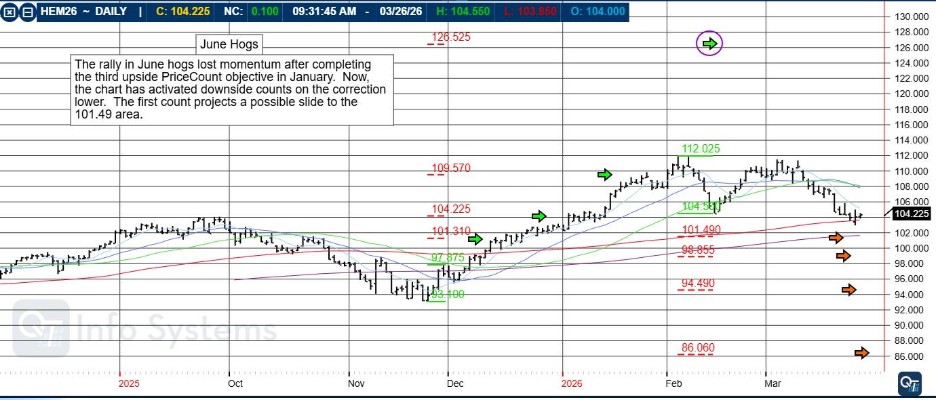
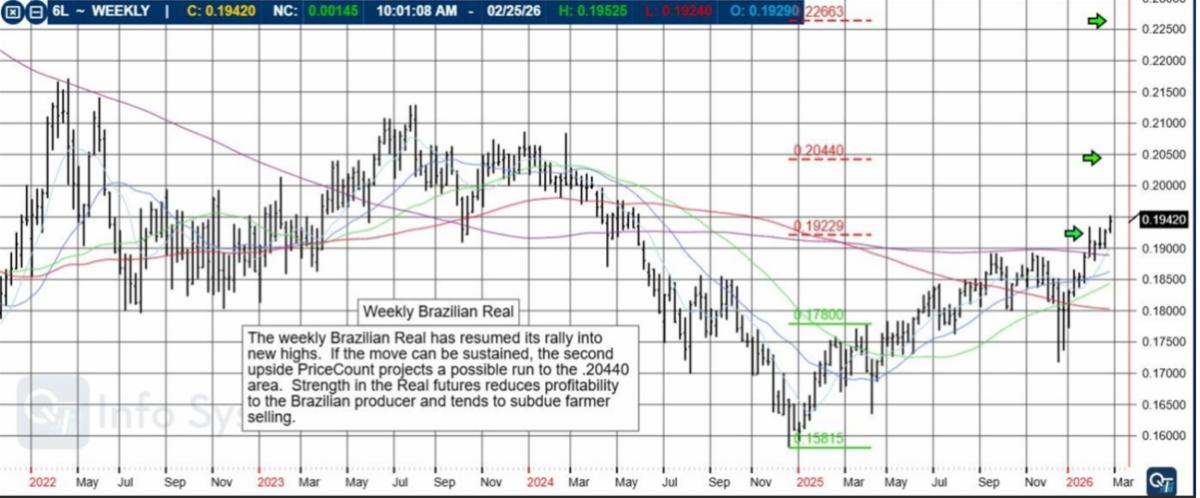
The PriceCount study is a tool that can help to project the distance of a move in price. The counts are not intended to be an ‘exact’ science but rather offer a target area for the four objectives which are based off the first leg of a move with each subsequent count having a smaller percentage of being achieved.
It is normal for the chart to react by correcting or consolidating at an objective and then either resuming its move or reversing trend. Best utilized in conjunction with other technical tools, PriceCounts offer one more way to analyze charts and help to manage your positions and risk. Learn more at www.qtchartoftheday.com
Trading in futures, options, securities, derivatives or OTC products entails significant risks which must be understood prior to trading and may not be appropriate for all investors. Past performance of actual trades or strategies is not necessarily indicative of future results.
|
|
|
|
|
|
|
|
|
||||||||||||||||||||||||||||
|
||||||||||||||||||||||||||||
|
Algorithmic Precision Trading, December Soymeal, Levels, Reports; Your 4 Important Need-To-Knows for Trading Futures on October 24th, 2025
|
|
At-a-Glance Levels
| Instrument | S2 | S1 | Pivot | R1 | R2 | ||
|---|---|---|---|---|---|---|---|
| Gold (GC) — Dec (GCZ5) | 4035.77 | 4083.83 | 4127.67 | 4175.73 | 4219.57 | ||
| Silver (SI) — Dec (SIZ5) | 46.88 | 47.71 | 48.47 | 49.30 | 50.05 | ||
| Crude Oil (CL) — Nov (CLX5) | 58.60 | 60.12 | 61.16 | 62.68 | 63.72 | ||
| Dow Jones (YM) — Dec 2025 | 46437 | 46669 | 46831 | 47063 | 47225 |
|
||||||||||||||||||||||||||||||||||||||||||||||||||||||||||
|
||||||||||||||||||||||||||||||||||||||||||||||||||||||||||
|
Futures FYI: Metals, Stock Index Futures, Energies, Dec-March Corn Spread, Levels, Reports; Your 6 Important Need-To-Knows for Trading Futures on October 23rd, 2025
|
|
|||||||||||||||||||||||||||||||||||||||||||||||||||||||||||||||||||||||||||||||||||||||||||||||||
|
|||||||||||||||||||||||||||||||||||||||||||||||||||||||||||||||||||||||||||||||||||||||||||||||||
|
Gov’t Shutdown Continues, Impact on Traders’ Reports, Blackout & Volatility, Levels, Reports; Your 5 Important Must-Knows for Trading Futures on October 22nd, 2025
|
|
|
||||||||||||||||||||||||||||||||||||||||||||||||||||||||||||||||||||||||||||||||||||||||||||||||||
|
||||||||||||||||||||||||||||||||||||||||||||||||||||||||||||||||||||||||||||||||||||||||||||||||||
|
- December 2025
- November 2025
- October 2025
- September 2025
- August 2025
- July 2025
- June 2025
- May 2025
- April 2025
- March 2025
- February 2025
- January 2025
- December 2024
- November 2024
- October 2024
- September 2024
- August 2024
- July 2024
- June 2024
- May 2024
- April 2024
- March 2024
- February 2024
- January 2024
- December 2023
- November 2023
- October 2023
- September 2023
- August 2023
- July 2023
- June 2023
- May 2023
- April 2023
- March 2023
- February 2023
- January 2023
- December 2022
- November 2022
- October 2022
- September 2022
- August 2022
- July 2022
- June 2022
- May 2022
- April 2022
- March 2022
- February 2022
- January 2022
- December 2021
- November 2021
- October 2021
- September 2021
- August 2021
- July 2021
- June 2021
- May 2021
- April 2021
- March 2021
- February 2021
- January 2021
- December 2020
- November 2020
- October 2020
- September 2020
- August 2020
- July 2020
- June 2020
- May 2020
- April 2020
- March 2020
- February 2020
- January 2020
- December 2019
- November 2019
- October 2019
- September 2019
- August 2019
- July 2019
- June 2019
- May 2019
- April 2019
- March 2019
- February 2019
- January 2019
- December 2018
- November 2018
- October 2018
- September 2018
- August 2018
- July 2018
- June 2018
- May 2018
- April 2018
- March 2018
- February 2018
- January 2018
- December 2017
- November 2017
- October 2017
- September 2017
- August 2017
- July 2017
- June 2017
- May 2017
- April 2017
- March 2017
- February 2017
- January 2017
- December 2016
- November 2016
- October 2016
- September 2016
- August 2016
- July 2016
- June 2016
- May 2016
- April 2016
- March 2016
- February 2016
- January 2016
- December 2015
- November 2015
- October 2015
- September 2015
- August 2015
- July 2015
- June 2015
- May 2015
- April 2015
- March 2015
- February 2015
- January 2015
- December 2014
- November 2014
- October 2014
- September 2014
- August 2014
- July 2014
- June 2014
- May 2014
- April 2014
- March 2014
- February 2014
- January 2014
- December 2013
- November 2013
- October 2013
- September 2013
- August 2013
- July 2013
- June 2013
- May 2013
- April 2013
- March 2013
- February 2013
- January 2013
- December 2012
- November 2012
- October 2012
- September 2012
- August 2012
- July 2012
- June 2012
- May 2012
- April 2012
- March 2012
- February 2012
- January 2012
- December 2011
- November 2011
- October 2011
- September 2011
- August 2011
- July 2011
- June 2011
- May 2011
- April 2011
- March 2011
- February 2011
- January 2011
- December 2010
- November 2010
- October 2010
- September 2010
- August 2010
- July 2010
- June 2010