Futures Trading Platform – Sierra Charts

Sierra Charts is consistently ranked among the best futures trading platforms on the market today. With a reputation for precision, performance, and deep customization, Sierra Chart software offers traders a reliable and powerful experience. Whether you’re just stepping into the world of trading futures or are already immersed in the professional landscape, Sierra Charts caters to every level of need with robust and scalable features.

At Cannon Trading Company, traders will find the perfect complement to Sierra Charts. With decades of futures trading expertise, hands-on client support, and cost-effective solutions, Cannon Trading stands out as the ideal brokerage partner for those who rely on Sierra Chart software for success.

Sierra Charts: An In-Depth Look

Sierra Chart software is engineered for high-performance futures trading, with ultra-low latency, real-time data, and advanced analytics. It’s trusted by both retail and institutional traders due to its professional-grade toolkit and seamless operation. More than just a charting application, Sierra Charts functions as a complete institutional trading platform, meeting the needs of a wide variety of trading styles.

Key Features and Benefits

  • True Tick-by-Tick Data: Delivers incredibly accurate historical and real-time data.
  • Custom Charting Tools: Includes hundreds of indicators and supports complex scripting.
  • Order Flow Visualizations: Advanced tools such as volume profiles, DOM, and footprint charts.
  • Fast Execution: Server-side bracket orders and direct connections to top-tier data feeds.
  • Limitless Customization: Nearly every interface and charting element can be configured.

This unparalleled level of detail and adaptability makes Sierra Charts not just one of the best retail futures trading platforms but also a reliable institutional trading platform for high-volume trading

Try a FREE Demo!

10 Advanced Tips for Sierra Charts Users

Here are 10 valuable tips to help you get the most out of Sierra Chart software:

  1. Study Subgraph Alerts Configure conditional alerts using study subgraphs to spot critical trade setups in futures trading. This feature is perfect for catching price reactions in real time.
  2. Organize Chartbooks Strategically Divide your workspace by market types, such as metals or energy. This structure enhances performance and usability, especially when using Sierra Charts for trading futures across different sectors.
  3. Leverage Global Drawing Tools Annotate key levels and have them appear across all charts of the same symbol. This is crucial for traders analyzing multiple timeframes in Sierra Chart software.
  4. Spreadsheet Systems for Strategy Building Use built-in spreadsheet functions to develop strategies without coding. Many professional traders find this tool invaluable for testing futures trading hypotheses.
  5. Apply Volume-by-Price for Depth Insight Use the volume-by-price study to uncover trading zones. Sierra Charts’ capacity to analyze order flow makes it an institutional trading platform trusted by professionals.
  6. Customize Trade DOM for Speed Modify the Trade DOM with custom layouts to suit your strategy. High-frequency traders will especially appreciate this flexibility when trading futures rapidly.
  7. Use Replay Mode for Analysis Recreate past markets using replay mode. This tool helps traders review trades and improve skills using Sierra Chart software in a realistic setting.
  8. Implement Attached OCO and OSO Orders Use One-Cancels-Other (OCO) and Order-Sends-Order (OSO) to automate risk management. These tools are standard on any institutional trading platform.
  9. Set Hotkeys for Order Actions Customize keyboard shortcuts for quick trade execution. For those using the best futures trading platform during fast markets, speed is critical.
  10. Enable Auto Backups Protect your chartbooks and templates by enabling automatic backups. Sierra Charts ensures your trading environment is secure and recoverable.

Try a FREE Demo!

Partnering with Cannon Trading Company

Partnering with Cannon

Partnering with Cannon

Cannon Trading Company enhances the Sierra Charts experience by offering traders robust support and exclusive advantages. Here’s what makes Cannon Trading a top Brokerage partner
✅ Experience You Can Trust
Registered for more than 35 years in Futures Industry. Cannon Trading offers years experience and  depth of knowledge. Their team understands the intricacies of Sierra Chart software and supports users from onboarding to strategy refinement.
✅ Complimentary Access to Sierra Charts
Unlike many brokers, Cannon Trading provides free access to Sierra Charts as part of its platform offerings. This makes it one of the best futures trading platform arrangements for cost-conscious professionals.

✅ Outstanding Reputation
Rated highly on TrustPilot, Cannon Trading is known for responsive support and personalized service. This commitment extends to all aspects of trading futures through their extensive list of platform offerings

✅ Regulatory Transparency
Cannon maintains a strong compliance record, offering peace of mind to clients who demand professionalism from their institutional trading platform.

✅ Platform Versatility
Beyond Sierra Chart software, Cannon offers access to platforms like CQG, Rithmic, and Firetip. This ensures traders have access to the best futures trading platform for their unique needs.

Enhanced Functionality for All Traders

Sierra Charts offers instutional traders and retail traders alike. With scalable features and straightforward interface options, newer traders will also find Sierra Charts to be an ideal environment for learning and executing futures trading strategies. The software supports simulation modes, practice trades, and deep learning opportunities, making it accessible even for those just beginning to explore trading futures.

Additionally, the support for external data feeds and broker connectivity makes Sierra Charts one of the few platforms that bridge the gap between retail and institutional trading platform environments. They also offer free real-time market data through Teton. This dual appeal ensures that users can evolve without changing software, making it a top contender for the best futures trading platform.

Whether you’re trading futures part-time or engaged full-time in institutional trading, Sierra Charts delivers the performance, flexibility, and reliability required in a fast-paced market. Paired with Cannon Trading Company, traders gain access to Sierra Chart software and a comprehensive support network that enhances their results.

With the right tools and the right partner, every futures trading journey becomes more focused, more informed, and ultimately more successful. Sierra Charts, coupled with Cannon Trading, stands as a formidable choice for anyone seeking the best futures trading platform!

Try a FREE Demo!

Ready to start trading futures? Call us at 1(800)454-9572 (US) or (310)859-9572 (International), or email info@cannontrading.com to speak with one of our experienced, Series-3 licensed futures brokers and begin your futures trading journey with Cannon Trading Company today.

Disclaimer: Trading Futures, Options on Futures, and retail off-exchange foreign currency transactions involve substantial risk of loss and are not suitable for all investors. Past performance is not indicative of future results. Carefully consider if trading is suitable for you in light of your circumstances, knowledge, and financial resources. You may lose all or more of your initial investment. Opinions, market data, and recommendations are subject to change at any time.

Important: Trading commodity futures and options involves a substantial risk of loss. The recommendations contained in this article are opinions only and do not guarantee any profits. This article is for educational purposes. Past performances are not necessarily indicative of future results.

This article has been generated with the help of AI Technology and modified for accuracy and compliance.

Follow us on all socials: @cannontrading


Futures Trading Platform CQG

In the fast-moving world of futures and commodities, choosing the right futures trading platform is essential. Among the top contenders is the Futures Trading Platform CQG, widely recognized for delivering robust tools, reliable data, and seamless connectivity to global markets. As a premier online futures trading platform, CQG supports both institutional and retail traders through its diverse suite of products including CQG Spreader, CQG ONE, CQG Desktop, CQG Trader, and CQG Mobile. This guide explores the full range of offerings within the CQG ecosystem and how you can leverage them, especially through trusted brokers like Cannon Trading.

What is CQG?

At its foundation, CQG (Commodity Quote Graphics) is a sophisticated technology provider—not a brokerage—that delivers high-speed market access and trade execution. It offers the infrastructure upon which many brokers build their futures trading platform services. With over four decades of experience, CQG is known for its accuracy, speed, and comprehensive CQG data feed. Whether you’re trading on CQG Desktop, CQG Trader, or CQG Mobile, you’re backed by a platform engineered for low-latency and high-performance trading.

CQG Desktop: Modern, Web-Based Market Mastery

The flagship interface of the platform suite is CQG Desktop, an HTML5-powered tool accessible via modern web browsers. Traders often search for CQG desktop download, but in most cases, no software installation is needed. This cloud-based interface brings together advanced charting, analytics, and execution features in one accessible solution. Traders value it for its:

  • Real-time Market Visualization: Charts, heatmaps, and real-time quotes powered by the CQG data feed.
  • Powerful Charting Suite: Includes dozens of technical indicators, custom studies, and layout configurations.
  • Easy Order Management: The Hybrid Order Ticket simplifies order entries with DOM views and intuitive buttons.
  • Cross-Platform Sync: Account data syncs across devices, making transitions between desktop and mobile seamless.
  • News Integration: RSS feeds within the platform keep traders informed on critical market developments.

A CQG desktop demo is the perfect introduction for new users, allowing for exploration of the platform in a simulated trading environment. With a focus on accessibility, CQG Desktop is ideal for both active traders and analysts seeking a professional-grade futures trading platform.

Try a FREE Demo!

CQG Trader: Focused Execution for Active Traders

For those who prioritize order entry and execution speed over technical analysis, CQG Trader is the go-to choice. This lightweight yet powerful tool is designed with simplicity and precision in mind. Features include:

  • DOMTrader® Interface: A detailed depth-of-market view showing bid/ask ladders for rapid execution.
  • Fast Order Entry: The Hybrid Order Ticket is engineered for one-click buying and selling.
  • Real-Time Quotes and Positions: Monitor account balance, fills, and working orders in real-time.
  • Minimal Resource Usage: Runs efficiently on older machines or lower bandwidth environments.

Though it lacks the comprehensive charting tools found in CQG Desktop, CQG Trader is a streamlined alternative for traders who already use external charting or want a dedicated execution interface. As part of the cqg trading suite, it remains a reliable and high-speed solution for professional use.

CQG Mobile: Portable Power for Traders on the Move

In today’s mobile-first world, CQG Mobile ensures traders are never out of touch with the markets. Available for iOS and Android, CQG Mobile provides:

  • Access Anywhere: View quotes, place orders, and monitor positions while on the go.
  • Seamless Integration: Trades placed on mobile are reflected on CQG Desktop, thanks to account sync.
  • High-Speed Connectivity: The same reliable CQG data feed underpins the mobile experience.
  • Biometric Security: Fast cqg login options using FaceID or TouchID offer secure access.
  • Custom Alerts: Set price or fill alerts to stay updated without monitoring constantly.

CQG Mobile enables traders to take the full power of their futures trading platform with them. Whether you’re traveling, commuting, or working remotely, cqg mobile keeps you connected.

CQG Desktop Demo: Learn and Test Risk-Free

For those new to the ecosystem or considering switching from another online futures trading platform, the CQG desktop demo offers a no-risk environment to explore the platform. This simulated version replicates live market conditions using real-time data, but with virtual capital.

Key benefits include:

  • Platform Familiarization: Practice with the interface, chart settings, and order tickets.
  • Strategy Testing: Backtest or paper trade new methods using a live cqg data feed.
  • Smooth Transition to Live Accounts: Since the demo mirrors the real platform, moving to live trading is seamless.

Most brokers, including Cannon Trading, offer access to the CQG desktop demo via a quick sign-up and CQG desktop download link or web-based portal. The platform is easy to get started with and doesn’t require extensive technical skills.

Try a FREE Demo!

The CQG Data Feed: Why Accuracy Matters

At the heart of every CQG product lies the high-performance CQG data feed. Known for its accuracy and reliability, it powers the full suite of platforms and offers:

  • Consolidated Market Coverage: Futures, options, forex, and more in a unified view.
  • Low Latency Execution: CQG co-locates servers with exchanges for minimal delays.
  • Global Reach: Direct access to 40+ exchanges, including CME, ICE, Eurex, and more.
  • Historical Data: Ideal for backtesting or strategy development.

Professional traders know that trading is only as good as the data behind it. The CQG data feed delivers the insight and speed needed to succeed.

One CQG Login, Multiple Access Points

Managing multiple platforms is simple with a single CQG login. Whether you’re on CQG Desktop, CQG Trader, or CQG Mobile, your credentials carry over. This unified access:

  • Streamlines Access: One CQG login gets you into all your trading interfaces.
  • Improves Security: CQG supports two-factor authentication and biometric logins.
  • Enhances Continuity: Orders, fills, and positions are updated across platforms in real time.

Most brokers support only one live session at a time per exchange rule, but switching between devices is quick and hassle-free.

Getting Started: CQG Desktop Download and Setup

While traditional platforms often require hefty installations, CQG Desktop redefines ease of access. Despite the popular term “CQG desktop download,” most users simply access the platform via a browser.

  • Web-Based Simplicity: Launch from any device with a modern browser—no installations needed.
  • Cross-Platform Compatibility: Works on Windows, Mac, and Linux.
  • Minimal Setup: Brokers provide login links, and you’re ready to trade in minutes.

For those who prefer desktop apps, light CQG desktop download versions or launchers are available. Mobile users can install CQG Mobile via app stores and begin trading immediately with their CQG login.

Try a FREE Demo!

Why Choose Cannon Trading for Your CQG Experience?

CQG Experience

CQG Experience
Brokers make a major difference in how effective a platform is. Cannon Trading stands out as a leading choice for accessing CQG Desktop, CQG Trader, or CQG Mobile.

Here’s why:

  1. Deep Experience: Founded in 1988, Cannon has been helping traders navigate volatile markets for over 35 years.
  2. Top-Rated Support: Consistently earning 5-star TrustPilot reviews, Cannon is known for exceptional client service.
  3. Regulatory Integrity: As an NFA-registered FCM, Cannon operates under strict CFTC oversight.
  4. Broad Platform Support: Beyond CQG, Cannon also offers Rithmic MultiCharts, Sierra Chart, and more.
  5. Personalized Training: Whether you need help setting up your CQG desktop demo or live account, Cannon provides one-on-one assistance.

Whether you’re just starting or are a seasoned trader, Cannon Trading combines the power of CQG with reliable, personalized brokerage service.

A Platform Built for Performance, Paired with Broker Excellence

From the fully featured CQG Desktop to the streamlined CQG Trader and flexible CQG Mobile, the CQG Futures Trading Platform provides traders with everything they need to thrive. With consistent and accurate market data through the CQG data feed, a seamless CQG login experience, and accessibility across devices, CQG is built for modern trading.

Starting is easy—just request a CQG desktop demo from a broker like Cannon Trading, complete your quick CQG desktop download, and enter the market with confidence. For those serious about trading, partnering with Cannon Trading brings added benefits—top-tier support, a broad platform offering, and decades of futures market expertise.

When reliability, flexibility, and data quality matter, CQG, combined with Cannon Trading, provides the ideal environment for success in futures markets.

Try a FREE Demo!

Ready to start trading futures? Call us at 1(800)454-9572 (US) or (310)859-9572 (International), or email info@cannontrading.com to speak with one of our experienced, Series-3 licensed futures brokers and begin your futures trading journey with Cannon Trading Company today.

Disclaimer: Trading Futures, Options on Futures, and retail off-exchange foreign currency transactions involve substantial risk of loss and are not suitable for all investors. Past performance is not indicative of future results. Carefully consider if trading is suitable for you in light of your circumstances, knowledge, and financial resources. You may lose all or more of your initial investment. Opinions, market data, and recommendations are subject to change at any time.

Important: Trading commodity futures and options involves a substantial risk of loss. The recommendations contained in this article are opinions only and do not guarantee any profits. This article is for educational purposes. Past performances are not necessarily indicative of future results.

This article has been generated with the help of AI Technology and modified for accuracy and compliance.

Follow us on all socials: @cannontrading

Bookmap Futures Trading Platform

Introduction to Bookmap

In today’s fast-paced financial markets, choosing the right futures trading platform can significantly influence trading outcomes. Bookmap stands out as a sophisticated platform that redefines how traders visualize and interpret market activity. With its unique graphical interface and real-time data analytics, Bookmap trading brings a new level of insight to order flow and liquidity, providing users with actionable market intelligence.

As technology transforms online trading, it’s crucial to work with a seasoned brokerage firm that offers both robust technology and dedicated support. That’s where Cannon Trading Company becomes essential. With a legacy of excellence and innovation in the online futures trading Brokerage industry, Cannon Trading helps traders leverage advanced tools like Bookmap for maximum performance.

This guide covers the highlights of Bookmap trading, outlines Bookmap pricing and Bookmap download steps, and explains how Cannon Trading can be your trusted ally in futures markets.

What is Bookmap?

Bookmap is a trailblazing futures trading platform that allows market participants to visualize full-depth order book activity in real time. Unlike standard charting software, Bookmap trading uncovers hidden layers of market data through its heatmap and volume tracking tools.

Users can access the platform via Bookmap Web or integrate it with Bookmap TradingView, offering multi-device convenience and compatibility. Bookmap free versions offer a hands-on preview, ideal for users evaluating its capabilities before subscribing.

A key strength of the platform lies in Bookmap data. Traders can analyze historical order books alongside real-time trade flows to uncover emerging trends and key market turning points—features that elevate this tool above traditional trading platforms.

Try a FREE Demo!

Features that Define the Bookmap Futures Trading Platform

  1. Real-Time Order Flow Insights
    One of Bookmap’s core functions is its real-time tracking of order flow. Users see limit orders, executions, and cancellations as they happen, enhancing their ability to anticipate price movements. For any futures trading platform, this level of insight is a game-changer.
  1. Dynamic Heatmap Interface
    The heatmap visual in Bookmap trading offers an intuitive display of liquidity changes. This helps traders pinpoint zones of market interest and understand how institutional players interact with price levels.
  1. Volume-Based Analytics
    Volume dots and delta analysis offer deep insight into the volume dynamics at different price levels. Traders on an online futures trading platform gain a distinct edge, especially in high-frequency or scalp trading strategies.
  1. Historical Replay Functionality
    Market Replay allows traders to review trading sessions tick-by-tick. This is a crucial feature for those who wish to backtest strategies or improve their decision-making skills in futures trading.
  1. Expandable Indicators and APIs
    Bookmap supports third-party plugins and custom APIs, offering flexibility that is rare among futures trading platforms. Users can design bespoke indicators to match their trading preferences.
  1. Support for Multiple Asset Classes
    Although optimized for futures, Bookmap also accommodates equities and crypto, giving it cross-market versatility and broad appeal to diversified traders.
  1. Browser Access and Charting Tools
    With Bookmap Web, traders are no longer tethered to desktop installations. Furthermore, Bookmap TradingView integration brings added layers of charting capabilities for comprehensive analysis.
  1. Try Before You Buy
    Bookmap free access includes historical data, foundational visuals, and limited tools. It’s a great way to familiarize yourself with Bookmap trading before committing to a paid plan.
  1. Market Data Integrity
    The platform relies on premium Bookmap data sourced from reliable vendors. This ensures speed, precision, and consistency—essential elements for real-time decision-making.

Try a FREE Demo!

Exploring Bookmap Pricing and Subscription Options

Understanding Bookmap pricing helps traders select the plan that best suits their trading objectives:

  • Bookmap Free: Offers a lightweight experience for those exploring Bookmap trading for the first time.
  • Digital+: Unlocks additional indicators and a modest scope of Bookmap data.
  • Global: Tailored for active traders in the futures space, with extended functionality and full-depth order book access.
  • Global+: The most robust plan, featuring premium analytics and exclusive add-ons.

All subscription levels support simple Bookmap download options for Windows and Mac users. Whether you’re just starting or already managing large positions, there’s a plan to meet your needs.

Getting Started with Bookmap

Ready to begin with Bookmap? Here’s how to initiate the Bookmap download and jump into trading:

  1. Visit the Cannon Trading Site: Start the process directly from the Broker homepage.
  2. Choose a Subscription Plan: Evaluate options from Bookmap Free to Global+.
  3. Download and Install: Follow the user-friendly steps for a seamless setup.
  4. Connect to a Data Source: Use your broker’s feed or a Bookmap data partner.
  5. Begin Trading: Utilize heatmaps, order flow, and Bookmap TradingView tools.

The availability of Bookmap Web means you can even monitor positions and conduct trades from a mobile browser or any internet-connected device.

Why Cannon Trading is the Perfect Companion for Bookmap

Companion for Bookmap

Companion for Bookmap
When it comes to futures trading, your broker matters as much as your platform. Cannon Trading excels in helping clients navigate and optimize online futures trading platforms—including Bookmap.

  1. Years of Proven Expertise
    Founded in 1988, Cannon Trading has been guiding traders through various futures trading platform evolutions. Their experts are well-versed in Bookmap trading, ensuring you get the most from every feature.
  1. Impressive Client Feedback
    A wealth of five-star reviews on platforms like TrustPilot reinforces the brokerage’s reputation for excellence in client service, education, and technology.
  1. Regulatory Trust
    Cannon Trading is registered with both the NFA and CFTC, following regulatory compliance and safeguarding data integrity.
  1. Versatile Platform Offerings
    In addition to Bookmap free trials, Cannon Trading grants access to a multitude of other online futures trading platform options such as CQG, Rithmic, and Sierra Chart—ensuring that all trading styles are supported.
  1. Dedicated Bookmap Support
    Clients enjoy personalized guidance in setting up Bookmap, connecting data feeds, and optimizing trading layouts. Support includes technical assistance and ongoing strategy consultations.

The Power of Cannon Trading + Bookmap

Merging Bookmap’s technical sophistication with Cannon Trading’s client-focused services produces a winning combination for any trader. With Cannon’s infrastructure and Bookmap’s tools, market transparency can potentially become a competitive advantage.

Whether it’s helping you analyze Bookmap pricing, managing Bookmap data integrations, or facilitating the Bookmap download process, Cannon ensures a smooth and efficient experience every step of the way.

Final Thoughts

Bookmap is more than just a futures trading platform—it’s a revolutionary tool that offers traders a unique edge through order flow visibility and granular market insight. With tools like Bookmap TradingView and browser-friendly Bookmap Web access, it fits perfectly into the modern trader’s workflow. Add in the robust Bookmap free edition and flexible pricing plans, and the platform becomes accessible to everyone from beginners to seasoned pros.

When you team up with a broker like Cannon Trading, you gain more than platform access—you gain a knowledgeable ally in your trading journey. Their commitment to excellence in online futures trading platforms, including Bookmap, positions them as the broker of choice for traders seeking both innovation and support.

Whether you’re evaluating Bookmap pricing or just beginning with a Bookmap download, Cannon Trading is the ideal partner to help you master Bookmap trading and elevate your results.

Try a FREE Demo!

Ready to start trading futures? Call us at 1(800)454-9572 (US) or (310)859-9572 (International), or email info@cannontrading.com to speak with one of our experienced, Series-3 licensed futures brokers and begin your futures trading journey with Cannon Trading Company today.

Disclaimer: Trading Futures, Options on Futures, and retail off-exchange foreign currency transactions involve substantial risk of loss and are not suitable for all investors. Past performance is not indicative of future results. Carefully consider if trading is suitable for you in light of your circumstances, knowledge, and financial resources. You may lose all or more of your initial investment. Opinions, market data, and recommendations are subject to change at any time.

Important: Trading commodity futures and options involves a substantial risk of loss. The recommendations contained in this article are opinions only and do not guarantee any profits. This article is for educational purposes. Past performances are not necessarily indicative of future results.

This article has been generated with the help of AI Technology and modified for accuracy and compliance.

Follow us on all socials: @cannontrading

Futures Trading Platform RTrader Pro

The Rithmic Futures Trading Platform has quickly become a top-tier choice among futures traders who demand ultra-low latency, robust connectivity, and institutional-grade tools. Built on Rithmic’s powerful infrastructure, this platform enables high-speed market access and seamless order execution. Whether you’re a retail trader or managing a proprietary trading desk, the Rithmic suite—especially RTrader Pro—offers a scalable and intuitive environment tailored for success in today’s volatile futures markets.

Try a FREE Demo!

Inside the Rithmic Trader Ecosystem

Central to the Rithmic Futures Trading Platform is the Rithmic backbone—a high-performance trading engine that excels in real-time data processing and trade execution with virtually no latency. Rithmic’s APIs facilitate direct integration with popular trading applications, giving users the flexibility to design customized workflows.

Rithmic Trader enables access to a comprehensive network of futures exchanges with direct routing capabilities, ensuring every order is processed with maximum speed and accuracy. At the user interface level, RTrader Pro serves as the premier tool for engaging with the platform’s advanced functionality. With RTrader Pro, traders enjoy a graphical interface that simplifies complex tasks while providing real-time P&L monitoring and deep customization.

Together, Rithmic, Trader/Rithmic, and RTrader Pro form a tightly integrated ecosystem designed to support both discretionary and automated futures trading strategies.

Standout Features of the Rithmic Futures Trading Platform

  1. Ultra-Low Latency Market Data
    Rithmic delivers real-time market data with minimal delay, a crucial advantage for scalpers and high-frequency traders. By operating within a low-latency environment, the Rithmic Futures Trading Platform ensures that market participants can respond instantly to shifting conditions. This makes the platform an ideal choice for traders who rely on precision and speed.
  1. Direct Market Access (DMA)
    Rithmic connects users directly to key futures exchanges including CME, ICE, NYMEX, and CBOT. Direct Market Access enhances trade transparency, reduces slippage, and improves execution quality. RTrader Pro complements DMA by simplifying order routing and execution management across multiple trading venues, ensuring seamless control.
  1. Sophisticated Order Types
    The Rithmic Futures Trading Platform supports a full suite of advanced order types including OCO, OSO, bracket orders, and trailing stops. Through RTrader Pro, traders can manage these orders easily with point-and-click interfaces or automated systems. This flexibility enables fine-tuned control over risk and execution timing.
  1. Real-Time Risk Monitoring
    RTrader Pro includes real-time margin tracking, live position updates, and comprehensive order logs. Rithmic’s infrastructure continuously enforces risk parameters, helping firms and individuals stay within regulatory and account constraints. These features are essential for prop shops or traders managing multiple accounts concurrently.
  1. Server-Side Order Management
    The platform’s server-side execution architecture stores orders on Rithmic’s servers rather than the trader’s local machine. This minimizes exposure to internet interruptions or local failures. In combination with RTrader Pro, server-side handling ensures orders are executed reliably, even in volatile market conditions.
  1. High-Fidelity Simulation Environment
    Rithmic’s simulation mode replicates real market behavior, including slippage and latency, offering a near-authentic environment for strategy testing. Traders can access this feature through RTrader Pro, enabling stress-free evaluation of new systems without financial risk. This is especially beneficial for educators and strategy developers.
  1. Integration with Third-Party Platforms
    Thanks to Rithmic’s open APIs, the Trader/Rithmic Futures Trading Platform integrates seamlessly with charting software such as Sierra Chart, and MultiCharts. RTrader Pro acts as the primary access point, while traders enjoy the flexibility to layer on custom analytics and execution tools from third-party providers.
  1. Comprehensive Analytics and Journaling
    RTrader Pro offers robust journaling features and post-trade analytics. Each trade is recorded and analyzed to provide insights into win rates, average trade duration, drawdowns, and other metrics. These tools help traders refine strategies and improve decision-making based on real performance data.
  1. Custom Alerts and Notifications
    Users can set tailored alerts on price thresholds, trade volume, or specific execution conditions. These alerts, configurable within RTrader Pro, can be delivered via audio signals, on-screen popups, or even via API integrations. This functionality ensures traders stay ahead of crucial developments.
  1. Built-In Security and Reliability
    Security is central to the Rithmic platform. Encrypted connections, secure logins, and built-in redundancy measures keep data and orders protected. RTrader Pro supports session logging, automatic backups, and auto-reconnect options, offering users a resilient futures trading platform that won’t falter during technical hiccups.

Try a FREE Demo!

Designed for All Trader Profiles

The Trader/Rithmic Futures Trading Platform is flexible enough to support a variety of trading roles:

  • Retail Traders benefit from intuitive interfaces, responsive order entry, and high-speed data feeds—all through RTrader Pro.
  • Prop Firm Traders leverage risk controls, multi-account support, and server-side automation.
  • Algorithmic Traders use Rithmic’s fast and accessible APIs to build and deploy sophisticated trading models.
  • Trading Educators find value in simulation tools and journaling features, ideal for teaching new traders in a risk-free environment.

Regardless of trading style, RTrader Pro provides an adaptable interface that brings the full power of the Rithmic system to the fingertips of every user.

Try a FREE Demo!

Why Choose the Trader/Rithmic Futures Trading Platform through Cannon Trading Company?

Rithmic Futures

trustpilot
What distinguishes Rithmic is its unwavering focus on performance, reliability, and trader flexibility. By combining the institutional-grade infrastructure of Rithmic with the advanced features of RTrader Pro, the Rithmic Futures Trading Platform becomes more than just a trading interface—it becomes a complete trading solution.

  • Latency-sensitive strategies flourish due to real-time execution.
  • Multi-account management becomes efficient and scalable.
  • Customization ensures the platform aligns trading goals

With its full suite of features and proven performance under demanding conditions, the Trader/Rithmic Futures Trading Platform is engineered to deliver a top notch product.

In a world where milliseconds matter, the TRithmic Futures Trading Platform provides a robust foundation for successful futures trading.

Whether you’re just starting your trading journey or managing a book of institutional-size accounts, the Rithmic platform offers the precision, reliability, and speed necessary to excel in the competitive futures markets. As trading continues to evolve, platforms like this ensure that futures traders remain one step ahead—equipped, informed, and ready to act.

Try a FREE Demo!

Ready to start trading futures? Call us at 1(800)454-9572 (US) or (310)859-9572 (International), or email info@cannontrading.com to speak with one of our experienced, Series-3 licensed futures brokers and begin your futures trading journey with Cannon Trading Company today.

Disclaimer: Trading Futures, Options on Futures, and retail off-exchange foreign currency transactions involve substantial risk of loss and are not suitable for all investors. Past performance is not indicative of future results. Carefully consider if trading is suitable for you in light of your circumstances, knowledge, and financial resources. You may lose all or more of your initial investment. Opinions, market data, and recommendations are subject to change at any time.

Important: Trading commodity futures and options involves a substantial risk of loss. The recommendations contained in this article are opinions only and do not guarantee any profits. This article is for educational purposes. Past performances are not necessarily indicative of future results.

FOMC, NVIDIA, June Dollar Index; Your 5 Important Need-To-Knows for Trading through Memorial Day Weekend, 2025

7cfe5b36 db9f 4933 824a 7f264613e7fe

Cannon Futures Weekly Letter

In Today’s Issue #1243

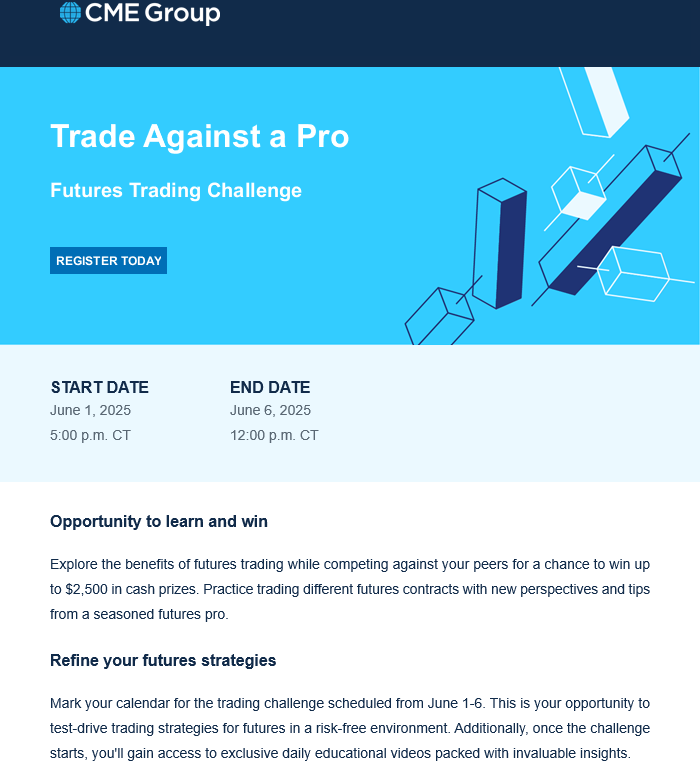
  • Trade Against the Pro – Trading Competition
  • The Week Ahead – A shortened week. FOMC Minutes and NVIDIA earnings

  • Futures 101 – Memorial Day Trading Schedule
  • Hot Market of the Week – June Dollar Index
  • Broker’s Trading System of the Week – Heating Oil Swing Trading System
  • Trading Levels for Next Week
  • Trading Reports for Next Week

Trade Against the Pro – Simulated Contest, Real Cash prizes!

Opportunity to learn and win

Explore the benefits of futures trading while competing against your peers for a chance to win up to $2,500 in cash prizes. Practice trading different futures contracts with new perspectives and tips from a seasoned futures pro.

Refine your futures strategies

Mark your calendar for the trading challenge scheduled from June 1-6. This is your opportunity to test-drive trading strategies for futures in a risk-free environment. Additionally, once the challenge starts, you’ll gain access to exclusive daily educational videos packed with invaluable insights.

GET STARTED

28ae1ddf f400 4901 82b9 03a497f63f26

Important Notices: The Week Ahead

FOMC! NVIDIA!

fomc

By John Thorpe, Senior Broker

A shortened week. FOMC Minutes and NVIDIA earnings top the list.

More volatility to come as next week all markets will be reacting to whatever comes out of the U.S. Govt leadership relating to conflicts cessation and trade deals. Therefore, increased volatility expectations.

Earnings Next Week:

  • Mon. Memorial Day
  • Tue. PDD Holdings
  • Wed. Nvidia, Salesforce
  • Thu. Dell, Marvell tech
  • Fri. Costco

FED SPEECHES: (all time CDT)

  • Mon.     Memorial Day no speeches
  • Tues.     Kashkari 3 am ct, Williams, 6pm ct
  • Wed.     Kashkari 3 am ct,
  • Thu.      Kugler 1 pm ct, Daly, 3 pm ct, Logan 7 pm ct
  • Fri.       Goolsbee 5:30 pm ct

Economic Data week:

  • Mon. Memorial Day no releases
  • Tue. Durable Goods, Case-Schiller, CB Consumer Confidence, Dallas Fed
  • Wed. Redbook, Richmond Fed, Dallas Svcs. Index, FOMC MINUTES EIA Crude Stocks MOVED TO Thursday,
  • Thur. Initial claims, Core PCE. GDP Q2 est., Pending Home Sales, EIA Nat Gas 7:30 am ct, EIA stocks 11 am ct
  • Fri. Core PCE, Chicago PMI, Mich. Consumer Sentiment


Futures 101: Memorial Day Trading Hours

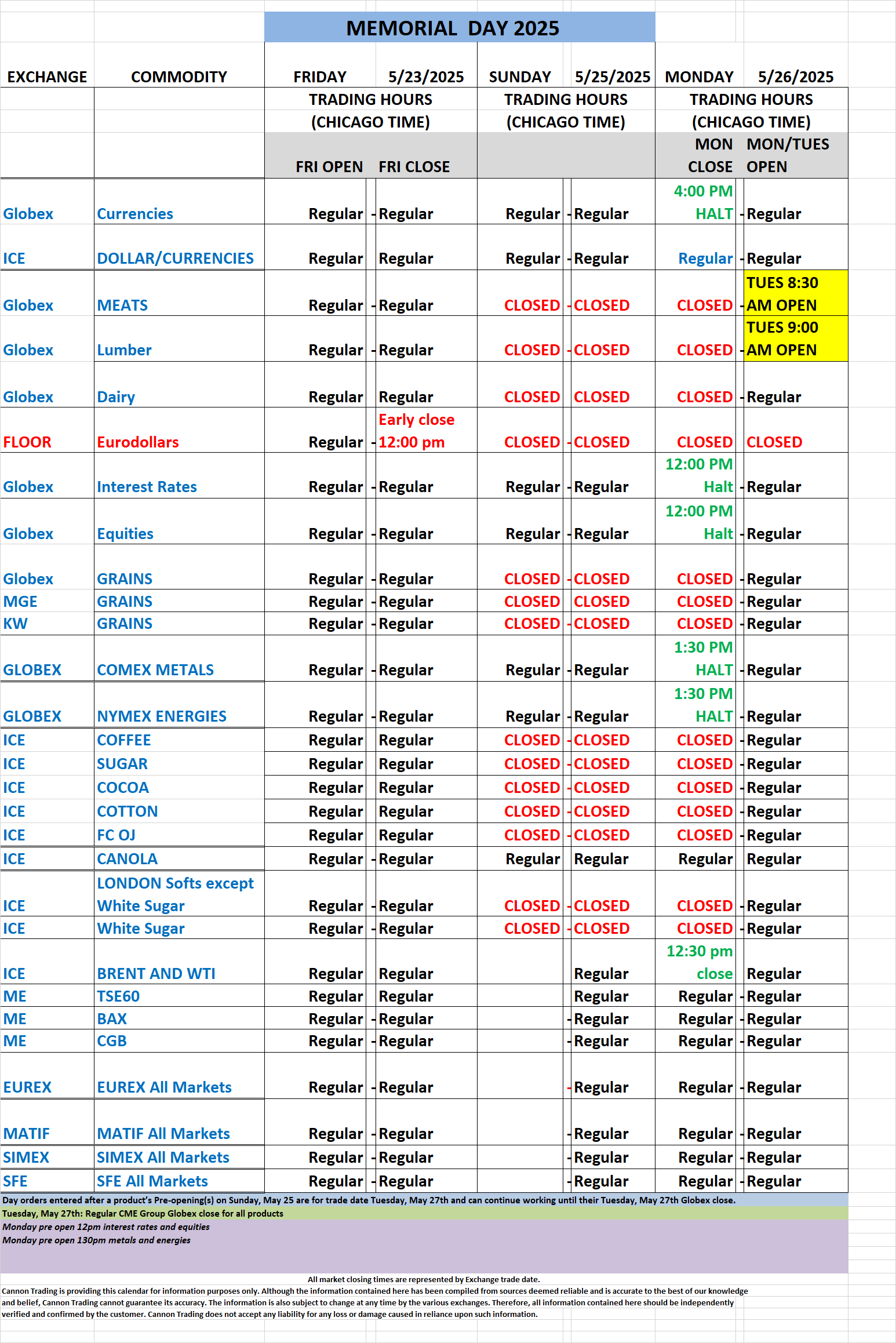
The upcoming US Memorial Day Holiday Trading Schedule for Friday, May 23rd, through Monday, May 26th, 2025, is below.

Memorial Day (May 26th) Holiday Trading Schedule:

Grains

Sunday – Closed

Monday – Closed

Tuesday – 8:30 a.m. CT Open

Livestock

Sunday – Closed

Monday – Closed

Tuesday – 8:30 a.m. CT Open

Cryptocurrencies

Monday – 4:00 p.m. CT Halt

5:00 p.m. CT Re-Open

Energy

Sunday – 5:00 p.m. CT Open

Monday – 1:30 p.m. CT Halt

5:00 p.m. CT Re-Open

FX

Monday – 4:00 p.m. CT Halt

5:00 p.m. CT Re-Open

Interest Rates

Monday – 12:00 p.m. CT Halt

5:00 p.m. CT Re-Open

Metals

Monday – 1:30 p.m. CT Halt

5:00 p.m. CT Re-Open

Stock Indices

Monday – 12:00 p.m. CT Halt

5:00 p.m. CT Re-Open

Sugar, Coffee, Cotton, Cocoa, FCOJ

Monday – Closed

Tuesday – Regular Hours

Canola

Monday – Regular Hours

U.S. Dollar Index

Monday – Regular Hours

FULL SCHEDULE

4b495d37 c52c 4f4e b57d 591dca865d6d

Hot Market of the Week

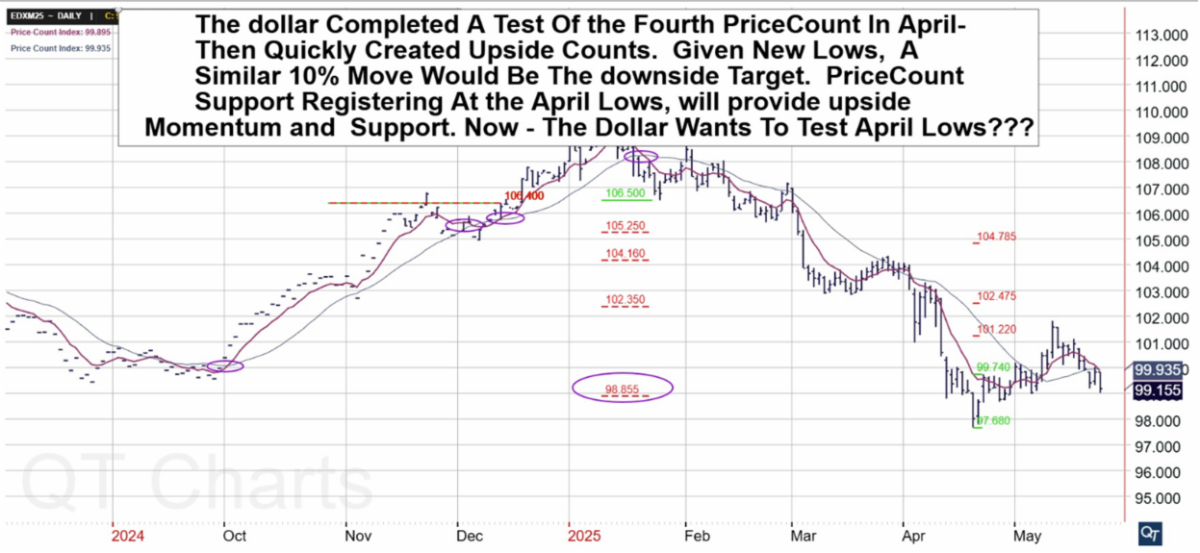
Hot market of the week is provided by QT Market Center, A Swiss army knife charting package that’s not just for Hedgers, Cooperatives and Farmers alike but also for Spread traders, Swing traders and shorter time frame application for intraday traders with a unique proprietary indicator that can be applied to your specific trading needs.

Free Trial Available

June Dollar Index

Key decision levels?

trade

fd669fc2 958b 43e4 8503 b5e81126e73a

The PriceCount study is a tool that can help to project the distance of a move in price. The counts are not intended to be an ‘exact’ science but rather offer a target area for the four objectives which are based off the first leg of a move with each subsequent count having a smaller percentage of being achieved.

It is normal for the chart to react by correcting or consolidating at an objective and then either resuming its move or reversing trend. Best utilized in conjunction with other technical tools, PriceCounts offer one more way to analyze charts and help to manage your positions and risk. Learn more at www.qtchartoftheday.com

Trading in futures, options, securities, derivatives or OTC products entails significant risks which must be understood prior to trading and may not be appropriate for all investors. Past performance of actual trades or strategies is not necessarily indicative of future results.

Brokers Trading System of the Week

Swing 61B Trading System

Market Sector: Energies

Markets Traded:   HO – Heating Oil

System Type:  Swing Trading

Risk per Trade: varies

Trading Rules: Partially Disclosed

Suggested Capital: $25,000

Developer Fee per contract: $145.00 Monthly Subscription

System Description:

Trade ES futures. System coded to seek long or short entries, and the system only uses the higher probability signal. System contains a money management component.

Get Started


Learn More

0666c204 d4e3 445d 80c0 a09213a7baca
Disclaimer The risk of trading can be substantial and each investor and/or trader must consider whether this is a suitable investment. Past performance is not necessarily indicative of future results.

Futures Trading Disclaimer:

Transactions in securities futures, commodity and index futures and options on futures carry a high degree of risk. The amount of initial margin is small relative to the value of the futures contract, meaning that transactions are heavily “leveraged”.

A relatively small market movement will have a proportionately larger impact on the funds you have deposited or will have to deposit: this may work against you as well as for you.

You may sustain a total loss of initial margin funds and any additional funds deposited with the clearing firm to maintain your position. If the market moves against your position or margin levels are increased, you may be called upon to pay substantial additional funds on short notice to maintain your position.

If you fail to comply with a request for additional funds within the time prescribed, your position may be liquidated at a loss and you will be liable for any resulting deficit. Please read full disclaimer HERE.

Would you like to get weekly updates on real-time, results of systems mentioned above?

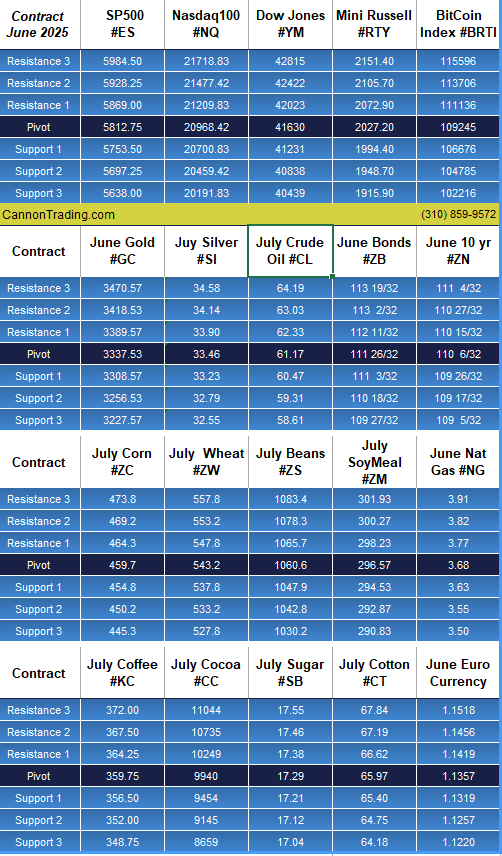
Trading Levels for Next Week

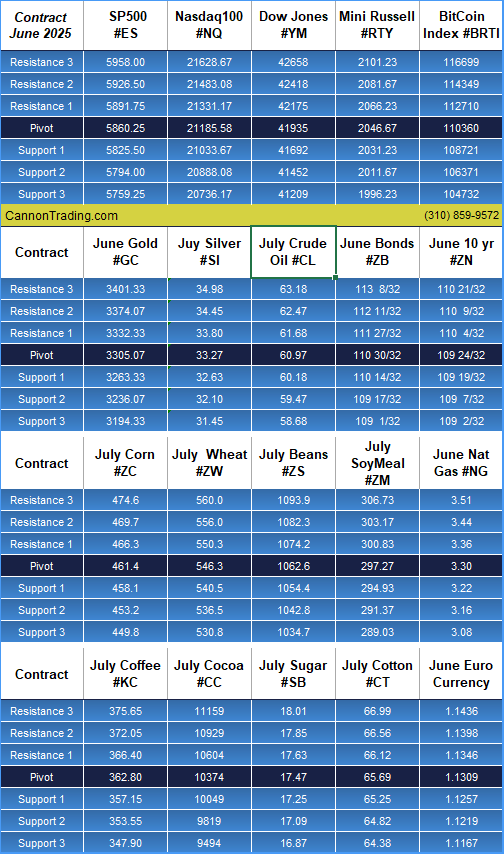
Daily Levels for May 26th/27th, 2025

e625bfc7 8af9 45cb b389 f952581c47a0

Would you like to receive daily support & resistance levels?

Trading Reports for Next Week

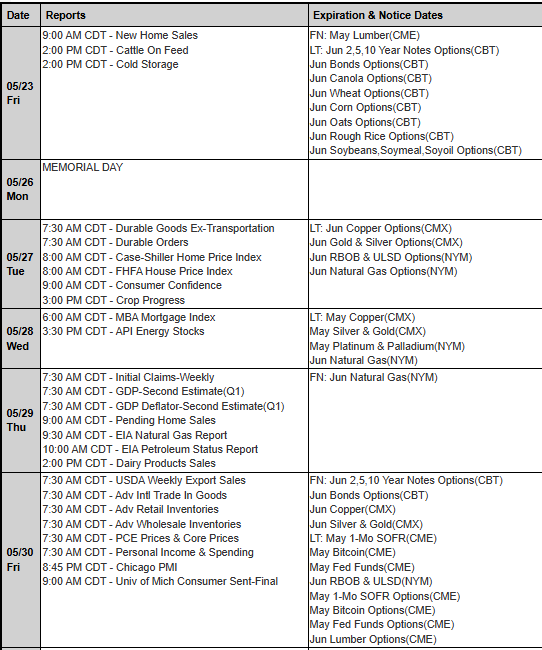
First Notice (FN), Last trading (LT) Days for the Week:

www.mrci.com

d0ed374e f4d6 4e96 b7f5 f6edd13fb84f

Find us on Trustpilot

stars

Trading Futures, Options on Futures, and retail off-exchange foreign currency transactions involves substantial risk of loss and is not suitable for all investors.

You should carefully consider whether trading is suitable for you in light of your circumstances, knowledge, and financial resources.

You may lose all or more of your initial investment. Opinions, market data, and recommendations are subject to change at any time.

Join our Private Facebook group

Subscribe to our YouTube Channel

Listen to our podcast: Subscribe on AppleSpotify, Amazon

or wherever you listen to podcasts!

S
Facebook  Instagram  LinkedIn
S
ef3ab1c9 8d6d 4e60 a3f1 af5d9d4ecbb3
Services
Software
Tools
Community
Contact

Futures Trading Platform MotiveWave

In today’s fast-evolving landscape of futures trading, choosing the right online futures trading platform can significantly impact your success. One platform making waves among traders—both seasoned and novice—is the MotiveWave Futures Trading Platform. Known for its depth, versatility, and user-centric design, MotiveWave trading offers everything from cutting-edge charting tools to seamless mobile integration.

This comprehensive MotiveWave review explores the platform’s core features, pricing, usability, and how it pairs perfectly with Cannon Trading Company to deliver an unparalleled futures trading platform experience.

What Is MotiveWave?

MotiveWave is a high-performance futures trading platform designed to cater to both manual and algorithmic traders. Initially popular among forex and equity markets, it has gained significant traction as an online futures trading platform. Its strength lies in its sophisticated tools and customizable interface, making it suitable for retail traders and institutional users alike.

From MotiveWave mobile access for on-the-go trading to advanced desktop functions via MotiveWave download, the software adapts to various trading styles. Add in Java-based scripting, modular add-ons, and high compatibility with brokers, and it’s clear why this is a leading platform in today’s markets.

Top Features of MotiveWave for Futures Traders

  1. Comprehensive Charting and Technical Tools
    One of the hallmarks of MotiveWave software is its advanced charting suite. With over 300 technical indicators, Fibonacci tools, Elliott Wave patterns, Gann strategies, and annotation features, it provides the precision needed for in-depth market analysis.

    This makes MotiveWave trading ideal for users who rely heavily on technical analysis. Whether you’re backtesting historical data or analyzing real-time markets, the software’s visual interface gives a clear edge.

  1. Strategy Builder and Automation
    The built-in Strategy Builder in MotiveWave software allows traders to create and test automated strategies with ease. It requires no programming skills, though advanced users can leverage Java SDKs for full customization.

    This feature empowers users to transition from manual to automated trading seamlessly—making it one of the standout capabilities in any MotiveWave review.

  1. Market Replay and Simulation
    The Market Replay function allows traders to practice in real-market conditions using historical data. This enhances decision-making without risking real capital. It’s a vital tool for both strategy development and education.
  1. Multi-Broker and Data Feed Integration
    MotiveWave supports major brokers and data feeds including Rithmic, CQG, Interactive Brokers, and others. This ensures reliable, fast, and real-time market data, enhancing performance and decision-making.

    For traders seeking a flexible futures trading platform, this level of integration is essential.

  1. Scalable Pricing Tiers
    Is MotiveWave free? Not entirely. The platform offers a free trial, allowing users to explore core functionalities. Once ready to commit, users can choose from several tiers, depending on the desired features.

    The MotiveWave price structure is designed to grow with the user—from beginner-level access to robust institutional-grade packages.

  1. Notifications and Alerts
    Alerts can be set based on price actions, indicators, or custom triggers. These can be delivered via desktop, email, or mobile, ensuring you’re always in tune with the market—even when you’re away from your desk.

    Whether you’re using MotiveWave mobile or desktop, this feature supports proactive decision-making.

  1. Full Mobile Functionality
    MotiveWave mobile gives traders the power to access markets from anywhere. The app’s responsive design ensures full functionality, allowing users to manage positions, monitor alerts, and execute trades in real-time.

    This convenience is a major highlight in any thorough MotiveWave review.

  1. Workspace Customization
    The platform lets you design personalized workspaces—color themes, multi-timeframe chart views, custom toolbars, and more. It’s perfect for reducing clutter and improving efficiency.

    For frequent users, especially those who run several strategies at once, this can be a game-changer.

  1. Order Management and Risk Controls
    Tools like trailing stops, OCO orders, and bracket trades are seamlessly integrated. They offer traders enhanced risk management and order execution precision—critical for futures market volatility.

Try a FREE Demo!

MotiveWave Login and Setup

Getting started is simple. The MotiveWave login process includes secure, two-factor authentication and customizable dashboards. Once logged in, traders can tailor the layout to suit their trading style.

The MotiveWave download is available on the official website and supports Windows, macOS, and Linux. Updates are frequent, ensuring compatibility and security.

Is MotiveWave Free?

A common beginner question is: Is MotiveWave free? While there’s no fully free version, the platform offers a generous trial to explore its core features. Once the trial ends, pricing tiers become available.

However, with features such as strategy automation, integrated market data, and custom analytics, the MotiveWave price reflects its value. Cannon Trading occasionally provides special offers or extended trials, adding to its appeal.

Why Cannon Trading Enhances the MotiveWave Experience

MotiveWave Experience

MotiveWave

Cannon Trading Company is more than just a broker—it’s a long-established industry leader that complements MotiveWave trading with unmatched support and guidance. Here’s how:

  1. 35+ Years of Experience
    Founded in 1988, Cannon Trading brings deep market knowledge and veteran insights to the table. Their guidance ensures you get the most out of the MotiveWave futures trading platform.
  1. Stellar Reputation
    With multiple 5-star TrustPilot reviews, Cannon Trading is known for integrity, client care, and reliable service. Their clients range from hobbyist traders to seasoned professionals.
  1. Regulatory Excellence
    Cannon Trading is CFTC-registered and NFA-member approved. Traders can feel confident that Cannon Trading is following regulatory regulations.
  1. Platform Variety
    While MotiveWave software is a highlight, Cannon offers over a dozen other online futures trading platform options. This versatility ensures every trader finds their fit.
  1. Trader Education and Support
    Cannon Trading provides in-depth tutorials, webinars, live chat support, and daily market insights. Their onboarding process for MotiveWave download and setup is especially praised by new users.
  1. Competitive Pricing
    Low commissions and flexible plans make Cannon a cost-effective choice for using MotiveWave software. The combination of pricing and performance creates a superior trading environment.

MotiveWave Review: What Traders Are Saying

User feedback consistently reinforces a positive MotiveWave review. Traders point to its robust charting, customization, and real-time data access as defining strengths. Both manual and automated traders find value in its design.

Many highlight how MotiveWave trading simplifies complex strategies while offering powerful tools under the hood. Add MotiveWave mobile to the mix, and it’s a platform that fits every lifestyle.

Cannon Trading’s support team is often mentioned in tandem with the MotiveWave review experience, especially for helping new users navigate setup, MotiveWave login, and ongoing optimization.

Final Thoughts

The MotiveWave Futures Trading Platform stands out in the crowded landscape of online futures trading platform options. From customizable workspaces to algorithmic execution and mobile access, its versatility is hard to beat.

The platform delivers performance where it counts, backed by cutting-edge tools and support.

Combined with Cannon Trading’s decades of experience, you’re not just getting software—you’re getting a trading partner.

For anyone serious about stepping up their game in the futures markets, MotiveWave—especially when paired with Cannon Trading—is a great decision.

Try a FREE Demo!

Ready to start trading futures? Call us at 1(800)454-9572 (US) or (310)859-9572 (International), or email info@cannontrading.com to speak with one of our experienced, Series-3 licensed futures brokers and begin your futures trading journey with Cannon Trading Company today.

Disclaimer: Trading Futures, Options on Futures, and retail off-exchange foreign currency transactions involve substantial risk of loss and are not suitable for all investors. Past performance is not indicative of future results. Carefully consider if trading is suitable for you in light of your circumstances, knowledge, and financial resources. You may lose all or more of your initial investment. Opinions, market data, and recommendations are subject to change at any time.

Important: Trading commodity futures and options involves a substantial risk of loss. The recommendations contained in this article are opinions only and do not guarantee any profits. This article is for educational purposes. Past performances are not necessarily indicative of future results.

This article has been generated with the help of AI Technology and modified for accuracy and compliance.

Follow us on all socials: @cannontrading

Memorial Day hours, July Wheat, Levels; Your 3 Important Need-To-Knows for Futures Trading on May 23rd, 2025

9dc1e02e d5f7 4ff4 abf7 1df60775f196

Wheat Outlook and Memorial Day Schedule

The upcoming US Memorial Day Holiday Trading Schedule for Friday, May 23rd, through Monday, May 26th, 2025, is below.

Memorial Day trading Schedule is available!

memorial day
S

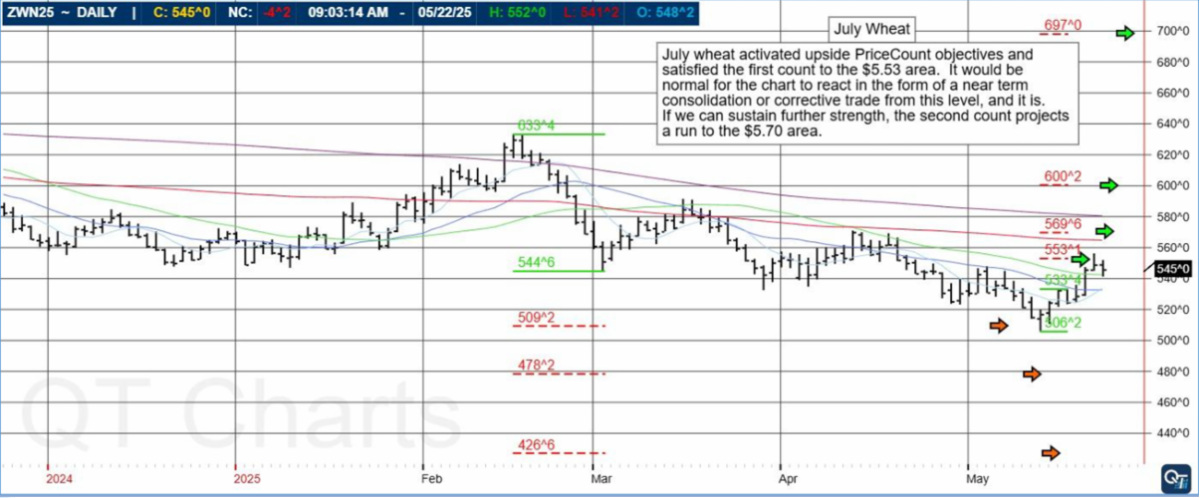
July Wheat

July wheat activated upside PriceCount objectives and satisfied the first count to the $5.53 area. It would be normal for the chart to react in the form of a near term consolidation or corrective trade from this level, and it is. If we can sustain further strength, the second count projects a run to the $5.70 area.

209ae422 9377 45cf aefa 28be9a9be07a

The PriceCount study is a tool that can help to project the distance of a move in price. The counts are not intended to be an ‘exact’ science but rather offer a target area for the four objectives which are based off the first leg of a move with each subsequent count having a smaller percentage of being achieved.

It is normal for the chart to react by correcting or consolidating at an objective and then either resuming its move or reversing trend. Best utilized in conjunction with other technical tools, PriceCounts offer one more way to analyze charts and help to manage your positions and risk. Learn more at www.qtchartoftheday.com

Trading in futures, options, securities, derivatives or OTC products entails significant risks which must be understood prior to trading and may not be appropriate for all investors. Past performance of actual trades or strategies is not necessarily indicative of future results.

Daily Levels for May 23rd, 2025

50112e04 6a7a 49bf b1a7 8e0f096637fd

Want to feature our updated trading levels on your website? Simply paste a small code, and they’ll update automatically every day! 

Click here for quick and easy instructions.

28ae1ddf f400 4901 82b9 03a497f63f26

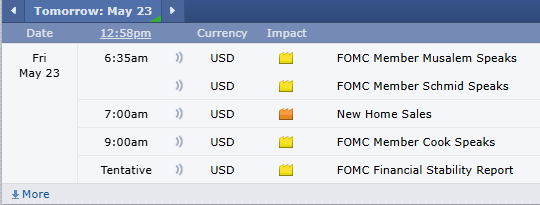
Economic Reports

provided by: ForexFactory.com

All times are Eastern Time ( New York)

c489a0d7 311e 40ea 9037 a81f0c3a824b

Find us on Trustpilot

stars

Trading Futures, Options on Futures, and retail off-exchange foreign currency transactions involves substantial risk of loss and is not suitable for all investors. You should carefully consider whether trading is suitable for you in light of your circumstances, knowledge, and financial resources. You may lose all or more of your initial investment. Opinions, market data, and recommendations are subject to change at any time.

Join our Private Facebook group

Subscribe to our YouTube Channel

Listen to our podcast: Subscribe on AppleSpotify, Amazon

or wherever you listen to podcasts!

S
Facebook  Instagram  LinkedIn
S
ef3ab1c9 8d6d 4e60 a3f1 af5d9d4ecbb3
Services
Software
Tools
Community
Contact

What to Know Before Trading Futures on May 22nd; Your 4 Important Need-To-Knows for Equity Indexes, Financials, Crypto

9dc1e02e d5f7 4ff4 abf7 1df60775f196

What to Know Before Trading Futures on May 22nd

Key Points for Tomorrow

By Mark O’Brien, Senior Broker

futures

Equity Indexes / Interest Rates:

Stock index futures turned lower this afternoon after a disappointing Treasury bond auction accelerated a selloff in the debt market.

The June E-mini Dow Jones futures contract dropped over 800 points, more than 2.0%, leading the E-mini S&P 500 and E-mini Nasdaq indexes lower in afternoon trading.

Financials:

U.S. 30-yr. T-bond and 10-yr. T-note futures also sold off and correspondingly debt yields spiked, with the 10-yr. rate climbing toward 4.6% and the 30-yr. rate eclipsing 5.0%

Yields extended gains in the afternoon after a $16 billion auction of 20-year Treasury bonds attracted relatively soft demand from investors, selling at a higher yield than traders had anticipated.

The selloff in stocks followed earnings reports from retailers Target, Lowe’s and TJX. Target cut its annual outlook.

Crypto:

Bitcoin futures climbed to a new all-time high for the first time since January. The current front-month May futures contract traded intraday up to 110,745 before paring its gains. Bitcoin futures total open interest surged to a record $75 billion, signaling heightened leveraged exposure as traders are eyeing a breakout above a key $108,000 resistance level. The CME Group / Chicago Mercantile Exchange leads with $17.43 billion in open interest. Within the highly leveraged environment, the potential for liquidations of short positions becomes a powerful force that could propel Bitcoin futures to new highs.


S

Memorial Day Schedule

Memorial-Day-2025 image

Daily Levels for May 22nd 2025

7bf96000 eda1 4971 901d 0d5dd3111402
Want to feature our updated trading levels on your website? Simply paste a small code, and they’ll update automatically every day! Click here for quick and easy instructions.
822b33c5 2339 45ed bc84 e9c8f8c7358e

Economic Reports

provided by: ForexFactory.com

All times are Eastern Time (New York)

ebd6bb78 124a 4412 a455 e596136d8654

Find us on Trustpilot

stars

Trading Futures, Options on Futures, and retail off-exchange foreign currency transactions involves substantial risk of loss and is not suitable for all investors. 

You should carefully consider whether trading is suitable for you in light of your circumstances, knowledge, and financial resources.

You may lose all or more of your initial investment. Opinions, market data, and recommendations are subject to change at any time.

Join our Private Facebook group

Subscribe to our YouTube Channel

Listen to our podcast: Subscribe on AppleSpotify, Amazon

or wherever you listen to podcasts!

S
Facebook  Instagram  LinkedIn
S
ef3ab1c9 8d6d 4e60 a3f1 af5d9d4ecbb3
Services
Software
Tools
Community
Contact

Day Trading Margins, June Milk Class III, CME Trading Challenges; Your 3 Important Need-To-Knows for Trading Futures on May 21st, 2025

9dc1e02e d5f7 4ff4 abf7 1df60775f196

Margins

SPAN and Day Trade Margins

by John Thorpe, Senior Broker

margins

Dive into Margin creation

Day trade margins are back to “normal” day trade valuations.

Remember Trump highlighted the need to pass and extend his 2017 tax cuts which are set to expire at years end if a new bill wasn’t passed to extend those tax credits.

Well, we are on the doorstep of that request.  Watch for equity index strength if it passes in the house this week and weakness if it doesn’t. Memorial Day weekend was his target to have the legislation passed.

A quiet data day tomorrow.

On a different note, I hear a lot about from my day traders want to understand more clearly how margin is set and when can we expect reduced day trade margins.

Here’s the short version: Margins are set by the exchange based on a number of factors then the clearing houses adjust day trading parameters based on the exchange Initial margin. Volatility is the biggest factor to affect exchange minimum initial margin.

Here’s the long story from the CME:

https://www.cmegroup.com/solutions/risk-management/performance-bonds-margins/span-methodology-overview.html

Market volatility is here to stay for the foreseeable future with it’s ebbs and flows.

Choose your opportunities wisely. Today’s market swings were largely back to normal ( pre tariff talk normal)

Tomorrow:

Econ Data:  EIA Energy stocks.

FED Speak: One speaker Barkin @ 11am CT

Earnings: TJ Max, Lowe’s, Medtronic, Target

Tariff news:  Anything goes!

SPAN Methodology Overview

CME SPAN is a market simulation-based Value at Risk system that allows you to assess risk on a portfolio basis. Explanations and examples of risk arrays and SPAN analysis are included.

S

June Milk

June class III milk satisfied its second upside PriceCount objective and is correcting. At this point, IF the chart can resume its rally into new sustained highs the third count would project a potential run to the 20.55 area.

a3e3c6f3 8540 46de b671 eb4e3dd2b6a6

The PriceCount study is a tool that can help to project the distance of a move in price. The counts are not intended to be an ‘exact’ science but rather offer a target area for the four objectives which are based off the first leg of a move with each subsequent count having a smaller percentage of being achieved.

It is normal for the chart to react by correcting or consolidating at an objective and then either resuming its move or reversing trend. Best utilized in conjunction with other technical tools, PriceCounts offer one more way to analyze charts and help to manage your positions and risk. Learn more at www.qtchartoftheday.com

Trading in futures, options, securities, derivatives or OTC products entails significant risks which must be understood prior to trading and may not be appropriate for all investors. Past performance of actual trades or strategies is not necessarily indicative of future results.

Daily Levels for May 21st, 2025

56944e9a 29f1 4ed8 9edd e1b2af2e8cb9
Want to feature our updated trading levels on your website? Simply paste a small code, and they’ll update automatically every day! Click here for quick and easy instructions.
28ae1ddf f400 4901 82b9 03a497f63f26

Economic Reports

provided by: ForexFactory.com

All times are Eastern Time (New York)

665d0f4a 769c 4e11 8bf5 ef051d770639

Find us on Trustpilot

stars

Trading Futures, Options on Futures, and retail off-exchange foreign currency transactions involves substantial risk of loss and is not suitable for all investors. 

You should carefully consider whether trading is suitable for you in light of your circumstances, knowledge, and financial resources. You may lose all or more of your initial investment.

Opinions, market data, and recommendations are subject to change at any time.

Join our Private Facebook group

Subscribe to our YouTube Channel

Listen to our podcast: Subscribe on AppleSpotify, Amazon

or wherever you listen to podcasts!

S
Facebook  Instagram  LinkedIn
S
ef3ab1c9 8d6d 4e60 a3f1 af5d9d4ecbb3
Services
Software
Tools
Community
Contact

Futures Trading

Futures trading has grown from humble beginnings into a cornerstone of modern global finance. What started centuries ago as simple agreements for future delivery of goods has evolved into a sophisticated marketplace where traders can speculate and hedge on everything from wheat and oil to stock indexes and cryptocurrencies. The practice of trading futures today involves advanced techniques, powerful electronic platforms, and a deep understanding of market dynamics. This comprehensive exploration covers the origins of futures trading and speculation, how these instruments became integrated into financial markets, and the evolution of the science of trading futures over time. Along the way, we will also highlight how one futures broker in particular – Cannon Trading Company – exemplifies innovation and excellence in this field. The goal is to inform beginners, institutional investors, and financial students alike about the rich history, key developments, and best practices in futures trading.

Futures Trading and Speculation

The concept of futures trading traces back to the need for farmers and merchants to manage price risk. Centuries ago, producers of crops and buyers would agree on a price for a commodity to be delivered at a future date. These early forward contracts allowed both parties to secure a deal in advance, bringing stability in the face of unpredictable supply, demand, and weather. For example, records from 17th century Japan show that rice merchants used contracts to lock in future rice prices – a practice that led to the establishment of the Dojima Rice Exchange in Osaka in 1730, often cited as the world’s first organized futures market. Likewise, in Europe, traders during the Dutch Golden Age sometimes engaged in forward contracts (notoriously during the tulip bulb mania of the 1630s) to speculate on future prices.

As these practices took root, formal exchanges emerged to standardize and regulate the trading of such agreements. In the United States, the Chicago Board of Trade (CBOT) was founded in 1848, providing a centralized place for trading contracts on grains like corn and wheat. By the 1850s and 1860s, the CBOT was evolving the forward contract concept into standardized futures contracts – agreements that specified the quality, quantity, and delivery timing of a commodity. Standardization made it easier for contracts to be traded among participants, which in turn attracted more traders. This included not just farmers and grain merchants but also speculators drawn by the profit opportunities in price fluctuations. Speculation became an integral part of trading futures almost from the start. While farmers used futures to hedge against crop price drops and buyers used them to secure supply, speculators provided vital liquidity by taking on the risk with the hope of financial gain. Early on, some viewed speculative futures trading as gambling, but it became clear that these speculators helped make the markets more efficient by matching buyers and sellers and contributing to price discovery.

Throughout the late 19th and early 20th centuries, futures markets expanded to other commodities. Exchanges were established for cotton in New York (the New York Cotton Exchange in 1870), for coffee and sugar, and later for products like cattle, metals, and more. These markets enabled producers and users of commodities across industries to manage price volatility. By the early 20th century, the idea of futures trading was well entrenched: a diverse range of commodities had active futures contracts, and a growing class of professional traders was specializing in trading futures contracts for profit. Regulatory oversight also began to develop – for instance, the United States introduced the Grain Futures Act in 1922 to curb abuses, which eventually led to the Commodity Exchange Act of 1936. These laws laid the groundwork for modern regulation of futures exchanges and helped integrate futures into the broader financial system by ensuring fair practices and building public trust.

Integration of Futures into Financial Markets

Originally conceived for agricultural and commodity markets, futures gradually became integrated into the wider financial markets as their usefulness and appeal broadened. A major turning point came in the 1970s. The collapse of the Bretton Woods system and the end of the gold standard in 1971 introduced significant volatility into currency exchange rates and commodity prices. In response, financial exchanges expanded the futures concept beyond traditional commodities. In 1972, the Chicago Mercantile Exchange (CME) launched the International Monetary Market, which listed the first currency futures contracts. Suddenly, investors and businesses could use futures trading to hedge or speculate on foreign exchange rates in the same way farmers had been using futures on corn or wheat. The integration of futures into the financial realm accelerated from there.

By the late 1970s and early 1980s, new types of futures contracts appeared that tracked financial instruments. The Chicago Board of Trade introduced U.S. Treasury bond futures, allowing traders to manage interest rate risk. Stock index futures were launched, with the first major contract on the S&P 500 index debuting in 1982 at the CME. This innovation meant that portfolio managers and investors could protect or leverage broad stock market positions efficiently through trading futures rather than buying or selling dozens of individual stocks. These developments firmly embedded futures markets into the core of modern finance. Banks, hedge funds, and institutional investors began relying on futures for everything from hedging stock portfolios and interest rate exposures to implementing complex trading strategies. What had started as a tool for commodity producers became an indispensable financial instrument for Wall Street and global markets.

As futures gained prominence, the infrastructure and regulation around them kept pace. In 1974, the U.S. government established the Commodity Futures Trading Commission (CFTC) as a federal regulator specifically to oversee futures and commodity markets, much like the SEC does for securities. Self-regulatory organizations like the National Futures Association (NFA) were formed in 1982 to uphold ethical standards among futures brokers and firms. These steps ensured that as futures became mainstream, there were protections in place for traders and the integrity of the marketplace. During this expansion, working with a skilled future broker became increasingly important for traders venturing into new markets. Such brokers served not just as order executors but also as guides, helping investors navigate the complexities of a rapidly growing futures landscape and adhere to evolving regulations. By the end of the 20th century, virtually every major financial market was linked with a futures market: stock indexes, interest rates, currencies, and even new instruments like weather futures and electricity futures. This integration brought greater liquidity and continuous price discovery across global markets. It also meant that events in one market (for example, a stock market move) could quickly be reflected in related futures (like stock index futures), underscoring how deeply interwoven futures trading and the broader financial system had become.

Historical Timeline: Key Milestones in Futures Trading

To better visualize the development of futures trading through the ages, below is a brief historical timeline highlighting major milestones and innovations:

  • 17th Century: Informal forward trading and speculation take place in Europe and Asia. Notably, Dutch merchants during the 1630s tulip mania trade forward contracts on tulip bulbs, and Japanese rice traders develop methods to lock in future rice prices.
  • 1730: The Dojima Rice Exchange in Osaka, Japan becomes the first officially recognized futures exchange, where rice futures contracts are traded under the oversight of the Tokugawa shogunate.
  • 1848: The Chicago Board of Trade (CBOT) is established in the United States. It provides a central marketplace for grain trade and lays the foundation for standardized futures contracts (with the first standardized grain futures contracts introduced in the 1860s).
  • 1870s: Expansion of futures exchanges in the U.S. and Europe. The New York Cotton Exchange opens in 1870, and other commodities like coffee, sugar, and cocoa see futures markets established. Futures trading becomes a common practice for various agricultural products.
  • 1920s–1930s: Regulatory frameworks emerge. The Grain Futures Act of 1922 and the Commodity Exchange Act of 1936 in the U.S. introduce federal oversight to reduce manipulation and fraud in commodity futures. Futures trading continues through the Great Depression under stricter rules, reinforcing its role in the economy.
  • 1970s: Integration into financial markets accelerates. Currency futures launch in 1972 (CME’s International Monetary Market), followed by interest rate futures (e.g., Treasury bond futures in 1977). The newly formed CFTC (1974) regulates these markets. Oil shocks and economic volatility drive more participants to use futures for hedging.
  • 1980s: Stock index futures and global growth. The first stock index futures (such as the S&P 500 futures in 1982) revolutionize equity risk management. Futures exchanges open around the world, and more financial futures (stock indexes, interest rates, currencies) gain popularity. The NFA is established (1982) to govern futures brokers and protect traders.
  • 1990s: Electronic trading emerges. Exchanges begin shifting from traditional open-outcry pit trading to electronic systems. The CME launches its Globex electronic trading platform in 1992. Internationally, fully electronic exchanges like Eurex gain prominence. Futures trading volumes grow significantly as access widens.
  • 2000s: Technological revolution and new products. Most futures markets complete the transition to electronic trading, increasing speed and efficiency. Mergers create global exchange groups (e.g., CME Group). New futures contracts appear on everything from emissions credits to real estate indexes. Online futures trading becomes accessible to retail traders worldwide via internet-based futures broker platforms.
  • 2010s: Diversification and modernization. Futures on cryptocurrencies (like Bitcoin futures in 2017) and volatility indices launch, showing the adaptability of futures to new asset classes. Algorithmic and high-frequency trading become significant in futures markets. Exchanges introduce micro-sized contracts to attract beginning traders. The futures industry enjoys robust growth in participation.
  • 2020s: Futures markets today are highly liquid, globally integrated, and served by advanced electronic trading platforms. Nearly all trading is conducted digitally through sophisticated software. Real-time market data, mobile trading apps, and algorithmic strategies are commonplace. Futures brokers continue to innovate in platform offerings and risk management tools, making futures more accessible to both institutional and individual traders.

The Rise of Technical Analysis in Futures Trading

One of the key developments in the science of trading futures has been the rise of technical analysis as a tool for making trading decisions. Technical analysis involves studying price charts, patterns, and indicators to predict future market movements. Its roots in futures trading go back to the very beginning – even in the 18th century, Japanese rice traders were said to use chart patterns (the precursor to modern candlestick charts) to gain an edge in rice markets. However, technical analysis truly flourished in the 20th century as futures markets expanded. Traders found that by analyzing historical price data, they could identify trends and potential turning points in markets ranging from corn to currencies.

By the mid-1900s, technical analysis had become an established discipline, with published theories and methods. Analysts like Charles Dow (originator of Dow Theory in the early 1900s) laid early groundwork suggesting that price trends tend to follow certain patterns. Futures traders eagerly adopted these ideas, since fundamental information (like crop reports or economic data) could be hard to obtain quickly, whereas price charts were readily available and contained the distilled information of all market participants’ expectations. In the 1970s and 1980s, as financial futures emerged, many successful traders and futures brokers relied on technical trading systems. They used tools like moving averages, momentum oscillators, and chart patterns to make trading decisions. Famous trend-following strategies were developed in futures markets – for example, the “Turtle Traders” experiment in the 1980s demonstrated that with some rules based largely on price trends (a technical approach), even novices could potentially trade futures profitably. This era saw an explosion of technical indicators (such as the Relative Strength Index and Moving Average Convergence Divergence (MACD)) applied to futures charts for commodities and financial instruments alike.

The advent of personal computers and electronic trading platforms further propelled technical analysis in futures trading. By the 1990s and into the 2000s, traders could use software to back-test technical strategies on historical data and even automate their analysis. Modern trading futures often involves algorithmic systems that are essentially automated technical analysis models – they scan market data for specific signals and execute trades in milliseconds. Technical analysis is now deeply ingrained in the futures trading culture, used by beginners studying simple chart patterns and by institutional traders running complex quantitative models. While not infallible, technical analysis provides a systematic framework to navigate the fast-moving futures markets, and it pairs well with the leveraged, short-term nature of futures contracts. A skilled futures trader today often combines technical chart analysis with other insights to decide when to enter or exit trades, and many futures broker platforms come equipped with advanced charting tools and technical indicators to support this analytical approach.

Evolution of Risk Management in Futures Trading

As futures trading grew in popularity and scale, the importance of risk management became ever more apparent. Futures are leveraged instruments – a trader only posts a fraction of a contract’s value as margin, which means both potential gains and losses are magnified. Historically, both exchanges and traders have continually improved risk management practices to keep futures markets stable and to protect trading accounts from catastrophic losses.

From the beginning, the structure of futures exchanges was designed to manage risk. Clearinghouses were established as intermediaries between buyers and sellers of futures, guaranteeing the performance of contracts. This eliminated counterparty default risk: even if one side of a trade went bankrupt, the clearinghouse ensured the other side would still be made whole. Exchanges also set rules like daily price limits (maximum moves allowed per day) and margin requirements (the minimum funds a trader must hold) to prevent extreme volatility from destabilizing the market. These measures, introduced over the early and mid-20th century, were crucial in integrating futures into the mainstream financial system as safe and reliable instruments.

For individual traders and futures brokers, managing risk has evolved into a science of its own. A key development was the widespread use of stop-loss orders – instructions to automatically exit a position if the market moves against the trader by a specified amount. By the late 20th century, most experienced traders were using stop-losses or related techniques to cap their downside risk on any given trade. Position sizing strategies also became common: rather than betting the farm on one trade, traders learned to risk only a small percentage of their capital on each futures position. Futures brokers often educate their clients on these principles, emphasizing that successful futures trading is as much about controlling risk as chasing profit.

In the 1990s and 2000s, with the advent of sophisticated software, risk management took another leap forward. Brokers and trading platforms began offering real-time monitoring of portfolio risk, margin calculators, and analytics to simulate “what-if” scenarios. Traders could instantly see how a price change might impact their account or whether adding a new futures position would exceed their risk limits. Institutions trading futures deployed advanced models like Value at Risk (VaR) to quantify potential losses in their portfolios on a daily basis. Meanwhile, regulators also tightened rules – for instance, after episodes of excessive speculation or defaults, margin requirements might be raised to ensure stability. Modern futures brokers provide a suite of risk management tools to clients: from basic stop-loss and limit order capabilities to more complex options like trailing stops (which adjust exit levels as the market moves favorably) and risk dashboards that aggregate exposure across multiple markets.

Perhaps one of the greatest tests of futures risk management came during periods of extreme market stress, such as the 2008 financial crisis or the rapid market swings of 2020. Through these events, the futures markets remained resilient, thanks in part to robust risk controls at exchanges and prudent risk management by traders and brokers. The lesson reinforced over time is clear: while trading futures offers high return potential, managing the risks through careful strategies is absolutely essential. Today, a reputable futures broker will strongly emphasize risk management to clients, knowing that long-term success in futures trading comes from surviving the market’s ups and downs through discipline and protective measures.

Electronic Trading Platforms and Modern Futures Trading

No discussion of the evolution of futures trading would be complete without examining the impact of electronic trading platforms. For most of their history, futures were traded in open-outcry pits – noisy floors where traders literally shouted and signaled orders. This began to change in the late 20th century as exchanges and brokers harnessed new technology to trade faster and reach more participants. Electronic futures trading had modest beginnings in the 1980s and early 1990s, but it triggered a revolution that made trading more accessible and efficient than ever.

One of the first major moves came in 1992 when the CME introduced Globex, an electronic after-hours trading system for futures. Initially, many traders still preferred the face-to-face action of the pits during regular hours, but over the next decade electronic trading gained traction. By the late 1990s, fully electronic futures exchanges like Eurex in Europe were outpacing some traditional exchanges, proving that screen trading could be as liquid and deep as the trading pit. Futures brokers began offering clients software to connect directly to these electronic markets. Cannon Trading Company, for instance, was among the early adopters, providing online access to futures trading in the late 1990s when this technology was still new. Embracing online platforms allowed such futures brokers to serve clients globally with real-time quotes, advanced charting, and instant trade execution – something impossible in the old pit-only days.

The advantages of electronic trading quickly became apparent. Orders that once took minutes (or longer, if you had to call your broker who then relayed it to a pit trader) could now be executed in seconds or milliseconds. Traders could see live price feeds and use internet-based platforms to trade from anywhere, leveling the playing field between institutional and individual market participants. Over the 2000s, nearly all major futures exchanges transitioned to predominantly electronic trading. The open-outcry pits for many commodities and financial futures gradually closed or saw drastically reduced activity (with a few iconic exceptions lasting into the 2010s).

Modern electronic trading platforms offer a rich array of features that have advanced the science of trading futures. These include algorithmic trading capabilities (where a computer program can execute trades based on predefined criteria far faster than any human), advanced charting and technical analysis tools built into the software, and risk management modules that alert traders of margin calls or excessive exposure. Futures brokers differentiate themselves by the quality and variety of trading platforms they provide. Some platforms cater to active day traders with streaming data and custom indicators, while others appeal to long-term traders with advanced order types and strategy automation. The competition has driven innovation: today’s trader can choose from platforms like MetaTrader, TradingView, NinjaTrader, and proprietary systems offered by brokers – each loaded with features that traders decades ago could only dream of. The shift to electronic trading also opened the door to a global 24-hour market; futures on U.S. exchanges can be traded from Asia or Europe with ease, and vice versa, making trading futures a round-the-clock endeavor.

Overall, electronic platforms have made futures markets more efficient and accessible. They have lowered transaction costs and empowered traders with information. At the same time, they require traders to be savvy; with speed and power at one’s fingertips, discipline is key to avoid impulsive moves. The best futures brokers today combine cutting-edge electronic trading technology with strong customer support, ensuring that traders can harness these modern tools effectively and responsibly.

Cannon Trading Company: An Innovative Futures Broker with Decades of Excellence

Cannon Trading

Cannon Trading 1

In the highly competitive world of futures brokerage, a few firms distinguish themselves through longevity, innovation, and client service. One standout example is Cannon Trading Company, which is widely regarded as one of the most innovative futures brokerage firms in the industry. In fact, many traders consider Cannon to be the best futures broker due to its blend of advanced technology and outstanding service. Cannon Trading was established in 1988, giving it decades of experience as a futures broker serving traders across the globe. Over the years, the firm has continually adapted to the changes in futures trading, often leading where others followed. Its blend of traditional brokerage values and forward-thinking technology has earned Cannon a stellar reputation among both retail and institutional traders.

A key indicator of Cannon Trading Company’s success is its consistent 5 out of 5-star client ratings on TrustPilot. In an industry where customer satisfaction can be elusive, Cannon’s near-perfect scores reflect excellence in service, transparency, and reliability. Clients frequently praise the firm’s knowledgeable brokers and attentive support. Having a team of experienced, Series 3 licensed futures brokers available to guide clients sets Cannon apart as more than just a trading portal – they act as partners in the trading journey. This customer-centric approach has solidified Cannon’s status as a trusted future broker for thousands of traders. Testimonials often highlight fast, personalized responses and a genuine commitment to helping clients succeed in futures trading.
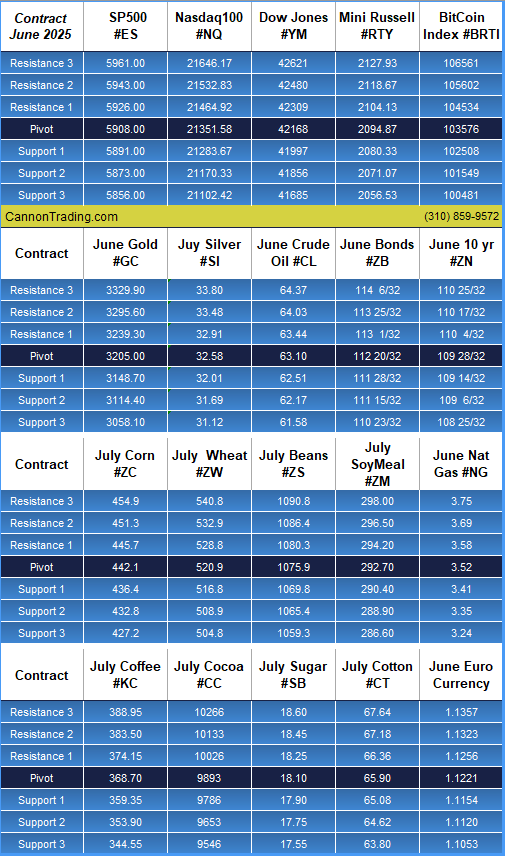
Cannon Trading’s dedication to innovation goes hand in hand with a focus on education and risk management. As a top-tier futures broker, Cannon makes sure that clients are not only equipped with technology but also with knowledge. The firm regularly provides educational webinars, market analysis, and trading guides to help traders make informed decisions. They emphasize risk management techniques, offering guidance on using stop-loss orders, managing leverage, and diversifying across markets – critical factors for anyone involved in futures trading. This emphasis on trader education and safety speaks to Cannon’s integrity, and it aligns with their excellent standing with regulatory bodies. Cannon Trading Company is a registered member of the National Futures Association and remains in full compliance with Commodity Futures Trading Commission regulations. Over its long history, the company has maintained an impeccable record, giving clients peace of mind that they are dealing with a reputable and law-abiding future broker.
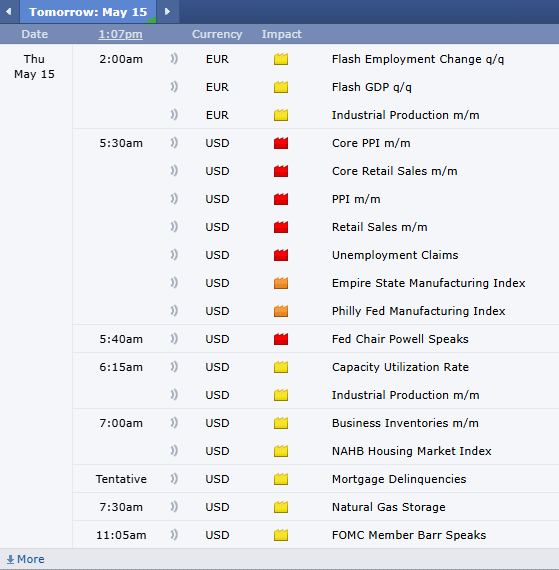
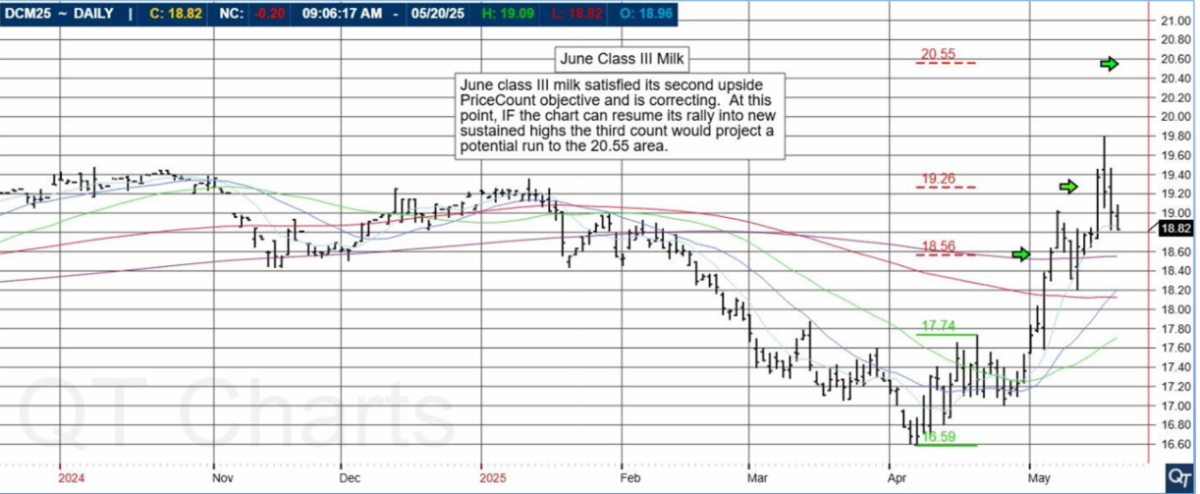
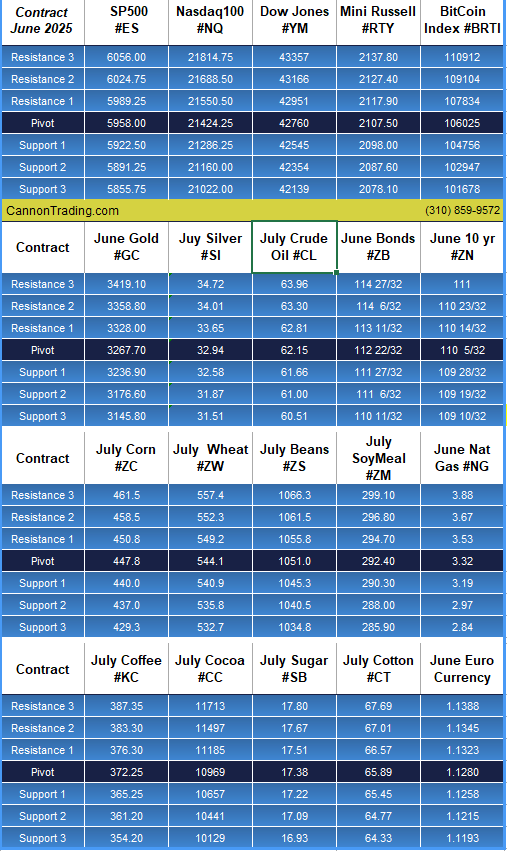
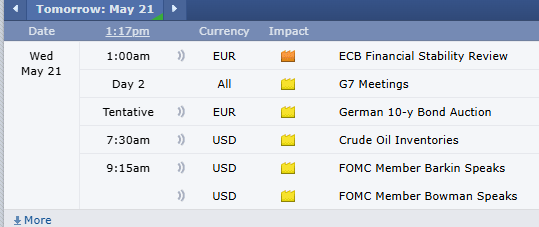
Another reason Cannon is often cited as one of the best futures brokers is its comprehensive range of products and services. Clients can trade an enormous variety of futures – from classic commodity contracts like grains and metals to modern stock index, interest rate, and currency futures. Cannon facilitates trading on all major U.S. futures exchanges and many international ones. Despite offering such breadth, the firm remains attentive to individual client needs. Whether a trader is a beginner placing their first trade or an institution executing large, complex orders, Cannon’s team provides tailored support. This level of versatility and customer care is rare, and it underscores why Cannon Trading Company has earned numerous industry accolades and unwavering customer loyalty.

Innovation is a cornerstone of Cannon’s identity. The firm was among the first brokers to offer online futures trading and continues to stay at the cutting edge of technology. They provide one of the widest selections of trading platforms in the industry – over twenty different platform options – ensuring every client can find the ideal toolkit. Platforms such as E-Futures International and Sierra Chart are available, along with Cannon’s own proprietary solutions like the CannonX trading platform for spreads and iSystems for automated strategies. This wide array of platforms is complemented by competitive pricing, including low day-trading margins and attractive commission rates, which further solidify Cannon’s standing as a best futures broker choice for traders seeking value and performance.

In summary, Cannon Trading Company exemplifies what a modern futures broker should be: experienced, innovative, and client-focused. Its decades-long presence in the futures industry, unmarred regulatory reputation, top-tier customer satisfaction ratings, and broad selection of platforms and services all combine to make it a leader. For anyone seeking a reliable partner in the futures markets – whether you are a beginner learning the ropes or an institutional investor demanding high performance – Cannon Trading Company stands out as a premier choice among futures brokers.

Futures trading has come a long way from its origins in agricultural trade and simple speculative bets. It has transformed into a sophisticated domain where global financial markets, advanced technology, and skilled analysis converge. We have seen how futures contracts started as a means to stabilize farmers’ incomes and now are used to hedge entire portfolios or gain exposure to markets with precision and leverage. The science and art of trading futures have progressed through innovations like technical analysis, which gives traders roadmaps of market sentiment, and through rigorous risk management practices that protect participants in a highly leveraged environment. The move to electronic trading platforms has broken down barriers, making futures markets accessible to anyone with an internet connection and a trading account, while vastly increasing speed and efficiency.

Throughout this evolution, the role of the futures broker remains as crucial as ever. Brokers serve as the gateway to the futures exchanges, and the best in the business do much more than execute trades – they educate, provide insights, and equip traders with cutting-edge tools. In today’s competitive landscape, the best futures broker firms distinguish themselves by combining deep market expertise with technology and client service. As highlighted, Cannon Trading Company is a shining example of this balance, with its longstanding dedication to innovation and trader support. For traders at any level, partnering with a reliable future broker can make all the difference in navigating the opportunities and challenges that futures trading presents.

In the end, futures trading remains an exciting and dynamic field. It offers opportunities for profit and portfolio protection alike, but it demands knowledge, discipline, and the right support. By understanding the rich history of futures, appreciating the developments that shape how we trade today, and choosing the right partners and tools, traders and investors can confidently participate in this ever-evolving market. Whether you are a student exploring financial concepts, a new trader taking your first steps, or an institutional investor hedging multi-million dollar exposures, the world of futures trading welcomes you with a promise: the future of trading is what you make of it, especially when you have a top future broker by your side to help turn your strategies into success.

For more information, click here.

Ready to start trading futures? Call us at 1(800)454-9572 (US) or (310)859-9572 (International), or email info@cannontrading.com to speak with one of our experienced, Series-3 licensed futures brokers and begin your futures trading journey with Cannon Trading Company today.

Disclaimer: Trading Futures, Options on Futures, and retail off-exchange foreign currency transactions involve substantial risk of loss and are not suitable for all investors. Past performance is not indicative of future results. Carefully consider if trading is suitable for you in light of your circumstances, knowledge, and financial resources. You may lose all or more of your initial investment. Opinions, market data, and recommendations are subject to change at any time.

Important: Trading commodity futures and options involves a substantial risk of loss. The recommendations contained in this article are opinions only and do not guarantee any profits. This article is for educational purposes. Past performances are not necessarily indicative of future results.

This article has been generated with the help of AI Technology and modified for accuracy and compliance.

Follow us on all socials: @cannontrading