Futures Broker

Futures trading has a rich history that spans continents and centuries, and at the heart of this history is the futures broker. From the early days of open-outcry trading pits to today’s multi-screen electronic trading terminals, futures brokers have continually adapted to new technologies, evolving regulations, and shifting client needs. What began as a niche service for commodity merchants and farmers has grown into a global industry connecting traders to futures markets around the clock. In this paper, we explore the evolution of the future broker from its historical roots to its modern form, incorporating both U.S. and global perspectives. We examine how technology, regulation, services, and client relationships changed the brokerage landscape for futures trading, and we highlight how one firm – Cannon Trading Company – exemplifies this evolution. In a journalistic yet promotional lens, we will see why today’s environment demands the best futures broker to combine cutting-edge platforms, robust compliance, and exemplary customer service in facilitating trading futures.

Historical Roots of Futures Brokers

The concept of futures contracts – agreements to buy or sell a commodity at a set date in the future – has been around for centuries. In fact, the first organized futures exchange is traced back to Japan’s Dojima Rice Exchange, established in 1730 for trading rice futures. Such early markets set the stage globally, demonstrating the value of standardized forward contracts. By the 19th century, futures trading took root in the West. The United States opened its first official commodity exchange in 1848 with the founding of the Chicago Board of Trade (CBOT), where futures brokers matched sellers (often farmers with crops) and buyers (millers, merchants) in contracts for corn, wheat, and other staples. These futures trading intermediaries provided a vital service: they brought liquidity and trust to markets that helped producers hedge against price swings and consumers secure supplies.

In those early days, a futures broker typically operated on the exchange floor. Communication was loud and chaotic – a method known as open outcry where brokers would shout bids and offers and use hand signals in a trading pit. The trading floor (often simply called “the pit”) was the domain of the futures broker for well over a century. It was a physical arena where only those present – members of the exchange and their brokerage representatives – could participate in trading futures contracts. This system had its advantages: brokers on the floor could gauge market sentiment by reading the crowd’s energy and the urgency in others’ voices or gestures. However, it was also limited to those physically present and could be prone to errors or miscommunications in the heat of the moment.

Globally, similar patterns emerged. In London, for example, commodity exchanges developed by the 19th century, with the London Metal Exchange (LME) forming in 1877 to trade metals. The open-outcry tradition was not unique to the U.S. – the “Ring” of the LME, the pits of exchanges in Chicago and New York, and other trading halls in Frankfurt, Tokyo, and Sydney all relied on human brokers to facilitate trades. Futures brokers in these venues were essential intermediaries, arranging deals for clients across oceans and telegraph wires long before the internet. In the early 20th century, as futures markets expanded beyond agriculture into other commodities (like metals and later financial instruments), the role of futures brokers became even more prominent. They were experts not only in executing trades but also in networking – knowing whom to call to find a buyer or seller, and understanding supply and demand dynamics in the underlying markets.

Regulatory Milestones and Their Impact

As futures markets grew, so did the need for oversight. The sometimes volatile and speculative nature of futures trading led to episodes of market manipulation and the notorious “bucket shops” in the early 1900s that gave legitimate futures brokers a bad name. In response, the U.S. government began to enact regulation to protect market integrity and participants. A landmark moment came with the Commodity Exchange Act of 1936, which built on earlier legislation to firmly establish federal oversight of U.S. commodity futures markets. Later, in 1974, amid rising trading volumes and new financial futures products, the U.S. Congress created the Commodity Futures Trading Commission (CFTC) as an independent regulator. This move professionalized the industry; every futures broker now had to register and comply with strict rules aimed at promoting fair, efficient markets and safeguarding customers from fraud and abuse. Notably, the same legislation in 1974 authorized the futures industry to create a self-regulatory organization. This led to the formation of the National Futures Association (NFA), which began operations in 1982, introducing a new layer of accountability for U.S. futures brokers through audits, enforcement of ethical standards, and mandatory licensing exams.

These regulatory milestones transformed how futures brokers operated. Brokers were now required to segregate client funds, maintain adequate capital, report transactions, and adhere to codes of conduct. The era of the freewheeling, handshake-based future broker was over; in its place emerged the highly regulated futures commission merchant and introducing broker model. In practice, this meant greater safety for clients – no more worries that a broker might abscond with funds or that trades wouldn’t be honored. It also meant brokers had to invest in compliance departments and legal oversight, changing the nature of the business. Many embraced this as a positive evolution, knowing that a well-regulated market boosts public confidence. For example, Cannon Trading Company, founded in 1988, came of age in this environment and from the outset aligned itself with top-tier compliance. As a member of the NFA and a firm registered with the CFTC since its inception, Cannon has consistently been held to the highest regulatory standards. This exemplary track record with regulators – no significant infractions over decades of operation – underscores how seriously the company and its peers treat compliance in the modern era. Indeed, Cannon’s exemplary reputation with regulatory bodies is frequently noted as one of its defining strengths. In an industry where a single regulatory misstep can tarnish a firm’s reputation, Cannon Trading’s clean record and cooperative stance with regulators stand out.

Regulatory evolution has not been limited to the United States. Around the world, countries developed their own oversight structures for futures markets: the U.K. eventually folded futures oversight into its Financial Conduct Authority (after earlier bodies in the 1980s), while Japan’s regulators supervise the Tokyo Commodity Exchange and others. International standards have gradually converged, with many jurisdictions emphasizing customer protections, broker transparency in pricing, and prevention of market manipulation. This global regulatory fabric means that a future broker today, whether operating in Chicago or Singapore, must place compliance and ethics at the core of their business model. The best futures broker in any region is often distinguished not just by profits, but by an exemplary reputation for integrity and adherence to the rules – a reputation that Cannon Trading has exemplified through decades of clean audits and proactive compliance measures.

Technological Evolution: From Pits to Platforms

Perhaps the most dramatic change in the world of futures trading over the past half-century has been the rise of electronic trading technology. For most of the 20th century, the open-outcry method reigned. But by the late 1980s and early 1990s, electronic trading systems began to emerge, promising greater speed and wider access. A pivotal moment came in 1992 when the Chicago Mercantile Exchange introduced its Globex electronic trading platform. Initially used alongside the live pits (often after-hours), Globex and similar systems demonstrated that futures could be traded by clicking a mouse rather than shouting in a pit. Traders gradually warmed to these new systems for their speed and efficiency. By entering orders on a computer, a trader could get near-instant confirmation, and a futures broker could service clients across the globe without needing a physical presence on the exchange floo.

The shift from floor to screen was not instantaneous – through the 1990s, many veteran brokers straddled both worlds, placing orders electronically while still gauging the pit’s mood. However, as technology improved, the advantages of electronic trading became undeniable. Orders that once took minutes (a phone call to a broker, who yells it to a pit clerk, who relays it to a floor broker) could now be executed in milliseconds. Moreover, electronic platforms leveled the playing field by offering the same real-time market data and depth of market display to any trader with a computer, something that previously only floor insiders might fully sense. This democratization of information was a game-changer. It allowed trading futures to expand beyond the traditional hubs; a trader in a small town or overseas could participate in the Chicago or London markets with the same immediacy as a trader physically present at the exchange.

By the early 2000s, most major futures exchanges had introduced electronic trading for all or most contracts, and many began phasing out their pits. Today’s futures markets are almost entirely screen-based; as Investopedia succinctly notes, “today’s futures markets are global and fully electronic.”. For futures brokers, this meant reinventing their services. No longer was it sufficient to have a strong set of lungs and sharp elbows on the trading floor. Now a broker needed to offer clients robust futures trading software, reliable network connectivity, and technical support. The brokerage business model shifted from physically executing orders to providing electronic market access and value-added services around it.

Cannon Trading Company serves as an illustrative case of a brokerage that successfully navigated this technological revolution. In the late 1990s, as the Internet began reshaping the financial industry, Cannon Trading embraced online futures trading early. It was a pioneering move at a time when many established brokers were hesitant to change their floor-based, phone-driven operations. Cannon integrated sophisticated online trading platforms for its clients, providing them with direct market access, real-time data, and advanced charting tools that were once available only to institutional traders on Wall Street or in Chicago pits. This forward-thinking step positioned Cannon at the forefront of the industry’s digital transformation. By pioneering online trading when it was still in its infancy, Cannon set a standard among futures brokers – demonstrating that embracing technology could enhance, not diminish, the broker’s role.

Today, the toolkit of a futures broker looks very different than it did decades ago. Brokers offer multiple electronic platforms to cater to different trading styles and needs. For instance, Cannon Trading Company provides a wide selection of trading platforms – including industry-leading software like NinjaTrader, TradingView, Sierra Chart, CQG, and MultiCharts – to ensure that whether a client is a day trader needing low-latency execution or a strategist needing deep analysis and backtesting, they have the right tools. This breadth of platform choice is a direct response to technological evolution: no single interface fits all traders, so the best futures broker now often differentiates itself by supporting an array of technologies. The modern future broker must also invest in cybersecurity and system stability. With trades happening 24/6 (futures markets run nearly around the clock during weekdays), brokers maintain IT infrastructure that can securely handle large volumes of trades from clients worldwide without downtime. Cannon, for example, continuously updates and expands its offerings as trading technology evolves, ensuring its clients have access to the best futures trading experience possible – a trait that has kept many of its customers loyal through the decades of tech change.

Changing Services and Client Relationships

Hand-in-hand with technology and regulation, the services offered by futures brokers and their relationships with clients have significantly evolved. Historically, many futures brokers functioned as order-takers for large commercial clients. A mid-20th-century broker might have spent his day on the phone with grain elevators, food companies, or floor traders, executing instructions and maybe providing the occasional market tip gleaned from the trading floor buzz. Personal relationships were paramount; trust was built over long lunches and frequent calls. If you were a farmer or a corporate hedger, your futures broker was not just a trade executor but often a confidant and advisor who understood your business needs.

As futures trading broadened to include financial investors and, eventually, retail traders in the late 20th century, the client base diversified. By the 2000s, a college student with a few thousand dollars could open an online futures account – a client profile unheard of in earlier decades. This democratization meant that futures brokers had to cater to a wide range of knowledge levels and expectations. Education and customer support became central services. The best futures brokers began offering webinars, trading tutorials, daily market research, and one-on-one consultations. A broker’s value was no longer just in executing a trade cheaply; it was in enhancing the client’s trading experience and success rate.

Moreover, competition among brokers intensified, putting downward pressure on commission fees and raising the bar for service quality. In the U.S., brokers had to differentiate either through superior technology, lower costs, or premium service (or all of the above). Many traditional “full-service” brokers that charged high commissions for personalized advice found themselves disrupted by nimble futures brokers who offered discount commissions alongside free research tools and responsive support. This evolution benefited traders: today even a self-directed retail trader expects prompt, professional customer support and transparency in all dealings.

Cannon Trading Company provides a prime example of excellence in client service in the modern era. With over 35 years in the industry, Cannon has cultivated a client-centric approach that is frequently praised in public reviews. The firm boasts numerous 5 out of 5-star ratings on TrustPilot, a testament to its high customer satisfaction. In fact, Cannon’s TrustPilot reviews often highlight the firm’s exceptional personalized service – clients note the quick and efficient responses from brokers that make every interaction feel personal, and applaud the professionalism and friendliness of the staff. Unlike some large brokers where customers struggle to reach a knowledgeable human being, Cannon ensures that every client can speak to an experienced, Series-3 licensed broker when they call. This level of attention is invaluable, especially in trading futures where market conditions can change in an instant and having a reliable broker on the line can make all the difference.

The range of services that a modern futures broker like Cannon offers goes well beyond trade execution. Cannon provides educational resources for beginners (acknowledging that many new traders enter the futures markets each year), market analysis for seasoned traders, and even supports more complex needs such as automated trading systems and access to managed futures programs. The firm’s adaptability is also evident in how it bridges service models: it capably serves full-service clients who want broker guidance and input, while also catering to discount clients who simply need an efficient platform and low commissions. Cannon’s ability to do both under one roof speaks to how futures brokers have evolved to become multi-faceted service providers. They must wear many hats – tech support, educator, risk manager, and sometimes even coach or psychologist during volatile markets – to build strong, long-term client relationships.

Finally, an important aspect of modern broker-client relationships is transparency. With information ubiquitous, traders demand to know all the costs and risks upfront. Hidden fees or murky margin policies are not tolerated. The best futures brokers openly publish their commission rates and margins and keep clients informed of any changes. Cannon Trading, for example, prides itself on competitive commissions and transparent pricing, ensuring traders know exactly what they pay for. This transparency fosters trust, which in turn strengthens the client relationship. In the long run, the evolution of the future broker has been towards a partnership model – brokers and clients working together to navigate the markets, rather than the old transactional model. Cannon’s decades-long client retention and glowing testimonials suggest that this partnership approach, built on service, trust, and mutual respect, is a winning formula in the modern era of futures trading.

Global Expansion and International Perspectives

While the evolution of futures brokers in the United States is a compelling story, it is important to recognize that similar transformations have occurred worldwide, sometimes in parallel and sometimes in unique local ways. In the latter half of the 20th century, futures markets expanded rapidly across Europe and Asia, introducing new exchanges and brokers to cater to region-specific needs. For instance, Europe saw the rise of the London International Financial Futures Exchange (LIFFE) in the 1980s and Germany’s Deutsche Terminbörse (DTB) in 1990 – the latter launching as an all-electronic exchange from the start. These developments meant that a futures broker in London or Frankfurt had to adapt to electronic trading even earlier in some cases than their American counterparts. In Asia, exchanges like the Tokyo Commodity Exchange and the Singapore Exchange (which launched SIMEX in 1984, one of the first Asian financial futures markets) created a demand for skilled futures brokers fluent in local market dynamics and global trends.

One notable aspect of globalization is that it broke down barriers for investors. A trader sitting in London could just as easily trade Chicago grain futures or Tokyo Nikkei index futures, provided their broker had access. This led to many brokers forming international partnerships or using omnibus clearing arrangements to offer clients a menu of global markets. Today, leading futures brokers position themselves as gateways to the world. It’s not unusual for a client of a U.S. broker like Cannon Trading Company to be trading crude oil futures on a New York exchange one moment, and the FTSE 100 index futures on a London exchange the next. This global reach requires brokers to understand and comply with multiple regulatory regimes and exchange rules, and to operate nearly 24 hours a day to service clients across time zones.

Cannon Trading has leveraged its strong reputation and technology to attract a worldwide clientele. The company proudly serves traders from various countries, reflecting the universal appeal of its brokerage services. Reviews and feedback indicate that international clients value Cannon’s reliable trade infrastructure and English-language support in navigating U.S. futures markets (which remain among the deepest and most liquid in the world). In turn, Cannon’s brokers stay abreast of global market news – whether it’s an overnight policy change by the European Central Bank or a sudden movement in Asian markets – because such events can influence all traders. In essence, the future broker in today’s context must be globally aware and equipped. The evolution here is from being a domestic intermediary to being a global facilitator of trading futures.

The global perspective also highlights different paces of change. Some exchanges, like those in emerging markets, clung to floor trading longer or only recently underwent electronic transition, meaning brokers in those locales experienced a compressed, intense period of change. Others had regulatory evolutions at different times (for example, China’s futures markets only took off in the 1990s and 2000s under state oversight). Yet, despite these differences, a common trend emerges: technology and transparency uplifted brokerage standards everywhere. Whether a client walks into a brokerage office in Chicago, Mumbai, or London today, they expect a modern trading platform, adherence to strong regulations, and excellent service. The phrase best futures broker has a global connotation now – it implies a firm that can compete on an international stage, offering top-notch service and access. Cannon Trading’s decades of experience and adaptation have allowed it to be part of that elite group, recognized not just in the U.S. but by traders worldwide who seek out a stable, reputable partner for their futures trading endeavors.

Cannon Trading Company: A Case Study in Evolution

Throughout this paper, Cannon Trading Company has been cited as an example of a brokerage that personifies the industry’s evolution. Indeed, Cannon’s journey from a small Los Angeles-based futures brokerage in 1988 to a globally recognized firm today mirrors many of the broader changes in the sector – and in some cases, Cannon was ahead of the curve. It was founded at a time when the industry was on the cusp of seismic shifts. Over the ensuing decades, Cannon not only weathered those changes but leveraged them to build a stronger enterprise, all while maintaining the core principles that define the best futures brokers: integrity, customer service, and innovation.


Cannon Trading

Cannon Trading 1
From a historical standpoint, Cannon Trading started when open-outcry was still king. New brokers in the late 1980s needed to establish credibility and relationships in a somewhat clubby industry. Cannon did so by emphasizing client respect and transparency from day one. While some competitors might have cut corners or chased quick profits during the wild swings of commodity markets in the 1980s and 90s, Cannon took a longer view, prioritizing its reputation and client trust. This approach paid off as the firm steadily grew its client base. By the time electronic trading rose to prominence, Cannon had already built a legacy of excellence and was well-positioned to invest in new technologies that would serve its clients’ interests.

One of the defining moments for Cannon was its early adoption of online trading in the 1990s. Recognizing that the future of the futures brokerage business would be digital, Cannon committed resources to develop its online presence and technical capabilities. It was even featured as the subject of the first “online brokers review” by Futures Magazine in those early days of internet trading – a clear acknowledgment that Cannon was among the pioneers pushing the envelope. This forward-thinking stance won Cannon a loyal following of tech-savvy traders and earned it accolades, such as a Readers’ Choice Award from Trader Planet in later years. By embracing change rather than resisting it, Cannon helped shape what a modern future broker should be.

Cannon’s strengths today reflect both its rich history and its adaptability. The firm boasts decades of experience in futures markets, which gives clients confidence that they are dealing with seasoned professionals who have seen all types of market conditions. This experience is not just about longevity; it translates into practical market wisdom that brokers at Cannon impart to clients, whether it’s guidance on managing risk during a sudden price spike or insights into historical trends. Moreover, Cannon’s commitment to compliance – being in good standing with regulators like NFA and CFTC for nearly four decades – means clients can trade with peace of mind, knowing their broker operates with the highest integrity and oversight. In an era when a few high-profile futures broker failures (due to misconduct at those firms) made headlines, Cannon’s spotless record shines. The company’s exemplary reputation with regulators isn’t merely a plaque on the wall; it’s a day-to-day operational philosophy.

On the technology and service front, Cannon Trading truly exemplifies the modern futures broker. The wide selection of trading platforms it offers ensures that clients have choice – a novice might opt for a simple, user-friendly interface, while a veteran might use a professional-grade platform with advanced charting. Cannon’s brokers are well-versed in all these platforms, guiding users to the one that best fits their strategy. This is a far cry from the one-size-fits-all approach of decades past. Additionally, Cannon pairs technology with a human touch. Its customer service is frequently lauded as among the best in the industry; the firm’s numerous 5-star TrustPilot reviews attest that traders feel “heard” and supported by their Cannon brokers at every step. Whether it’s a question about a margin call in the middle of the night or help with setting up an automated strategy, Cannon’s team provides prompt, personalized assistance. This blend of cutting-edge technology with old-fashioned customer care is perhaps the ultimate hallmark of a best futures broker in today’s landscape.

In promotional terms, it’s fair to say Cannon Trading Company has not only kept pace with the evolution of the futures brokerage industry – it has often led the way. With its strong foundation, Cannon continues to innovate (recently exploring integration of AI tools for trading and expanding educational content) to remain a futures broker of choice for the next generation of traders. Few firms can claim a legacy dating back to the late 1980s and still be on the forefront of industry developments. Cannon’s story thus serves as both inspiration and blueprint: it shows that adapting to change, while holding onto core values of customer service and compliance, is the key to longevity in the world of futures trading.

The evolution of futures brokers from the open-outcry era to the modern digital age is a testament to the financial industry’s capacity for innovation and adaptation. Historically rooted in facilitating trades for agricultural and industrial markets, the future broker has transformed into a high-tech service provider operating in a fast-paced, global marketplace. This research journey has highlighted how technological breakthroughs, from telephones to internet trading platforms, revolutionized the way brokers connect clients to markets. We have seen how regulatory frameworks tightened to make futures trading safer and more transparent, raising the standards for all futures brokers. Services expanded from basic trade execution to a holistic offering encompassing education, strategy support, and personalized client care, reflecting a deeper, more enduring broker-client relationship model.

From a global perspective, the once U.S.-centric concept of the futures broker has spread and standardized across continents, so that excellence in brokerage is recognized and expected worldwide. And within this narrative, Cannon Trading Company stands out as a compelling example of a brokerage that not only navigated every phase of this evolution but helped shape it. With decades of experience, a forward-looking embrace of technology, unwavering regulatory compliance, and top-rated customer service, Cannon embodies many qualities of the best futures broker in the industry. It has successfully bridged the old and the new – from the traditions of the trading pit to the innovations of algorithmic futures trading – all while maintaining the trust of its clients and peers.

As we conclude, it’s evident that the role of a futures broker will continue to evolve. The future likely holds even more advanced trading algorithms, perhaps AI-driven market analysis, and an increasingly global pool of traders. Yet, the core principles that have guided the evolution thus far will remain crucial. Technology must be balanced with a human touch, innovation must go hand-in-hand with integrity, and brokers must always champion their clients’ best interests. The story of futures brokers is ultimately about enabling traders to participate in markets effectively and confidently. In that regard, modern brokers like Cannon Trading Company are not just survivors of change – they are leaders setting the pace for what comes next in trading futures.

For more information, click here.

Ready to start trading futures? Call us at 1(800)454-9572 (US) or (310)859-9572 (International), or email info@cannontrading.com to speak with one of our experienced, Series-3 licensed futures brokers and begin your futures trading journey with Cannon Trading Company today.

Disclaimer: Trading Futures, Options on Futures, and retail off-exchange foreign currency transactions involve substantial risk of loss and are not suitable for all investors. Past performance is not indicative of future results. Carefully consider if trading is suitable for you in light of your circumstances, knowledge, and financial resources. You may lose all or more of your initial investment. Opinions, market data, and recommendations are subject to change at any time.

Important: Trading commodity futures and options involves a substantial risk of loss. The recommendations contained in this article are opinions only and do not guarantee any profits. This article is for educational purposes. Past performances are not necessarily indicative of future results.

This article has been generated with the help of AI Technology and modified for accuracy and compliance.

Follow us on all socials: @cannontrading

What to Know Before Trading Futures on May 22nd; Your 4 Important Need-To-Knows for Equity Indexes, Financials, Crypto

9dc1e02e d5f7 4ff4 abf7 1df60775f196

What to Know Before Trading Futures on May 22nd

Key Points for Tomorrow

By Mark O’Brien, Senior Broker

futures

Equity Indexes / Interest Rates:

Stock index futures turned lower this afternoon after a disappointing Treasury bond auction accelerated a selloff in the debt market.

The June E-mini Dow Jones futures contract dropped over 800 points, more than 2.0%, leading the E-mini S&P 500 and E-mini Nasdaq indexes lower in afternoon trading.

Financials:

U.S. 30-yr. T-bond and 10-yr. T-note futures also sold off and correspondingly debt yields spiked, with the 10-yr. rate climbing toward 4.6% and the 30-yr. rate eclipsing 5.0%

Yields extended gains in the afternoon after a $16 billion auction of 20-year Treasury bonds attracted relatively soft demand from investors, selling at a higher yield than traders had anticipated.

The selloff in stocks followed earnings reports from retailers Target, Lowe’s and TJX. Target cut its annual outlook.

Crypto:

Bitcoin futures climbed to a new all-time high for the first time since January. The current front-month May futures contract traded intraday up to 110,745 before paring its gains. Bitcoin futures total open interest surged to a record $75 billion, signaling heightened leveraged exposure as traders are eyeing a breakout above a key $108,000 resistance level. The CME Group / Chicago Mercantile Exchange leads with $17.43 billion in open interest. Within the highly leveraged environment, the potential for liquidations of short positions becomes a powerful force that could propel Bitcoin futures to new highs.


S

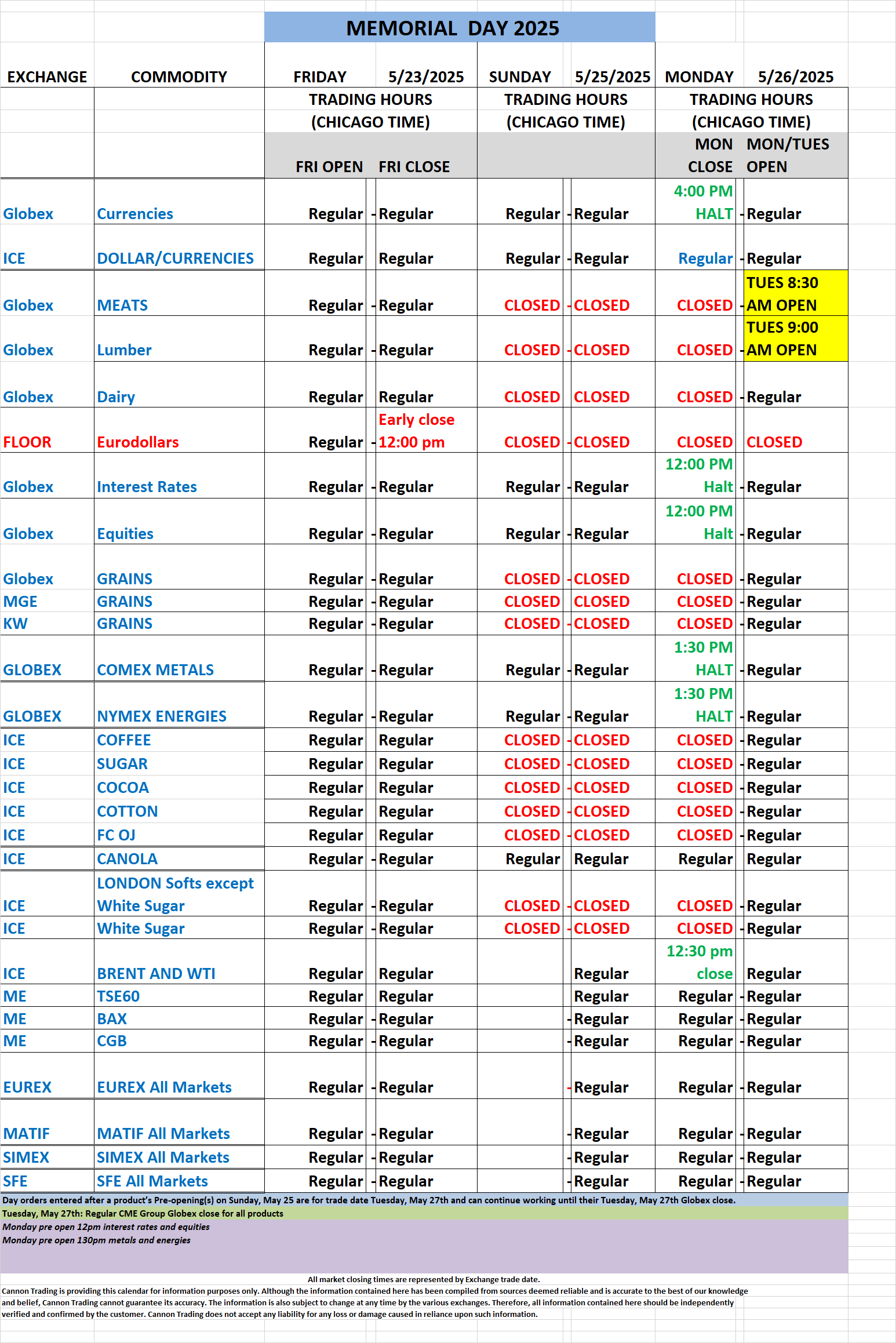
Memorial Day Schedule

Memorial-Day-2025 image

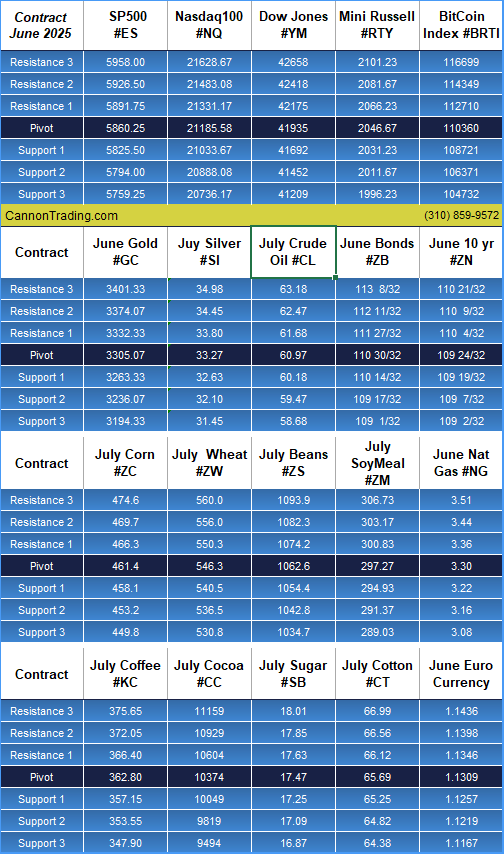
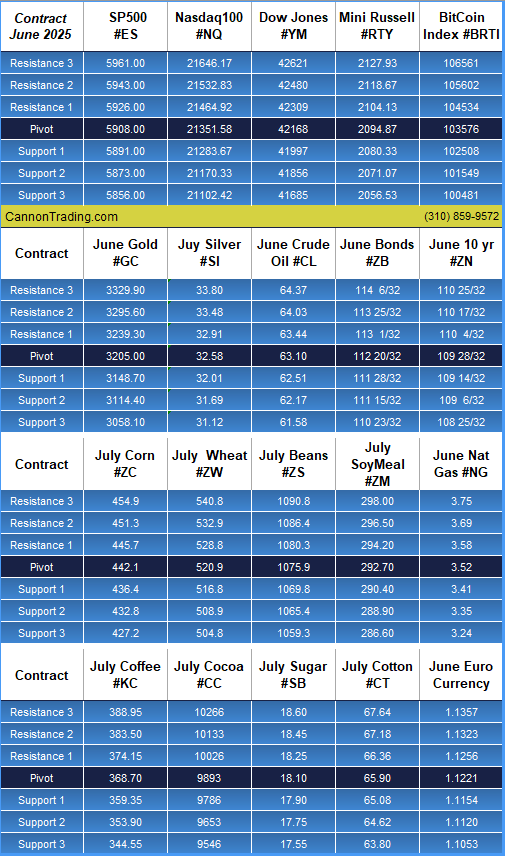
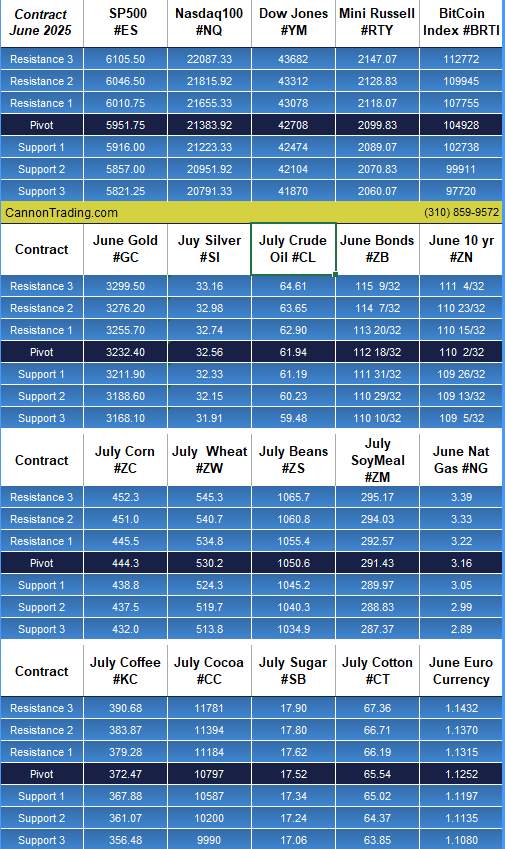
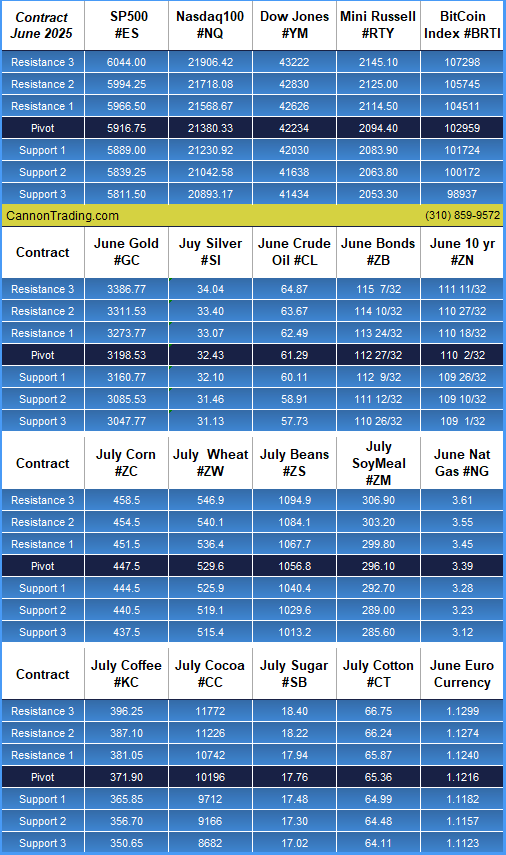
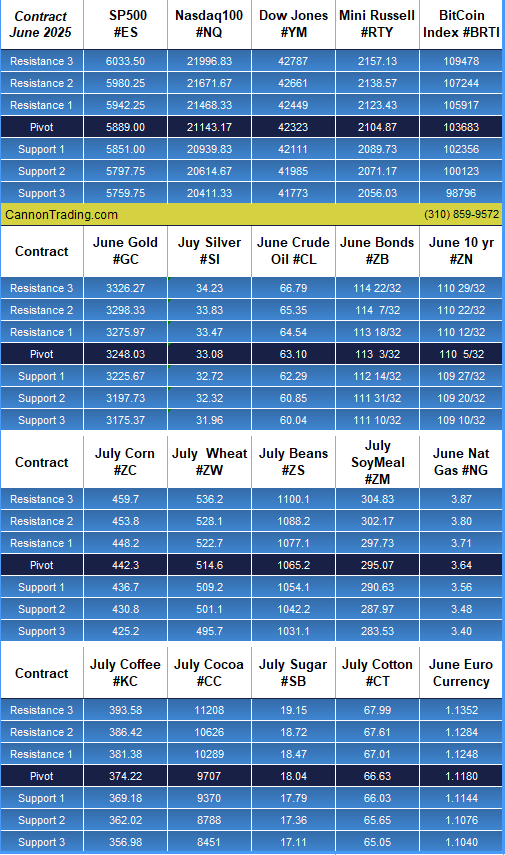
Daily Levels for May 22nd 2025

7bf96000 eda1 4971 901d 0d5dd3111402
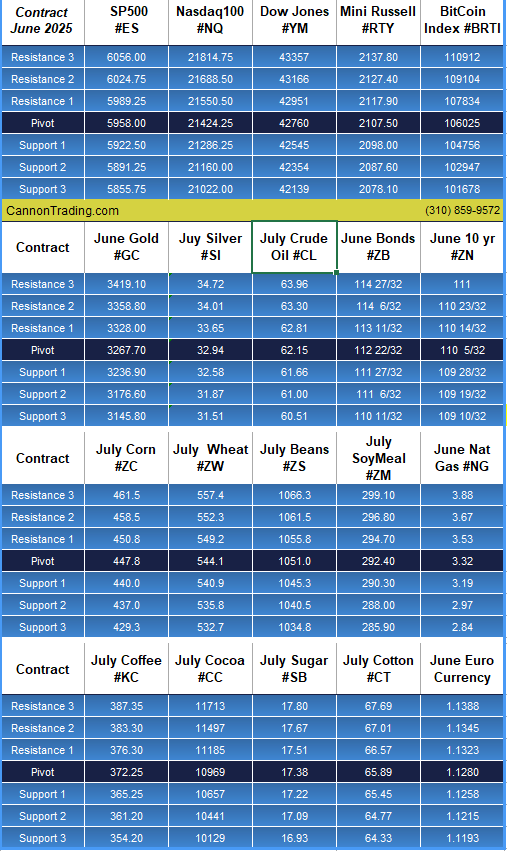
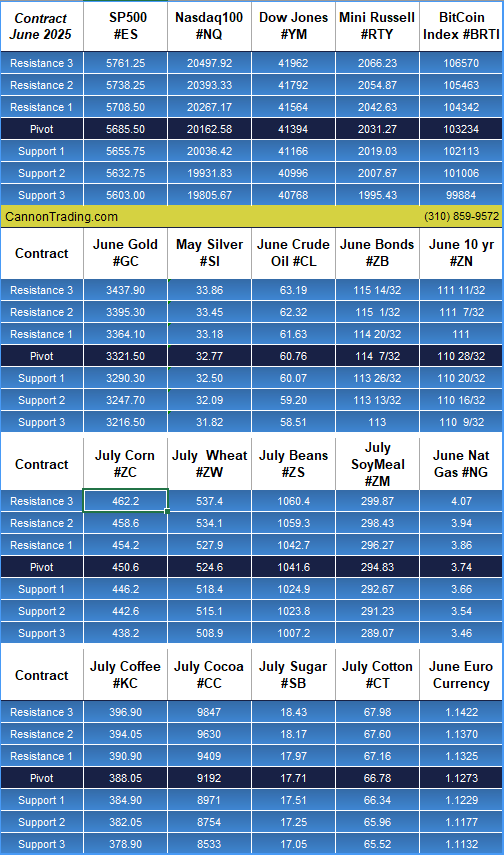
Want to feature our updated trading levels on your website? Simply paste a small code, and they’ll update automatically every day! Click here for quick and easy instructions.
822b33c5 2339 45ed bc84 e9c8f8c7358e

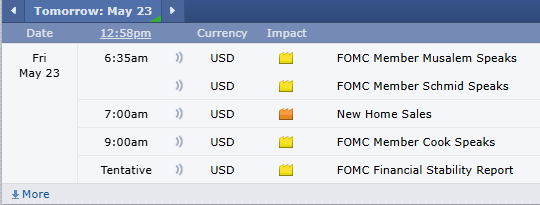
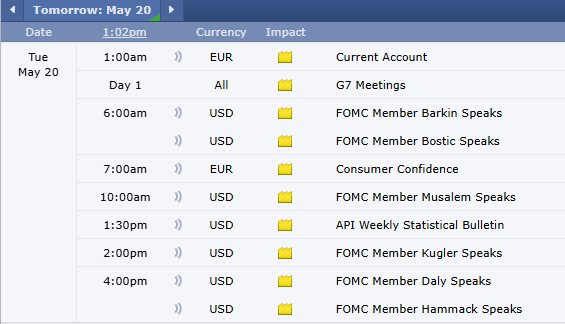
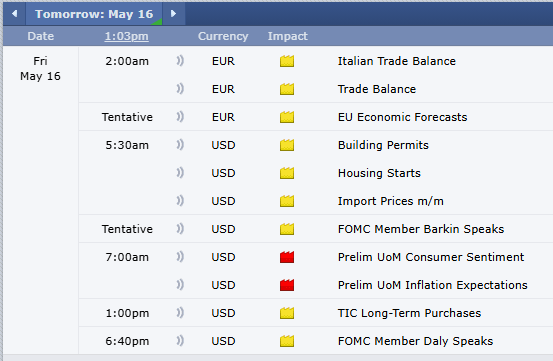
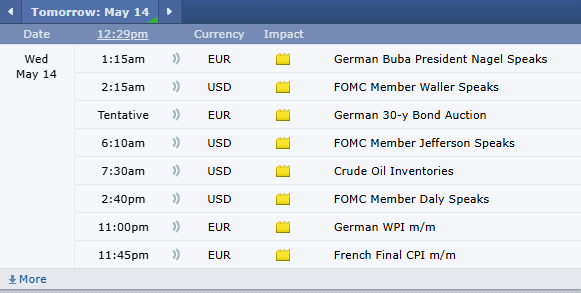
Economic Reports

provided by: ForexFactory.com

All times are Eastern Time (New York)

ebd6bb78 124a 4412 a455 e596136d8654

Find us on Trustpilot

stars

Trading Futures, Options on Futures, and retail off-exchange foreign currency transactions involves substantial risk of loss and is not suitable for all investors. 

You should carefully consider whether trading is suitable for you in light of your circumstances, knowledge, and financial resources.

You may lose all or more of your initial investment. Opinions, market data, and recommendations are subject to change at any time.

Join our Private Facebook group

Subscribe to our YouTube Channel

Listen to our podcast: Subscribe on AppleSpotify, Amazon

or wherever you listen to podcasts!

S
Facebook  Instagram  LinkedIn
S
ef3ab1c9 8d6d 4e60 a3f1 af5d9d4ecbb3
Services
Software
Tools
Community
Contact

Day Trading Margins, June Milk Class III, CME Trading Challenges; Your 3 Important Need-To-Knows for Trading Futures on May 21st, 2025

9dc1e02e d5f7 4ff4 abf7 1df60775f196

Margins

SPAN and Day Trade Margins

by John Thorpe, Senior Broker

margins

Dive into Margin creation

Day trade margins are back to “normal” day trade valuations.

Remember Trump highlighted the need to pass and extend his 2017 tax cuts which are set to expire at years end if a new bill wasn’t passed to extend those tax credits.

Well, we are on the doorstep of that request.  Watch for equity index strength if it passes in the house this week and weakness if it doesn’t. Memorial Day weekend was his target to have the legislation passed.

A quiet data day tomorrow.

On a different note, I hear a lot about from my day traders want to understand more clearly how margin is set and when can we expect reduced day trade margins.

Here’s the short version: Margins are set by the exchange based on a number of factors then the clearing houses adjust day trading parameters based on the exchange Initial margin. Volatility is the biggest factor to affect exchange minimum initial margin.

Here’s the long story from the CME:

https://www.cmegroup.com/solutions/risk-management/performance-bonds-margins/span-methodology-overview.html

Market volatility is here to stay for the foreseeable future with it’s ebbs and flows.

Choose your opportunities wisely. Today’s market swings were largely back to normal ( pre tariff talk normal)

Tomorrow:

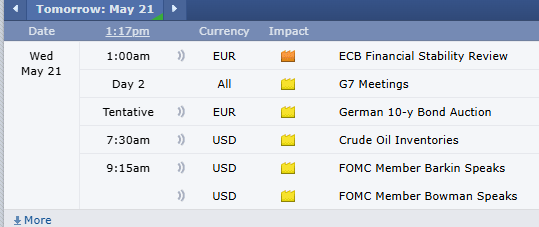
Econ Data:  EIA Energy stocks.

FED Speak: One speaker Barkin @ 11am CT

Earnings: TJ Max, Lowe’s, Medtronic, Target

Tariff news:  Anything goes!

SPAN Methodology Overview

CME SPAN is a market simulation-based Value at Risk system that allows you to assess risk on a portfolio basis. Explanations and examples of risk arrays and SPAN analysis are included.

S

June Milk

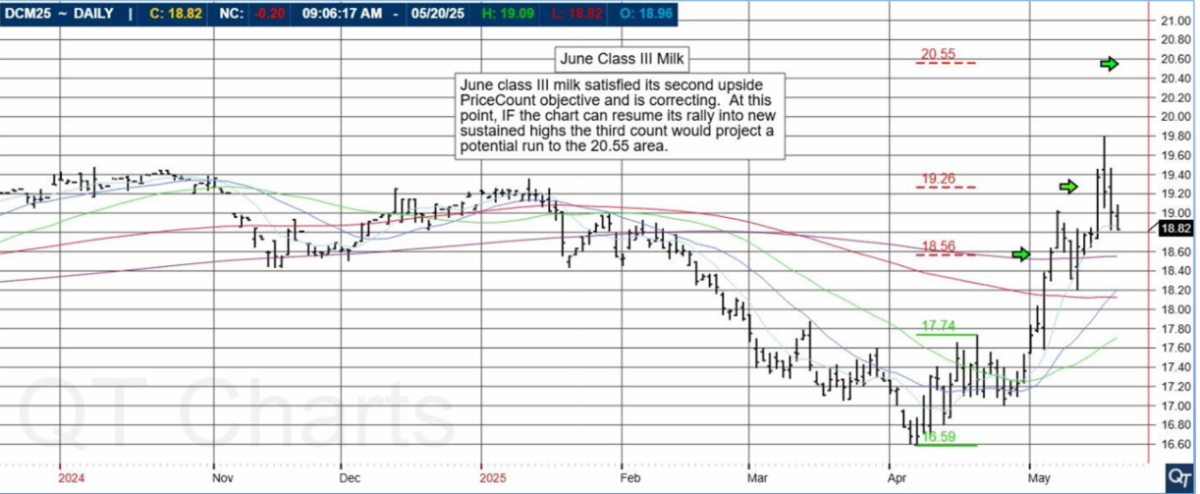
June class III milk satisfied its second upside PriceCount objective and is correcting. At this point, IF the chart can resume its rally into new sustained highs the third count would project a potential run to the 20.55 area.

a3e3c6f3 8540 46de b671 eb4e3dd2b6a6

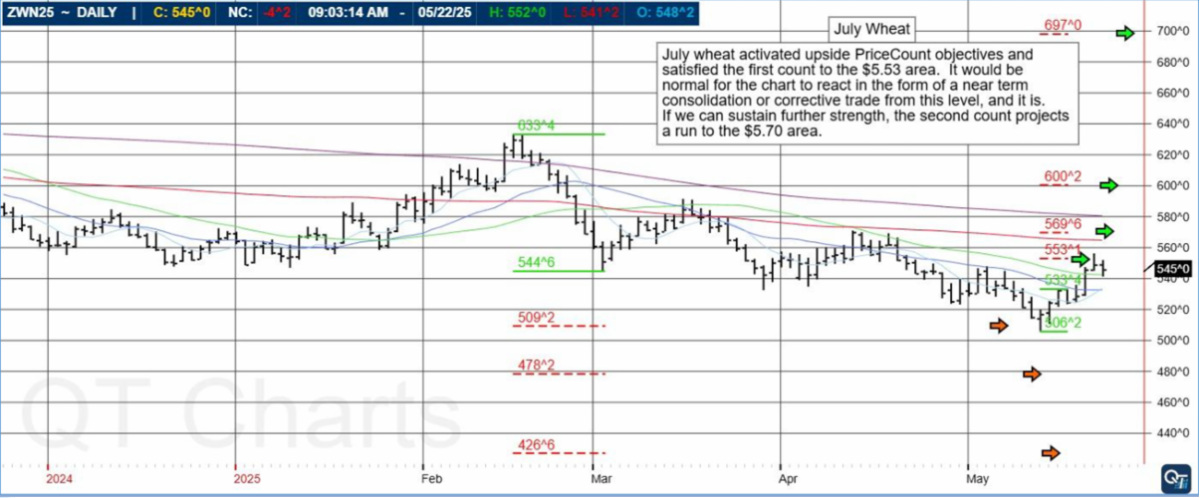
The PriceCount study is a tool that can help to project the distance of a move in price. The counts are not intended to be an ‘exact’ science but rather offer a target area for the four objectives which are based off the first leg of a move with each subsequent count having a smaller percentage of being achieved.

It is normal for the chart to react by correcting or consolidating at an objective and then either resuming its move or reversing trend. Best utilized in conjunction with other technical tools, PriceCounts offer one more way to analyze charts and help to manage your positions and risk. Learn more at www.qtchartoftheday.com

Trading in futures, options, securities, derivatives or OTC products entails significant risks which must be understood prior to trading and may not be appropriate for all investors. Past performance of actual trades or strategies is not necessarily indicative of future results.

Daily Levels for May 21st, 2025

56944e9a 29f1 4ed8 9edd e1b2af2e8cb9
Want to feature our updated trading levels on your website? Simply paste a small code, and they’ll update automatically every day! Click here for quick and easy instructions.
28ae1ddf f400 4901 82b9 03a497f63f26

Economic Reports

provided by: ForexFactory.com

All times are Eastern Time (New York)

665d0f4a 769c 4e11 8bf5 ef051d770639

Find us on Trustpilot

stars

Trading Futures, Options on Futures, and retail off-exchange foreign currency transactions involves substantial risk of loss and is not suitable for all investors. 

You should carefully consider whether trading is suitable for you in light of your circumstances, knowledge, and financial resources. You may lose all or more of your initial investment.

Opinions, market data, and recommendations are subject to change at any time.

Join our Private Facebook group

Subscribe to our YouTube Channel

Listen to our podcast: Subscribe on AppleSpotify, Amazon

or wherever you listen to podcasts!

S
Facebook  Instagram  LinkedIn
S
ef3ab1c9 8d6d 4e60 a3f1 af5d9d4ecbb3
Services
Software
Tools
Community
Contact

June Emini S&P, CannonX Custom Time on the Chart, Levels; 3 Important Need-To-Knows for Trading Futures on May 20th, 2025

9dc1e02e d5f7 4ff4 abf7 1df60775f196

What to Know Before Trading Futures on May 20th, 2025

June Emini S&P

emini

Emini S&P

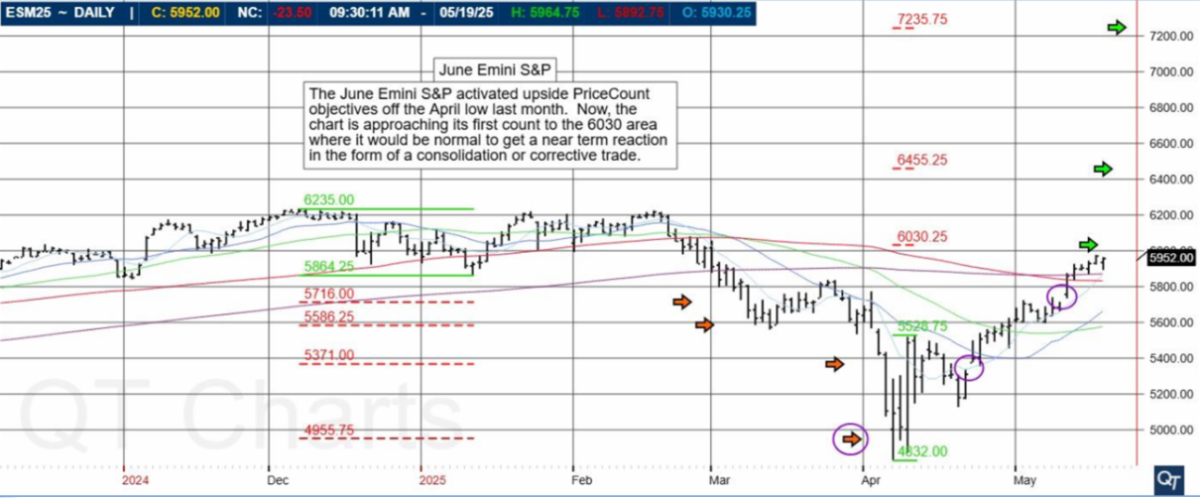
The June Emini S&P activated upside PriceCount objectives off the April low last month. Now, the chart is approaching its first count to the 6030 area where it would be normal to get a near term reaction in the form of a consolidation or corrective trade.

29d6df69 8503 4871 bee1 a285e9f170ec

The PriceCount study is a tool that can help to project the distance of a move in price. The counts are not intended to be an ‘exact’ science but rather offer a target area for the four objectives which are based off the first leg of a move with each subsequent count having a smaller percentage of being achieved.

It is normal for the chart to react by correcting or consolidating at an objective and then either resuming its move or reversing trend. Best utilized in conjunction with other technical tools, PriceCounts offer one more way to analyze charts and help to manage your positions and risk. Learn more at www.qtchartoftheday.com

Trading in futures, options, securities, derivatives or OTC products entails significant risks which must be understood prior to trading and may not be appropriate for all investors. Past performance of actual trades or strategies is not necessarily indicative of future results.

S
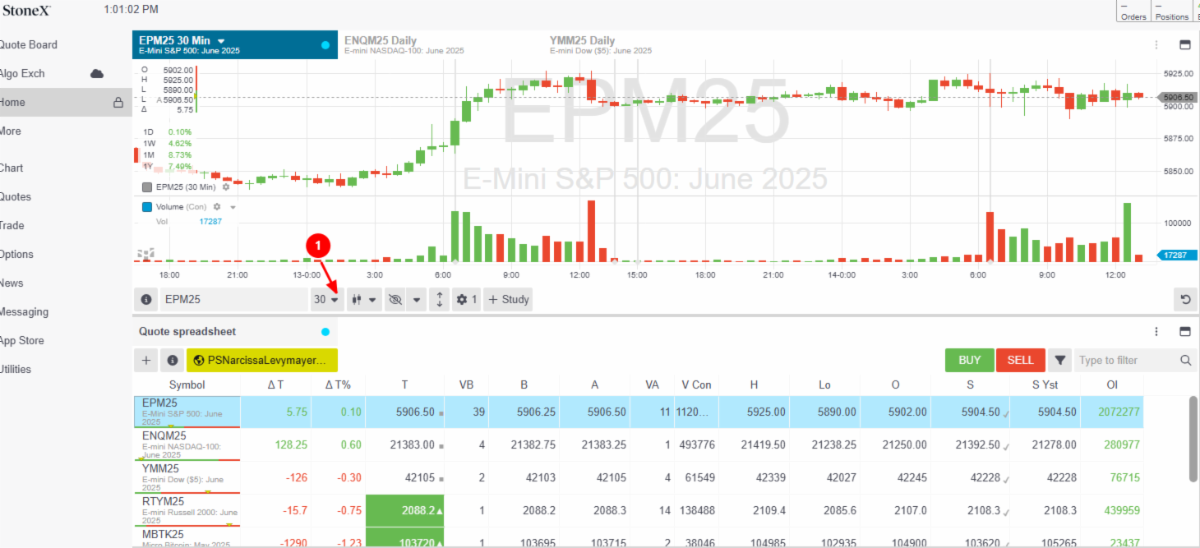
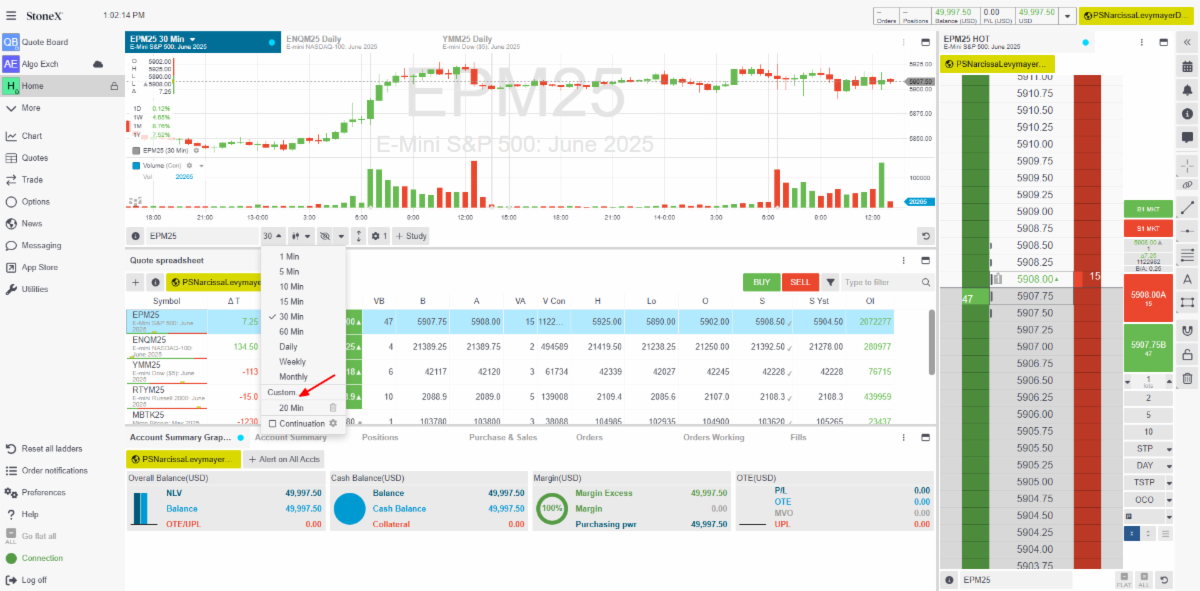
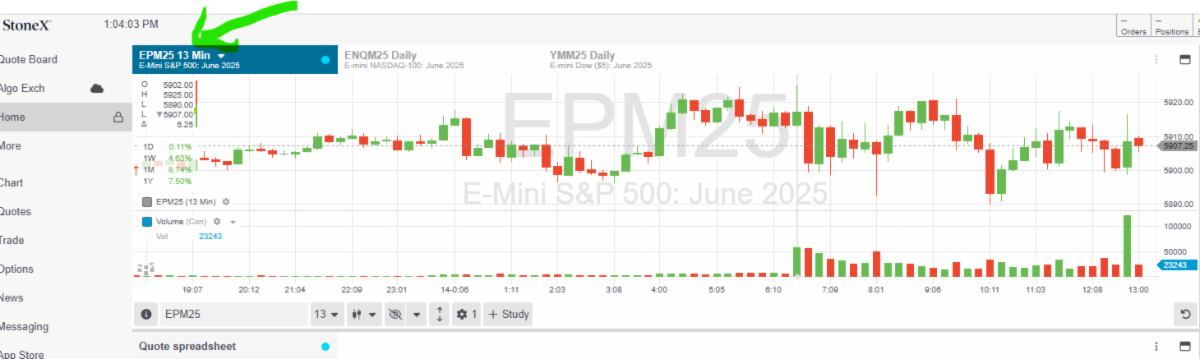
On a different note, here are some tips on creating a custom time chart interface using our FREE CannonX platform! (free demo)

How to create a custom Time on the charts?

Click on the arrow next to the current time interval

7862db77 9b30 4aca 8904 fbc25f21ca1e
Click on the custom option and type in the number of minutes or days you would like to see.
cba6258e 1077 416f 82aa 776d3f2d0a5b
Click ok and your new chart with custom time is available! In this example i selected 13 minutes.
8bfee785 e13b 4837 bd51 e65da93adb30

Daily Levels for May 20th, 2025

fbb3748e fceb 4c40 9b32 0c535da599f0

Want to feature our updated trading levels on your website? Simply paste a small code, and they’ll update automatically every day! 

Click here for quick and easy instructions.

822b33c5 2339 45ed bc84 e9c8f8c7358e

Economic Reports

provided by: ForexFactory.com

All times are Eastern Time (New York)

67ceaf55 65a4 4a59 927f 3b7ab33c0794

Find us on Trustpilot

stars

Trading Futures, Options on Futures, and retail off-exchange foreign currency transactions involves substantial risk of loss and is not suitable for all investors. 

You should carefully consider whether trading is suitable for you in light of your circumstances, knowledge, and financial resources. You may lose all or more of your initial investment.

Opinions, market data, and recommendations are subject to change at any time.

Join our Private Facebook group

Subscribe to our YouTube Channel

Listen to our podcast: Subscribe on AppleSpotify, Amazon

or wherever you listen to podcasts!

S
Facebook  Instagram  LinkedIn
S
ef3ab1c9 8d6d 4e60 a3f1 af5d9d4ecbb3
Services
Software
Tools
Community
Contact

Volatility, 16 Fed Speeches, July Coffee; Your Important Need-To-Knows for the Week of May 19th, 2025

7cfe5b36 db9f 4933 824a 7f264613e7fe

Cannon Futures Weekly Letter

In Today’s Issue #1242

  • LIVE, FREE Demo for Futures & Options

  • The Week Ahead – 16 Fed Speakers, Earnings, Housing, Tariffs, Volatility

  • Futures 102 – 5 Short Videos to Help Your Trading

  • Hot Market of the Week – July Coffee

  • Broker’s Trading System of the Week – Heating Oil Swing Trading System

  • Trading Levels for Next Week
  • Trading Reports for Next Week

Free Demo: Live Data, Streaming Charts

Introducing the newest trading platform to our already prominent selection: CannonX

  • Cloud-based and compatible with Windows and MacOS
  • Top-of-the-line tradable charts with abundant indicators and drawing tools
  • Option quotes display for all expirations and including all “Greeks.”
  • Quote programmability for straight futures and options as well as futures and option spreads, including multi-leg/complex options spreads.
  • Depth-of-market display at your fingertips for any of the position types listed aboveFull, easy-to-read account information display

START YOUR DEMO NOW

eb23d89b a6ee 494c a74a 38b5f4e886e7

Important Notices: The Week Ahead

By John Thorpe, Senior Broker

Volatility!

volatility

16! Count ‘em, 16 Fed speeches next week, a full week of trading in advance of Memorial Day weekend. Volatility expected.

More volatility to come as next week all markets will be reacting to whatever comes out of the U.S. Gov’t leadership relating to conflicts cessation and trade deals. Therefore, increased volatility expectations.

Look for changes from hawkishness to the doves fly in the tone and tenor of Fed speeches next week. June 18th is the next FOMC rate decision release.

Economic hard data Highlights next week will include Chicago Fed Economic Activity Index, Purchasing Managers Index, and few housing market numbers. Earnings reports will reflect 350+ total reports while we are in the bottom of the 7th inning of earnings season, the reports can still impact the indices but much less than in past weeks Highlighted by Home Depot, Palo Alto Networks, TJ Max and intuit to name a few Large Cap stocks.

Earnings Next Week:

  • Mon. Quiet
  • Tue. Home Depot, Palo Alto Networks
  • Wed.  TJ Max, Lowes, Medtronic
  • Thu. Intuit
  • Fri. Quiet

FED SPEECHES:

  • Mon.     Bostic 7:30 am, Jefferson and Williams 7:45 am, Logan 123:15pm, Kashkari 12:30 pm
  • Tues.     Barkin and Bostic 8:00 am, Collins 8:30 am, Musalem 12:00pm, Kugler 3:00 pm, Daly  and Hammack 5:00 pm
  • Wed.     Barkin 11:00am
  • Thu.      Williams 1:00pm,
  • Fri.       Cook 11:00am

Economic Data week:

  • Mon. CB index of leading indicators
  • Tue. quiet
  • Wed. EIA Crude Stocks,
  • Thur. Chgo Fed Activity Index, Initial claims, PMI, Existing Home Sales, KC Fed Activity Index, EIA Nat Gas
  • Fri. Bldg Permits, Home Sales

Futures 102: Short Trading Videos to Improve Your Trading

Watch a series of short videos, where our VP, Ilan Levy-Mayer shares his personal preferences and opinions on different trading topics.

·    Ever wondered when to exit a trade? Take a look at what Ilan has to share on Bollinger Bands and a study called PARABOLICS

·    Some common uses you can make of support and resistance levels.

·    Filter out the noise with range bar charts

·    “Price Confirmation” how to use it for entering trades?

·    Where do I exit a profitable position?

Hot Market of the Week

Hot market of the week is provided by QT Market Center, A Swiss army knife charting package that’s not just for Hedgers, Cooperatives and Farmers alike but also for Spread traders, Swing traders and shorter time frame application for intraday traders with a unique proprietary indicator that can be applied to your specific trading needs.

Free Trial Available

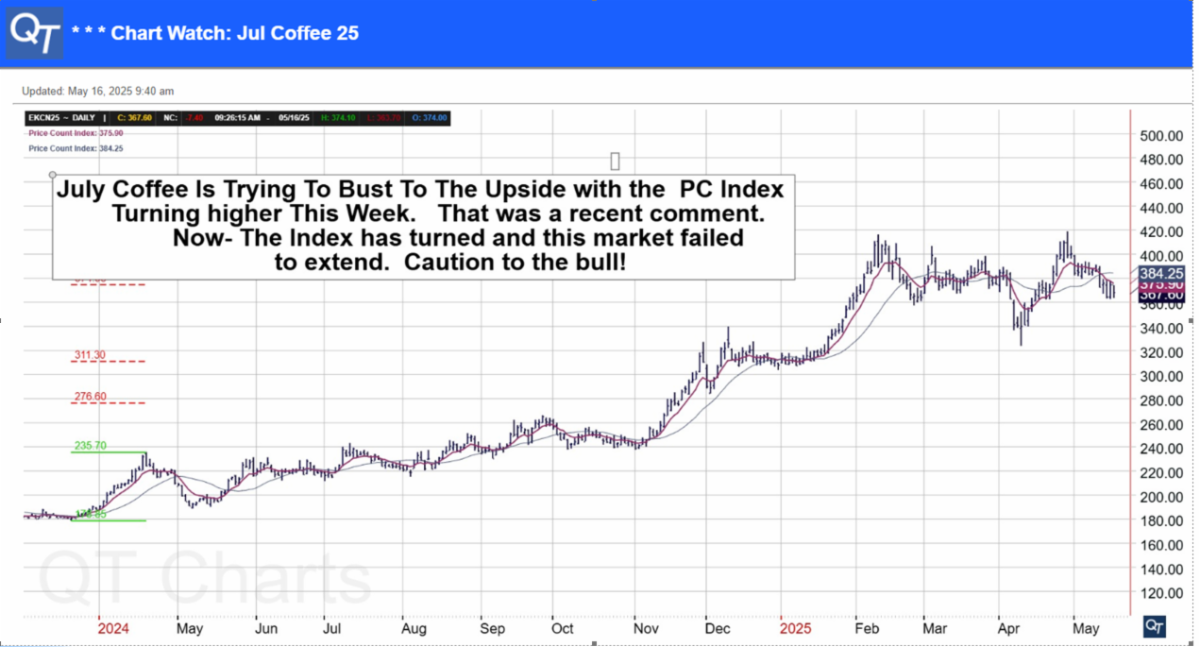
July Coffee

The July Coffee failed upside attempt!


e38b562d 5df9 4a2f 8fce 65f1999bd3f5

The PriceCount study is a tool that can help to project the distance of a move in price. The counts are not intended to be an ‘exact’ science but rather offer a target area for the four objectives which are based off the first leg of a move with each subsequent count having a smaller percentage of being achieved.

It is normal for the chart to react by correcting or consolidating at an objective and then either resuming its move or reversing trend. Best utilized in conjunction with other technical tools, PriceCounts offer one more way to analyze charts and help to manage your positions and risk. Learn more at www.qtchartoftheday.com

Trading in futures, options, securities, derivatives or OTC products entails significant risks which must be understood prior to trading and may not be appropriate for all investors. Past performance of actual trades or strategies is not necessarily indicative of future results.

Brokers Trading System of the Week

Swing 61B Trading System

Market Sector: Energies

Markets Traded:   HO – Heating Oil

System Type:  Swing Trading

Risk per Trade: varies

Trading Rules: Partially Disclosed

Suggested Capital: $25,000

Developer Fee per contract: $145.00 Monthly Subscription

System Description:

Trade ES futures. System coded to seek long or short entries, and the system only uses the higher probability signal. System contains a money management component.

Get Started

Learn More

0666c204 d4e3 445d 80c0 a09213a7baca
Disclaimer: The risk of trading can be substantial and each investor and/or trader must consider whether this is a suitable investment. Past performance is not necessarily indicative of future results.

Futures Trading Disclaimer:

Transactions in securities futures, commodity and index futures and options on futures carry a high degree of risk. The amount of initial margin is small relative to the value of the futures contract, meaning that transactions are heavily “leveraged”.

A relatively small market movement will have a proportionately larger impact on the funds you have deposited or will have to deposit: this may work against you as well as for you.

You may sustain a total loss of initial margin funds and any additional funds deposited with the clearing firm to maintain your position.

If the market moves against your position or margin levels are increased, you may be called upon to pay substantial additional funds on short notice to maintain your position.

If you fail to comply with a request for additional funds within the time prescribed, your position may be liquidated at a loss and you will be liable for any resulting deficit. Please read full disclaimer HERE.

Would you like to get weekly updates on real-time, results of systems mentioned above?

Trading Levels for Next Week

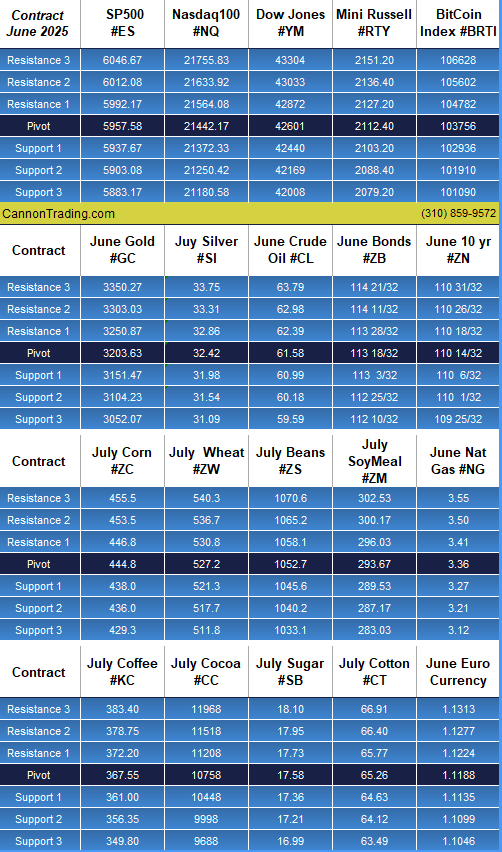
Daily Levels for May 19th, 2025

a4775fc4 116f 43af 9bb0 cb397910b086

Would you like to receive daily support & resistance levels?

Trading Reports for Next Week

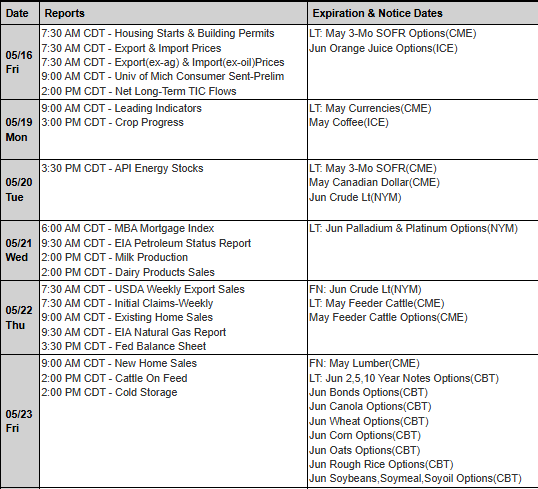
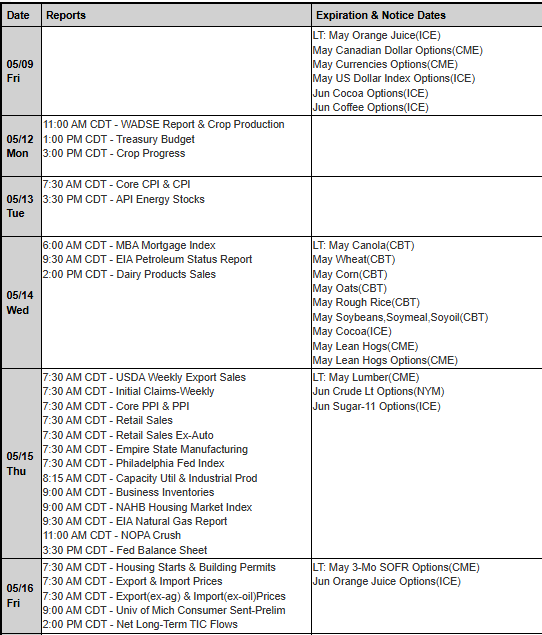
First Notice (FN), Last trading (LT) Days for the Week:

www.mrci.com

224ec1bd d52f 43ec 8a26 714158d9c8c1

Find us on Trustpilot

stars

Trading Futures, Options on Futures, and retail off-exchange foreign currency transactions involves substantial risk of loss and is not suitable for all investors. 

You should carefully consider whether trading is suitable for you in light of your circumstances, knowledge, and financial resources.

You may lose all or more of your initial investment. Opinions, market data, and recommendations are subject to change at any time.

Join our Private Facebook group

Subscribe to our YouTube Channel

Listen to our podcast: Subscribe on AppleSpotify, Amazon

or wherever you listen to podcasts!

S
Facebook  Instagram  LinkedIn
S
ef3ab1c9 8d6d 4e60 a3f1 af5d9d4ecbb3
Services
Software
Tools
Community
Contact

Crude Oil Volatility, CannonX Futures Trading Platform Time Charts – Your 2 Important Need-To-Knows for Trading Futures on May 16th, 2025

9dc1e02e d5f7 4ff4 abf7 1df60775f196

What to Know Before Trading Futures on May 16th

crude oil

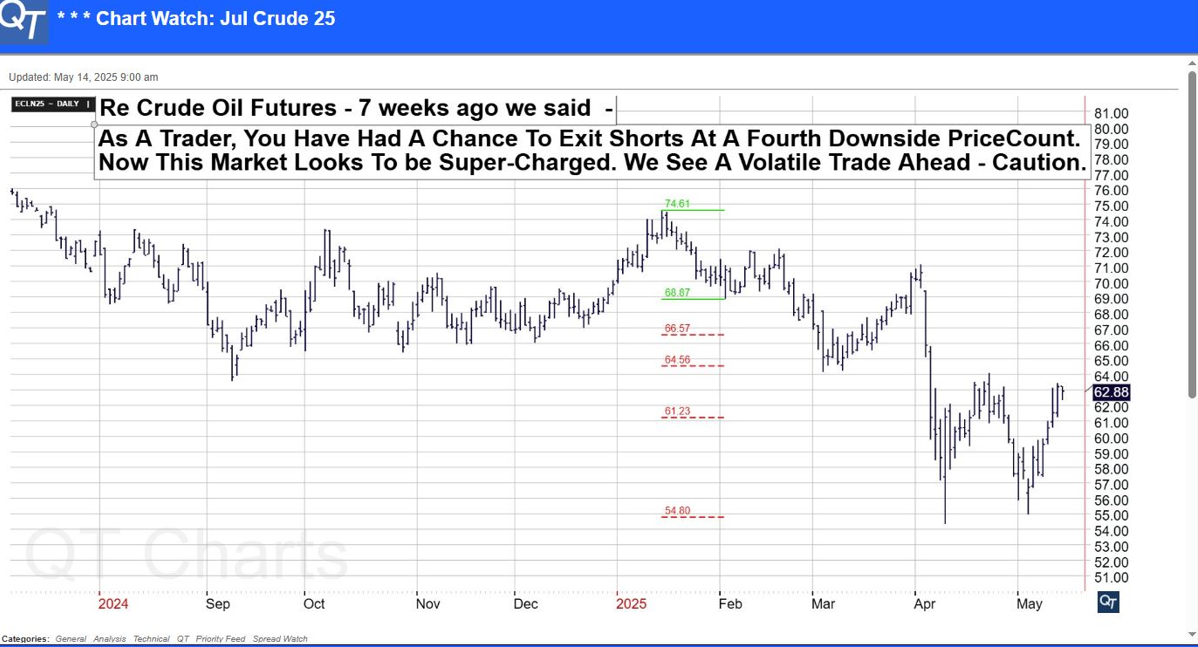
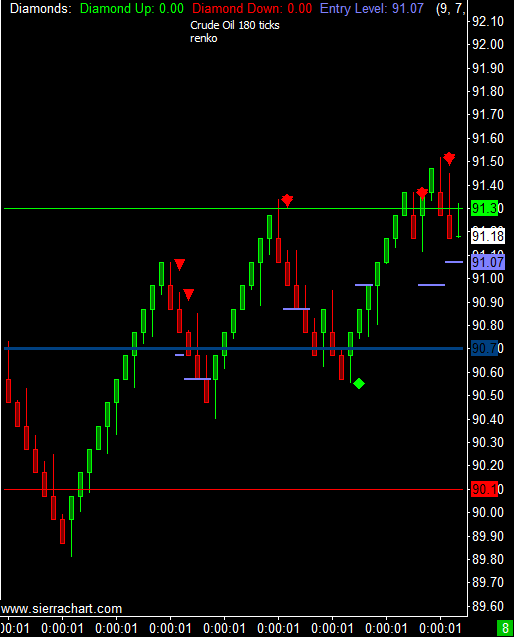
 Crude Oil Volatility Continues!

0f648e19 3092 4c7b 96b5 7199ad4af6e2
S
On a different note, here are some tips on creating a custom time chart interface using our FREE CannonX platform! (free demo)

How to create a custom Time on the charts?

Click on the arrow next to the current time interval

7862db77 9b30 4aca 8904 fbc25f21ca1e
Click on the custom option and type in the number of minutes or days you would like to see.
cba6258e 1077 416f 82aa 776d3f2d0a5b
Click ok and your new chart with custom time is available! In this example i selected 13 minutes.
8bfee785 e13b 4837 bd51 e65da93adb30

Daily Levels for May 16th, 2025

b4d2ed32 1a7f 42c4 8213 cb5e39978b21

Want to feature our updated trading levels on your website? Simply paste a small code, and they’ll update automatically every day! 

Click here for quick and easy instructions.

822b33c5 2339 45ed bc84 e9c8f8c7358e

Economic Reports

provided by: ForexFactory.com

All times are Eastern Time (New York)

3295aad0 18a7 4b3f 8703 d49275838cbf

Find us on Trustpilot

stars

Trading Futures, Options on Futures, and retail off-exchange foreign currency transactions involves substantial risk of loss and is not suitable for all investors. You should carefully consider whether trading is suitable for you in light of your circumstances, knowledge, and financial resources. You may lose all or more of your initial investment. Opinions, market data, and recommendations are subject to change at any time.

Join our Private Facebook group

Subscribe to our YouTube Channel

Listen to our podcast: Subscribe on AppleSpotify, Amazon

or wherever you listen to podcasts!

S
Facebook  Instagram  LinkedIn
S
ef3ab1c9 8d6d 4e60 a3f1 af5d9d4ecbb3
Services
Software
Tools
Community
Contact

PPI, Manufacturing Surveys, CannonX Time on Charts; 3 Important Need to Knows for Futures Trading on May 15th, 2025

9dc1e02e d5f7 4ff4 abf7 1df60775f196

What to Know Before Trading Futures on May 15th

PPI, Key points for tomorrow

By Mark O’Brien, Senior Broker

ppi

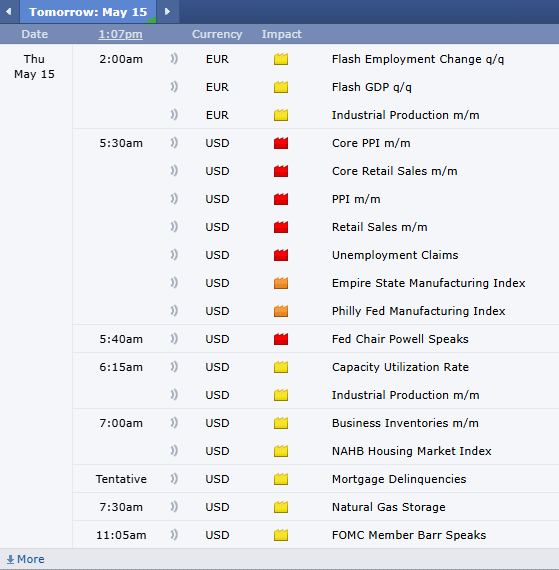
Keep an eye out for tomorrow’s economic reports, starting at 7:30 A.M., Central Time with the release of the Bureau of Labor Statistics’ PPI, showing the cost of wholesale goods and services.

The PPI reading reflects what companies pay for supplies such as grains, fuel, metals, lumber, packaging and so forth. The PPI is a key inflation gauge.

At the same time, the Labor Department will release its Initial Jobless Claims, which measures the number of individuals who filed for unemployment insurance for the first time during the past week.

Manufacturing Surveys

Although with less cachet, tomorrow will also see the release of the Empire State Manufacturing Survey, which is a monthly survey of manufacturers in New York State conducted by the Federal Reserve Bank of New York.

Probably in the same category the Philadelphia Fed Manufacturing Survey will be released by the Federal Reserve Bank of Philadelphia.

Both surveys will be released at 7:30 A.M., Central Time.

Probably the most compelling event tomorrow will be at the Thomas Laubach Research Conference in Washington, D.C. where Fed Chair Jerome Powell will speak at 7:40 A.M., Central Time.

CannonX Time on the Charts

On a different note, here are some tips on creating a custom time chart interface using our FREE CannonX platform! (free demo)

How to create a custom Time on the charts?

S

Click on the arrow next to the current time interval

7862db77 9b30 4aca 8904 fbc25f21ca1e
Click on the custom option and type in the number of minutes or days you would like to see.
cba6258e 1077 416f 82aa 776d3f2d0a5b
Click ok and your new chart with custom time is available! In this example i selected 13 minutes.
8bfee785 e13b 4837 bd51 e65da93adb30

Daily Levels for May 15th, 2025

7bf96000 eda1 4971 901d 0d5dd3111402
Want to feature our updated trading levels on your website? Simply paste a small code, and they’ll update automatically every day! Click here for quick and easy instructions.
822b33c5 2339 45ed bc84 e9c8f8c7358e

Economic Reports

provided by: ForexFactory.com

All times are Eastern Time (New York)

ebd6bb78 124a 4412 a455 e596136d8654

Find us on Trustpilot

stars

Trading Futures, Options on Futures, and retail off-exchange foreign currency transactions involves substantial risk of loss and is not suitable for all investors. 

You should carefully consider whether trading is suitable for you in light of your circumstances, knowledge, and financial resources. You may lose all or more of your initial investment.

Opinions, market data, and recommendations are subject to change at any time.

Join our Private Facebook group

Subscribe to our YouTube Channel

Listen to our podcast: Subscribe on AppleSpotify, Amazon

or wherever you listen to podcasts!

S
Facebook  Instagram  LinkedIn
S
ef3ab1c9 8d6d 4e60 a3f1 af5d9d4ecbb3
Services
Software
Tools
Community
Contact

Voice of The Tomb: Seasonals, Corn, Wheat, & More Crucial, Important Need-To-Knows for Trading Futures on May 14th, 2025

9dc1e02e d5f7 4ff4 abf7 1df60775f196

Voice from the Tomb

Voice from The Tomb, Seasonals & more

by John Thorpe, Senior Broker

Day trade margins are back to normal valuations.

A quiet data day tomorrow.

    Market volatility is here to stay for the foreseeable future

Choose your opportunities wisely. Today’s market swings were largely back to normal (pre tariff talk normal)

I thought the timing would be correct to revisit this sage wisdom from the not-so-distant past since April WASDE was released yesterday.

This 8 ½ x 11, well worn, sheet of paper version has been pinned to the corkboard in my office for decades and is worth a share. Called “Voice from the Tomb”, I have noticed a web page dedicated solely to this Myth or Non-Fiction? Lore or Fact? and his experiences following the execution dates.

It’s interesting to contemplate the prospective impact of following the note left to family members, in light of some of the upcoming dates provided. What follows is simply a brief of the contents, feel free to google search the topic to follow the trader’s experiences, you too may end up saving the primary authors advice.

Voice From the Tomb

This is the legend of a wise grain trader that made a fortune trading “seasonals” in the pits of the Chicago Board of Trade.

“After his wife died, a millionaire grain trader dedicated his life to raising their children. The children were lazy and thought they’d inherit all of their father’s money. He felt that his children were wasteful and believed they took him for granted. When he died, all the money went to charity. All he left them in his will were the following dates of when to buy and sell. The will said that if they strictly followed his advice, they’d have the fortunes they always thought were going to drop in their laps.”

Seasonals, Corn, Wheat

seasonals corn wheat

So what is a “seasonal”? “Seasonality often plays a part in determining prices for commodities in regular cycles throughout the year. Normal increases and decreases in supply and demand for particular commodities seem to occur every year in fairly consistent patterns. Commodity seasonal patterns might appear to be an easy trading strategy for commodities, but seasonal tendencies are just that – tendencies.” Chuck Kowalski

Wheat

  • Sell March Wheat on January 10
  • Buy May and/or July Wheat on February 22
  • Sell July Wheat on May 10
  • Buy December Wheat on July 1
  • Sell December Wheat on September 10
  • Buy March Wheat on November 28

Corn

  • Buy July Corn on March 1
  • Sell July Corn on May 20
  • Buy December Corn on June 25
  • Sell December and March Corn on August 10

Disclaimers:

* Past results are not necessarily indicative of future results. The risk of loss in the futures trading market can be substantial, carefully consider the inherent risks of such an investment in light of your financial condition.

** SEASONAL TENDENCIES ARE A COMPOSITE OF SOME OF THE MORE CONSISTENT COMMODITY FUTURES SEASONAL THAT HAVE OCCURRED OVER THE PAST 15 YEARS. THERE ARE USUALLY UNDERLYING FUNDAMENTAL CIRCUMSTANCES THAT OCCUR ANNUALLY THAT TEND TO CAUSE THE FUTURES TRADING MARKETS TO REACT IN A SIMILAR DIRECTIONAL MANNER DURING A CERTAIN CALENDAR PERIOD OF THE YEAR.

EVEN IF A SEASONAL TENDENCY OCCURS IN THE FUTURE, IT MAY NOT RESULT IN A PROFITABLE TRANSACTION AS FEES, AND THE TIMING OF THE ENTRY AND LIQUIDATION MAY IMPACT ON THE RESULTS. NO REPRESENTATION IS BEING MADE THAT ANY ACCOUNT HAS IN THE PAST OR WILL IN THE FUTURE ACHIEVE PROFITS UTILIZING THESE STRATEGIES. NO REPRESENTATION IS BEING MADE THAT PRICE PATTERNS WILL RECUR IN THE FUTURE.

Tomorrow:

Econ Data:  EIA Energy stocks.

FED Speak: Three speakers

Earnings: TenCent, Siemens, Cisco systems, Sony

Tariff news: Anything goes!

S

November Beans

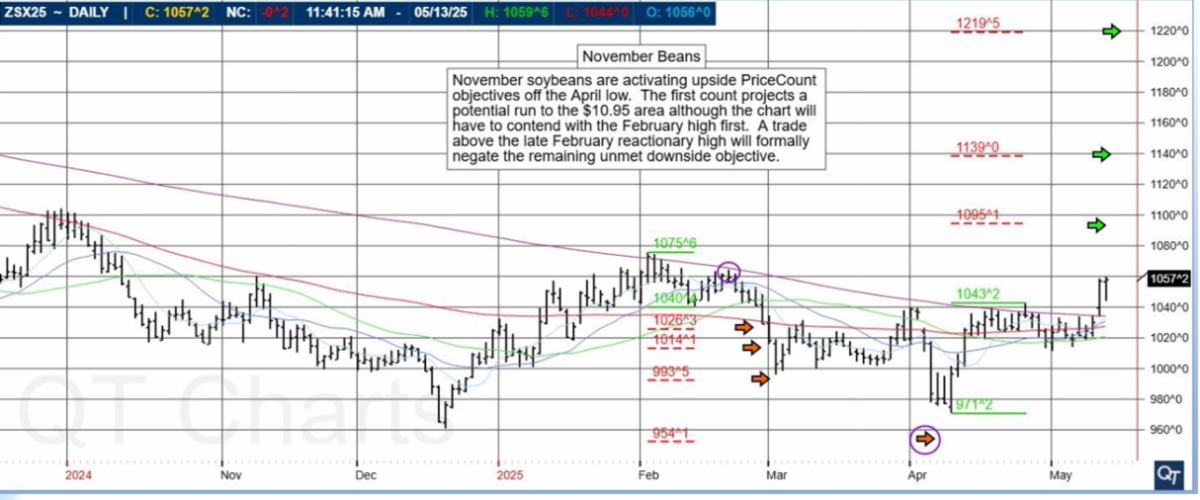
November soybeans are activating upside PriceCount objectives off the April low. The first count projects a potential run to the $10.95 area although the chart will have to contend with the February high first. A trade above the late February reactionary high will formally negate the remaining unmet downside objective.

ebf4a4c6 f339 4bf2 901d 713af0464d2c

Daily Levels for May 14th, 2025

81f4f47c 4e84 47db 94a6 ef1426b23a7f

Want to feature our updated trading levels on your website? Simply paste a small code, and they’ll update automatically every day! 

Click here for quick and easy instructions.

28ae1ddf f400 4901 82b9 03a497f63f26

Economic Reports

provided by: ForexFactory.com

All times are Eastern Time ( New York)

fcb094a8 dfd3 490d aa87 6b054e8f18b1

Find us on Trustpilot

stars

Trading Futures, Options on Futures, and retail off-exchange foreign currency transactions involves substantial risk of loss and is not suitable for all investors. 

You should carefully consider whether trading is suitable for you in light of your circumstances, knowledge, and financial resources.

You may lose all or more of your initial investment. Opinions, market data, and recommendations are subject to change at any time.

Join our Private Facebook group

Subscribe to our YouTube Channel

Listen to our podcast: Subscribe on AppleSpotify, Amazon

or wherever you listen to podcasts!

S
Facebook  Instagram  LinkedIn
S
ef3ab1c9 8d6d 4e60 a3f1 af5d9d4ecbb3
Services
Software
Tools
Community
Contact

CPI/PPI Week, July – September Corn, Trading Using ALGOS: 3 Important Need-to-Knows for the Week Ahead

7cfe5b36 db9f 4933 824a 7f264613e7fe

Cannon Futures Weekly Letter

In Today’s Issue #1241

corn

  • LIVE, FREE Demo for Futures & Options
  • The Week Ahead – CPI/PPI Week! Chair Powell on Thursday.

  • Futures 102 – Trading Set Ups for Review
  • Hot Market of the Week – July-Sept. Corn Spread

  • Broker’s Trading System of the Week – Notorious ES Day Trading System
  • Trading Levels for Next Week
  • Trading Reports for Next Week

Free Demo: Live Data, Streaming Charts

Introducing the newest trading platform to our already prominent selection: CannonX

  • Cloud-based and compatible with Windows and MacOS
  • Top-of-the-line tradable charts with abundant indicators and drawing tools
  • Option quotes display for all expirations and including all “Greeks.”
  • Quote programmability for straight futures and options as well as futures and option spreads, including multi-leg/complex options spreads.
  • Depth-of-market display at your fingertips for any of the position types listed aboveFull, easy-to-read account information display

START YOUR DEMO NOW

eb23d89b a6ee 494c a74a 38b5f4e886e7

Important Notices: The Week Ahead

By John Thorpe, Senior Broker

CPI/PPI Week! Chair Powell on Thursday

cpi

More volatility to come as next week all markets will be reacting to whatever comes out of Geneva, Switzerland where U.S.-China trade representatives will be meeting for the first time since the tariff tantrums had begun. Therefore, increased volatility expectations.

WASDE Monday, 11a.m. CT World Agricultural Supply and Demand

Economic hard data Highlights next week will include Consumer Price Index and Producer Price Index as Tues. and Wed. respectively. The Y o Y forecast is 2.4 % for the CPI and Next month’s PPI numbers should reflect producer price changes affected by global tariff implementation.

Earnings reports will reflect 900+ total reports while we are in the top of the 5th inning of earnings season, the reports can still impact the indices but much less than in past weeks.

Highlighted by Constellation Software, Honda motor Company, Tencent Holding LTD., Siemens AG, Sony Corp, Walmart, Alibaba to name a few Large Cap stocks

Earnings Next Week:

  • Mon. Constellation Group
  • Tue. Honda Motor Company
  • Wed. Tencent, Cisco, Siemens, Sony
  • Thu. Walmart, Alibaba
  • Fri. Quiet

FED SPEECHES:

  • Mon.     Kugler 9:25 am CT
  • Tues.    Quiet
  • Wed.    Waller 4:15 a.m. CT, Jefferson 8:10 a.m. CT, Daly 4:40 p.m. CT
  • Thu.   Fed Chair Powell 7:40 a.m. CT, Barr 1:05 p.m. CT, at the Thomas Laubach Research  Conference, Washington, D.C.
  • Fri.     Williams 8:05 am CDT

Economic Data week:

  • Mon. WASDE
  • Tue.  CPI 7:30 a.m. CT , Redbook
  • Wed. EIA Crude Stocks
  • Thur. Continuing Jobless Claims, PPI, Philly Fed, Retail Sales, Capacity Utilization, Hsg Mkt Index, .EIA Nat Gas
  • Fri. Bldg Permits, Housing Starts, Mich. Consumer Sentiment

Futures 102: Free trial to Trade Algos


Simpler Approach To Trading Using ALGOS and Trade Management

Sign up to receive family of studies along with trading ALGORITHMS you can place on your own charts, your own time frame and the markets you prefer.

Once you register to the free 3 weeks trial, you will also receive a 23 page PDF eBook that details the logic, concept and trading applications that can be used while applying these indicators.

  • Counter Trend Signals
  • Early Trend Signals

Start Your FREE Trial Now

signals_4 image

Hot Market of the Week

Hot market of the week is provided by QT Market Center, A Swiss army knife charting package that’s not just for Hedgers, Cooperatives and Farmers alike but also for Spread traders, Swing traders and shorter time frame application for intraday traders with a unique proprietary indicator that can be applied to your specific trading needs.

Free Trial Available

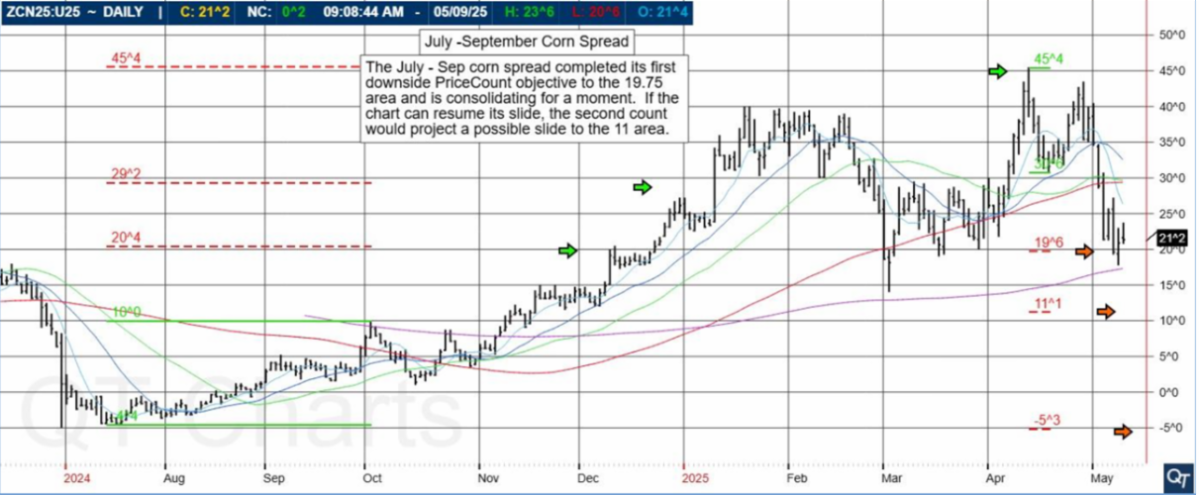
July-September Corn Spread

The July – Sep corn spread completed its first downside PriceCount objective to the 19.75 area and is consolidating for a moment. If the chart can resume its slide, the second count would project a possible slide to the 11 area.


487b9ea0 a10a 4e31 98c6 06876f8f3449

The PriceCount study is a tool that can help to project the distance of a move in price. The counts are not intended to be an ‘exact’ science but rather offer a target area for the four objectives which are based off the first leg of a move with each subsequent count having a smaller percentage of being achieved.

It is normal for the chart to react by correcting or consolidating at an objective and then either resuming its move or reversing trend. Best utilized in conjunction with other technical tools, PriceCounts offer one more way to analyze charts and help to manage your positions and risk.

Learn more at www.qtchartoftheday.com

Trading in futures, options, securities, derivatives or OTC products entails significant risks which must be understood prior to trading and may not be appropriate for all investors. Past performance of actual trades or strategies is not necessarily indicative of future results.

Brokers Trading System of the Week

Notorious ES Trading System

Market Sector: Stock Index Futures

Markets Traded:   ES

System Type: Day Trading

Risk per Trade: varies

Trading Rules: Partially Disclosed

Suggested Capital: $30,000

Developer Fee per contract: $110.00 Monthly Subscription

System Description:

Trade ES futures. System coded to seek long or short entries, and the system only uses the higher probability signal. System contains a money management component.

Get Started

Learn More

45b94a5c c998 4fdb 895b 3b8c246c63d6
Disclaimer: The risk of trading can be substantial and each investor and/or trader must consider whether this is a suitable investment. Past performance is not necessarily indicative of future results.

Futures Trading Disclaimer:

Transactions in securities futures, commodity and index futures and options on futures carry a high degree of risk. The amount of initial margin is small relative to the value of the futures contract, meaning that transactions are heavily “leveraged”.

A relatively small market movement will have a proportionately larger impact on the funds you have deposited or will have to deposit: this may work against you as well as for you.

You may sustain a total loss of initial margin funds and any additional funds deposited with the clearing firm to maintain your position. If the market moves against your position or margin levels are increased, you may be called upon to pay substantial additional funds on short notice to maintain your position.

If you fail to comply with a request for additional funds within the time prescribed, your position may be liquidated at a loss and you will be liable for any resulting deficit. 

Please read full disclaimer HERE.

Would you like to get weekly updates on real-time, results of systems mentioned above?

Trading Levels for Next Week

Daily Levels for May 12th, 2025

959152aa 5905 4aff a726 86dab08b1e14
Would you like to receive daily support & resistance levels?

Trading Reports for Next Week

First Notice (FN), Last trading (LT) Days for the Week:

www.mrci.com

6931e744 d8c8 41a8 a2a4 64db1b49a792

Find us on Trustpilot

stars

Trading Futures, Options on Futures, and retail off-exchange foreign currency transactions involves substantial risk of loss and is not suitable for all investors.

You should carefully consider whether trading is suitable for you in light of your circumstances, knowledge, and financial resources.

You may lose all or more of your initial investment. Opinions, market data, and recommendations are subject to change at any time.

Join our Private Facebook group

Subscribe to our YouTube Channel

Listen to our podcast: Subscribe on AppleSpotify, Amazon

or wherever you listen to podcasts!

S
Facebook  Instagram  LinkedIn
S
ef3ab1c9 8d6d 4e60 a3f1 af5d9d4ecbb3
Services
Software
Tools
Community
Contact

FOMC Key Takeaways from CME, Dollar Index; 4 Important Need-To-Knows When Trading Futures Tomorrow

9dc1e02e d5f7 4ff4 abf7 1df60775f196

FOMC Takeaways

FOMC Key Takeaways with Craig of CME Group

The awaited Fed Interest Rate decision was released yesterday, and as expected, the Fed kept the interest rates unchanged while signaling that rate cuts could be on the horizon for the remainder of the year.

With this announcement, the equity indices initially broke to the downside and then were able to recover at the end of the session. Gold, Silver, and Crude Oil all traded lower today after seeing strong gains to start the week.

FOMC

The CME Fed Watch Tool has been moving today with the interest rate decision along with the volatility in different markets, and seeing the changes over time can be beneficial.

This morning at 9:00 A.M. Central Time, the tool was pricing in a pause for the June meeting with a 69% probability, and that figure went up to 76% as of 3:00 Central Time after hearing remarks from Powell.

In a similar way, the probability for a rate cut at the July meeting remained the same near 56%. What this tells traders is that the market is pricing in a higher chance of the first interest rate cut coming at the July meeting instead of the previous expectation of the June meeting.

Would you like to view daily updates/takeaways and general research?

Visit our RESEARCH section which updates throughout the day!

Craig Bewick has spent 25 years in futures and options markets, starting at CBOT and CME working in risk management, regulatory, technology, product management and client development.

S

June Dollar Index

The June Dollar Index stabilized its inside last month after it satisfied its fourth downside PriceCount objective. Now, the chart has activated upside counts and is taking aim at the first objective to the 101.22 area.

73ecc020 47a6 45ae 93fd 242aa08058fa

The PriceCount study is a tool that can help to project the distance of a move in price. The counts are not intended to be an ‘exact’ science but rather offer a target area for the four objectives which are based off the first leg of a move with each subsequent count having a smaller percentage of being achieved.

It is normal for the chart to react by correcting or consolidating at an objective and then either resuming its move or reversing trend. Best utilized in conjunction with other technical tools, PriceCounts offer one more way to analyze charts and help to manage your positions and risk.

Learn more at www.qtchartoftheday.com

Trading in futures, options, securities, derivatives or OTC products entails significant risks which must be understood prior to trading and may not be appropriate for all investors. Past performance of actual trades or strategies is not necessarily indicative of future results.

Daily Levels for May 9th 2025

332f851e 9380 4512 83f4 0ca9337e446e

Want to feature our updated trading levels on your website? Simply paste a small code, and they’ll update automatically every day! 

Click here for quick and easy instructions.

822b33c5 2339 45ed bc84 e9c8f8c7358e

Economic Reports

provided by: ForexFactory.com

All times are Eastern Time (New York)

8ae5b15c 4faf 4b03 bc21 79185307a5fc

Find us on Trustpilot

stars

Trading Futures, Options on Futures, and retail off-exchange foreign currency transactions involves substantial risk of loss and is not suitable for all investors. You should carefully consider whether trading is suitable for you in light of your circumstances, knowledge, and financial resources. You may lose all or more of your initial investment. Opinions, market data, and recommendations are subject to change at any time.

Join our Private Facebook group

Subscribe to our YouTube Channel

Listen to our podcast: Subscribe on AppleSpotify, Amazon

or wherever you listen to podcasts!

S
Facebook  Instagram  LinkedIn
S
ef3ab1c9 8d6d 4e60 a3f1 af5d9d4ecbb3
Services
Software
Tools
Community
Contact