Weekly Market Update

The good the bad and the ugly; this market as of late feels like a western movie. Maybe we’re just so used to the market going up. Where will the next catalyst for this market come from? The price action is pointing to consolidation phase. Leadership has flipped to other areas such as energy, staples, materials. There is too much volatility as of late. NDX broke below its upward sloping trendline from December lows. Everything I am reading, hearing and seeing is causing me to turn more cautious on this market.
???
How can the market go higher without tech? Did anyone see that financials (XLF) stalled as well. We’ve had 3 notable pullbacks this year so far in the S&P500 and they all stopped and found support around 6800 on the SPX. So right now, it’s a 3% pullback around the 100 Day Moving Average. And then the buyers come in. That is the key number I am looking at if that support breaks, Houston we have an alert. It seems the market is lucky to avert danger; there was a chance that the jobs report and CPI could go in the wrong direction and start painting a stagflation picture. Is AI recking tech so bad that its bad for the market? David Einhorn from greenlight capital was quoted saying “I think this is the most expensive market we’ve been in”.
DOW
DOW 50,000: an underlying assumption in both the bond and stock markets has been that the Fed would resume cutting rates after Jerome Powell steps down when his term as chair ends in May and is replaced by Kevin Warsh, who has endorsed rate cuts. The chair has just one vote out of 12 on the Federal Open Market Committee. If the anticipated rate-cut scenario doesn’t play out, and the AI hits keep on coming, the Dow 50,000 print may be the peak for a while.
RSP
RSP which is the equal weight S&P500 has been the leading ETF this year as opposed to the S&P. the Industrials sector is 16% of the RSP and Industrials have been going up. Over the last 10 years the CapEx companies have been cap light, high margins, and solid recuring revenues. Are now becoming CapEx very heavy, more debt and lower margins. The market is in a digestive stage of how do we value these stocks going forward. While we do see this economic expansion which is in the center of what RSP gives you such as Industrials. I keep hearing that valuations are too high.
Earnings
And perhaps we should have a new valuation paradigm? I would hold off on the latter until proven to be correct. Earnings have outperformed by 5% for 10 straight quarters. We’ve come to expect that from earnings season. Speaking of CapEx raises in spending by the mega cap companies, they were substantial. Shouldn’t that spending lift the SMH sector, I only saw the memory chips going up and that’s a disconnect to keep an eye out for.
Investors Intelligence’s tally of opinions showed bulls topping bears by 40 percentage points, a reading in the 90 percentiles of positivity, according to Jeff deGraaf, founder and chairman of Renaissance Macro Research. That elevated sentiment suggested at least some near-term caution, he wrote in a client note on Thursday morning. Traders should be patient, buying dips instead of chasing strength, he wrote.
“If tech cannot get an AI-driven valuation premium, one must wonder if any sector can earn its way into a better multiple in the next few years,” Colas writes.
Retail sales were a bad miss. And stocks continue to go up because of a K shape recovery, UBS says we believe the backdrop remains favorable; driven by resilient economic growth, supportive federal reserve policy and AI investment and adoption. Earnings are getting revised higher and that may be a reason markets are maintaining the gains of past days. Transport and Industrial are confirming just that and that’s where momentum has been. CSX which is in railways is at a 52-week high that points that the market believes in a growing industrial.
Growth
Earnings growth in the emerging markets in 2025 outpaced the US, US is around 14% emerging markets around 29 %, add to that the declining value of the dollar. The broadening thesis is supported by earnings and it’s not just domestic in the emerging market.
The markets seem to be transitioning in this 4th year of a bull market from a momentum multiple driven market to an earnings driven market, traditionally and historically over the last 80 years when the S&P moves into more of an earnings driven market, the returns are roughly half that of the momentum driven market. Barclays on Wednesday upgraded value, downgraded momentum and cautions on small caps. Am going to note that small caps finally are seeing on annualized basis positive earnings. And momentum is currently pivoting more towards quality and value.
We don’t have the ability to accurately assess what and how AI is going to be disruptive to certain sectors. This week we saw news that AI is disruptive to software, trucking, commercial real estate. And the market sold these sectors.
YIELDS
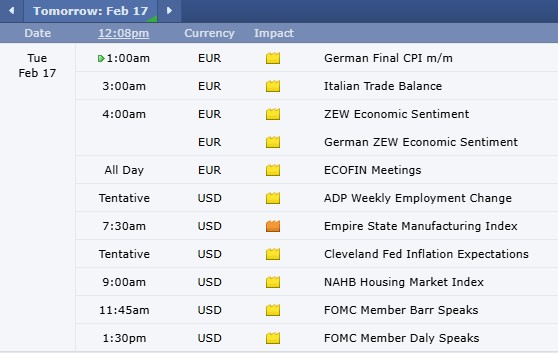
The Bond market is relatively calm and that is good for credit availability and the cost of capital not being a moving target. In Treasuries, the benchmark 10-year note yield dropped as low as 4.05% on Friday, down about 23 basis points from a couple of weeks earlier and the lowest level since late October, when it dipped under the 4%
The bullish bond backdrop was further bolstered by economic data, notably a smaller-than-expected rise of 0.2% in the consumer price index for January, the smallest increase since July. That boosted the odds that the Fed would cut interest rates by more than half a percentage point by year end.
I asked ChatGPT what’s the total value of all gold Vs. the US market and she answered Gold-30-40 trillion, US market capitalization 69 trillion.
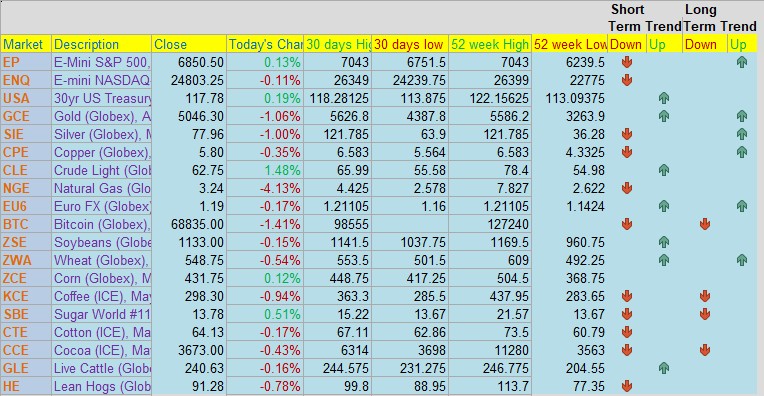
Weekly Commodities Futures Overview (Week of Feb 9–13, 2026)
Market theme: Mixed performance with energy and some soft commodities under pressure, while precious metals remained relatively firm and grains were broadly stable. Volatility was heightened by macro uncertainty, holiday-thin trading, and positioning adjustments after recent rallies.
Energy Commodities
Crude Oil (WTI & Brent)
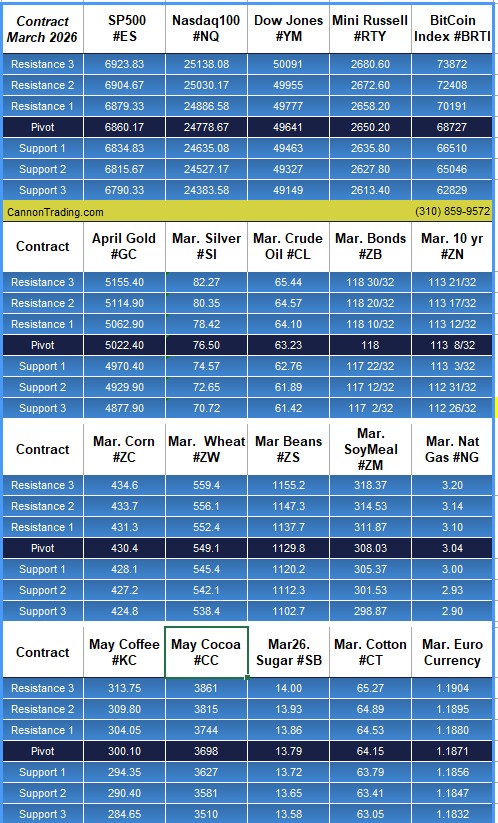
- WTI crude futures traded around the $62–63/bbl zone into Friday.
- Brent crude hovered near $68/bbl by week’s end. The weekly move was modest and flat to slightly down overall, reflecting consolidation after recent geopolitical driven rallies.
Key drivers:
- Ongoing geopolitical risk premium (U.S.–Iran talks) keeps prices supported.
- But overall direction was sideways with traders booking profits after recent gains.
Natural Gas
- Natural gas futures declined over the week, with prices near $3.04/MMBtu around Feb 16 — marking a notable weekly drop.
Summary (Energy):
- WTI & Brent: Mild net declines / sideways.
- Natural gas: Significant weekly weakness — one of the bigger movers lower on the energy side.
Precious & Industrial Metals
Gold
- Gold futures held around the $5,000/oz level into mid-week and finished with relatively modest weekly gains vs. the prior Friday. Prices were still elevated from recent strength earlier in the month.
Silver
- Silver underperformed gold with prices near ~$75/the ounce mid-Feb, reflecting a stronger pullback this week.
Platinum & Palladium
- Platinum was slightly down; palladium ticked modestly higher, but overall moves were smaller compared with gold and silver.
Industrial Metals (Copper, Aluminum)
- Copper futures drifted mildly lower over the week.
- Aluminum showed some decline early then modest recovery, finishing the trading week with small net changes.
Summary (Metals):
- Gold: modest weekly gains / holding firm.
- Silver & Platinum: lower.
- Industrial metals: overall soft or mixed with no strong directional trend.
Agricultural Commodities
Grains
Using broad market data:
- Wheat futures were higher on the week, supported by topping activity and export dynamics.
- Corn futures saw small positive weekly change.
Softs & Others
- Commodities like sugar and coffee generally stayed muted with soft to slightly mixed weekly results.
Summary (Agriculture):
- Wheat & Corn: modest up moves.
- Soft commodities: flat to slightly mixed.
Top Weekly Movers – Commodities Futures
Upside / Outperformers
- Gold futures: Held gains and remained resilient around key technical levels.
- Wheat & Corn: Modest weekly strength among ag futures.
Downside / Underperformers
- Natural gas futures: Among the largest weekly declines in the energy complex.
- Silver: Weaker relative to gold.
- Crude oil (WTI & Brent): Slightly down or flat through profit-taking and consolidation.
Key Market Drivers Last Week
1. Positioning after big rallies
Positioning shifts in metals and energy have led to profit-taking, particularly in silver and natural gas.
2. Geopolitics & macro data
Talks between the United States and Iran shape energy risk premiums, but haven’t triggered new directional breakouts.
3. Holiday-light trading
Thin volumes around Presidents’ Day and Lunar New Year contributed to choppy price action and sharper short-term moves.
What to Watch Next Week
- Geopolitical developments (U.S.–Iran negotiations).
- U.S. economic data & Fed expectations — dollar strength/weakness will influence metals and energy.
- Weather in North America — especially for natural gas demand forecasts.
Disclaimer: Trading Futures, Options on Futures, and retail off-exchange foreign currency transactions and other financial instruments involve substantial risk of loss and are not suitable for all investors. Past performance is not indicative of future results. Carefully consider if trading is suitable for you in light of your circumstances, knowledge, and financial resources. You may lose all or more of your initial investment. Opinions, market data, and recommendations are subject to change at any time. I am registered solely as a commodities broker. Any references, recommendations & information contained in this article are of opinion only, should not be considered investment advice. And do not guarantee any profits. |