Non-Farm Payrolls (NFP)
The following is a crash course on the monthly NFP report (Non-Farm Payroll = Employment Situation) – usually NFP comes out on the first Friday of every month.
Due to the partial govt. shutdown, NFP will be out tomorrow morning at 7:30 AM central (was supposed to be released this past Friday same time)
- When NFP is released the following markets, generally, tend to be affected by the most volatility.
- Foreign Exchange (Forex) Market: A strong report often strengthens the USD, while a weak report causes it to fall.
- Bond Market (Fixed Income): Stronger job growth can lead to higher interest rates (yields) as investors anticipate tighter Fed policy, driving bond prices down. Conversely, weak data often causes investors to move to safe-haven Treasury bonds, lifting prices.
- Stock Market (Equities): Markets often react positively to strong growth, but a very strong report can sometimes hurt stocks if it suggests aggressive interest rate hikes. A weak report can cause declines, but it might also trigger a rally if the market expects the Fed to lower interest rates.
- Commodity Market (Gold): Gold often reacts inversely to the USD and Treasury yields, acting as a safe haven during economic weakness.
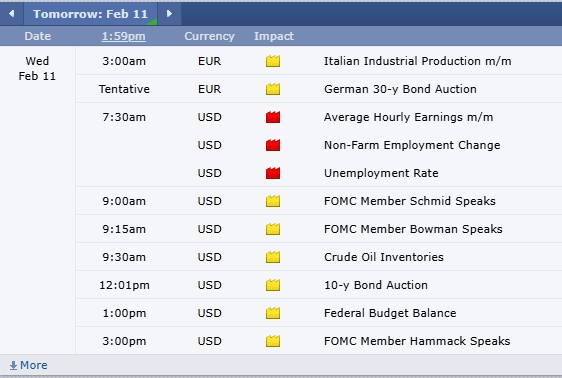
US January Non-Farm Payrolls data will be released Wednesday morning at 7:30 am CT. Economists are forecasting non-farm payrolls +55,000 compared to December’s month’s +50,000. The January jobless rate is expected at 4.4%. Average hourly earnings are expected up +0.3% month over month, up +3.7% year over year.
The Non-Farm Payroll (NFP) report…
Officially called the Employment Situation — is one of the most important monthly U.S. economic indicators. The Bureau of Labor Statistics (BLS) releases it on the first Friday of each month (covering the prior month) at 8:30 a.m. ET. However, due to the partial U.S. Government shutdown, the BLS is releasing the report tomorrow, Feb. 11th
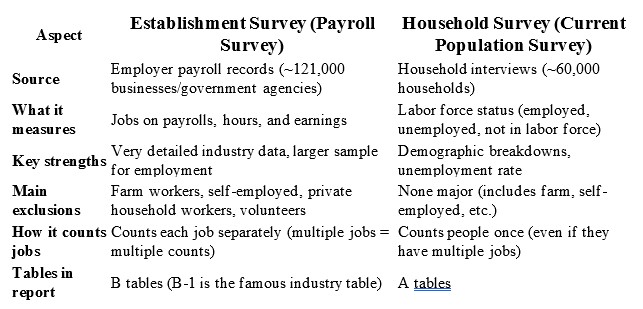
It gets its name from the establishment (payroll) survey, which tracks paid jobs outside of farming. The full report actually combines two separate surveys with different methodologies, strengths, and focuses.
The Two Core Surveys
|
Main Components of the Report
1. Headline Nonfarm Payroll Employment Change (Establishment Survey)
- The most-watched number: Net change in total nonfarm payroll jobs (e.g., +50,000 or -100,000).
- Often broken out as:
- Total nonfarm
- Private nonfarm (excludes government)
- Revisions to the prior 1–2 months are very common and can be large (tens or even hundreds of thousands).
2. Industry Sector Breakdown (Establishment Survey)
This is one of the most valuable parts. Table B-1 shows detailed job gains/losses by sector. Major categories include:
- Goods-producing: Mining, Construction, Manufacturing
- Service-providing: Retail Trade, Wholesale Trade, Transportation & Warehousing, Information, Financial Activities, Professional & Business Services, Education & Health Services (especially Health Care), Leisure & Hospitality (food services & drinking places are big), Other Services
- Government (federal, state, local)
Markets watch which sectors are driving the total (e.g., health care and leisure/hospitality often add jobs steadily; manufacturing and retail can be volatile).
3. Wage and Hours Data (Establishment Survey)
- Average Hourly Earnings (all private nonfarm employees) — month-over-month and year-over-year % change. This is a key inflation signal.
- Average Weekly Hours worked (total private, manufacturing, etc.).
- Overtime hours in manufacturing.
Strong wage growth can be hawkish for the Fed (potential rate hikes or delayed cuts).
4. Unemployment Rate and Labor Force Metrics (Household Survey)
- Official Unemployment Rate (U-3): Unemployed as a percentage of the labor force.
- Labor Force Participation Rate
- Employment-Population Ratio
- Broader measures (sometimes referenced): U-6 (includes underemployed and discouraged workers)
- Demographic details (by age, sex, race/ethnicity)
- Part-time for economic reasons, long-term unemployed, discouraged workers
5. Other Notable Elements
- Annual benchmark revisions — released once a year (usually February/March data) — can revise the entire previous year significantly.
- Birth-Death Model — statistical adjustment for new business formations and closures not yet captured in the sample.
Seasonal adjustment — all headline numbers are seasonally adjusted to remove predictable patterns (holidays, school cycles, weather, etc.).
Quick Summary of What Traders and Economists Focus on Most:
-
Headline NFP (jobs added/lost)
-
Unemployment rate
-
Average hourly earnings (wage growth)
-
Revisions to prior months
-
Sector details (where the jobs are coming from)
|
|
 |
|
Introducing Cannon Edge — Your Daily Futures Snapshot
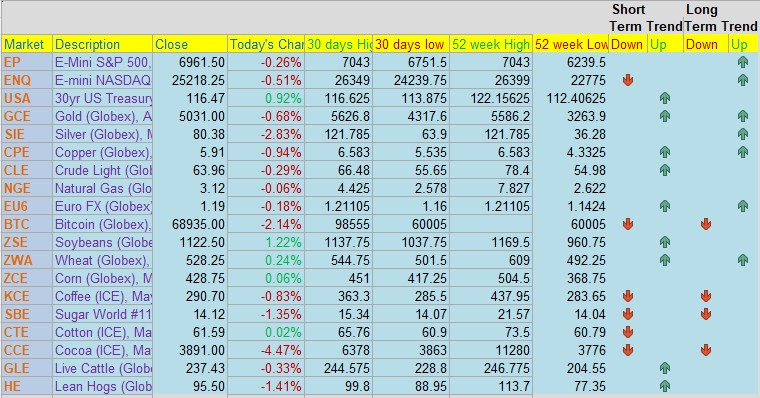
Cannon Edge is our new daily feature designed to give traders a fast, actionable overview of key futures markets. Each post delivers:
-
Current price and daily % change
-
30‑day and 52‑week highs/lows
-
PROPRIETARY Short‑term and long‑term trend signals
-
Coverage across equity indices, metals, energies, currencies, and ags
Whether you’re scanning for breakout setups, trend reversals, or just staying informed — Cannon Edge puts the data in your hands before the open.
Built for speed. Backed by insight. Powered by CQQ.
|
|
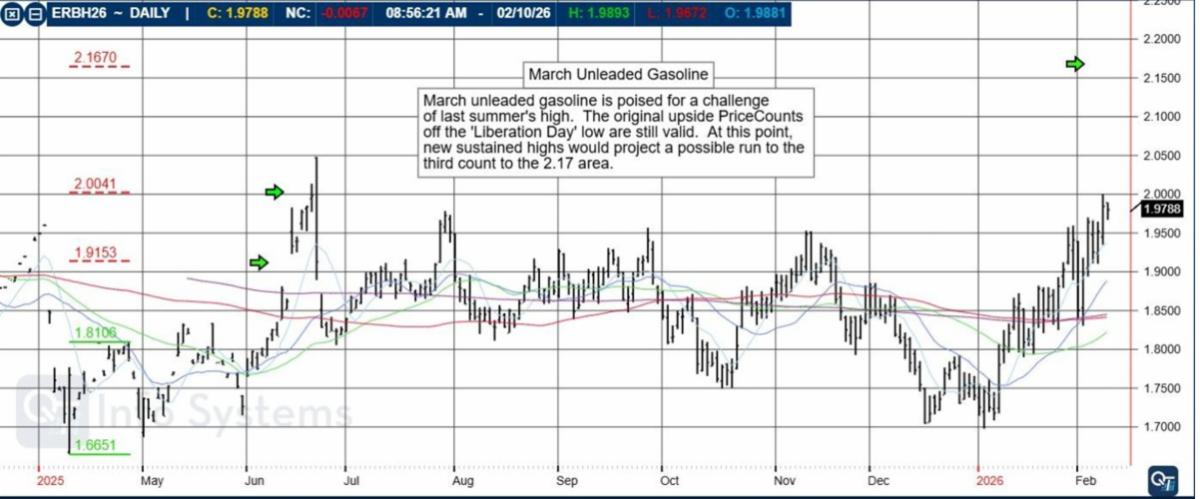
March RBOB (Unleaded Gas)
March Unleaded Gasoline is poised for a challenge of last summer’s high. The original upside PriceCounts off the ‘Liberation Day’ low are still valid. At this point, new sustained highs would project a possible run to the third count to the 2.17 area.
|
|
|
The PriceCount study is a tool that can help to project the distance of a move in price. The counts are not intended to be an ‘exact’ science but rather offer a target area for the four objectives which are based off the first leg of a move with each subsequent count having a smaller percentage of being achieved.
It is normal for the chart to react by correcting or consolidating at an objective and then either resuming its move or reversing trend. Best utilized in conjunction with other technical tools, PriceCounts offer one more way to analyze charts and help to manage your positions and risk.
Learn more at www.qtchartoftheday.com
Trading in futures, options, securities, derivatives or OTC products entails significant risks which must be understood prior to trading and may not be appropriate for all investors. Past performance of actual trades or strategies is not necessarily indicative of future results. |
|
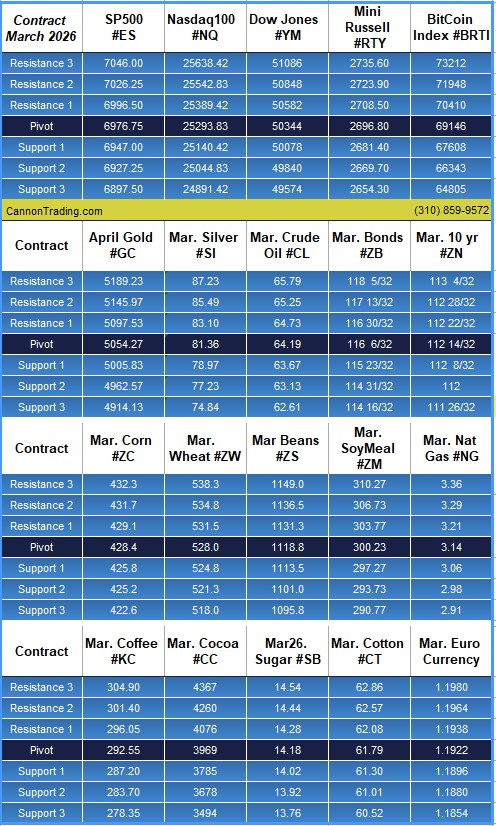
Daily Levels for February 11th, 2026
|
|
Economic Reports
provided by: ForexFactory.com
All times are Central Time ( Chicago)
|
|
|
Trading Futures, Options on Futures, and retail off-exchange foreign currency transactions involves substantial risk of loss and is not suitable for all investors. You should carefully consider whether trading is suitable for you in light of your circumstances, knowledge, and financial resources. You may lose all or more of your initial investment. Opinions, market data, and recommendations are subject to change at any time.
|
|
|
|
|