Fresh Highs, Firmer Fed — And a Trendline Worth Watching
Crude Oil at $75/Barrel
By Eli Levy, Senior Analyst & Series 3 Broker

Dow Jones, S&P, Russell 2000 – FOMC
Dow Jones, the Equal-Weight S&P, and the Russell 2000 indices hit fresh record highs this week, but it was anything but a quiet grind higher. The tape was caught off-guard by a hawkish surprise out of the FOMC, where incoming Fed Chair Kevin Warsh delivered a firm message that the committee’s focus is squarely on price stability, leaning on a stable labor market as the cover to do so.
Stocks
Stocks sank and the 2-year yield spiked as the market re-calibrated its expectations for the path of the Fed funds rate. What stands out to me is how quickly the bounce-back came — by the back half of the week the indices had largely round-tripped the FOMC sell-off, helped along by lower oil prices and Treasury yields that, while higher, steadied rather than ran away.
There are really two ways to read the same meeting, and the market is still arguing it out. On one side, the message was plainly hawkish — the dots drifted toward a potential hike, the easing bias was stripped out, and the risk of a move higher has clearly increased; the question is no longer whether but when, with the back half of the summer in play if the inflation data cooperates.
On the other side, the removal of explicit forward guidance and the de-emphasis of the dots can be read as the Fed simply buying itself optionality rather than committing to tightening — a less hawkish, even market-friendly, interpretation. Both readings are live, and the price action tells me the market hasn’t fully settled on one. If oil prices stay down that should help inflation and the Fed as to not raise rates.
US & Iran – WTI Crude Oil
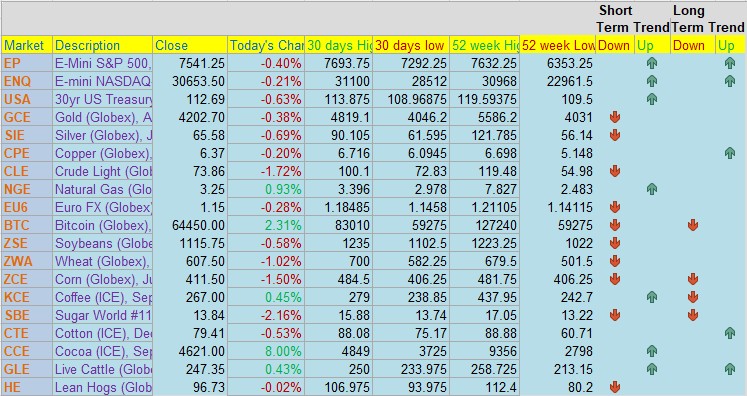
On the geopolitical front, U.S.–Iran relations took a constructive turn: the two sides signed a memorandum of understanding that opens a 60-day window for negotiations, with technical talks slated to begin this weekend. Oil responded in kind — WTI crude is down roughly 9.5% on the week to around $75/barrel, its lowest level since early March. Lower energy is a tailwind for the disinflation story and for risk appetite, but it cuts both ways: any breakdown in the framework or fresh friction around the Strait of Hormuz could put a bid right back under crude.
The Bull Market
As for what’s actually holding this bull market up, I’d point to two forces, and they’re related: first, the prospect of roughly 20% corporate earnings growth in the coming quarters; and second, the AI infrastructure buildout, which remains firmly in its expansion phase — demand for compute still outstrips available supply. The clearest piece of evidence is the PHLX Semiconductor Index (SOX), printing fresh all-time highs even through the week’s volatility.
The financing behind the theme tells the same story: Amazon’s C$14B bond + $17.5B bank loan and a $25B corporate debt offering from Nvidia early this week followed an ~$85B capital raise from Alphabet earlier this month.
As long as that spending holds and supply stays tight, the AI trade is likely to keep its grip on trader psychology. The flip side is the obvious one — the day demand and supply look balanced, or hyperscaler spending shows any sign of fatigue or deceleration, or rates go up and borrowing gets more expensive, the same names that have led can lead lower, and that leaves the chip/AI complex exposed to higher volatility.
|