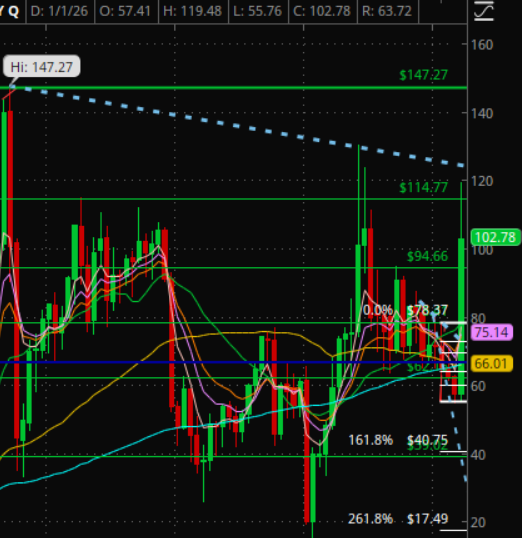
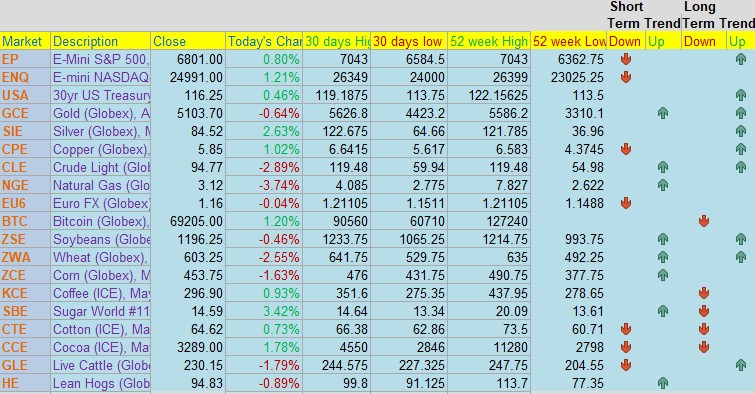
| As of this writing oil was as high as $119 – 3 hours ago and came back in to around $100, that’s very high volatility.
It’s all abought the degree and duration of the jump in oil prices. The questions I leave open are if crude oil quickly reverses is that not going to impact the US earnings? If oil prices stay high that’s where we can see the transmission mechanism actually impact earnings. 2022 was weak because GDP estimates were cut and EPS estimates were cut. But in our market, we’ve seen EPS estimates get raised. So are analysts going to start cutting EPS forecasts? Some analysts thought the forecast was high for the back half of this year anyway.
The estimates for EPS are at $314 which prices in 200 basis points of margin expansion. And for 2027 the forecasts are $363 that’s aggressive. The past few years have benefited from oil prices going down consistently, is that going to change now.
Analyst Matt Boss said “a 30% increase in gas, it abought a 9 billion headwind to consumer spending. Interesting metric is tax refunds in February are up 10% that’s roughly 9 to 10 billion $ headwind”.
I bring this up because last week we were up around 30% for oil, oil at $120 is close to 60%. Bottom line: how long will this war last and how much effect will it have on higher sustained oil prices. The U.S./Iran conflict is in its seventh day. Earlier this morning, U.S. President Donald Trump said there will be no deal with Iran to end the war without “unconditional surrender.”
The second thing I will keep an I out on is private credit, it was staring in the news last few weeks, talk about; that it started showing cracks. I tend to look at bond prices for companies that issue private credit.
The third sign I look at is the AI buildout, President Donald Trump talked up a joint venture investing up to $500 billion for infrastructure tied to AI by a new partnership formed by OpenAI, Oracle and SoftBank. Since they are some of the largest investors in the AI buildout, I view how their stock and bonds are trading.
All this leads to higher inflation. Which puts The FED is in a tuff spot, how can they lower interest rates if inflation might creep up with oil prices going higher.
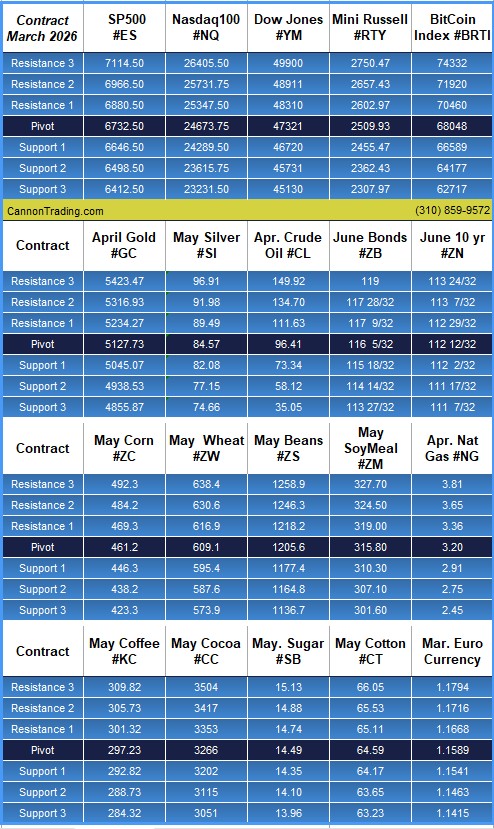
In my last articles I pointed out that support for the SPX was the 100 Day Moving average and we bounced of that level a few times in the past few months. I also mentioned that the more we keep slamming into a door, eventually it opens and that’s what happened, we broke that level of support and closed below that level on Friday. Next level of support for the SPX comes in at the 200 DMA which currently sits at 6,582.
Last week the market trend was opening down and bouncing on most days and eventually we closed lower for the week. I will be watching for that trend to continue until proven otherwise or if positive news comes out regarding the war and its effect on oil. I will also be watching if the 100 DMA level will turn into resistance.
Russell 2000 Index (RUT −50 to 2,534)
The Russell 2000 Index (RUT) is on pace to finish the week down approximately 3.7%, pressured by a combination of rising oil prices and higher Treasury yields. Elevated yields tend to impact smaller companies more heavily because they rely more on borrowing, making financing costs more expensive. At the same time, higher oil prices raise input costs, compress profit margins, and create a broader headwind for the U.S. economy. As a result, it is not surprising to see the Russell 2000 underperform the larger major indices this week.
From a technical perspective, this week’s sell-off has pushed the index below key support levels, including the 50-day simple moving average (SMA) and the 100-day SMA.
Artificial intelligence (AI) disruption concerns around the software space eased up last week as the iShares Expanded Tech-Software Sector ETF (IGV + $0.13 to $87.75) is on track to be up ~7.50% on the week. On the flipside, the PHLX Semiconductor Index was on track to register its worst weekly performance (-4%) since November.
Private credit concerns are still hovering over Wall Street.
On Wednesday, Blackstone’s flagship private credit fund (BCRED) was hit with record redemption requests. In response, Blackstone raised the fund’s repurchase cap and provided additional capital to meet all the requests. Elsewhere, earlier today BlackRock said that it is limiting withdrawals from one of its private credit funds following a surge in redemption requests.
Investors were seeking ~$1.2B in redemptions but only $620M was paid out.
On the economic front, this morning’s Nonfarm Payrolls report stands out and the report was discouraging. Employers cut 92,000 jobs in February vs. expectations for +55,000, which represents the largest monthly drop since the pandemic.
Q4 earnings scorecard: out of the 493 S&P 500 companies that have reported results, 65% have beat on the top line while 74% have beat on the bottom line. Revenue growth has been tracking at +9.23% year-over-year while EPS growth is +13.65%.
Cryptocurrency News
Over the weekend, Bitcoin initially sold off as investors reacted to developments in the Middle East. As the crypto market has matured, it has increasingly served as a real-time gauge of investor sentiment while traditional financial markets are closed.
During the week, sentiment improved as prediction markets began assigning higher odds to the passage of the Financial Innovation and Technology for the 21st Century Act (FIT21) / CLARITY Act, helping push Bitcoin back above the $70,000 level. While the administration and much of the crypto industry continue to advocate for the bill, the banking sector has not significantly softened its opposition, particularly regarding provisions related to stablecoin rewards.
Bitcoin’s rally, however, stalled near $74,000, an area that coincides with the 50-day exponential moving average (EMA) and has acted as a technical resistance level.
Following the rejection at the 50-day EMA, Bitcoin could retest recent support levels. The first key level sits near $65,000, which roughly aligns with the network’s estimated production cost. A deeper pullback could bring prices toward $60,000, the recent swing low.
On-chain data is showing early signs of strengthening demand. Spot crypto ETPs have recorded two consecutive weeks of inflows, and large digital-native investors continue to accumulate.
Economic:
- Monday (Mar. 9): no reports
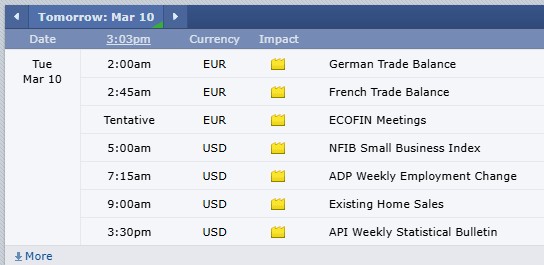
- Tuesday (Mar. 10): Existing Home Sales, NFIB Small Business Optimism
- Wednesday (Mar. 11): Consumer Price Index (CPI), EIA Crude Oil Inventories, Mortgage Applications Index, Treasury Budget
- Thursday (Mar. 12): Producer Price Index (PPI), Continuing Claims, EIA Natural Gas Inventories, Initial Claims, Factory Orders
- Friday (Mar. 13): PCE Prices, GDP – Second Estimate, Personal Income, Personal Spending, University of Michigan Consumer Sentiment – Preliminary
Here’s a breakdown of the reports:
- Nonfarm Payrolls: Headline payrolls declined 92,000 in February, which was well below the +55,000 economists were expecting. There were also negative revisions to the prior two months totaling 69,000.
- Unemployment Rate: Ticked up to 4.4% from 4.3% in the prior month (and above the 4.3% economists had expected)
- Average Hourly Earnings: Increased 0.4% versus the +0.3% expected. This brings the year-over-year gain up to 3.8% from 3.7% in January and versus the +3.7% expected.
- Average Workweek: 34.3 versus 34.3 expected.
- ADP Employment Change: U.S. private employers added 63K jobs in February. This represented the largest monthly gain since last July and was above the 50K economists had expected.
- Retail Sales: Declined 0.2% in January, the largest drop since last May, and worse than the flat reading economists were expecting. However, the Control Group measure of sales rose 0.4%.
- ISM Manufacturing Index: 52.4% vs. 53.0% est.
- S&P Global U.S. Manufacturing PMI – Final: Fell to 51.6 in February from 53.4 in January and below the 52.6 economists had expected.
- ISM Non-Manufacturing Index: 56.1 highest since July of 2022.
- S&P Global U.S. Services PMI: 51.7.
- Import Prices: +0.2%.
- Export Prices: +0.6%.
- Productivity – Preliminary: +2.8% vs. +4.5% est.
- Unit Labor Costs: +2.8% vs. +0.5% est.
- Initial Jobless Claims: Initial applications for US jobless benefits were unchanged from last week at 213K, which was below the 215K economists had expected. Continuing Claims increased 35K from the prior week to a seasonally adjusted 1.868M.
- EIA Crude Oil Inventories: +3.48M barrels.
- EIA Natural Gas Inventories: -132 bcf.
- The Atlanta Fed’s GDPNow “nowcast” for Q1 GDP was revised down 1.0% to 2.1% from 3.1% last Friday.
U.S. Treasury yields jumped across the board this week, and the yield curve saw some modest flattening. This week’s treasury selling is essentially tied to the ramp up in oil prices and the potential inflation implications. Compared to last Friday, two-year Treasury yields rose by ~18 basis points (3.561% vs. 3.379%), 10-year yields also increased ~18 basis points (4.142% vs. 3.962%), while 30-year yields (4.777% vs. 4.633%) saw a ~14 basis point lift.
Disclaimer: Trading Futures, Options on Futures, and retail off-exchange foreign currency transactions and other financial instruments involve substantial risk of loss and are not suitable for all investors. Past performance is not indicative of future results. Carefully consider if trading is suitable for you in light of your circumstances, knowledge, and financial resources. You may lose all or more of your initial investment. Opinions, market data, and recommendations are subject to change at any time. I am registered solely as a commodities broker. Any references, recommendations & information contained in this article are of opinion only, should not be considered investment advice. And do not guarantee any profits. |