What Futures Traders Should Watch This Week
By John Thorpe, Senior Broker

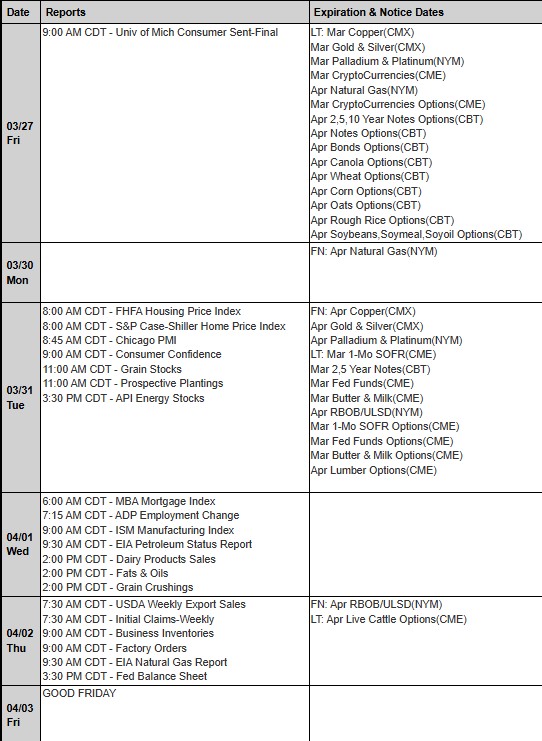
A loaded, shortened trading week. Non-Farm Payrolls on an exchange Holiday morning (CME Equities close @ 8:15 am; the report drops at 7:30 am CDT, energies and metals will not be open). The End of Q2, Chairman J. Powell speaks Monday early. AG Prospective plantings (this is a big one), Heavy Data, light earnings. Passover and plenty of fed speeches prior to the Good Friday-Easter weekend.
The IRAN War continues, speculation leads the volatility.
Historically, the second quarter (Q2: April–June) does tend to behave differently from the other quarters, but not in a dramatic or perfectly reliable way. There is a mild seasonal pattern in U.S. stocks, especially in the S&P 500, but it’s weaker than many people expect.
Average performance by quarter (long-term)
Using historical S&P 500 data since 1950:
- Q1 (Jan–Mar): solid average returns
- Q2 (Apr–Jun): usually positive but weaker
- Q3 (Jul–Sep): typically the weakest and most volatile
- Q4 (Oct–Dec): historically the strongest quarter
A simplified long-term pattern looks like:
Quarter
Typical relative strength
Q1
Strong
Q2
Moderate
Q3
Weakest
Q4
Strongest
Why Q2 often looks different
Several recurring factors affect April–June:
1. “Sell in May and go away”
This old market saying comes from a real seasonal tendency:
- Returns from May–October have historically been lower than November–April.
- Q2 contains May and June, which are often softer months on average.
2. Earnings and macro cycle timing
- Q1 earnings season (April) can boost early Q2.
- But the market often becomes more cautious later in the quarter as:
- guidance is updated
- macro data (inflation, Fed outlook) becomes clearer
- This sometimes causes mid-year consolidations or corrections.
3. Investor behavior and liquidity
- Summer vacation season begins late in Q2.
- Lower trading volumes can lead to:
- slower rallies
- or sharper volatility when surprises hit.
But the key reality: differences are small
Even though these patterns exist:
- Each quarter still has positive average returns over long periods.
- The spread between quarters is only a few percentage points per year.
- In any given year, macro events (Fed policy, recessions, AI booms, etc.) dominate seasonality.
For example, some of the strongest bull markets saw:
- huge gains in Q2 during economic recoveries
- and some crashes began in Q1 or Q3 instead.
Bottom line
Yes, Q2 is somewhat distinct:
- usually not as strong as Q4
- often better than Q3
- but still positive on average
So, seasonality exists, but it’s a weak statistical tendency—not a trading rule you can rely on alone.
Simple takeaway
The seasonal pattern often looks like:
Strong → Moderate → Weak → Strong
Q1 ██████
Q2 ████
Q3 ██
Q4 ███████
But this is only a statistical tendency, not a rule. In many years the strongest quarter can be Q2 or Q3 depending on macro events, earnings cycles, and interest rates.
Earnings Next Week:
· Mon. Quiet
· Tue. Nike
· Wed. Quiet
· Thu. Quiet
· Fri. Quiet
FED SPEECHES: (all times CDT)
· Mon. Chairman Powell 9:30 am , Williams 3:00 pm
· Tues. Goolsbee 11:00am, Barr 2:pm
· Wed. Musalem 8:05 a.m., Barr 8:13 am
· Thu. Logan 10:00 a.m.
· Fri. Good Friday
Econ Data: (all times CST)
· Mon. Dallas Fed
· Tue. Redbook, Case Shiller, CHGO PMI, JOLTS, Dallas Fed, PROSPECTIVE PLANTINGS, Redbook, API Crude Stock Change
· Wed. Retail Sales, ISM, EIA Crude stocks,
· Thu. Challenger Job Cuts, Initial Jobless claims, Nat Gas Stocks, Fed Balance Sheet
· Fri. NON-Farm Payrolls
|