Trading Crude Oil Futures: Strategies, Techniques, and Considerations

Learn more about trading crude oil futures with Cannon Trading Company here.

Trading crude oil futures is a dynamic and potentially lucrative endeavor that requires a deep understanding of the energy markets, technical analysis, risk management, and trading strategies. In this comprehensive guide, we will delve into the world of crude oil futures trading, focusing on a specific type of crude oil, discussing relevant exchanges, exploring day trading techniques for futures, and touching on techniques for trading crude oil options on futures. Additionally, we will highlight the services of Cannon Trading Company, known for their customer service excellence and high TrustPilot rating.

Understanding Crude Oil Futures Trading

Crude oil is a crucial global commodity that not only fuels economies but also presents trading opportunities for individuals and institutions. Crude oil futures contracts allow traders to speculate on the price movements of oil, whether they anticipate its price to rise (go long) or fall (go short). Futures contracts provide a standardized way to buy or sell a specific quantity of crude oil at a predetermined price on a future date.

Types of Crude Oil: When trading crude oil futures, it’s important to consider the different types of crude oil. West Texas Intermediate (WTI) and Brent crude are two of the most widely traded types. WTI is primarily produced in the United States and is known for its relatively low sulfur content. Brent crude, on the other hand, is sourced from the North Sea and is considered a global benchmark for oil prices.

Exchanges for Crude Oil Futures: Crude oil futures are traded on various exchanges around the world, with the New York Mercantile Exchange (NYMEX) and the Intercontinental Exchange (ICE) being two prominent ones. NYMEX offers WTI crude oil futures, while ICE provides Brent crude oil futures. These exchanges provide liquidity, price discovery, and a platform for traders to engage in both speculation and risk management.

Day Trading Techniques for Crude Oil Futures

Day trading involves opening and closing positions within the same trading day, capitalizing on short-term price movements. Trading crude oil futures using day trading techniques requires discipline, a solid strategy, and an understanding of market dynamics.

  1. Technical Analysis: Day traders often rely on technical analysis, using indicators such as moving averages, MACD, RSI, and candlestick patterns to identify entry and exit points. Price charts and patterns can provide insights into potential price movements.
  2. Volatility Analysis: Crude oil markets can be highly volatile, presenting both opportunities and risks. Traders can use tools like the Average True Range (ATR) to gauge volatility and adjust their position sizing and stop-loss levels accordingly.
  3. News and Events: Economic and geopolitical news can significantly impact oil prices. Day traders should stay informed about major events, such as OPEC meetings, inventory reports, and geopolitical tensions, to anticipate potential price swings.
  4. Scalping and Momentum Strategies: Scalping involves making quick trades to capture small price movements, while momentum strategies capitalize on trends. These techniques require quick decision-making and a keen understanding of price momentum.
  5. Risk Management: Effective risk management is crucial in day trading. Setting stop-loss orders, defining maximum loss thresholds, and managing position sizes can help traders protect their capital.

Trading Crude Oil Options on Futures

Options on futures provide traders with the right, but not the obligation, to buy or sell a futures contract at a specific price (strike price) on or before a certain date (expiration date). Trading crude oil options on futures allows for more flexibility and risk management.

  1. Hedging Strategies: Crude oil options can be used for hedging purposes, allowing producers and consumers to protect themselves against price fluctuations. For example, a crude oil producer can purchase put options to hedge against a potential price decline.
  2. Directional Strategies: Traders can also use options to speculate on the future price direction of crude oil. Buying call options can provide exposure to potential price increases, while buying put options can provide exposure to potential price decreases.
  3. Spread Strategies: Option spreads involve trading multiple options contracts simultaneously to capitalize on price differentials. Calendar spreads and vertical spreads are common strategies that can be used to take advantage of volatility or time decay.
  4. Implied Volatility Considerations: Implied volatility reflects the market’s expectation of future price volatility. Traders should be aware of implied volatility levels, as it can impact option prices. High implied volatility may make options more expensive.

Cannon Trading Company: Customer Service and TrustPilot Rating

Cannon Trading Company is a brokerage firm known for its services in facilitating various types of trading, including crude oil futures and options on futures. The company’s commitment to customer service plays a crucial role in assisting traders as they navigate the complexities of the commodities markets.

Customer Service Excellence: Cannon Trading Company prides itself on providing exceptional customer service. Their experienced brokers offer personalized assistance, market insights, and trading strategies to help clients make informed decisions.

TrustPilot Rating: The company’s high TrustPilot rating of 4.9 out of 5 stars is a testament to its dedication to customer satisfaction. TrustPilot is a platform where customers can share their experiences with businesses. Such a high rating indicates that customers have found value in Cannon Trading Company’s services and have had positive interactions with their team.

Trading crude oil futures presents opportunities for both institutional and individual traders to capitalize on the volatility and price movements in the energy markets. Understanding the nuances of different crude oil types, utilizing relevant exchanges, and employing effective day trading techniques can help traders navigate this complex market. Moreover, trading options on crude oil futures offers additional strategies for risk management and speculation. As exemplified by Cannon Trading Company’s customer service and high TrustPilot rating, choosing the right brokerage partner can enhance the trading experience and provide valuable support to traders of all levels.

Ready to start trading futures? Call 1(800)454-9572 and speak to one of our experienced, Series-3 licensed futures brokers and start your futures trading journey with Cannon Trading Company today.

DisclaimerTrading Futures, Options on Futures, and retail off-exchange foreign currency transactions involves substantial risk of loss and is not suitable for all investors.  Past performance is not indicative of future results. You should carefully consider whether trading is suitable for you in light of your circumstances, knowledge, and financial resources. You may lose all or more of your initial investment. Opinions, market data, and recommendations are subject to change at any time.

The Week Ahead for Commodities + Trading Levels for August 15th 2023

Get Real Time updates and more on our private FB group!

The Week Ahead

by Mark O’Brien, Senior Broker

General: 


As the duel between the United States and China continues, seemingly on several fronts, a new sign emerged the first half of the year: China’s imports to the U.S. accounted for the smallest percentage of goods arriving here in 20 years.  Just 13.3% of all imports to the U.S. came from China the first half of 2023.  Compare that to its peak of 21.6% for all of 2017 and its low point of 12.1% in 2013.  The downturn is not due to any list of stand-out products or industries, nor has any country or small number of countries jumped up to import a bigger share of anything.  Rather, slow-moving supply chain shifts across dozens of industries and nations are driving the trend.  When the dollar values of exports and imports are combined, Mexico is now America’s no. 1 trading partner, followed by Canada, pushing China to third place.


Last Thursday, the Labor Department reported the consumer-price index increased 0.2% in July, the same as in June. That is down sharply year-over-year looking at the 1.2% gain in June 2022.  If the downward trend continues – now over a year from its June 2022 peak reading of 9.1%, inflation is on a path to draw near the Federal Reserve’s 2% target by late 2023 or early 2024.


What could stand in the way of that trend?  Geopolitical events and weather could impact food and energy prices.


After Saudi Arabia and Russia announced reductions in their oil production last month, unleaded gas prices, which tend to lag behind crude oil prices, traded to 1-year highs on Friday (basis September) within less than two cents of $3.00 per gallon.


Further regarding Russia, last month it withdrew from a deal that allowed Ukraine to export grain through the Black Sea and has since attacked key port facilities in Odesa.  Ukraine is one of the world’s largest grain suppliers including 13% of global corn exports and the 12% of wheat.


Add to all this, scientists watching the periodic climate pattern called El Niño are now anticipating it arriving this winter more likely as “moderate,” and possibly a “strong” event than how they assessed conditions in May.  Ocean surface temperatures in the central Pacific Ocean have warmed enough off the coast of South America to trigger an El Niño, meaning possibly a warmer, dryer winter here in the U.S. and higher temperatures globally. This can cause disruptions to crops in some of the world’s most important commodities sources.


Keltner Channels, Volume Charts, Algo Signals – Trade Set Up

  • Watch the 5 minute video below in which I share a trading set up I like, using volume charts, candle sticks, Keltner Channels and proprietary ALGOs for trading signals.

Volume charts, candle sticks, Keltner Channels and proprietary ALGOs for trading signals.


Trading Futures, Options on Futures, and retail off-exchange foreign currency transactions involves substantial risk of loss and is not suitable for all investors.  You should carefully consider whether trading is suitable for you in light of your circumstances, knowledge, and financial resources. You may lose all or more of your initial investment. Opinions, market data, and recommendations are subject to change at any time when it comes to Futures Trading.

Futures Trading Levels

08-15-2023

#ES, #NQ, #YM, #RTY, #XBT, #GC, #SI, #CL, #ZB, #6E, #ZC, #ZW, #ZS, #ZM, #NG

Improve Your Trading Skills

Get access to proprietary indicators and trading methods, consult with an experienced broker
 1-800-454-9572 Explore trading methods. Register Here


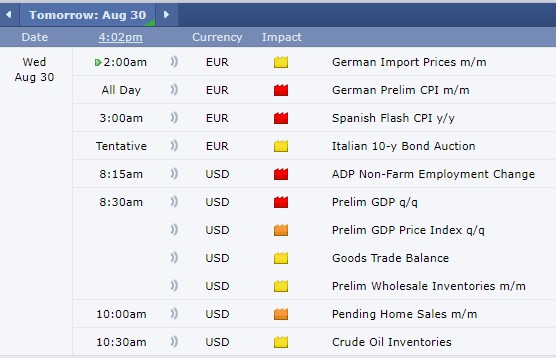
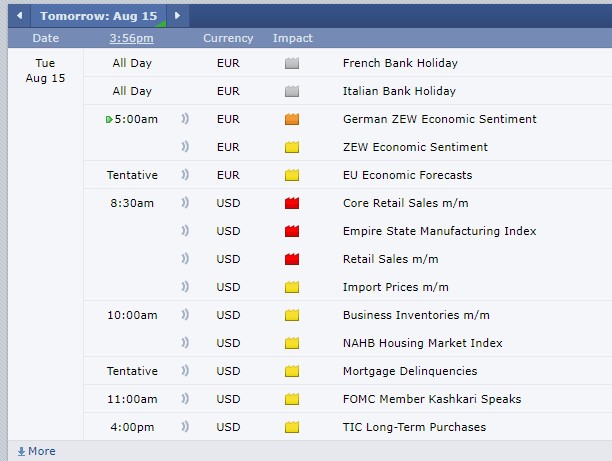
Economic Reports, Source: 

Forexfactory.com

35be821d db18 4f8d a197 41e44f99854b


This is not a solicitation of any order to buy or sell, but a current market view provided by Cannon Trading Inc. Any statement of facts here in contained are derived from sources believed to be reliable, but are not guaranteed as to accuracy, nor they purport to be complete. No responsibility is assumed with respect to any such statement or with respect to any expression of opinion herein contained. Readers are urged to exercise their own judgement in trading.

Weekly Newsletter: Trading Around Economic Reports + Levels for August 7th

Cannon Futures Weekly Newsletter Issue # 1157


Join our private Facebook group for additional insight into trading and the futures markets!

Have a safe Memorial Day Weekend. Trading Schedule HERE

In this issue:

  • Trading Resource of the Week – Trading Key Economic reports
  • Hot Market of the Week – September Crude Oil
  • Broker’s Trading System of the Week – NQ Day Trading System
  • Trading Levels for Next Week
  • Trading Reports for Next Week


  • Trading Resource of the Week – Trading Key Economic Reports

As a trader, you will come across many factors that you must consider before entering or exiting the markets. Some of the most important aspects to look for are economic events that can move the markets drastically one way or another.
There are many types of economic events including releases by a governing body, changes in sales or consumption of commodities, and increases in supply and demand. All of these can affect the markets you trade, making it important for you to know how and when these changes are happening.
  • What is GDP?
  • About the Retail Sales Report
  • What is NFP ( non farm payroll) Report?
  • Understanding US housing Data
  • FOMC
  • Understanding Oil Data Report
  • Importance of Consumer Confidence Survey


ACCESS THE COURSE NOW

Hot market of the week is provided by QT Market Center, A swiss army knife charting package that’s not just for Hedgers, Cooperatives and Farmers alike but also for Spread traders, Swing traders and shorter time frame application for intraday traders with a unique proprietary indicator that can be applied to your specific trading needs.
September Crude Oil completed it’s first upside PriceCount objective and had a brief break. At this point, if the market can maintain the bullish tone, the next upside PriceCount objective comes at 89.31
PriceCounts – Not about where we’ve been , but where we might be going next!
7f0ff57c c8e5 44b4 8878 3d075d53315e
The PriceCount study is a tool that can help to project the distance of a move in price. The counts are not intended to be an ‘exact’ science but rather offer a target area for the four objectives which are based off the first leg of a move with each subsequent count having a smaller percentage of being achieved. It is normal for the chart to react by correcting or consolidating at an objective and then either resuming its move or reversing trend. Best utilized in conjunction with other technical tools, PriceCounts offer one more way to analyze charts and help to manage your positions and risk. Learn more at www.qtchartoftheday.com
Trading in futures, options, securities, derivatives or OTC products entails significant risks which must be understood prior to trading and may not be appropriate for all investors. Past performance of actual trades or strategies is not necessarily indicative of future results.
3b644da2 2bee 4d39 8d98 5208a20bec39
With algorithmic trading systems becoming more prevalent in portfolio diversification, the following system has been selected as the broker’s choice for this month.
PRODUCT
SYSTEM TYPE
Intraday
Recommended Cannon Trading Starting Capital
$30,000
COST
USD 255 / monthly
5fb18316 b96d 43a4 82f2 7d437d41d864
The performance shown above is hypothetical in that the chart represents returns in a model account. The model account rises or falls by the average single contract profit and loss achieved by clients trading actual money pursuant to the listed system’s trading signals on the appropriate dates (client fills), or if no actual client profit or loss available – by the hypothetical single contract profit and loss of trades generated by the system’s trading signals on that day in real time (real‐time) less slippage, or if no real time profit or loss available – by the hypothetical single contract profit and loss of trades generated by running the system logic backwards on back adjusted data. Please read full disclaimer HERE.
Sign Up for a Free Personalized Consultation with a Broker from Cannon Trading Company
Questions about the markets? trading? platforms? technology? trading systems? Get answers with a complimentary, confidential consultation with a Cannon Trading Company series 3 broker.
  • Trading Levels for Next Week

Daily Levels for August 7th, 2022
#ES, #NQ, #YM, #RTY, #XBT, #GC, #SI, #CL, #ZB, #6E, #ZC, #ZW, #ZS, #ZM, #NG
Would you like to receive daily support & resistance levels?
Yes
S
No
S

Weekly Levels

a061e890 f8c1 47a7 987e efdfdac49a02


  • Trading Reports for Next Week

First Notice (FN), Last trading (LT) Days for the Week: www.mrci.com 
4351474b 5535 4e04 bd6c d18a7ccf8388

This is not a solicitation of any order to buy or sell, but a current market view provided by Cannon Trading Inc. Any statement of facts herein contained are derived from sources believed to be reliable but are not guaranteed as to accuracy, nor they purport to be complete. No responsibility is assumed with respect to any such statement or with respect to any expression of opinion herein contained. Readers are urged to exercise their own judgment in trading.


Good Trading!
Trading Futures, Options on Futures, and retail off-exchange foreign currency transactions involves substantial risk of loss and is not suitable for all investors. You should carefully consider whether trading is suitable for you in light of your circumstances, knowledge, and financial resources. You may lose all or more of your initial investment. Opinions, market data, and recommendations are subject to change at any time.

Rest of the Trading Week: What to Watch Out For + Trading Levels for August 3rd 2023

Get Real Time updates and more on our private FB group!

Rest of the Trading Week, by Mark O’Brien, Senior Broker

General:


The answer is: Germany, Denmark, Netherlands, Sweden, Norway, Switzerland, Luxembourg, Singapore and Australia.

The question is: name the remaining countries whose credit is rated AAA by all three ratings companies – S&P Global, Fitch and Moody’s – after Fitch downgraded the United States’ debt rating from its top-tier AAA, down to AA+.


Among the contributing factors leading to the downgrade, Fitch cited, “the expected fiscal deterioration over the next three years, a high and growing general government debt burden, and the erosion of governance . . . that has manifested in repeated debt limit standoffs and last-minute resolutions.”


Remember in 2011, even though at that time a debt-limit deal was reached, S&P Global lowered the U.S.’s credit rating from AAA down to AA+ and it has not recovered since.


Canada is rated AAA by two of the ratings companies.


Stock Indexes:


Probably not surprisingly, as of this typing, stock indexes reacted negatively to the ratings news with the E-mini Dow Jones losing more than 300 points, roughly a 2% haircut. The E-mini Nasdaq is off ±325 points, a similar 2% correction.


Energy:


As the stock market foundered, crude oil felt weak in the knees as well and by mid-session, the September contract had sold off $3.00 per barrel from its Sunday opening. This despite today’s EIA crude oil stocks report showing a 17 million barrel reduction in U.S. crude stocks; the largest drop in inventories since 1982.


Grains:


After trading within 13 cents of its April 2022 highs last week, November soybeans factored in an expected conga line of wet weather fronts moving broadly over the U.S. Midwest and sold off ±$1.00 down to ±$13.25/bushel, a $5,000 per contract move, the bulk of which comprised just three trading sessions. Estimates for this year’s crop are a virtual wild card given the approach of August, its most critical growing period, so expect volatile price movement throughout.


Trading Futures, Options on Futures, and retail off-exchange foreign currency transactions involves substantial risk of loss and is not suitable for all investors.  You should carefully consider whether trading is suitable for you in light of your circumstances, knowledge, and financial resources. You may lose all or more of your initial investment. Opinions, market data, and recommendations are subject to change at any time when it comes to Futures Trading.

Futures Trading Levels

08-03-2023

#ES, #NQ, #YM, #RTY, #XBT, #GC, #SI, #CL, #ZB, #6E, #ZC, #ZW, #ZS, #ZM, #NG

Improve Your Trading Skills

Get access to proprietary indicators and trading methods, consult with an experienced broker
 1-800-454-9572 Explore trading methods. Register Here


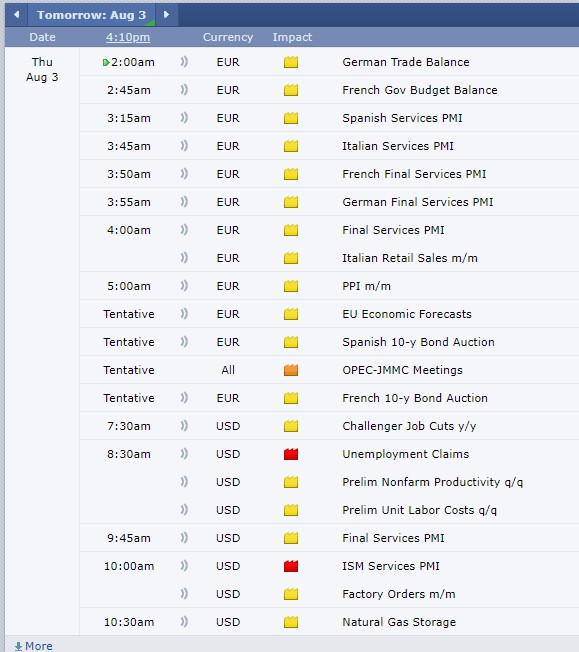
Economic Reports, Source: 

Forexfactory.com

3d697f7b c0af 4f39 8307 1e6cba2d59e7


This is not a solicitation of any order to buy or sell, but a current market view provided by Cannon Trading Inc. Any statement of facts here in contained are derived from sources believed to be reliable, but are not guaranteed as to accuracy, nor they purport to be complete. No responsibility is assumed with respect to any such statement or with respect to any expression of opinion herein contained. Readers are urged to exercise their own judgement in trading.

Highlights, Announcements + Trading Levels for 7.27.2023

Get Real Time updates and more on our private FB group!

Bullet Points, Highlights, Announcements

By Mark O’Brien, Senior Broker

General:


As expected, today Federal Reserve officials raised interest rates by 25 basis points. This puts the Federal Funds Rate – the central bank’s key borrowing rate – at a range of 5.25 to 5.50. This is the highest level at which Fed Funds have been set since 2001. The vote was unanimous among the Fed governors to take this latest step in the bank’s efforts to rein in inflation and cool the economy. This increase is the latest in the fed’s months-long effort to rachet up borrowing costs resulting in a reduction in demand for goods, services and labor in the economy.


WTI crude oil has been repeatedly plumbing its lows of the year between $67 and $70 per barrel the entire second quarter. Yesterday it traded within 10 cents of $80.00 per barrel intraday (basis Sept.) to 3-month highs – a solid ±$12 per barrel move this month; a ±$12,000 per contract move. Analysts largely attribute the increase to recently announced output cuts by Saudi Arabia and Russia.


September soybeans traded up 21 ¼ cents today to this crop year’s and life-of-contract highs, closing at $15.56 ½ per bushel. The current rally off it’s late-May lows just above $12.00 per bushel (a ±$17,500 per contract move) reflect the continued sentiment that U.S. soybean crop conditions will continue to deteriorate as harvest approaches.

Plan your trade and trade your plan.


Plan your trade and trade your plan.


Trading Futures, Options on Futures, and retail off-exchange foreign currency transactions involves substantial risk of loss and is not suitable for all investors.  You should carefully consider whether trading is suitable for you in light of your circumstances, knowledge, and financial resources. You may lose all or more of your initial investment. Opinions, market data, and recommendations are subject to change at any time when it comes to Futures Trading.

Futures Trading Levels

for 07-27-2023

#ES, #NQ, #YM, #RTY, #XBT, #GC, #SI, #CL, #ZB, #6E, #ZC, #ZW, #ZS, #ZM, #NG

3b644da2 2bee 4d39 8d98 5208a20bec39

Economic Reports, Source: 

Forexfactory.com

53981655 4310 47f6 9faf 8ac98b8c63fc


This is not a solicitation of any order to buy or sell, but a current market view provided by Cannon Trading Inc. Any statement of facts here in contained are derived from sources believed to be reliable, but are not guaranteed as to accuracy, nor they purport to be complete. No responsibility is assumed with respect to any such statement or with respect to any expression of opinion herein contained. Readers are urged to exercise their own judgement in trading.

Crude Oil Futures Contracts

Trading, Legislative Changes, Historical Overview, Top Producers, and the Role of Cannon Trading Company and E-Futures.com

Learn more about trading crude oil with Cannon Trading Company here.

Crude oil futures contracts are vital financial instruments that facilitate trading and hedging activities in the global oil market. In this article, we will explore the top trading crude oil futures contracts, recent legislative changes surrounding them, the trading process, the historical timeline of their introduction to the futures market, and the key players in crude oil contract production. Furthermore, we will discuss the role of Cannon Trading Company and E-Futures.com in trading crude oil futures.

I. Top Trading Crude Oil Futures Contracts:

The two primary crude oil futures contracts that dominate the global market are West Texas Intermediate (WTI) and Brent Crude Oil. These benchmarks serve as references for pricing crude oil and act as foundations for futures trading.

  1. WTI Crude Oil Futures:
    WTI crude oil futures represent the oil produced in the United States, primarily from the Permian Basin in Texas. WTI contracts are traded on the New York Mercantile Exchange (NYMEX) and are denominated in U.S. dollars.
  2. Brent Crude Oil Futures:
    Brent crude oil futures are derived from the North Sea oil produced in the Brent oilfield. These contracts are traded on the Intercontinental Exchange (ICE) and are denominated in U.S. dollars. Brent crude serves as a benchmark for pricing crude oil in Europe, Africa, and the Middle East.

II. Recent Legislative Changes:
Legislation surrounding crude oil futures contracts aims to promote market stability, transparency, and fair trading practices. Recent changes have focused on several key areas:

  1. Environmental Regulations and Energy Transition:
    In response to growing concerns over climate change and the need to transition to cleaner energy sources, legislative changes have been implemented to incentivize sustainable practices and reduce reliance on fossil fuels. These changes may impact the demand for and trading of crude oil futures contracts, especially as the world moves towards renewable energy alternatives.
  2. Regulatory Oversight and Market Surveillance:
    Enhanced regulatory oversight seeks to prevent market manipulation, ensure fair trading practices, and safeguard the integrity of crude oil futures markets. Stricter reporting requirements, increased transparency, and monitoring mechanisms have been introduced to promote market stability and protect market participants.

III. Trading Crude Oil Futures Contracts:

Crude oil futures contracts are traded on established futures exchanges, such as NYMEX and ICE. The trading process involves several key steps:

  1. Market Participants:
    Various participants engage in trading crude oil futures contracts, including commercial entities (such as oil producers, refiners, and end-users) seeking to manage price risks, speculators aiming to profit from price fluctuations, and institutional investors looking to diversify their portfolios.
  2. Contract Specifications:
    Crude oil futures contracts have standardized specifications, including the contract size, delivery location, quality of crude oil, and expiration months. These specifications ensure uniformity and ease of trading.
  3. Trading Platforms and Execution:
    Crude oil futures contracts are predominantly traded electronically. Traders access trading platforms provided by brokerage firms, such as Cannon Trading Company and E-Futures.com, to submit orders. These platforms offer real-time market data, order management tools, and execution capabilities.
  4. Margin Requirements and Leverage:
    To participate in crude oil futures trading, market participants are required to meet margin requirements, which act as collateral against potential losses. Margin allows traders to leverage their positions, amplifying potential gains or losses.

IV. Historical Overview of Crude Oil Futures Trading:
Crude oil futures trading has a rich history, with its origins dating back to the mid-19th century. The development of formalized futures markets for crude oil revolutionized risk management and price discovery in the energy sector.

  1. Early Beginnings:
    The first crude oil futures contracts were traded in the United States during the 1850s. These contracts allowed producers and consumers to hedge against price fluctuations and secure future supplies. However, the modern futures market for crude oil began to take shape in the 1970s.
  2. Evolution and Global Expansion:
    Crude oil futures trading evolved throughout the 20th century, driven by advancements in technology, increased globalization, and the establishment of benchmark crude oil grades. The introduction of standardized contracts and electronic trading platforms facilitated the growth and accessibility of crude oil futures markets.

V. Top Producers of Crude Oil Contracts:

Several countries play significant roles as producers and exporters of crude oil futures contracts, influencing global oil markets. The top producers include:

  1. United States:
    The United States is a major producer and consumer of crude oil. Through its WTI crude oil futures contract, the country holds substantial influence in the global oil market due to its significant domestic production, advanced infrastructure, and active financial markets.
  2. OPEC Countries:
    The Organization of the Petroleum Exporting Countries (OPEC) member countries collectively hold significant sway over crude oil prices and trading. Prominent OPEC producers include Saudi Arabia, Iraq, Iran, and the United Arab Emirates.
  3. Russia:
    Russia ranks among the world’s top crude oil producers and exporters, impacting global oil prices. Russian crude oil, particularly the Urals blend, serves as a benchmark in European markets.
  4. Other Producers:
    Canada, China, Brazil, and various countries in Africa, such as Nigeria and Angola, are also noteworthy producers of crude oil contracts.

VI. Cannon Trading Company and E-Futures.com in Crude Oil Futures Trading:
Cannon Trading Company and E-Futures.com are well-known brokerage firms that provide trading services and platforms for various futures contracts, including crude oil.

  1. Cannon Trading Company:
    Cannon Trading Company is a futures brokerage firm offering a range of services to traders, including access to various markets, trading platforms, research tools, and personalized customer support. They facilitate the trading of crude oil futures contracts, including WTI and Brent.
  2. E-Futures.com:
    E-Futures.com is an online futures trading platform that provides traders with access to multiple futures markets, including crude oil futures contracts. It offers advanced trading tools, real-time market data, and execution capabilities.

Crude oil futures contracts, particularly WTI and Brent, dominate the global oil market and provide a means for participants to manage price risks and engage in speculative activities. Recent legislative changes focus on environmental concerns and market oversight. Trading these contracts involves standardized specifications, electronic platforms, and margin requirements. The historical evolution of crude oil futures trading spans over a century, leading to the establishment of benchmark grades and global trading platforms. The top producers of crude oil contracts include the United States, OPEC countries, Russia, and other major oil-producing nations. Cannon Trading Company and E-Futures.com serve as brokerage firms facilitating the trading of crude oil futures contracts, enabling market participants to access these markets efficiently and effectively.

Ready to start trading futures? Call 1(800)454-9572 and speak to one of our experienced, Series-3 licensed futures brokers and start your futures trading journey with Cannon Trading Company today.

DisclaimerTrading Futures, Options on Futures, and retail off-exchange foreign currency transactions involves substantial risk of loss and is not suitable for all investors.  Past performance is not indicative of future results. You should carefully consider whether trading is suitable for you in light of your circumstances, knowledge, and financial resources. You may lose all or more of your initial investment. Opinions, market data, and recommendations are subject to change at any time.

Trading Levels for July 13th – PPI and the Bigger Picture

Get Real Time updates and more on our private FB group!

Bigger Picture

By Mark O’Brien, Senior Broker


Taking a look at a relatively bigger picture of the world’s growth – or lack thereof – below you’ll find a list of natural resource commodities and their performance over the first half of the year.

The list is certainly metals-centric and no softs (cocoa, sugar, cotton, coffee, orange juice) or livestock were included.  Nevertheless, it illustrates the broad theme of the global economy, in which the world’s leading demand engine – China – has experienced at best a sputtering recovery after nearly three years of pandemic-related falloff.

Notice just two: lithium and gold were the only ones heading into the second half of 2023 with positive returns.

Noteworthy is gold’s hold on to positive returns attributable to the relatively stable U.S. dollar and steady demand by the world’s central banks, which is likely to persist as long as the risk of recession remains for the big players – China, Europe and the U.S. – and high-quality, liquid assets remain desirable.  Compare gold to crude oil, which despite output cuts by OPEC+ countries and forecasts for demand to continue outpacing supply into 2024, has stayed negatively impacted by stalled economies.


4f0f3327 4e86 4926 8ab6 1a782f9069a8


Plan your trade and trade your plan.


Watch video below on ways to project exits on trades.

Projecting possible targets when trading futures

Trading Futures, Options on Futures, and retail off-exchange foreign currency transactions involves substantial risk of loss and is not suitable for all investors.  You should carefully consider whether trading is suitable for you in light of your circumstances, knowledge, and financial resources. You may lose all or more of your initial investment. Opinions, market data, and recommendations are subject to change at any time when it comes to Futures Trading.

Futures Trading Levels

for 07-13-2023

#ES, #NQ, #YM, #RTY, #XBT, #GC, #SI, #CL, #ZB, #6E, #ZC, #ZW, #ZS, #ZM, #NG

3b644da2 2bee 4d39 8d98 5208a20bec39

Economic Reports, Source: 

Forexfactory.com

95cb863e a8cf 4f54 9e4b 0f16b7d022f2


This is not a solicitation of any order to buy or sell, but a current market view provided by Cannon Trading Inc. Any statement of facts here in contained are derived from sources believed to be reliable, but are not guaranteed as to accuracy, nor they purport to be complete. No responsibility is assumed with respect to any such statement or with respect to any expression of opinion herein contained. Readers are urged to exercise their own judgement in trading.

Important Reports Tomorrow, Trading Competition + Levels for July 6th

Get Real Time updates and more on our private FB group!

Bullet Points, Highlights, Announcements

By Mark O’Brien, Senior Broker


General: it’s that time of the month again: we’re a couple of days from when the Labor Dept. releases its monthly Non-farm payrolls report. It’s widely considered to be one of the most important and influential measures of the U.S. economy and the report is released at 7:30 A.M., Central Time on the first Friday of the month.

To review, the Labor Dept.’s Bureau of Labor Statistics surveys about 141,000 businesses and government agencies, representing approximately 486,000 individual work sites. The report excludes farm workers, private household employees, domestic household workers and non-profit organization employees. The report also includes other detailed industry data including the overall unemployment rate as a percentage of the total labor force that is unemployed but actively seeking work, wages, wage growth and average workday hours.


Energy: West Texas crude oil futures (basis Aug.) is trading up ±$2.50/barrel / ±3% today near $72/barrel on the heels of joint Saudi Arabia / Russia announcements of supply cuts. The former announced it would extend its voluntary output cut of 1 million barrels per day out to August. Russia committed to lowering its August output and export levels by 500,000 barrels per day. Typically, the Fourth of July holiday marks the peak of the U.S. travel season.

Equity Index Futures Trading Challenge

Sign up for the Cannon Trading via clearing partner StoneX + CME Group Equity Index Futures Trading Challenge for your chance to sizzle the competition this summer – Trade Micro, E-mini, and Standard size contracts on the S&PNASDAQRussell, and Dow Jones in a risk-free environment while competing with fe11ow traders for a cash prize•.

Use the Cannon Futures Trader Simulated Trading Environment and a virtual account of $100,000 to trade CME Group Equity Index futures. Increase your balance as much as possible between July 9th and July 21st for your chance to win!


Duration

Start date: July 9th 2023

End date: July 21st 2023

Prizes

1st Place: $1200

2nd Place: $850

3rd Place: $450

Sign up NOW


Plan your trade and trade your plan.


Trading Futures, Options on Futures, and retail off-exchange foreign currency transactions involves substantial risk of loss and is not suitable for all investors.  You should carefully consider whether trading is suitable for you in light of your circumstances, knowledge, and financial resources. You may lose all or more of your initial investment. Opinions, market data, and recommendations are subject to change at any time when it comes to Futures Trading.

Futures Trading Levels

for 07-06-2023

#ES, #NQ, #YM, #RTY, #XBT, #GC, #SI, #CL, #ZB, #6E, #ZC, #ZW, #ZS, #ZM, #NG

3b644da2 2bee 4d39 8d98 5208a20bec39

Economic Reports, Source: 

Forexfactory.com

1fefcaff 0a8b 4fbb 81a1 7d2d31be6be3


This is not a solicitation of any order to buy or sell, but a current market view provided by Cannon Trading Inc. Any statement of facts here in contained are derived from sources believed to be reliable, but are not guaranteed as to accuracy, nor they purport to be complete. No responsibility is assumed with respect to any such statement or with respect to any expression of opinion herein contained. Readers are urged to exercise their own judgement in trading.

Major Commodity Exchanges for Crude Oil and Oil Futures Trading

Find out more about trade crude oil futures here.

Commodity exchanges play a crucial role in facilitating the trading of various commodities, including crude oil and oil futures. These exchanges provide a platform for buyers and sellers to engage in transactions, hedge risks, and determine the prices of commodities. Several major commodity exchanges around the world are known for their active trading of crude oil and oil futures. Let’s explore some of these exchanges, their geographic locations, the types of crude oils traded, and the top five producers of crude oil globally.

    1. New York Mercantile Exchange (NYMEX) – United States: The New York Mercantile Exchange, located in New York City, is one of the world’s largest and most influential commodity exchanges. NYMEX offers an array of energy futures contracts, including the West Texas Intermediate (WTI) crude oil futures, which are considered the benchmark for oil pricing in the United States. WTI crude oil is a light, sweet crude oil known for its low sulfur content.
      • Overview of NYMEX Crude Oil Futures: NYMEX Crude Oil Futures represent a contract to buy or sell a specific quantity of WTI crude oil at a predetermined price and delivery date in the future. The contract size for NYMEX Crude Oil Futures is 1,000 barrels of oil. The pricing of these futures contracts is based on the price of WTI crude oil, which is a benchmark for oil prices in the United States and serves as a reference for global oil markets.
      • Speculation: NYMEX Crude Oil Futures attract speculative traders who aim to profit from short-term price movements. These traders analyze various factors such as supply and demand fundamentals, geopolitical events, and economic indicators to make informed trading decisions. Speculative trading adds liquidity to the market and contributes to efficient price discovery.
    2. Intercontinental Exchange (ICE) – United Kingdom: The Intercontinental Exchange, based in London, operates the ICE Futures Europe, where a significant volume of crude oil and oil futures contracts are traded. The Brent crude oil futures, the most widely recognized benchmark for oil pricing worldwide, are traded on this exchange. Brent crude oil is sourced from the North Sea and is known for its higher sulfur content compared to WTI.
    3. Intercontinental Exchange (ICE) – United Kingdom: The Intercontinental Exchange, based in London, operates the ICE Futures Europe, where a significant volume of crude oil and oil futures contracts are traded. The Brent crude oil futures, the most widely recognized benchmark for oil pricing worldwide, are traded on this exchange. Brent crude oil is sourced from the North Sea and is known for its higher sulfur content compared to WTI.
      • Importance of INE Crude Oil Futures: INE Crude Oil Futures plays a crucial role in China’s efforts to enhance its energy market and strengthen its influence in the global oil market. As the world’s largest energy consumer, China’s demand for crude oil continues to rise. By establishing a domestic futures contract, China aims to gain more control over its oil pricing, reduce reliance on international benchmarks, and develop a pricing mechanism that better reflects regional supply and demand dynamics.
      • Contract Specifications: The INE Crude Oil Futures contract is denominated in Chinese Yuan (CNY) and trades on the INE. The contract size is 1,000 barrels of crude oil, with delivery months extending for the next 12 calendar months. The crude oil grade specified in the contract is medium sour crude oil, allowing market participants to trade a specific grade of oil that is relevant to the Chinese market.
    4. Dubai Mercantile Exchange (DME) – United Arab Emirates: The Dubai Mercantile Exchange, located in Dubai, facilitates the trading of various energy futures contracts, including the DME Oman Crude Oil Futures. The DME Oman contract serves as a benchmark for pricing Middle East crude oil exports to Asia. Oman crude oil is a medium sour crude known for its higher sulfur content.Contract Specifications: DME Crude Oil Futures represent the delivery of Dubai, Oman, or Upper Zakum crude oil. The contract specifications include the following:
      • Underlying Commodity: Dubai, Oman, or Upper Zakum crude oil
      • Contract Size: 1,000 barrels
      • Tick Size: $0.01 per barrel
      • Pricing Unit: U.S. Dollars per barrel
      • Contract Months: Up to 36 consecutive months
      • Trading Hours: Sunday to Thursday, 02:00 pm to 11:30 pm Gulf Standard Time (GMT+4)
      • Delivery Location: Fujairah, United Arab Emirates
    5. Multi Commodity Exchange (MCX) – India: The Multi Commodity Exchange, based in Mumbai, India, operates the MCX Crude Oil futures These contracts enable participants to trade Indian crude oil futures. The Indian crude oil basket comprises a mix of various crude oil types, including Brent, Dubai, and Omani crudes.
      • Contract Specifications: MCX Crude Oil Futures contracts have specific specifications that traders need to understand. The contract size for MCX Crude Oil Futures is typically 100 barrels, denominated in Indian Rupees (INR). The minimum price fluctuation, also known as the tick size, is INR 1 per barrel. This means that a price change of INR 1 per barrel results in a profit or loss of INR 100 per contract.
      • Factors Affecting MCX Crude Oil Futures Prices: Several factors impact the prices of MCX Crude Oil Futures. These include:
        1. Global Crude Oil Market: MCX Crude Oil Futures prices are influenced by international crude oil prices, particularly benchmark prices like Brent Crude or West Texas Intermediate (WTI). Supply and demand dynamics, geopolitical events, production cuts or increases by major oil-producing countries, and changes in global economic conditions all play a significant role in determining crude oil prices.
        2. Currency Exchange Rates: As MCX Crude Oil Futures are denominated in Indian Rupees, fluctuations in currency exchange rates, particularly the USD/INR exchange rate, can affect the prices of MCX Crude Oil Futures. A stronger Indian Rupee relative to the US Dollar can potentially lower the prices of MCX Crude Oil Futures and vice versa.
        3. Inventory Data: Inventory reports, such as the weekly crude oil inventory data released by the U.S. Energy Information Administration (EIA), can influence crude oil prices and subsequently impact MCX Crude Oil Futures. Changes in inventory levels, indicating either a build-up or drawdown of crude oil stocks, provide insights into supply-demand dynamics and can impact market sentiment.
        4. Macroeconomic Factors: Broader economic factors, such as GDP growth, inflation rates, and monetary policy decisions, can impact crude oil prices. Economic indicators that reflect the health of major oil-consuming nations, including India, can influence MCX Crude Oil Futures prices.

Ranking of the Top Five Producers of Crude Oil Worldwide:

  1. United States: The United States is the world’s largest producer of crude oil, thanks to its significant shale oil production. The country has experienced a surge in oil production in recent years, driven by advancements in extraction technologies such as hydraulic fracturing (fracking).
  2. Saudi Arabia: As the leading producer within the Organization of the Petroleum Exporting Countries (OPEC), Saudi Arabia holds substantial reserves and maintains a high level of crude oil production capacity. The country plays a crucial role in global oil markets and has a significant influence on oil prices.
  3. Russia: Russia has consistently been one of the top producers of crude oil It possesses vast oil reserves and operates expansive oil fields. Russian oil production is a vital component of the country’s economy, contributing significantly to its export revenues.
  4. Canada: Canada is renowned for its vast oil sands reserves, particularly in the province of Alberta. The extraction and production of oil from these unconventional sources have propelled Canada into the ranks of the world’s major crude oil
  5. Iraq: Iraq holds significant oil reserves, making it one of the top producers globally. Despite facing geopolitical challenges, the country has managed to sustain and increase its oil production, contributing substantially to the global crude oil supply.

Major commodity exchanges worldwide facilitate the trading of crude oil and oil futures contracts, providing a platform for market participants to engage in transactions and manage price risks. Geographic locations such as the United States, the United Kingdom, China, the United Arab Emirates, and India are home to prominent exchanges where various types of crude oils are traded. Additionally, the top five producers of crude oil globally include the United States, Saudi Arabia, Russia, Canada, and Iraq, with each country playing a significant role in shaping the global oil market.

Ready to start trading futures? Call 1(800)454-9572 and speak to one of our experienced, Series-3 licensed futures brokers and start your futures trading journey with Cannon Trading Company today.

DisclaimerTrading Futures, Options on Futures, and retail off-exchange foreign currency transactions involves substantial risk of loss and is not suitable for all investors.  Past performance is not indicative of future results. You should carefully consider whether trading is suitable for you in light of your circumstances, knowledge, and financial resources. You may lose all or more of your initial investment. Opinions, market data, and recommendations are subject to change at any time.

Trading Competition! Win REAL Cash + 4th of July Trading Hours

Get Real Time updates and more on our private FB group!
4th of July is around the corner! Make sure you are aware of the modified trading hours.

Bullet Points, Highlights, Announcements

By Mark O’Brien, Senior Broker


General (agriculture): 


The U.S. is well into summertime and with it agricultural futures, particularly field crops like corn, wheat and soybeans have gained in stature as already-planted crops are growing and developing toward their fall harvest.  At the same time, corn, wheat and soybean futures contracts have seen seasonal and meaningful increases in trade volume.  Along side this development, this year has seen noteworthy volatility in price movement.  To provide some perspective on this year’s U.S. crop season is the futures exchange where these agricultural products’ futures contracts are traded: CME Group.  While its exchanges make up the world’s largest operator of financial derivatives, it’s also an important source of futures research and education, with a collection of courses, lessons and webinars on trading, as well as a wealth of academic resources.  For example, take a look at their report on corn released this week entitled, “Vol is High by the Fourth of July.”  Get an understanding of how this crop year compares to other recent ones and what could be in store for prices.


More general (energy) 


Keep an eye on the third-smallest country on the continent and the second-least populated there.  It’s also one of the least densely populated countries on Earth (±10 people/mi²) with over 40% of its population living below the country’s poverty line.  Because ever since the discovery of a collection of astonishing and promising oil finds in recent years – estimated at over 11 billion barrels of oil reserves off its coast – Guyana in South America has become an enlivened player on the world stage.  With infrastructure investment dollars and know-how coming in from major energy players like Exxon Mobile, a formal invitation to join OPEC (so far, rebuffed), Guyana with a population of barely 800,000, has become the world’s fastest growing economy and is now ranked as having the fourth-highest GDP per capita in the Americas after the United States, Canada, and The Bahamas.


What level of attention have energy futures paid to the introduction of the largest addition to global oil reserves in the last 50 years?  The early answer is very little, but worthy of monitoring.  At ±360,000 barrels per day currently, Guyana barely moves the needle alongside the current ±90 million barrel-per day production globally.  Still, oil demand is expected to decline in the coming decades and OPEC’s influence over oil prices has regressed in recent years as non-OPEC countries like the U.S. Brazil, Guyana and Egypt have collectively impacted the global supply/demand dynamic.  This puts Guyana in a position to be an influential player as it works to increase production – with a planned 1 million barrels per day output by 2028.

Plan your trade and trade your plan. 


Equity Index Futures Trading Challenge

Sign up for the Cannon Trading via clearing partner StoneX + CME Group Equity Index Futures Trading Challenge for your chance to sizzle the competition this summer – Trade Micro, E-mini, and Standard size contracts on the S&PNASDAQRussell, and Dow Jones in a risk-free environment while competing with fe11ow traders for a cash prize•.

Use the Cannon Futures Trader Simulated Trading Environment and a virtual account of $100,000 to trade CME Group Equity Index futures. Increase your balance as much as possible between July 9th and July 21st for your chance to win!


Duration

Start date: July 9th 2023

End date: July 21st 2023

Prizes

1st Place: $1200

2nd Place: $850

3rd Place: $450

Sign up NOW


3b644da2 2bee 4d39 8d98 5208a20bec39


Trading Futures, Options on Futures, and retail off-exchange foreign currency transactions involves substantial risk of loss and is not suitable for all investors.  You should carefully consider whether trading is suitable for you in light of your circumstances, knowledge, and financial resources. You may lose all or more of your initial investment. Opinions, market data, and recommendations are subject to change at any time when it comes to Futures Trading.

Futures Trading Levels

for 06-29-2023

#ES, #NQ, #YM, #RTY, #XBT, #GC, #SI, #CL, #ZB, #6E, #ZC, #ZW, #ZS, #ZM, #NG

Economic Reports, Source: 

Forexfactory.com

f87e69e6 1964 416b a05e 1c8537dfe0f0


This is not a solicitation of any order to buy or sell, but a current market view provided by Cannon Trading Inc. Any statement of facts here in contained are derived from sources believed to be reliable, but are not guaranteed as to accuracy, nor they purport to be complete. No responsibility is assumed with respect to any such statement or with respect to any expression of opinion herein contained. Readers are urged to exercise their own judgement in trading.