Futures Quotes

Futures quotes are fundamental to the world of futures trading, serving as the essential indicators of market sentiment, pricing, and future expectations across a broad array of asset classes. These quotes play a vital role for various market participants, from commodities brokers and future brokers to retail and institutional traders, as well as hedgers. By offering detailed insights into contract prices, trade volumes, and open interest, futures quotes help in making informed trading and hedging decisions, enhancing the efficiency of the entire marketplace.

What are Futures Quotes?

Futures quotes represent the current prices and associated data for futures contracts in the market. They typically include key information such as the bid (the highest price a buyer is willing to pay), ask (the lowest price a seller is willing to accept), last traded price (the most recent transaction price), open interest (total number of open contracts), and volume (the number of contracts traded over a given period). The price of a futures quote fluctuates in real time based on supply and demand and reflects the market’s expectations of where an asset’s price is headed in the future.

These quotes are crucial for market participants because they provide insights into the current sentiment and expected direction of prices for various commodities, currencies, stock indices, and other underlying assets. By interpreting futures quotes, traders and brokers can gauge market conditions, strategize on entry and exit points, and anticipate potential price movements to maximize profitability or mitigate risks.

How Futures Quotes Inform Traders and Brokers

Traders, brokers, and investors alike use futures quotes as a real-time source of information for decision-making. These quotes allow them to monitor market trends and price fluctuations and analyze supply and demand dynamics in the futures market. For example, commodities brokers closely follow futures quotes to assess the prices of agricultural products, metals, or energy resources. Future brokers, on the other hand, may focus on quotes across different asset classes, offering insights and trading options to their clients.

Futures quotes also help market participants recognize patterns and trends. If a quote shows a consistent upward trend, traders might interpret this as a signal of increasing demand or decreasing supply. In contrast, if a futures quote exhibits frequent fluctuations or erratic movements, this could suggest market uncertainty or volatility, potentially influencing brokers’ and traders’ strategies. By understanding these patterns, traders and brokers can make more informed decisions, placing themselves in a stronger position to capitalize on price movements.

Sources of Futures Quotes

Access to real-time futures quotes is essential for traders who want to act on the most current information. Futures quotes can be found through several sources, including online trading platforms, financial news websites, brokerage platforms, and dedicated market data providers. Many commodities brokers and future brokers provide real-time or delayed futures quotes on their trading platforms, making it convenient for clients to monitor market changes and adjust their strategies accordingly.

Popular sources of futures quotes include:

  • Brokerage Platforms: Most brokers, whether focused on commodities or futures trading, provide real-time futures quotes on their trading platforms. These platforms allow traders to monitor their desired contracts, conduct analysis, and place trades.
  • Financial News Websites: Websites such as CNBC, Bloomberg, and Reuters offer futures quotes, often accompanied by news, analysis, and expert opinions. This comprehensive view helps traders interpret data within the larger economic context.
  • Market Data Providers: Specialized market data providers, like CME Group, ICE (Intercontinental Exchange), and Nasdaq, offer extensive futures data across multiple asset classes. These platforms provide up-to-date data that’s especially valuable to institutional traders and hedgers.
  • Trading Terminals: Professional trading terminals like Bloomberg Terminal and Thomson Reuters Eikon provide in-depth access to futures quotes, alongside various analysis tools and market insights.
  • Mobile Apps and Online Platforms: Retail traders frequently use mobile apps and online platforms like TD Ameritrade, E*TRADE, and Interactive Brokers to obtain futures quotes on the go. These platforms are often geared toward retail investors and provide a user-friendly interface with real-time quotes.

How Retail Traders Use Futures Quotes to Their Advantage

Retail traders, or individual investors, can leverage futures quotes to develop strategies for short-term trading, day trading, or long-term positions. By analyzing futures quotes, they can spot opportunities for profit in trending markets or capitalize on price swings. Here are a few strategies through which retail traders use futures quotes to their advantage:

  • Timing Entry and Exit Points: Futures quotes help retail traders determine the optimal times to enter or exit trades. By studying fluctuations in bid and ask prices, retail traders can decide when to place orders based on their price targets.
  • Analyzing Open Interest and Volume: Open interest and volume data included in futures quotes indicate market activity and liquidity. High volume and increasing open interest generally suggest a strong trend, which can be a signal for traders to join a market move, while declining volume may indicate a trend reversal.
  • Anticipating Market Movements with Technical Analysis: Futures quotes allow retail traders to use technical analysis indicators, such as moving averages or Bollinger Bands, to predict price movements. Technical analysis based on real-time futures quotes helps retail traders make more precise and informed decisions.
  • Hedging: Some retail traders use futures to hedge against other investments in their portfolio. For instance, if a trader has a substantial investment in stocks, they might hedge by taking a position in stock index futures as a way to mitigate downside risk.

By using futures quotes as the foundation of their trading strategies, retail traders can enhance their potential for success and build more resilient portfolios.

Institutional Traders and Futures Quotes

Institutional traders, such as hedge funds, mutual funds, and large investment firms, often rely on futures quotes as part of their sophisticated trading strategies. Institutional traders tend to have access to high-quality, real-time data and advanced trading platforms, enabling them to process vast amounts of information and respond quickly to market changes. Futures quotes offer institutional traders various advantages:

  • Leveraging Large Market Movements: Institutional traders often use futures quotes to identify large-scale price movements across commodities, indices, and interest rates. By analyzing futures quotes, they can make highly leveraged trades and achieve substantial profits from even minor price changes.
  • Market Analysis and Predictions: Institutional traders typically have access to proprietary models and algorithms that analyze futures quotes in conjunction with other market data to make predictions about future market behavior. This allows them to trade with a data-backed understanding of market expectations.
  • Arbitrage Opportunities: Futures quotes also reveal price discrepancies between different markets, and institutional traders capitalize on these discrepancies through arbitrage. For example, if the price of a futures contract differs between two exchanges, institutional traders can buy on one exchange and sell on the other to profit from the difference.
  • Hedging and Risk Management: Institutional traders often use futures to hedge against various risks. For instance, a pension fund might use bond futures to hedge against interest rate changes, while an international firm might use currency futures to hedge against forex risks.

Institutional traders’ use of futures quotes highlights the flexibility and potential for profit that these quotes offer, particularly for those with the resources and expertise to interpret and act on complex market information.

Hedgers and Futures Quotes

Hedgers, including agricultural producers, manufacturers, and corporations, use futures quotes to reduce price uncertainty and protect against adverse price movements in the underlying assets they rely on. Here are a few ways hedgers utilize futures quotes:

  • Locking in Prices for Commodities: Futures quotes allow hedgers to lock in prices for future purchases or sales of commodities. For example, a farmer might sell futures contracts on wheat based on futures quotes to lock in a selling price before the harvest, thereby reducing the risk of price declines.
  • Protecting Against Market Volatility: Futures quotes provide a real-time picture of market volatility, which can guide hedgers in implementing risk management strategies. By following the quotes, hedgers can make timely adjustments to their positions, reducing the impact of sudden price swings.
  • Budgeting and Cost Management: Corporations can use futures quotes to predict future expenses more accurately, especially for key materials. For instance, an airline might rely on fuel futures quotes to project fuel costs, enabling better budget planning and cost management.
  • Currency and Interest Rate Hedging: Companies involved in international trade might use futures to hedge against currency risk, while those dependent on debt financing may use interest rate futures to manage interest rate exposure. Futures quotes provide these companies with up-to-date information on currency and interest rate trends, allowing them to anticipate and mitigate risk.

Hedgers’ primary objective is not profit but risk mitigation, and futures quotes serve as a vital tool to achieve this goal. By using futures quotes, hedgers can achieve greater financial stability, protecting themselves against market fluctuations that might otherwise impact their business operations.

Companies Known for Producing Futures Quotes

Certain companies stand out in the industry for producing reliable and comprehensive futures quotes. These organizations provide real-time data feeds, analysis tools, and market insights that serve brokers, traders, and investors alike.

  • CME Group: One of the most prominent companies for futures quotes, the CME Group offers a vast range of futures data across various asset classes, including commodities, currencies, interest rates, and indices. With its robust data services and platforms, CME Group is a go-to source for both retail and institutional traders.
  • Intercontinental Exchange (ICE): ICE provides futures quotes for commodities, financials, and currencies, along with real-time and historical data. It is well-known for its role in energy futures, particularly crude oil, natural gas, and power markets.
  • Bloomberg: Bloomberg is highly regarded for its real-time data and trading analytics. The Bloomberg Terminal is a powerful tool for futures quotes, providing in-depth market data and advanced analytical tools that benefit institutional traders.
  • Thomson Reuters: Now part of Refinitiv, Thomson Reuters is a major player in financial data and offers futures quotes across multiple asset classes. Its Eikon platform is popular among professional traders for its comprehensive data and advanced features.
  • Nasdaq: Known for equities and options data, Nasdaq also provides futures quotes, particularly in the index futures space. Nasdaq’s market data is accessible to both retail and institutional traders.

Each of these companies offers a range of tools to facilitate trading, hedging, and market analysis, making them indispensable for accessing reliable futures quotes.

Futures quotes are an indispensable tool for understanding market sentiment, predicting price movements, and making informed trading and hedging decisions. For commodities brokers and future brokers, these quotes are essential for providing clients with actionable information and market access. Retail traders rely on futures quotes to time trades, analyze trends, and execute hedging strategies, while institutional traders use them for advanced analysis, arbitrage, and risk management. Hedgers, on the other hand, utilize futures quotes to stabilize costs and secure prices for future transactions.

By interpreting and leveraging futures quotes, all market participants can gain an edge, allowing them to navigate complex and often volatile markets more effectively. Companies like CME Group, ICE, Bloomberg, Thomson Reuters, and Nasdaq play a critical role in providing access to high-quality futures quotes, enhancing the accessibility and transparency of the futures market for everyone involved.

For more information, click here.

Ready to start trading futures? Call us at 1(800)454-9572 – Int’l (310)859-9572 (International), or email info@cannontrading.com to speak with one of our experienced, Series-3 licensed futures brokers and begin your futures trading journey with Cannon Trading Company today.

Disclaimer: Trading Futures, Options on Futures, and retail off-exchange foreign currency transactions involve substantial risk of loss and are not suitable for all investors. Past performance is not indicative of future results. Carefully consider if trading is suitable for you in light of your circumstances, knowledge, and financial resources. You may lose all or more of your initial investment. Opinions, market data, and recommendations are subject to change at any time.

Important: Trading commodity futures and options involves a substantial risk of loss. The recommendations contained in this article are opinions only and do not guarantee any profits. This article is for educational purposes. Past performances are not necessarily indicative of future results.

This article has been generated with the help of AI Technology and modified for accuracy and compliance.

Follow us on all socials: @cannontrading

Weekly Newsletter: Elections, FOMC, Volatile Week Ahead+ Trading Levels for Nov. 4th

Get Real Time updates and more by joining our Private Facebook Group!
Subscribe to our YouTube Channel

C101

Cannon Futures Weekly Letter Issue # 1215

In this issue:

  •  Important Notices – Elections, FOMC – Volatile Week ahead.
  • Futures 102 – Crude Oil Outlook + Premium Daily Research
  • Hot Market of the Week – March sugar
  • Broker’s Trading System of the Week – Nikkei 225 Swing System
  • Trading Levels for Next Week
  • Trading Reports for Next Week


Important Notices – Next Week Highlights:


The Week Ahead

By John Thorpe, Senior Broker

Time change, Clocks “Fall Back” 1 hour in U.S. Nov. 2nd, US Presidential Election Nov 5th, Fed Rate announcement (expectations are .25 cut), 3756 corporate earnings reports and a few Economic data releases. To wit, Market volatility could be very high next week.

Many clearing firms will be raising margins to protect from and for the undercapitalized in what could be extreme moves related to the US Election outcomes which may not be known for hours or days following poll closings Tuesday evening.


Tuesday is the 60th U.S. Quadrennial Presidential Election, Polls close @ 7:00 P.M. in each of the 4 time zones. (a recent Nevada Supreme Court Ruling allows un-postmarked mail-in ballots received within 3 days past the official poll closing may be counted)


Prominent Earnings this Week:

  • The following are the largest cap stocks reporting and for those that are little known, however their market cap is in the billions of dollars, I have provided lists of their core services, you will agree they fulfill critical roles in our internet of things infrastructure.
  • Wed. Qualcomm, ARM Holdings (operates as a holding company, which engages in the licensing, marketing, research, and development of microprocessors, systems IP, graphics processing units, physical IP and associated systems IP, software, and tools.) Gilead Sciences report post close.
  • Thu. Arista Networks (engages in the development, marketing, and sale of cloud networking solutions. Its solutions include EOS, a set of network applications, and Gigabit Ethernet switching and routing platforms. Its product categories include Core, Cognitive Adjacencies, and Network Software and Services) AirBNB


FED SPEECHES:

  • Mon. quiet
  • Tue. quiet
  • Wed. Day 1 FOMC
  • Thu. Day 2 FOMC Rate Decision 1pm CST, Powell Presser @ 1:30 pm CST
  • Fri. quiet


Big Economic Data week:

  • Mon. Factory Orders
  • Tues. U.S. Trade Balance, ISM Services PMI, Redbook
  • Wed. Quiet
  • Thur. Retail Inventories, Jobless Claims, FED RATE Decision
  • Fri. Michigan Consumer Sentiment, agricultural numbers>WASDE 11:00 a.m. CST


Futures 101: Ask a Broker!!

Ask a Broker: Bollinger Bands?

Bollinger Bands


Futures 102: Crude Oil In Depth Analysis

Please click here to instantly view a PDF with Crude Oil outlook for the short, medium and long term.

With tensions in Middle East yoyoing…you may want o read and view the outlook provided by Artac Advisory!

Crude Oil PDF Outlook HERE.


stars

3b644da2 2bee 4d39 8d98 5208a20bec39


    • Hot Market of the Week – March Sugar

    Hot market of the week is provided by QT Market Center, A Swiss army knife charting package that’s not just for Hedgers, Cooperatives and Farmers alike but also for Spread traders, Swing traders and shorter time frame application for intraday traders with a unique proprietary indicator that can be applied to your specific trading needs.

    FREE TRIAL AVAILABLE

    March Sugar

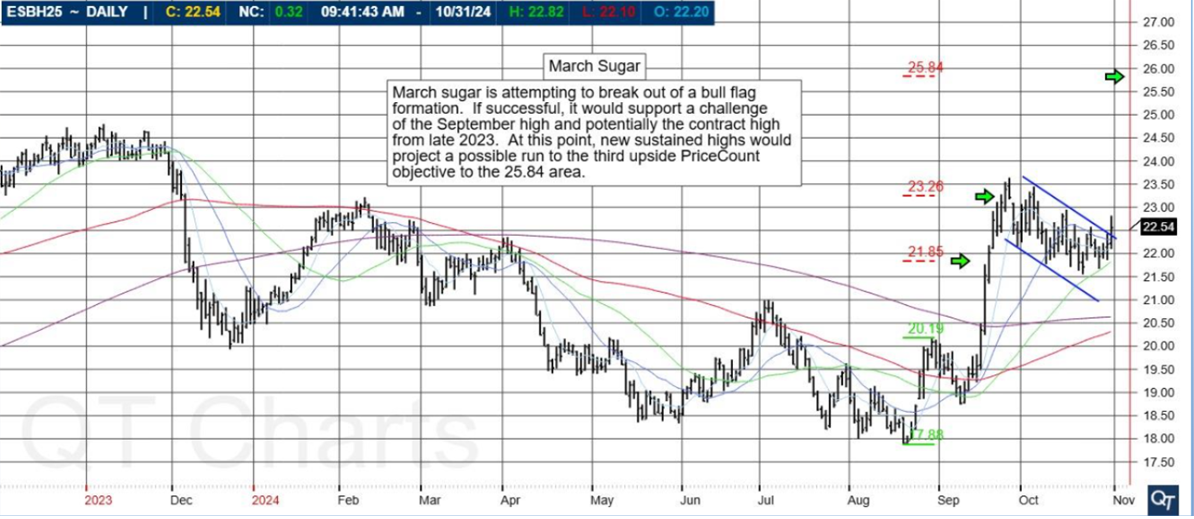
    March sugar is attempting to break out of a bull flag formation. If successful, it would support a challenge of the September high and potentially the contract high from late 2023. At this point, new sustained highs would project a possible run to the third upside PriceCount objective to the 25.84 area.


    PriceCounts – Not about where we’ve been , but where we might be going next!

    dbfaff1d a7a1 407d 9b9b ac58d7a723c2

The PriceCount study is a tool that can help to project the distance of a move in price. The counts are not intended to be an ‘exact’ science but rather offer a target area for the four objectives which are based off the first leg of a move with each subsequent count having a smaller percentage of being achieved. It is normal for the chart to react by correcting or consolidating at an objective and then either resuming its move or reversing trend. Best utilized in conjunction with other technical tools, PriceCounts offer one more way to analyze charts and help to manage your positions and risk. Learn more at www.qtchartoftheday.com
Trading in futures, options, securities, derivatives or OTC products entails significant risks which must be understood prior to trading and may not be appropriate for all investors. Past performance of actual trades or strategies is not necessarily indicative of future results.

   Broker’s Trading System of the Week

With algorithmic trading systems becoming more prevalent in portfolio diversification, the following system has been selected as the broker’s choice for this month.

QuantumFusion ProMax

PRODUCT

NK – Nikkei 225


SYSTEM TYPE

Swing Trading


Recommended Cannon Trading Starting Capital

$50,000


COST

USD 165 / monthly


Get Started

Learn More

1b80c371 48c5 4acb bf0f 5b6a463a8dc7

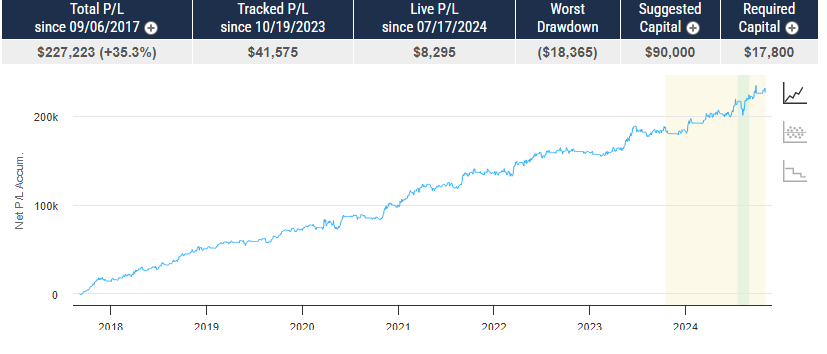
The performance shown above is hypothetical in that the chart represents returns in a model account. The model account rises or falls by the average single contract profit and loss achieved by clients trading actual money pursuant to the listed system’s trading signals on the appropriate dates (client fills), or if no actual client profit or loss available – by the hypothetical single contract profit and loss of trades generated by the system’s trading signals on that day in real time (real‐time) less slippage, or if no real time profit or loss available – by the hypothetical single contract profit and loss of trades generated by running the system logic backwards on back adjusted data. Please read full disclaimer HERE.
Would you like to receive daily support & resistance levels?
Yes
S
No
S

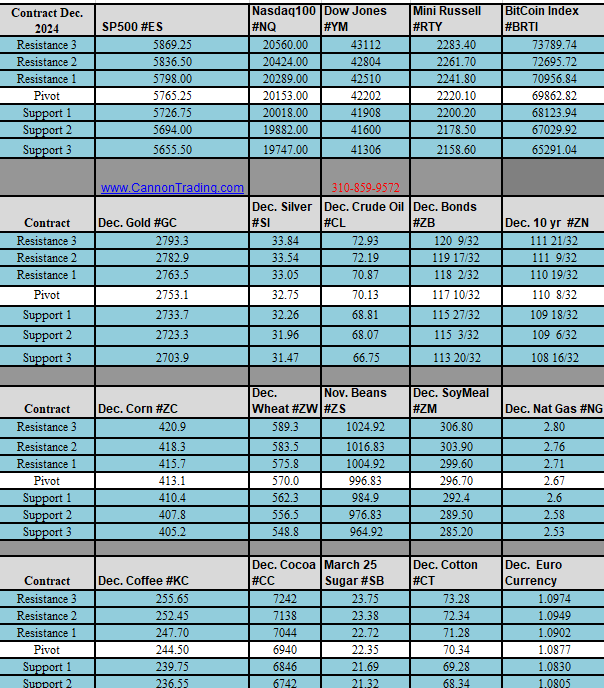
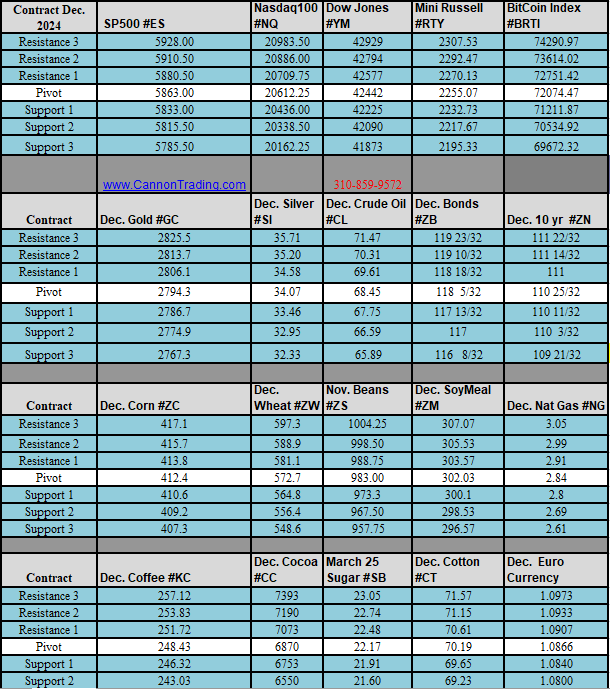
Daily Levels for November 4th, 2024

ba59adaa 213f 430c 90cc 5bb758bfd7e9

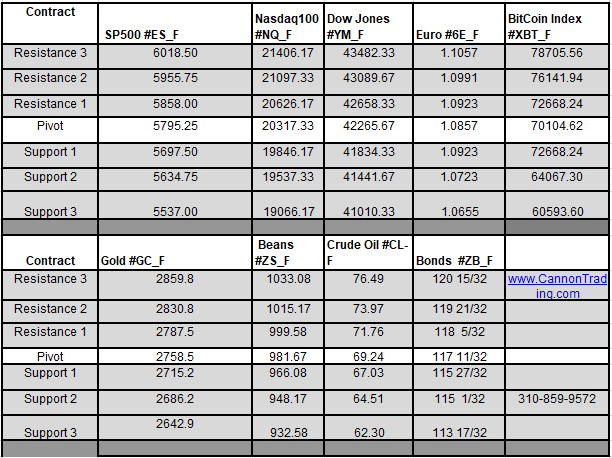
Weekly Levels for the week of November 4th, 2024

d3fb33b3 1817 41bd 88c5 f150949c7217


bf9b3e0d 9c23 44e8 980c a8c01bfbe2cf

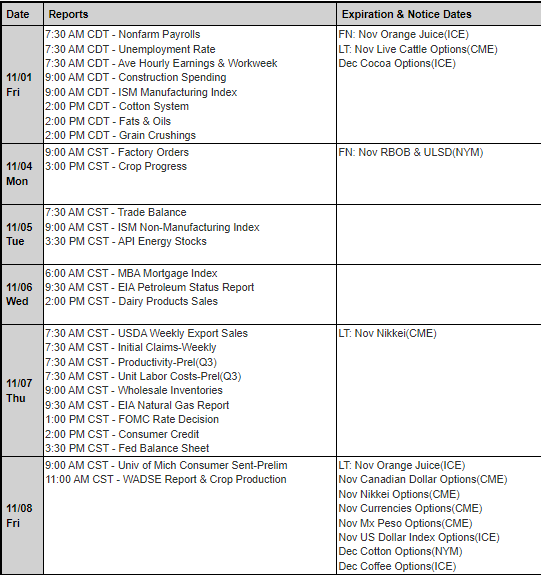
Trading Reports for Next Week

First Notice (FN), Last trading (LT) Days for the Week:
4b4c4fb2 3241 43c0 a073 bf7aab53c942

Improve Your Trading Skills

Get access to proprietary indicators and trading methods, consult with an experienced broker at 1-800-454-9572.

Explore trading methods. Register Here

* This is not a solicitation of any order to buy or sell, but a current market view provided by Cannon Trading Inc. Any statement of facts here in contained are derived from sources believed to be reliable, but are not guaranteed as to accuracy, nor they purport to be complete. No responsibility is assumed with respect to any such statement or with respect to any expression of opinion herein contained. Readers are urged to exercise their own judgement in trading.

Countdown to NFP: High Volatility Brings New Opportunities for Traders

Join our Private Facebook group

Subscribe to our YouTube Channel

Listen to our podcast: Subscribe on AppleSpotify, Amazon, or wherever you listen to podcasts!

C100


All Roads lead to NFP


Heads up:  Highly anticipated NFP (non farm payrolls) report tomorrow.


It’s that time of the month again: Tomorrow the Labor Dept. releases its monthly Non-farm payrolls report. It’s widely considered to be one of the most important and influential measures of the U.S. economy and the report is released at 7:30 A.M., Central Time on the first Friday of the month.


To review, the Labor Dept.’s Bureau of Labor Statistics surveys about 141,000 businesses and government agencies, representing approximately 486,000 individual work sites. The report excludes farm workers, private household employees, domestic household workers and non-profit organization employees. The report also includes other detailed industry data including the overall unemployment rate as a percentage of the total labor force that is unemployed but actively seeking work, wages, wage growth and average workday hours.


Volatility is quite high. This requires one to evaluate their stops? targets? Trading size?


With the micros Trading such good volume across the board a trader now has the option of trading one 3, 6 micros for example rather than trading one Single mini SP or mini Nasdaq This is especially true on volatility as as high as we have seen the last few days And may help certain traders adapt to the volatility.


If you like feedback, discuss ideas – let us know and we will do our best to assist.


Mini SP 240 min chart (4 hours) for your review below with possible support levels. Click image below for larger image.


d0932a29 4d80 4d5f 9f1c 71b897b06043


stars

Daily Levels for November 1, 2024

7f12c620 72d2 49b1 a8b2 efa992ba54ab

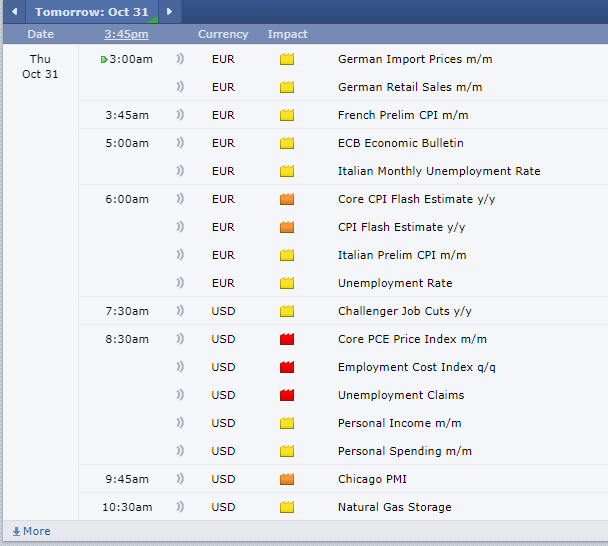
Economic Reports
provided by:ForexFactory.com
All times are Eastern Time ( New York)
dbe9044b 5358 4f67 b34c f37a07ab4342
Good Trading!
About: Cannon Trading is an independent futures brokerage firm established in 1988 in Los Angeles. Our mission is to provide reliable service along with the latest technological advances and choices while keeping our clients informed and educated in the field of futures and commodities trading.
Trading Futures, Options on Futures, and retail off-exchange foreign currency transactions involves substantial risk of loss and is not suitable for all investors. You should carefully consider whether trading is suitable for you in light of your circumstances, knowledge, and financial resources. You may lose all or more of your initial investment. Opinions, market data, and recommendations are subject to change at any time.
Contact
S
Cannon Trading Company
12100 Wilshire Boulevard
Suite 1640
Los Angeles, CA 90025
(800) 454-9572
Follow Us
Facebook  Twitter  Instagram
Visit Our Website


Weekly Newsletter: FOMC next Week, Bonds Outlook & Trading Levels for April 29th

Get Real Time updates and more by joining our Private Facebook Group!
Subscribe to our YouTube Channel

C47

Cannon Futures Weekly Letter Issue # 1191

In this issue:
  • Important Notices – FOMC & NFP Next Week
  • Futures 101 – Understanding Volume
  • Hot Market of the Week – June Bonds
  • Broker’s Trading System of the Week – ES intraday System
  • Trading Levels for Next Week
  • Trading Reports for Next Week


Important Notices – Next Week Highlights:

    • FOMC Rate Announcement Wed.
    • Heavy Earnings, AMZN and AMD Tues, AAPL Thur. all after the close
    • Heavy Data, Chicago PMI, Consumer Confidence, Construction Spending, ISM Manufacturing PMI, Jobless Claims.
    • NON FARM Payrolls to cap off the week on Fri. , preopening


Futures 101 : Understanding VOLUME

Volume is reported for all futures contracts. It is calculated by counting the number of contracts that have been bought and sold over a given time. You can track volume using different time intervals like daily or intraday.
When a futures contract is traded, whether bought or sold, it counts towards volume for that contract.
For example, a trader closes a short position in the E-mini S&P 500 (ES) futures contract by buying one contract in the ES, so volume will increase by 1.
Traders often use and interpret the rise or decline of volume in a futures contract to help make trading decisions.
Volume can give important information to traders such as:
  • Indicate the price levels at which traders are more or less interested in trading a futures contract
  • During the roll, indicate to traders when to switch to trading the front month futures contract as volume decreases in the expiring contract
  • Identify the times of day when a futures contract is most liquid
Price Levels
When volume changes as price of a futures contract moves towards certain levels, this can indicate to a trader that a change in direction may occur. Some traders may use this information to indicate whether to buy or sell at those key levels.
­Contract Roll
During the futures rollover, traders pay attention to the contract that is taking the higher levels of volume. Traders use this information to determine when to start trading the next month contract. As volume decreases in the expiring contract, trading will shift to the next available month contract.
For example, say the June ES (E-mini S&P 500) futures contract is about to expire and September will become the new front month. On the Thursday of rollover week, watch how the June contract starts to lose volume and the September contract begins to pick up volume. When the September contract has more volume than the June contract, it is time to switch to the September contract.
Active Periods
Traders typically prefer higher volume times to trade, as it means that more traders are actively interested in buying and selling. When volume is high, the bid-ask spread is typically smaller, orders are filled faster and less gaps may exist between ticks.
For example, markets can have lower volume between the hours of 12:00 p.m.-2:00 p.m. ET, before major economic releases; conversely, market often see higher volume around the open and close of the trading day.
Traders also can look at average daily volume over a longer time period, such as a few weeks or months, to see if the markets currently are in a lower or higher volume than is typical.
Summary
What volume can’t show however, is whether traders are buying or selling, or opening or closing a position.
For example, if the ES contract is trading at 2375 and suddenly pushes down to 2360 while volume increases, the volume that comes into the market could be from traders opening new long positions at key levels of support. That could indicate a bullish sentiment. Volume also can be generated by liquidation of exiting long positions or opening of new short positions, a possible bearish indication.
A spike in volume at 2360 doesn’t necessarily mean that buyers are coming into the market and that the price will bounce.
Volume data is readily available for each futures contract and for the market as a whole. Although traders may use volume in different ways to interpret how to trade, volume can be an important factor to help inform your trading decisions.


stars

3b644da2 2bee 4d39 8d98 5208a20bec39


  • Hot Market of the Week – June Bonds
Hot market of the week is provided by QT Market Center, A Swiss army knife charting package that’s not just for Hedgers, Cooperatives and Farmers alike but also for Spread traders, Swing traders and shorter time frame application for intraday traders with a unique proprietary indicator that can be applied to your specific trading needs.
June 30 Year T-Bonds
The June 30 Year T-Bond break found temporary stability at its second downside PriceCount objective recently. Now, the chart has resumed its slide into new lows which, if sustained, would project a run to the third count in the 109^20 area.
PriceCounts – Not about where we’ve been , but where we might be going next!
e705ddd3 93f1 4833 80e3 d1e808fbc117
The PriceCount study is a tool that can help to project the distance of a move in price. The counts are not intended to be an ‘exact’ science but rather offer a target area for the four objectives which are based off the first leg of a move with each subsequent count having a smaller percentage of being achieved. It is normal for the chart to react by correcting or consolidating at an objective and then either resuming its move or reversing trend. Best utilized in conjunction with other technical tools, PriceCounts offer one more way to analyze charts and help to manage your positions and risk. Learn more at www.qtchartoftheday.com
Trading in futures, options, securities, derivatives or OTC products entails significant risks which must be understood prior to trading and may not be appropriate for all investors. Past performance of actual trades or strategies is not necessarily indicative of future results.
  • Broker’s Trading System of the Week

With algorithmic trading systems becoming more prevalent in portfolio diversification, the following system has been selected as the broker’s choice for this month.
PRODUCT
SYSTEM TYPE
Intraday
COST
USD 110 / monthly
Recommended Cannon Trading Starting Capital
$10,000
a5fd1228 3ba8 42c5 a40d c3e46544bdd0
The performance shown above is hypothetical in that the chart represents returns in a model account. The model account rises or falls by the average single contract profit and loss achieved by clients trading actual money pursuant to the listed system’s trading signals on the appropriate dates (client fills), or if no actual client profit or loss available – by the hypothetical single contract profit and loss of trades generated by the system’s trading signals on that day in real time (real‐time) less slippage, or if no real time profit or loss available – by the hypothetical single contract profit and loss of trades generated by running the system logic backwards on back adjusted data. Please read full disclaimer HERE.
Would you like to receive daily support & resistance levels?
Yes
S
No
S


Daily Levels for April 29th 2024

eb118b97 a50d 48fb ab4a efafa6ff5968

Trading Reports for Next Week

d398c77d 24dc 450b 92fb ef3ef27b13d9
d259df9c bf07 4429 9fa8 d12b53c37804
First Notice (FN), Last trading (LT) Days for the Week:
6d1a7821 c606 4107 83ef 6fa197eb7433

Improve Your Trading Skills

Get access to proprietary indicators and trading methods, consult with an experienced broker at 1-800-454-9572.

Explore trading methods. Register Here

* This is not a solicitation of any order to buy or sell, but a current market view provided by Cannon Trading Inc. Any statement of facts here in contained are derived from sources believed to be reliable, but are not guaranteed as to accuracy, nor they purport to be complete. No responsibility is assumed with respect to any such statement or with respect to any expression of opinion herein contained. Readers are urged to exercise their own judgement in trading.

Weekly Newsletter: Role of Speculators, Coffee Outlook & Trading Levels for April 22nd

Get Real Time updates and more by joining our Private Facebook Group!
Subscribe to our YouTube Channel

C35

Cannon Futures Weekly Letter Issue # 1190

In this issue:
  • Important Notices – Israel, Iran, PCE Report & More
  • Futures 101 – The Role of Speculators in Futures Trading
  • Hot Market of the Week – July Coffee
  • Broker’s Trading System of the Week – NQ intraday System
  • Trading Levels for Next Week
  • Trading Reports for Next Week


Important Notices –

  • The situation in the Middle East will loom over the markets next week. More on that below.
  • Keep an eye on these potential futures market movers:
  • It was hardly unexpected, but Israel’s missile strike on Iran Friday may foreshadow a dangerous series of tit-for-tat retaliation between the Middle East powers – and unsettle world markets. At the same time, the limited scale of the attack and Iran’s muted response appears so far to signal a successful effort by diplomats who have been working to avert all-out war.
  • At the outset of Israel’s offensive last night, volatility amplified in key futures markets – stock indexes (S&P 500, Dow, Nasdaq), currencies, energies (crude oil), metals (gold), financials (30-yr. bonds, 10-yr. notes). Into late evening and on into today, there has been a virtual across-the-board drop-off in the inflated price fluctuation seen when news broke of the military action.
  • GDP and PMI along with homes sales, durable goods and overall a packed week with economic reports.
  • PCE Friday will provide additional clues as to the future of interest rates
  • big earnings week MSFT, GOOG, META, XOM, Visa, TSLA
  • Volatility in Cocoa and Coffee continues. Copper broke higher.


Trading Resource of the Week: Understanding the Role of Speculators

What Are Speculators?
Speculators are primary participants in the futures market. A speculator is any individual or firm that accepts risk in order to make a profit. Speculators can achieve these profits by buying low and selling high. But in the case of the futures market, they could just as easily sell first and later buy at a lower price.
Obviously, this profit objective is easier said than done. Nonetheless, speculators aiming to profit in the futures market come in a variety of types. Speculators can be individual traders, proprietary trading firms, portfolio managers, hedge funds or market makers.
Individual Traders
For individuals trading their own funds, electronic trading has helped to level the playing field by improving access to price and trade information. The speed and ease of trade execution, combined with the application of modern risk management, gives the individual trader access to markets and strategies that were once reserved for institutions.
Proprietary Trading Firms
Proprietary trading firms, also known as prop shops, profit as a direct result of their traders’ activity in the marketplace. These firms supply their traders with the education and capital required to execute a large number of trades per day. By using the capital resources of the prop shop, traders gain access to more capital than they would if they were trading on their own account. They also may have access to the same type of research and strategies developed by larger institutions.
Portfolio or Investment Managers
A portfolio or investment manager is responsible for investing or hedging the assets of a mutual fund, exchange-traded fund or closed-end fund. The portfolio manager implements the fund’s investment strategy and manages the day-to-day trading. Futures markets are often used to increase or decrease the overall market exposure of a portfolio without disrupting the delicate balance of investments that may have taken a significant effort to build.
Hedge Funds
A hedge fund is a managed portfolio of investments that uses advanced investment strategies to maximize returns, either in an absolute sense or relative to a specified market benchmark. The name hedge fund is mostly historical, as the first hedge funds tried to hedge against the risk of a bear market by shorting the market. Today, hedge funds use hundreds of different strategies in an effort to maximize returns. The diverse and highly liquid futures marketplace offer hedge funds the ability to execute large transactions and either increase or decrease the market exposure of their portfolio.
Market Makers
Market makers are trading firms that have contractually agreed to provide liquidity to the markets, continually providing both bids and offers, usually in exchange for a reduction in trading fees. Market makers are important to the trading ecosystem as they help facilitate the movement of large transactions without effecting a substantial change in price. Market makers often profit from capturing the spread, the small difference between the bid and offer prices over a large number of transactions, or by trading related futures markets that they view as being priced to provide opportunity.
Conclusion
All types of speculators bring liquidity to the market place. Providing liquidity is a crucial market function that enables individuals to easily enter or exit the market. Though speculative trading activity generates considerable liquidity, all market players benefit. In contrast to speculators who aim to profit by assuming market risk, some buyers and sellers have a vested interest in the underlying asset of each contact. These market participants aim to offset or eliminate risk and are referred to as hedgers.


stars

3b644da2 2bee 4d39 8d98 5208a20bec39


  • Hot Market of the Week – July Coffee
Hot market of the week is provided by QT Market Center, A Swiss army knife charting package that’s not just for Hedgers, Cooperatives and Farmers alike but also for Spread traders, Swing traders and shorter time frame application for intraday traders with a unique proprietary indicator that can be applied to your specific trading needs.
July Coffee
July Coffee satisfied its third upside PriceCount objective in where it would be normal to get a near term reaction in the form of a consolidation or corrective trade, at least. At this point, IF the chart can sustain additional upside we are left with thelow percentage fourth count to aim for just above $300.
PriceCounts – Not about where we’ve been , but where we might be going next!
f1508120 0acf 4c7e 889d 59d4a77866e0
The PriceCount study is a tool that can help to project the distance of a move in price. The counts are not intended to be an ‘exact’ science but rather offer a target area for the four objectives which are based off the first leg of a move with each subsequent count having a smaller percentage of being achieved. It is normal for the chart to react by correcting or consolidating at an objective and then either resuming its move or reversing trend. Best utilized in conjunction with other technical tools, PriceCounts offer one more way to analyze charts and help to manage your positions and risk. Learn more at www.qtchartoftheday.com
Trading in futures, options, securities, derivatives or OTC products entails significant risks which must be understood prior to trading and may not be appropriate for all investors. Past performance of actual trades or strategies is not necessarily indicative of future results.
  • Broker’s Trading System of the Week

With algorithmic trading systems becoming more prevalent in portfolio diversification, the following system has been selected as the broker’s choice for this month.
PRODUCT
SYSTEM TYPE
Intraday
COST
USD 55 / monthly
Recommended Cannon Trading Starting Capital
$25,000
228964a9 3514 4d3b a9c2 49621d6ebecd
The performance shown above is hypothetical in that the chart represents returns in a model account. The model account rises or falls by the average single contract profit and loss achieved by clients trading actual money pursuant to the listed system’s trading signals on the appropriate dates (client fills), or if no actual client profit or loss available – by the hypothetical single contract profit and loss of trades generated by the system’s trading signals on that day in real time (real‐time) less slippage, or if no real time profit or loss available – by the hypothetical single contract profit and loss of trades generated by running the system logic backwards on back adjusted data. Please read full disclaimer HERE.
Would you like to receive daily support & resistance levels?
Yes
S
No
S


Daily Levels for April 22nd 2024

127d4560 c19c 4c3e 872a 87e87bc3bfe4

Trading Reports for Next Week

d398c77d 24dc 450b 92fb ef3ef27b13d9
d259df9c bf07 4429 9fa8 d12b53c37804
First Notice (FN), Last trading (LT) Days for the Week:
fa8ac78f aaed 4d53 b8c1 7683e3af1f2d

Improve Your Trading Skills

Get access to proprietary indicators and trading methods, consult with an experienced broker at 1-800-454-9572.

Explore trading methods. Register Here

* This is not a solicitation of any order to buy or sell, but a current market view provided by Cannon Trading Inc. Any statement of facts here in contained are derived from sources believed to be reliable, but are not guaranteed as to accuracy, nor they purport to be complete. No responsibility is assumed with respect to any such statement or with respect to any expression of opinion herein contained. Readers are urged to exercise their own judgement in trading.

Coffee Outlook, Beige Book and Crude Oil Numbers + Levels for April 17th

Get Real Time updates and more by joining our Private Facebook Group!
Subscribe to our YouTube Channel


C33


Powell spoke and stock index futures traded in a volatile, zig zag type of trading most of the day unable to break one way or the other and closing near the unchange.

On the daily chart, both the SP and NASDAQ are noticing more pressure to the downside.

One of the keys for day Traders is to try and establish early on what type of day trading environment they are in.

Is this going to be a trend day it is this going to be a choppy low volatility trading day? is the day unfolding has a potential to be a volatile two-sided type of trading day?

Being aware of the top of trading day that is unfolding in front of you can help you decide which strategies to apply on that trading day.

Knowing what reports are coming out. the general direction of the long term charts can help you.

Different strategies will work better in different type of trading environments.

On a different note, softs, i.e. Cocoa, cotton, Coffee , Sugar, OJ are experiencing much higher volatility than historical norms. Cocoa just dropped close to 8% today after trading above the historical mark of $100 per metric ton.

below you will see a daily chart of Coffee futures and possible future direction.


62d19d5f caa4 41f4 9c2e dacb47995f39


stars

e35cb555 9ff3 4f00 9fe8 0655b28fbd90

Daily Levels for April 17th, 2024

535aeb7d 56cc 4a29 baec 89cf769d0efe

thumbnail?url=http%3A%2F%2Fi.ytimg.com%2Fvi%2FJnHAMUGdNoM%2Fhqdefault

Economic Reports
provided by: ForexFactory.com
All times are Eastern Time ( New York)
611bf28a 191a 4e89 bb29 ea18ac3b07a0

Improve Your Trading Skills

Get access to proprietary indicators and trading methods, consult with an experienced broker at 1-800-454-9572.

Explore trading methods. Register Here

3b644da2 2bee 4d39 8d98 5208a20bec39

* This is not a solicitation of any order to buy or sell, but a current market view provided by Cannon Trading Inc. Any statement of facts here in contained are derived from sources believed to be reliable, but are not guaranteed as to accuracy, nor they purport to be complete. No responsibility is assumed with respect to any such statement or with respect to any expression of opinion herein contained. Readers are urged to exercise their own judgement in trading.

Weekly Newsletter: May Crude Oil on the Move? & Trading Levels for April 15th

Get Real Time updates and more by joining our Private Facebook Group!
Subscribe to our YouTube Channel

C2

Cannon Futures Weekly Letter Issue # 1189

In this issue:
  •  Important Notices – Earnings, Gold all time Highs & More
  • Trading Resource of the Week – Trading Videos
  • Hot Market of the Week – May Crude Oil
  • Broker’s Trading System of the Week – NQ Swing System
  • Trading Levels for Next Week
  • Trading Reports for Next Week


Important Notices –

    • Earnings Tues- JNJ,BAC ,Morgan Stanley MS, Wed. -ABT, Thu.- AXP, NFLX
    • Econ Data  Mon- Retail Sales , Tues Housing Starts, Bldg Permits , Thu. Jobless claims, Existing home sales..
    • quiet on the fed speaker front
    • No Congressional action to speak of
    • The U.S. dollar index this morning forged another higher high and reached the highest level since early November.
    • With the June gold futures contract breaking a string of new all-time highs (eight straight days) yesterday, the market is facing the first definitive corrective environment since the middle of last month.
    • The bearish sentiment in financial futures (30-yr. T-bond, 10-yr. T-note) is escalating dramatically and could become overdone soon with some chatter in the market suggesting there might not be a single rate cuts this year.
    • Crude oil may see support this week from renewed talk of an imminent Iranian retaliation (as per U.S. officials) for the Israeli attack in Syria. U.S. officials have openly suggested Iranian retaliation against Israel is likely soon. Fears of disrupted supply remain front and center.


Trading Resource of the Week: Trading Videos, Instant Viewing

Watch a series of short videos, where our VP, Ilan Levy-Mayer shares his personal preferences and opinions on different trading topics.
·    Ever wondered when to exit a trade? Take a look at what Ilan has to share on Bollinger Bands and a study called PARABOLICS
·    Some common uses you can make of support and resistance levels.
·    Filter out the noise with range bar charts
·    “Price Confirmation”


stars

3b644da2 2bee 4d39 8d98 5208a20bec39


  • Hot Market of the Week – May Crude Oil
Hot market of the week is provided by QT Market Center, A Swiss army knife charting package that’s not just for Hedgers, Cooperatives and Farmers alike but also for Spread traders, Swing traders and shorter time frame application for intraday traders with a unique proprietary indicator that can be applied to your specific trading needs.
The March 20th Chart of the Day highlighted May crude oil had completed its first upside PriceCount objective. Now, the chart is consolidating after satisfying its second upside PriceCount objective. A this point, IF the chart can sustain further gains, the third count would project a possible run to the 94.82 area.
PriceCounts – Not about where we’ve been , but where we might be going next!
8b794a41 1b6d 49e3 be59 0a99af03b890
The PriceCount study is a tool that can help to project the distance of a move in price. The counts are not intended to be an ‘exact’ science but rather offer a target area for the four objectives which are based off the first leg of a move with each subsequent count having a smaller percentage of being achieved. It is normal for the chart to react by correcting or consolidating at an objective and then either resuming its move or reversing trend. Best utilized in conjunction with other technical tools, PriceCounts offer one more way to analyze charts and help to manage your positions and risk. Learn more at www.qtchartoftheday.com
Trading in futures, options, securities, derivatives or OTC products entails significant risks which must be understood prior to trading and may not be appropriate for all investors. Past performance of actual trades or strategies is not necessarily indicative of future results.
  • Broker’s Trading System of the Week

With algorithmic trading systems becoming more prevalent in portfolio diversification, the following system has been selected as the broker’s choice for this month.
PRODUCT
SYSTEM TYPE
Swing
COST
USD 299 / monthly
Recommended Cannon Trading Starting Capital
$75,000
32655e40 466f 43ab ae59 5d633fcbf7c3
The performance shown above is hypothetical in that the chart represents returns in a model account. The model account rises or falls by the average single contract profit and loss achieved by clients trading actual money pursuant to the listed system’s trading signals on the appropriate dates (client fills), or if no actual client profit or loss available – by the hypothetical single contract profit and loss of trades generated by the system’s trading signals on that day in real time (real‐time) less slippage, or if no real time profit or loss available – by the hypothetical single contract profit and loss of trades generated by running the system logic backwards on back adjusted data. Please read full disclaimer HERE.
Would you like to receive daily support & resistance levels?
Yes
S
No
S


Daily Levels for April 15th 2024

771a1b3e a8b5 4c92 93ff 8af9b7ddc603

Trading Reports for Next Week

355e348f 486b 4680 a381 a80073d0f10f
d259df9c bf07 4429 9fa8 d12b53c37804
First Notice (FN), Last trading (LT) Days for the Week:
863255b9 3bfd 4269 bc70 e4613f026765

Improve Your Trading Skills

Get access to proprietary indicators and trading methods, consult with an experienced broker at 1-800-454-9572.

Explore trading methods. Register Here

* This is not a solicitation of any order to buy or sell, but a current market view provided by Cannon Trading Inc. Any statement of facts here in contained are derived from sources believed to be reliable, but are not guaranteed as to accuracy, nor they purport to be complete. No responsibility is assumed with respect to any such statement or with respect to any expression of opinion herein contained. Readers are urged to exercise their own judgement in trading.

Triple Witching Tomorrow + Futures trading Levels for March 15th

Get Real Time updates and more by joining our Private Facebook Group!
Subscribe to our YouTube Channel


C26


TriPPPle witching tomorrow!

Stock Index March contracts (i.e., the E-mini and Micro S&P, Nasdaq, Dow Jones and Russell 2000.) expire Friday, March15th (8:30 A.M., Central Time). At that point, trading in these contracts halts. Stock index futures are CASH SETTLED contracts. If you hold any December futures contracts through 8:30 A.M., Central Time on Friday, Mar. 15th, they will be offset with the cash settlement price, as set by the exchange.

FRONT MONTH IS NOW JUNE , the symbol is M24, example for mini SP is ESM24

 Monday, March 18th is Last Trading Day for December currency futures. It is of the utmost importance for currency traders to exit all March futures contracts by Friday, March 15th and to start trading the June futures. Currency futures are DELIVERABLE contracts.

The month code for June is ‘M.’  Please consider carefully how you place orders when changing over.


Plan your trade and trade your plan


Watch video below on how to rollover from March to June contracts if you are a stock index trader on our E-Futures Platform!


thumbnail?url=http%3A%2F%2Fi.vimeocdn


stars

e35cb555 9ff3 4f00 9fe8 0655b28fbd90

Daily Levels for March 15th, 2024

d69d3d2b f11a 4e36 a041 cab7eee5bea1

b0ba1776 c0cd 4536 92c1 eef6595d7173

Economic Reports
provided by: ForexFactory.com
All times are Eastern Time ( New York)
312e053e 316d 43cd 8973 a7eb9de16fd2

Improve Your Trading Skills

Get access to proprietary indicators and trading methods, consult with an experienced broker at 1-800-454-9572.

Explore trading methods. Register Here

3b644da2 2bee 4d39 8d98 5208a20bec39

* This is not a solicitation of any order to buy or sell, but a current market view provided by Cannon Trading Inc. Any statement of facts here in contained are derived from sources believed to be reliable, but are not guaranteed as to accuracy, nor they purport to be complete. No responsibility is assumed with respect to any such statement or with respect to any expression of opinion herein contained. Readers are urged to exercise their own judgement in trading.

The Best $5 and 5 Daily Minutes You Can Invest in Your Trading!

Get Real Time updates and more by joining our Private Facebook Group!
Subscribe to our YouTube Channel


C24


Today’s CPI report, market action and looking back at my notes from previous CPI trading days encouraged me to share the below:

Maintaining a trading journal is a critical practice for any trader who aims to achieve long-term success in the markets. This meticulous record-keeping serves several vital functions that contribute to a trader’s development and strategy refinement.

Self-Reflection and Accountability: A trading journal fosters a habit of self-reflection. By documenting the details of each trade, including the rationale behind entry and exit points, traders can review their decisions objectively. This process encourages accountability and helps traders to recognize patterns in their trading behavior, both successful and detrimental.

Strategy Optimization: Over time, a trading journal becomes a valuable data repository that traders can analyze to fine-tune their strategies. By identifying what works and what doesn’t, traders can make informed adjustments to their approach, discard ineffective methods, and capitalize on strategies that yield positive outcomes.

Emotional Regulation: Trading can be an emotional endeavor, and a journal can act as a stabilizing force. By committing to a disciplined recording of trades, traders can distance themselves from the emotional highs and lows of market volatility. This emotional detachment is crucial for making rational, data-driven decisions.

Performance Tracking: A trading journal enables traders to track their performance over time. It provides a clear picture of profit and loss, helping traders to assess their financial progress and set realistic goals for future trades.

Learning Tool: For novice traders, a journal is an invaluable learning tool. It allows them to learn from their mistakes and successes, accelerating their journey towards becoming proficient traders.

In essence, a trading journal is more than just a record of transactions; it is a trader’s roadmap to continuous improvement and strategic mastery. It is an indispensable tool for anyone serious about excelling in the dynamic world of trading.


Plan your trade and trade your plan


Watch video below on how to rollover from March to June contracts if you are a stock index trader on our E-Futures Platform!


thumbnail?url=http%3A%2F%2Fi.vimeocdn


stars

e35cb555 9ff3 4f00 9fe8 0655b28fbd90

Daily Levels for March 13th, 2024

fbb146eb 40f8 432e a876 5c6c688e22b4

b0ba1776 c0cd 4536 92c1 eef6595d7173

Economic Reports
provided by: ForexFactory.com
All times are Eastern Time ( New York)
b395229a f1b9 4b8b 8fad da693f04e7b2

Improve Your Trading Skills

Get access to proprietary indicators and trading methods, consult with an experienced broker at 1-800-454-9572.

Explore trading methods. Register Here

3b644da2 2bee 4d39 8d98 5208a20bec39

* This is not a solicitation of any order to buy or sell, but a current market view provided by Cannon Trading Inc. Any statement of facts here in contained are derived from sources believed to be reliable, but are not guaranteed as to accuracy, nor they purport to be complete. No responsibility is assumed with respect to any such statement or with respect to any expression of opinion herein contained. Readers are urged to exercise their own judgement in trading.

Rollover, CPI & Futures Trading Levels for 03.12.24

Get Real Time updates and more by joining our Private Facebook Group!
Subscribe to our YouTube Channel


C3 1


CPI Tomorrow – Trade June ES/NQ/YM and MICROS

by John Thorpe, Senior Broker


For all of you index traders, you may have noticed the shrinking Open Interest and Volume in the March contracts. It’s that time when volume shifts to the next quarterly expiration contract. June! the symbol is M.

March volume will be drying up quickly, don’t get stuck Friday morning with a March contract at the crack of dawn when the carousel stops. Start trading the June contract today!

According to Bloomberg, the S&P 500 has averaged an 0.8% move on CPI days over the past six months

Today, stocks are sideways, the dollar and gold are both up marginally as investors nervously await tomorrows 7:30 a.m. CDT Consumer Price Index release.

Last Month, on Feb 13th stocks slid sharply following the release and Treasury yields surged higher when a surprise CPI number, an Increase of 0.3% in January, crossed the newswires. Housing costs accounted for much of the price rise.

Overall prices are expected to rise 0.4% percent after increasing 0.3% percent in January. Annual rates, which in January were 3.1% percent overall and 3.9% percent for the core, are expected at 3.1% and 3.7% percent respectively. Per econoday.


Plan your trade and trade your plan


Watch video below on how to rollover from March to June contracts if you are a stock index trader on our E-Futures Platform!


thumbnail?url=http%3A%2F%2Fi.vimeocdn


37d7a522 9491 476e bccd 5d86442eda21


stars

e35cb555 9ff3 4f00 9fe8 0655b28fbd90

Daily Levels for March 12th, 2024

700b4a89 9678 42c2 b57f 894fc90822f3

b0ba1776 c0cd 4536 92c1 eef6595d7173

Economic Reports
provided by: ForexFactory.com
All times are Eastern Time ( New York)
1c9e26e4 46da 486b bf63 f4f09f2959a4

Improve Your Trading Skills

Get access to proprietary indicators and trading methods, consult with an experienced broker at 1-800-454-9572.

Explore trading methods. Register Here

3b644da2 2bee 4d39 8d98 5208a20bec39

* This is not a solicitation of any order to buy or sell, but a current market view provided by Cannon Trading Inc. Any statement of facts here in contained are derived from sources believed to be reliable, but are not guaranteed as to accuracy, nor they purport to be complete. No responsibility is assumed with respect to any such statement or with respect to any expression of opinion herein contained. Readers are urged to exercise their own judgement in trading.