Standard and Poor 500 futures

standard and poor 500 futures

Standard and Poor 500 Futures

standard and poor 500 futures

standard and poor 500 futures

Index futures are the workhorses of professional risk management and active speculation. They let traders express a view on the broad market in a capital-efficient way, hedge portfolios quickly, and trade nearly 24 hours a day. Among them, standard and poor 500 futures are the flagship product for U.S. equity exposure, while the smaller e-mini and Micro E-mini contracts have helped a new generation of traders access the same market with less capital.

This guide explains how standard and poor 500 futures, e-mini contracts, and Micro E-minis work, then compares emini futures trading to full-size “traditional” futures on the S&P 500 and Nasdaq. We’ll cover contract specs, mechanics, margin, liquidity, volatility, trading hours, and real-world use cases. Then we’ll lay out the pros and cons of each contract type, plus a practical FAQ.

What Are Standard and Poor 500 Futures?

Standard and poor 500 futures are derivatives based on the S&P 500 Index, a basket of 500 large-cap U.S. companies. These futures trade on CME (Chicago Mercantile Exchange) and are cash-settled, meaning no one delivers shares of all 500 stocks at expiration. Instead, profits and losses settle in cash based on the index’s final value.

How the contract tracks the index

The futures price reflects:

  • The spot index level
  • Expected dividends from index constituents
  • Financing costs (interest rates)
  • Supply/demand and risk sentiment

In normal conditions, futures trade near “fair value,” which is spot plus net carry (interest minus dividends). When volatility spikes, the futures can trade at a notable discount or premium, but arbitrage and hedging usually pull prices back toward fair value.

The traditional full-size S&P 500 futures

Before the e-mini era, traders used the full-size S&P 500 futures contract. Today the full-size contract still exists (symbol SP), though most volume migrated to the E-mini line.

Key idea: full-size S&P futures provide the same exposure as E-mini, but with a bigger multiplier and larger tick value.

The Rise of the E-mini and Micro E-mini

What is the e-mini?

The e-mini is simply a smaller version of a traditional futures contract. For the S&P 500, the E-mini (symbol ES) launched in 1997 to give traders the same index exposure with lower margin requirements and smaller position sizes.

  • If the S&P 500 is at 5,000:
    • Full-size S&P futures exposure is much larger.
    • E-mini exposure is about one-fifth of the full-size.

The smaller size made intraday and swing trading more accessible. It also boosted liquidity because many more participants could trade it.

What is the Micro E-mini?

Micro E-minis (symbol MES for S&P 500) launched in 2019 as another step down in size. Each Micro E-mini is one-tenth of an E-mini. This lets traders fine-tune risk, scale in/out more precisely, and participate with even smaller accounts.

Why this matters for emini futures trading

Emini futures trading grew into the dominant way to trade U.S. equity index futures. ES volume often exceeds several million contracts per day, and MES provides a lower-capital on-ramp to the same market.

Contract Specs: Full-Size vs E-mini vs Micro E-mini

Let’s compare the S&P 500 family. Values change with index level; these are structural differences:

Full-size S&P 500 futures (SP)

  • Multiplier: larger than E-mini (historically $250 × index)
  • Tick size: 0.10 index point
  • Tick value: larger (more dollars per tick)
  • Typical users: institutions, big hedges, some large speculators
  • Liquidity: good but much smaller than ES

E-mini S&P 500 futures (ES)

  • Multiplier: $50 × index
  • Tick size: 0.25 index point
  • Tick value: $12.50 per tick
  • Typical users: institutions and active retail traders
  • Liquidity: extremely high

Micro E-mini S&P 500 futures (MES)

  • Multiplier: $5 × index
  • Tick size: 0.25 index point
  • Tick value: $1.25 per tick
  • Typical users: newer retail traders, precise risk managers
  • Liquidity: strong and growing, though below ES

Even if you don’t memorize every number, the hierarchy is what counts:
full-size > E-mini > Micro E-mini in exposure per contract.

This same scaling applies to other indices like Nasdaq 100 (NQ and MNQ), Dow (YM and MYM), and Russell 2000 (RTY and M2K).

Nasdaq Futures and How They Compare

When traders say “traditional futures contracts such as the S&P 500 and Nasdaq,” they’re usually referring to full-size and E-mini versions of both indices.

Traditional Nasdaq 100 futures vs E-mini Nasdaq

  • Full-size Nasdaq 100 futures (symbol ND) are larger and far less liquid.
  • The E-mini Nasdaq 100 (symbol NQ) is the market standard, just like ES is for S&P exposure.
  • Micro E-mini Nasdaq (MNQ) is one-tenth NQ.

Nasdaq futures tend to be more volatile than standard and poor 500 futures, because the Nasdaq 100 is more concentrated in tech and growth stocks. That means bigger moves, bigger opportunities, and bigger risk per point.

Where DJIA Index Futures Fit In

DJIA index futures track the Dow Jones Industrial Average—30 blue-chip U.S. companies. On CME, the E-mini Dow (YM) and Micro E-mini Dow (MYM) are most traded, while full-size DJIA futures are rarely used by retail traders.

Why trade Dow exposure?

  • The Dow is price-weighted, so high-priced stocks like UnitedHealth or Goldman Sachs can move the index more than lower-priced names.
  • The Dow can behave a bit differently from the S&P 500 in certain rotations, especially when industrials or financials lead.

Still, for broad market hedging and “benchmark” trading, standard and poor 500 futures dominate.

Mechanics of Futures Trading: The Stuff You Must Know

Margin and leverage

Futures use performance bond (margin), not a down payment on the full notional. Exchanges set initial and maintenance margin. Brokers may require more.

Example conceptually:

  • ES might require a few thousand dollars in day margin.
  • MES might require a few hundred.

Same market, different access point.

Leverage cuts both ways. A 1% S&P move can be large relative to margin, which is why risk controls matter so much in emini futures trading.

Mark-to-market and daily settlement

Gains and losses are realized every day. If you’re long and the market rises, cash is credited to your account; if it falls, cash is debited. That’s why traders can’t ignore losses in futures the way some people do with long-term stock holdings.

Trading hours and liquidity cycles

Index futures trade nearly 24/5. Liquidity is highest:

  • During U.S. equity hours (9:30 a.m.–4:00 p.m. ET)
  • Around major economic reports
  • In the “cash open” and “cash close” windows

ES is the deepest book. MES is active too, but bid/ask spreads widen more during thin hours.

Expiration and roll

Most traders roll positions to the next quarterly contract before expiration. Volume shifts from the front month to the next month during “roll week.”

E-mini and Micro E-mini Trading Styles

Because ES and MES are so liquid, many strategies evolved around them:

  • Day trading: scalping and momentum trades around intraday levels.
  • Swing trading: holding for days to weeks based on trend or macro themes.
  • Hedging: protecting a stock portfolio or ETF exposure.
  • Spread trading: trading ES vs NQ, or ES vs RTY.
  • Event trading: aligning with CPI, Fed meetings, earnings seasons.

Micro E-minis made these styles more precise. You can trade 3 MES instead of 1 ES to size between risk levels.

Emini Futures Trading vs Traditional Full-Size Index Futures

Let’s get direct about the comparison traders care about.

Access and capital efficiency

  • Traditional full-size contracts require higher margin and larger risk per tick. Great for big hedges, but hard for smaller traders.
  • E-mini contracts lowered the barrier.
  • Micro E-mini lowered it again.

So the main advantage of emini futures trading is that it democratizes the same market exposure.

Liquidity and execution

  • ES/NQ/YM are insanely liquid. Slippage is small even on market orders in normal hours.
  • Full-size contracts usually have wider spreads and thinner depth.
  • MES/MNQ are liquid enough for most retail traders, but very large orders still prefer ES/NQ.

Risk control and scaling

  • Full-size contracts jump too much for many accounts. One downtick can feel like a gut punch.
  • E-mini contracts allow scaling in 1-contract increments for medium accounts.
  • Micro E-mini contracts allow “risk granularity,” like adjusting by small steps.

Market impact

Retail traders essentially never move ES. But if you trade full-size, your order is larger relative to liquidity, so you can create more market impact and pay more in spreads.

Cost per exposure

Per contract commissions are often similar, which means:

  • ES offers more notional per commission dollar.
  • MES offers less exposure per commission dollar but lets you trade smaller.

So the most cost-efficient for active traders is usually ES, while MES is a training and precision tool.

Pros and Cons by Contract Type

Standard and Poor 500 Futures (full-size) — Pros

  • High notional exposure per contract. Efficient for large hedges.
  • Lower total commissions for big positions (fewer contracts needed).
  • Institutional alignment: some large funds still prefer full-size for hedging mandates.

Full-size standard and poor 500 futures — Cons

  • High margin requirement: not accessible to many retail traders.
  • Bigger tick value: harder to manage drawdowns.
  • Lower liquidity than ES: wider spreads, more slippage.
  • Less flexible scaling: you can’t easily size between whole contracts.

E-mini S&P 500 (ES) — Pros

  • Top-tier liquidity. Tight spreads and deep order book.
  • Accessible leverage for active traders without being tiny.
  • Best cost per exposure for most traders.
  • Massive ecosystem: data, indicators, and strategies built around ES.
  • Ideal for hedging mid-size portfolios quickly.

ES — Cons

  • Still leveraged: losses can mount fast without discipline.
  • Psychological pressure: tick value is meaningful; overtrading is common.
  • Gap risk overnight: global events can move the market while you sleep.

Micro E-mini S&P 500 (MES) — Pros

  • Lowest barrier to entry for futures on the S&P 500.
  • Perfect for learning without a single tick ruining your day.
  • Fine-tuned position sizing: scale in/out in small steps.
  • Great for smaller hedges or partial hedges.

MES — Cons

  • Higher relative commissions per unit of exposure.
  • Slightly thinner liquidity than ES, especially off-hours.
  • Temptation to over-size: “cheap” contracts can lead traders to grab too many.

E-mini Nasdaq 100 (NQ) — Pros

  • Higher volatility = higher opportunity for trend/momentum traders.
  • Strong liquidity during U.S. hours.
  • Good hedge for tech-heavy portfolios.

NQ — Cons

  • Bigger swings mean bigger risk. Stops need more room.
  • More whipsaws in choppy regimes.
  • Correlation shifts can hurt spreads vs ES.

Micro E-mini Nasdaq (MNQ) — Pros

  • Same benefits as MES applied to Nasdaq exposure.
  • Great for traders who want Nasdaq volatility with manageable dollars.

MNQ — Cons

  • Costs per exposure similar to MES.
  • Liquidity thinner than NQ during nights.

DJIA Index Futures (YM/MYM) — Pros

  • Different index behavior can offer diversification.
  • Cleaner trend days sometimes occur due to fewer constituents.
  • Useful for portfolio hedges tied to Dow benchmarks.

DJIA index futures — Cons

  • Price-weighted index can be less intuitive.
  • Lower liquidity than ES and NQ.
  • Heavily influenced by a few high-priced names.

Choosing Between S&P, Nasdaq, and Dow Futures

If your goal is broad U.S. market exposure, standard and poor 500 futures are the default. If your strategy needs more volatility, Nasdaq contracts are a natural fit. For a different lens on blue-chip industrials and financials, djia index futures can make sense.

A simple rule:

  • Benchmark trading and hedging: ES or MES.
  • High-beta tactical trading: NQ or MNQ.
  • Blue-chip rotation views: YM or MYM.

Also consider time horizon:

  • Day traders usually prefer ES/NQ for liquidity.
  • Swing traders may choose based on thesis (macro vs tech vs value tilt).
  • Hedgers choose the contract that best matches their portfolio beta.

For global (GEO) context: because ES, NQ, and YM trade nearly around the clock, international macro events—Asia open, Europe close, or overnight central-bank surprises—often show up in futures first, before the U.S. cash session even begins. Traders worldwide use these contracts as the “first read” on risk sentiment.

Practical Risk Management for E-mini and Micro E-mini Traders

In emini futures trading, staying in the game beats any single win.

  • Define risk per trade (dollars, not points).
  • Size by volatility: wider stop = fewer contracts.
  • Respect the session: volatility differs between Asia, Europe, and U.S. cash hours.
  • Plan for news: CPI, NFP, FOMC days can turn ES into a rocket.
  • Use bracket orders: entry, stop, and target set together.
  • Avoid emotional averaging down in a trending market.

Micros are especially good for this because you can test a strategy with low risk, then scale up to ES once performance is consistent.

Why Cannon Trading is a Great Choice to Trade Futures With


Standard and poor 500 futures remain the core index futures tool for U.S. equity exposure. The full-size contracts serve institutions, but most trading now happens in the e-mini and Micro E-mini ecosystem. E-mini contracts deliver the best liquidity and cost efficiency for most active traders, while Micro E-minis provide an accessible, fine-grained way to learn and size risk.

Comparing emini futures trading to traditional full-size futures comes down to four things: capital requirement, liquidity, risk control, and cost per exposure. For many traders, ES is the “sweet spot,” with MES as a stepping stone or precision hedge. Add Nasdaq and djia index futures to your toolkit when your strategy or portfolio calls for different volatility or factor exposure.

FAQ: Standard and Poor 500 Futures, E-mini, and Micro E-mini

Are standard and poor 500 futures the same as the S&P 500 index?
They track the same underlying index, but futures are leveraged contracts with margin, daily settlement, and expiration. The cash index is not leveraged and doesn’t expire.

Why is emini futures trading more popular than full-size futures?
Because E-minis require less margin, are more flexible for position sizing, and have far higher liquidity and tighter spreads.

What is the best contract for beginners: e-mini or Micro E-mini?
Most beginners start with Micro E-mini because the tick value and margin are smaller, allowing learning with lower financial stress.

How do Nasdaq futures differ from standard and poor 500 futures?
Nasdaq futures track the tech-heavy Nasdaq 100 and usually move more per day. That’s good for opportunity but increases risk.

What are djia index futures used for today?
They’re used for Dow-based hedging or for traders who want exposure to a blue-chip, price-weighted index with slightly different behavior than the S&P.

Do E-mini contracts trade overnight?
Yes. ES, NQ, and YM trade almost 24 hours a day, five days a week, with brief maintenance breaks.

What happens at expiration?
Index futures are cash-settled. If you hold through expiration, your position settles based on the final index value. Most traders roll earlier.

Is the Micro E-mini less liquid than the e-mini?
Yes, but MES liquidity is still strong during U.S. hours. For very fast scalping, ES remains better.

Can I hedge an ETF portfolio with Micro E-minis?
Yes. Many traders hedge partial exposure with MES because sizing is precise.

Are commissions higher on Micro E-minis?
The commission per contract is similar, so per dollar of exposure Micro E-minis cost more. The tradeoff is better risk control and lower capital requirements.

Try a FREE Demo!

Ready to start trading futures? Call us at 1(800)454-9572 (US) or (310)859-9572 (International), or email info@cannontrading.com to speak with one of our experienced, Series-3 licensed futures brokers and begin your futures trading journey with Cannon Trading Company today.

Disclaimer: Trading Futures, Options on Futures, and retail off-exchange foreign currency transactions involve substantial risk of loss and are not suitable for all investors. Past performance is not indicative of future results. Carefully consider if trading is suitable for you in light of your circumstances, knowledge, and financial resources. You may lose all or more of your initial investment. Opinions, market data, and recommendations are subject to change at any time.

Important: Trading commodity futures and options involves a substantial risk of loss. The recommendations contained in this article are opinions only and do not guarantee any profits. This article is for educational purposes. Past performances are not necessarily indicative of future results.

This article has been generated with the help of AI Technology and modified for accuracy and compliance.

Follow us on all socials: @cannontrading
NFP Tomorrow, September Dollar Index, Levels, Reports; Your 4 Crucial Need-To-Knows for Trading Futures on August 1st, 2025

9dc1e02e d5f7 4ff4 abf7 1df60775f196

NFP Tomorrow

By Ilan Levy-Mayer, VP

nfp

Prepare for Tomorrow’s First Friday: NFP Meets Month-Start Volume

Tomorrow marks the first Friday of the month, which means two things for futures and FX traders: the release of the U.S. Nonfarm Payrolls (NFP) report and the natural volume uptick that often comes with month-beginning flows. Combining a high-impact economic release with typically heavier order flow sets the stage for elevated volatility—and potential opportunity.

Why NFP Drives Volatility

– The headline jobs number and the unemployment rate are among the most influential data points for Fed policy expectations.

– Surprises (even by a few thousand jobs) can trigger immediate swings in stock index futures, Treasury futures, FX and commodities.

– High-frequency and algorithmic traders often reload positions right before and after the print, amplifying short-term moves.

Month-Start Volume Patterns

– Corporate and institutional managers adjust exposures at month boundaries, generating extra order flow in equity and bond futures.

– Portfolio rebalancing, pension contributions, and cash withdrawals/additions create natural buy/sell pressure.

– Combining these flows with an NFP release can lead to deeper liquidity pockets—but also faster fills and bigger gaps.

Key Trading Considerations

1. Pre-print positioning

– Lighten large directional bets ahead of the 8:30 am Eastern release.

– Identify key levels (prior-month high/low, round numbers) to bracket potential moves.

2. Execution tools

– Use volume- or range-bar charts to filter noise during rapid price swings.

– Consider spread or straddle strategies to capture volatility without outright directional risk.

3. Risk management

– Widen initial stops to account for wider spreads and slippage.

– Trade smaller size or switch to highly liquid markets (e.g., E-mini S&P, 30-year bonds) if you’re concerned about whipsaw.

Action Plan for Tomorrow

– Monitor the Atlanta Fed’s jobs tracker and ADP release for hints of the NFP surprise factor.

– Set alerts at your chosen intraday levels and be ready to step aside if the market action outpaces your risk limits.

– After the print, watch volume‐profile clusters for early signs of trend continuation or exhaustion.

Tomorrow’s convergence of NFP data and month-start flows often produces some of the liveliest—and most tradable (riskier?)—sessions of the calendar. Prepare your playbook, mind your risk, and get ready to capture high-probability setups. Good luck!


S
eb23d89b a6ee 494c a74a 38b5f4e886e7

September Dollar Index

The September dollar index found stability earlier this month and now it has activated upside PriceCount objectives on the correction. The first count projects a possible run to the 100.58 area.

de20c5ec 847b 4d30 ae9f d952223755c6

The PriceCount study is a tool that can help to project the distance of a move in price. The counts are not intended to be an ‘exact’ science but rather offer a target area for the four objectives which are based off the first leg of a move with each subsequent count having a smaller percentage of being achieved.

It is normal for the chart to react by correcting or consolidating at an objective and then either resuming its move or reversing trend. Best utilized in conjunction with other technical tools, PriceCounts offer one more way to analyze charts and help to manage your positions and risk. Learn more at www.qtchartoftheday.com

Trading in futures, options, securities, derivatives or OTC products entails significant risks which must be understood prior to trading and may not be appropriate for all investors. Past performance of actual trades or strategies is not necessarily indicative of future results.
Daily Levels for Aug 1st, 2025

47b42460 bed0 4923 972f faf9a7ffdd8f

Want to feature our updated trading levels on your website? Simply paste a small code, and they’ll update automatically every day! 
Click here for quick and easy instructions.

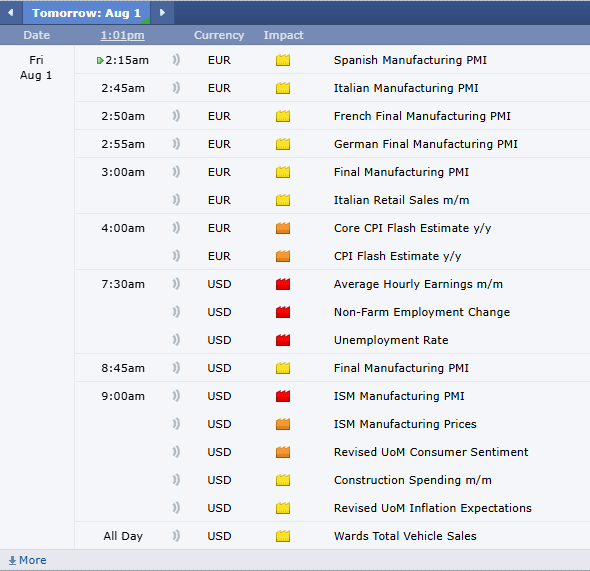
Economic Reports

provided by: ForexFactory.com

All times are Eastern Time ( New York)

4bab8c72 84f4 4b55 9a2d 17e89848db1c

Find us on Trustpilot

stars

Trading Futures, Options on Futures, and retail off-exchange foreign currency transactions involves substantial risk of loss and is not suitable for all investors. You should carefully consider whether trading is suitable for you in light of your circumstances, knowledge, and financial resources. You may lose all or more of your initial investment. Opinions, market data, and recommendations are subject to change at any time.

Join our Private Facebook group

Subscribe to our YouTube Channel

Listen to our podcast: Subscribe on AppleSpotify, Amazon

or wherever you listen to podcasts!

S
Facebook  Instagram  LinkedIn
S
ef3ab1c9 8d6d 4e60 a3f1 af5d9d4ecbb3
Services
Software
Tools
Community
Contact

E-Mini: Dow, Nasdaq, S&P 500; Jobs Report, July Hogs: Your 5 Important Need-To-Knows for Trading Futures on June 5th, 2025

9dc1e02e d5f7 4ff4 abf7 1df60775f196

What to Know Before Trading Futures on June 5th

Key points for tomorrow: E-Mini, Jobs Report

By Mark O’Brien, Senior Broker

U.S. stock index futures traded on both sides of the flatline into today’s close of trading with a lack of progress on tariff negotiations and economic data suggesting the uncertainty was taking a toll.

E-Mini

e-mini

At this typing, the E-mini S&P 500 index traded near unchanged, while the E-mini Dow Jones contract dipped ±100 pts and the E-mini Nasdaq pushed up ±67 pts.

Trade News

President Donald Trump stated he expected a call with Chinese leader Xi Jinping this week to discuss trade, though he also suggested it might be an uphill battle. Investors would welcome any thaw in trade relations with China, one of the U.S.’s largest trading partners.

Jobs Report

Meanwhile, investors also await the Labor Department’s monthly jobs report this Friday. The report could be a barometer of how much, if any, businesses are delaying hiring due to tariffs.

On Wednesday, payroll processor ADP said private-sector firms added just 37,000 workers in May, the lowest since March 2023, and well below Wall Street’s expectations of 115,000 workers. April’s tally was also revised down. ADP’s report is sometimes seen as a harbinger of the official government release, though it often misses the mark.

Also on Wednesday, the nonpartisan Congressional Budget Office said Trump’s tax bill will increase deficits by $2.4 trillion over the next decade. Investors and analysts have warned that elevated deficits will lead to higher interest rates, since the U.S. government will need to pay more to attract investors to buy its debt.

Meanwhile, a closely-watched gauge of business activity in the service sector fell below the line that separates growth from contraction in April. ISM’s Services Purchasing Managers Index was at 49.9 in May, the lowest in a year, and a reminder of the impact of trade war uncertainty.

S
7f78ed49 fbea 4656 8eb0 8ed334df3062

July Hogs:

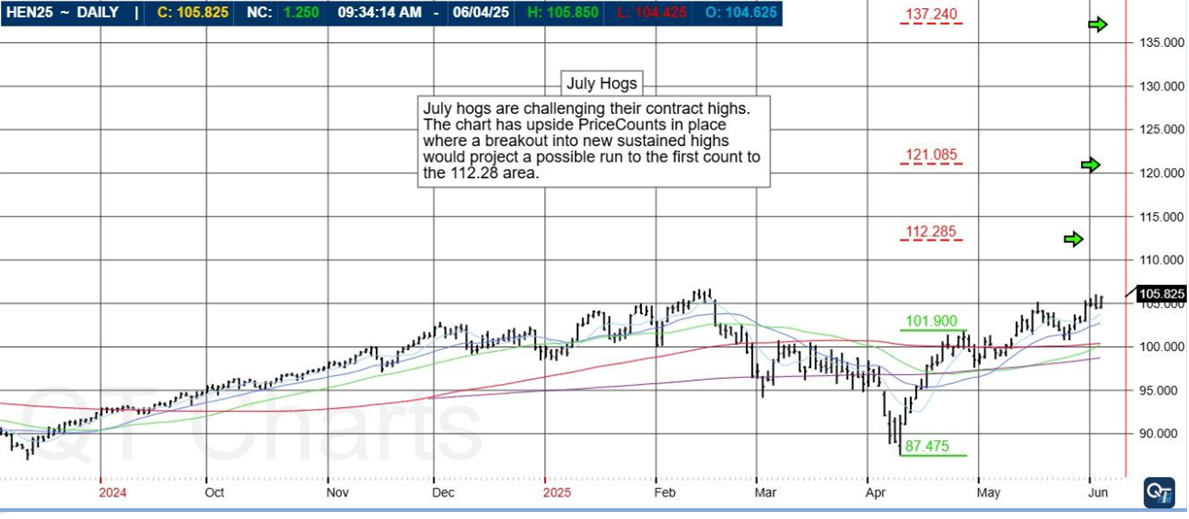
July hogs are challenging their contract highs. The chart has upside PriceCounts in place where a breakout into new sustained highs would project a possible run to the first count to the 112.28 area.

The PriceCount study is a tool that can help to project the distance of a move in price. The counts are not intended to be an ‘exact’ science but rather offer a target area for the four objectives which are based off the first leg of a move with each subsequent count having a smaller percentage of being achieved.

It is normal for the chart to react by correcting or consolidating at an objective and then either resuming its move or reversing trend. Best utilized in conjunction with other technical tools, PriceCounts offer one more way to analyze charts and help to manage your positions and risk. Learn more at www.qtchartoftheday.com

Trading in futures, options, securities, derivatives or OTC products entails significant risks which must be understood prior to trading and may not be appropriate for all investors. Past performance of actual trades or strategies is not necessarily indicative of future results.

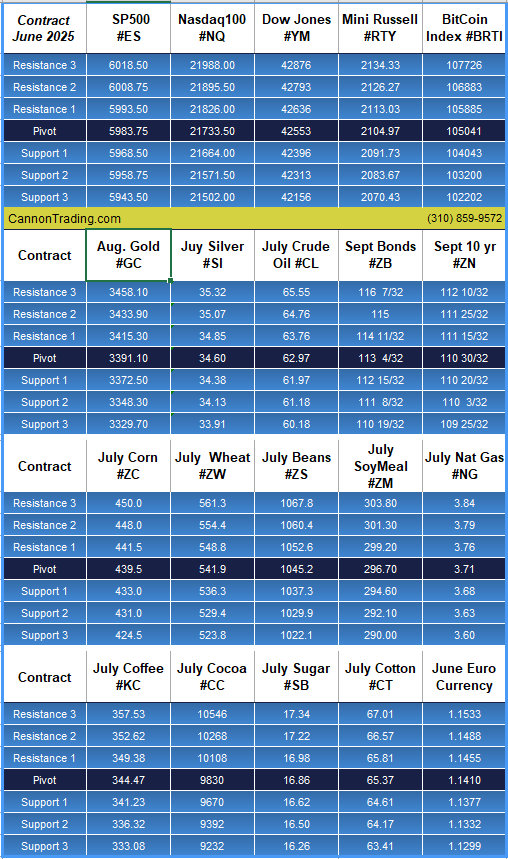
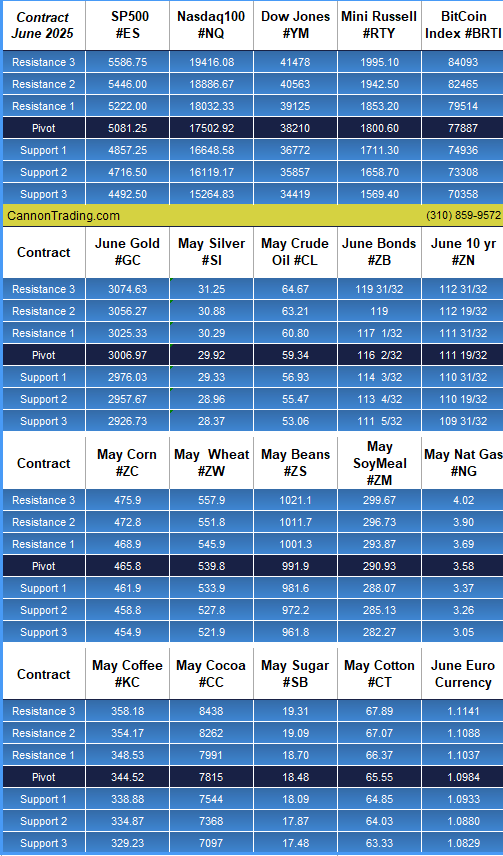
Daily Levels for June 5th, 2025

74626d8e ac98 4f22 83c3 f544734921e6
Want to feature our updated trading levels on your website? Simply paste a small code, and they’ll update automatically every day! Click here for quick and easy instructions.
822b33c5 2339 45ed bc84 e9c8f8c7358e

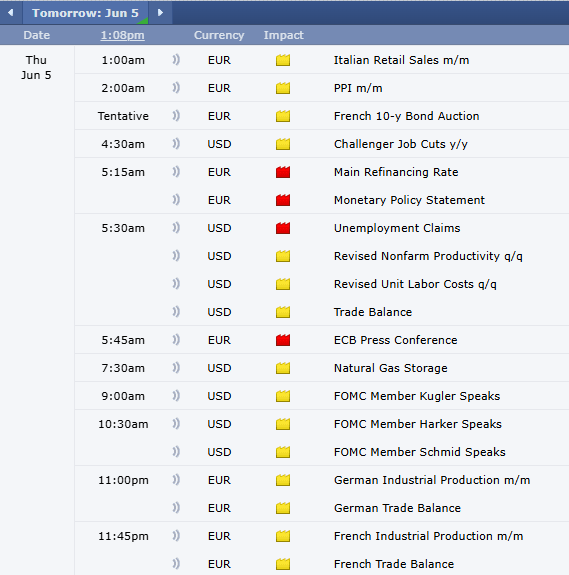
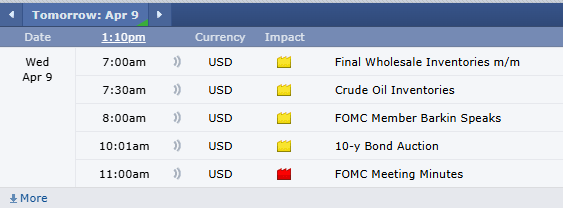
Economic Reports

provided by: ForexFactory.com

All times are Eastern Time ( New York)

388d2cbe 9891 48bb 801d 5ad2062bd8fd

Find us on Trustpilot

stars

Trading Futures, Options on Futures, and retail off-exchange foreign currency transactions involves substantial risk of loss and is not suitable for all investors. 

You should carefully consider whether trading is suitable for you in light of your circumstances, knowledge, and financial resources. You may lose all or more of your initial investment.

Opinions, market data, and recommendations are subject to change at any time.

Join our Private Facebook group

Subscribe to our YouTube Channel

Listen to our podcast: Subscribe on AppleSpotify, Amazon

or wherever you listen to podcasts!

S
Facebook  Instagram  LinkedIn
S
ef3ab1c9 8d6d 4e60 a3f1 af5d9d4ecbb3
Services
Software
Tools
Community
Contact

What to Know Before Trading Futures on May 22nd; Your 4 Important Need-To-Knows for Equity Indexes, Financials, Crypto

9dc1e02e d5f7 4ff4 abf7 1df60775f196

What to Know Before Trading Futures on May 22nd

Key Points for Tomorrow

By Mark O’Brien, Senior Broker

futures

Equity Indexes / Interest Rates:

Stock index futures turned lower this afternoon after a disappointing Treasury bond auction accelerated a selloff in the debt market.

The June E-mini Dow Jones futures contract dropped over 800 points, more than 2.0%, leading the E-mini S&P 500 and E-mini Nasdaq indexes lower in afternoon trading.

Financials:

U.S. 30-yr. T-bond and 10-yr. T-note futures also sold off and correspondingly debt yields spiked, with the 10-yr. rate climbing toward 4.6% and the 30-yr. rate eclipsing 5.0%

Yields extended gains in the afternoon after a $16 billion auction of 20-year Treasury bonds attracted relatively soft demand from investors, selling at a higher yield than traders had anticipated.

The selloff in stocks followed earnings reports from retailers Target, Lowe’s and TJX. Target cut its annual outlook.

Crypto:

Bitcoin futures climbed to a new all-time high for the first time since January. The current front-month May futures contract traded intraday up to 110,745 before paring its gains. Bitcoin futures total open interest surged to a record $75 billion, signaling heightened leveraged exposure as traders are eyeing a breakout above a key $108,000 resistance level. The CME Group / Chicago Mercantile Exchange leads with $17.43 billion in open interest. Within the highly leveraged environment, the potential for liquidations of short positions becomes a powerful force that could propel Bitcoin futures to new highs.


S

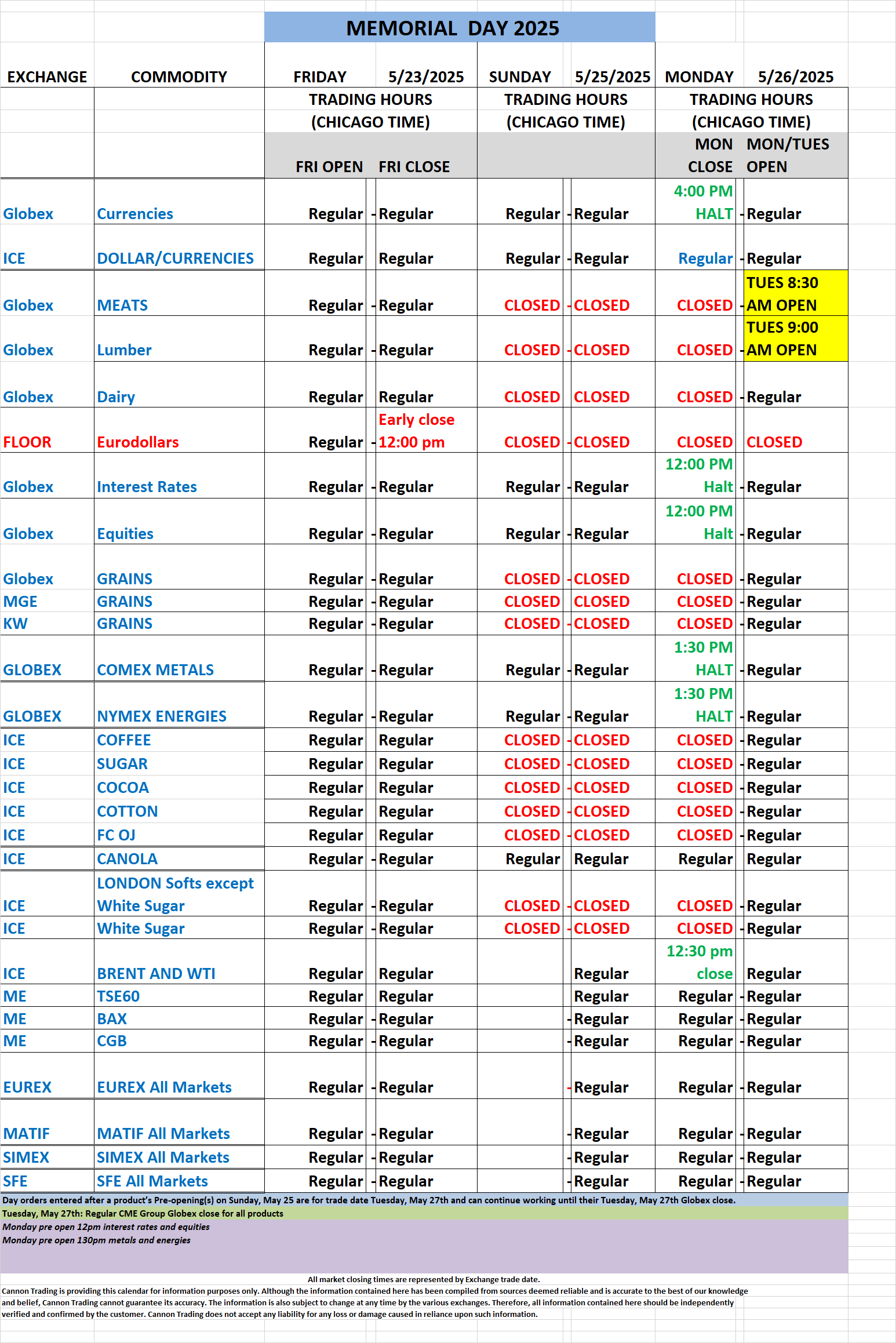
Memorial Day Schedule

Memorial-Day-2025 image

Daily Levels for May 22nd 2025

7bf96000 eda1 4971 901d 0d5dd3111402
Want to feature our updated trading levels on your website? Simply paste a small code, and they’ll update automatically every day! Click here for quick and easy instructions.
822b33c5 2339 45ed bc84 e9c8f8c7358e

Economic Reports

provided by: ForexFactory.com

All times are Eastern Time (New York)

ebd6bb78 124a 4412 a455 e596136d8654

Find us on Trustpilot

stars

Trading Futures, Options on Futures, and retail off-exchange foreign currency transactions involves substantial risk of loss and is not suitable for all investors. 

You should carefully consider whether trading is suitable for you in light of your circumstances, knowledge, and financial resources.

You may lose all or more of your initial investment. Opinions, market data, and recommendations are subject to change at any time.

Join our Private Facebook group

Subscribe to our YouTube Channel

Listen to our podcast: Subscribe on AppleSpotify, Amazon

or wherever you listen to podcasts!

S
Facebook  Instagram  LinkedIn
S
ef3ab1c9 8d6d 4e60 a3f1 af5d9d4ecbb3
Services
Software
Tools
Community
Contact

Zero-Day Options: 6 Strong Advantages Over Traditional Day Trading

9dc1e02e d5f7 4ff4 abf7 1df60775f196

0DTE Options

Options 3

By Mark O’Brien, Senior Broker

Options

Zero-day options are normal options — puts and calls — that expire in less than one day, hence the “0DTE” nickname (short for “zero days to expiration”).

In the current high-volatility environment we’re experiencing – one very likely to last awhile – one of the better alternatives to day trading, particularly in stock index futures like the E-mini S&P 500, E-mini Nasdaq, etc., is buying short-term call and put options.

With expirations every day of the week, stock index futures options can be purchased with minimal overall time value and give you a maximum risk coupled with a limitless upside potential.

Especially with markets seemingly hair-triggered to make large daily moves, but with erratic action intraday, the purchase of a limited-risk option provides staying power that no amount of rapid in-and-out trading trying to catch a large move can outperform.

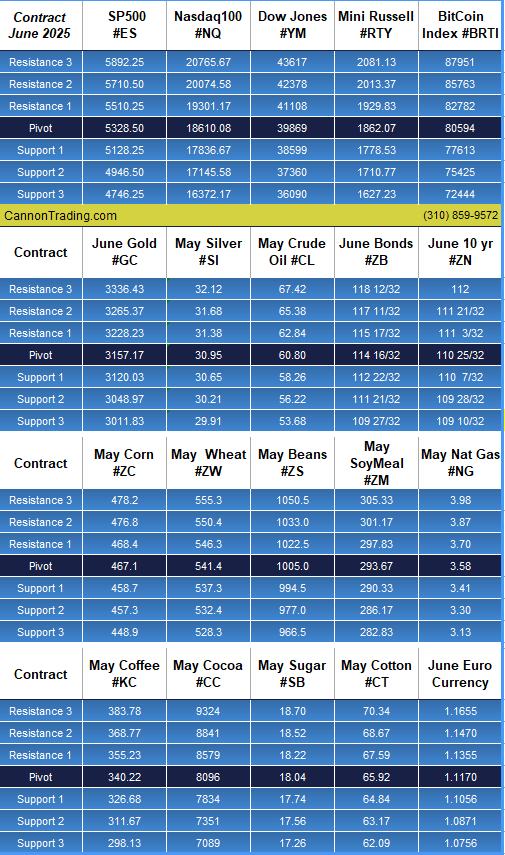
Daily Levels for April 11th, 2025

4d3a3ec5 b93b 4cde 8cc8 c56e7de2006f

Want to feature our updated trading levels on your website? Simply paste a small code, and they’ll update automatically every day! 

Click here for quick and easy instructions.

822b33c5 2339 45ed bc84 e9c8f8c7358e

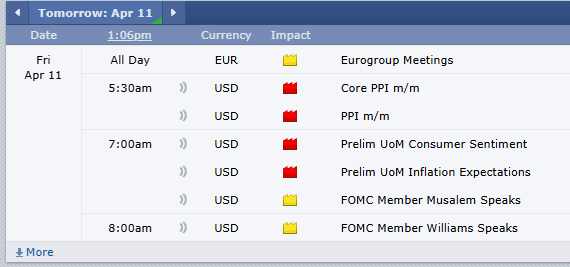
Economic Reports

provided by: ForexFactory.com

All times are Eastern Time (New York)

9d0da384 b589 4ed8 ae21 38be56394d51

Find us on Trustpilot

stars

Trading Futures, Options on Futures, and retail off-exchange foreign currency transactions involves substantial risk of loss and is not suitable for all investors. You should carefully consider whether trading is suitable for you in light of your circumstances, knowledge, and financial resources. You may lose all or more of your initial investment. Opinions, market data, and recommendations are subject to change at any time.

Call Now

Join our Private Facebook group

Subscribe to our YouTube Channel

Listen to our podcast: Subscribe on AppleSpotify, Amazon

or wherever you listen to podcasts!

S
Facebook  Instagram  LinkedIn
S
ef3ab1c9 8d6d 4e60 a3f1 af5d9d4ecbb3
Services
Software
Tools
Community
Contact

Massive Volatility Moves: 3 Futures Contracts Post Record One-Day Volatility

9dc1e02e d5f7 4ff4 abf7 1df60775f196

E-Mini Extreme Volatility!


The last few weeks and especially the last few trading sessions we saw tremendous volatility across many markets.

Volatility


What we witnessed last night and during today’s session reminded me of the markets when COVID first broke out and we saw limit moves across the board.

Temporarily: Most of our platforms now require 50% margins even for day trading!

tomorrow we have FOMC minutes!!

As of this typing stock index futures and other futures contracts have experienced single-day volatility moves not seen in years. Below you will see the range between high and lows made today for E-Mini stock index contracts:

→ E-mini Dow Jones: 2,173 points

→ E-mini S&P 500: 364 points

→ E-mini Nasdaq: 1,384 points

With tomorrow FOMC minutes and the furtherance of what looks to be the beginning of a global trade war,

expect no drop-off in market volatility.

Traders not only need to be extra cautious in making trading decisions, it’s also important to be aware of important aspects of the markets they’re trading.

Key among these are the daily price limits of the markets you’re trading. A price limit is the maximum price range permitted for a futures contract in each trading session. When markets hit the price limit, different actions occur depending on the product being traded.

Some markets may temporarily halt until price limits can be expanded or trading may be stopped for the day based on regulatory rules. Different futures contracts will have different price limit rules; i.e. Equity Index futures have different rules than Agricultural futures.

Price limits are re-calculated daily and remain in effect for all trading days (except in certain physically-deliverable markets, where price limits are lifted prior to expiration so that futures prices are not prevented from converging on prices for the underlying commodity).

Equity Indexes futures have a three level expansion: 7%, 13% and 20% to the downside, and a 7% limit up and down in overnight trading.

Follow the links below to the CME Group web site to find more information on price limits generally and specific price limits for the markets you’re trading:

Find daily price limits for CME Group Agricultural, Cryptocurrency, Energy, Equity Index, Interest Rates, and Metals products: click here.

S

May Feeder Cattle

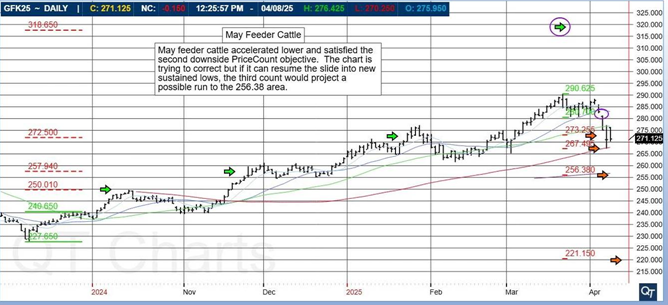
May feeder cattle accelerated lower and satisfied the second downside PriceCount objective. The chart is trying to correct but if it can resume the slide into new sustained lows, the third count would project a possible run to the 256.38 area.

7f8060b0 1041 4a69 b14a 99651bdc5c19

The PriceCount study is a tool that can help to project the distance of a move in price. The counts are not intended to be an ‘exact’ science but rather offer a target area for the four objectives which are based off the first leg of a move with each subsequent count having a smaller percentage of being achieved.

It is normal for the chart to react by correcting or consolidating at an objective and then either resuming its move or reversing trend. Best utilized in conjunction with other technical tools, PriceCounts offer one more way to analyze charts and help to manage your positions and risk. Learn more at www.qtchartoftheday.com

Trading in futures, options, securities, derivatives or OTC products entails significant risks which must be understood prior to trading and may not be appropriate for all investors. Past performance of actual trades or strategies is not necessarily indicative of future results.

Daily Levels for April 9th, 2025

43bfed2e fb70 4960 b433 73268e0bbe2a

Want to feature our updated trading levels on your website? Simply paste a small code, and they’ll update automatically every day! 

Click here for quick and easy instructions.

822b33c5 2339 45ed bc84 e9c8f8c7358e

Economic Reports

provided by: ForexFactory.com

All times are Eastern Time (New York)

09974a21 ea4f 427c 9d26 478fa3d1b980

Find us on Trustpilot

stars

Trading Futures, Options on Futures, and retail off-exchange foreign currency transactions involves substantial risk of loss and is not suitable for all investors. You should carefully consider whether trading is suitable for you in light of your circumstances, knowledge, and financial resources. You may lose all or more of your initial investment. Opinions, market data, and recommendations are subject to change at any time.

Call Now

Join our Private Facebook group

Subscribe to our YouTube Channel

Listen to our podcast: Subscribe on AppleSpotify, Amazon

or wherever you listen to podcasts!

S
Facebook  Instagram  LinkedIn
S
ef3ab1c9 8d6d 4e60 a3f1 af5d9d4ecbb3
Services
Software
Tools
Community
Contact

E-Mini S&P 500: Origins, Viability, and the Rise of Micro S&P Products

Find out more about trading E-Mini S&P 500 contracts with Cannon Trading Company here.

The E-Mini S&P 500 is a widely traded stock index futures contract that provides exposure to the S&P 500 index. In this article, we will explore the history of the E-Mini S&P 500, understand its viability as a futures contract, and examine the evolution of micro S&P products. We will delve into the conception of trading the S&P 500 index as an E-Mini futures contract, the reasons behind its success, and the subsequent development of micro S&P contracts.

I.Origins of the E-Mini S&P 500:

The E-Mini S&P 500 came into existence as a response to market demands and advancements in technology. Its creation was driven by the Chicago Mercantile Exchange (CME), which sought to introduce a more accessible and cost-effective way for traders to gain exposure to the S&P 500 index.

  1. Conception of E-Mini Futures: The concept of trading the S&P 500 index as an E-Mini futures contract was conceived by the CME. The exchange recognized the need for smaller-sized contracts that would allow individual traders to participate in stock market index trading without the capital requirements of full-sized contracts.
  2. Introduction of E-Mini S&P 500: In September 1997, the CME launched the E-Mini S&P 500 futures contract, marking a significant milestone in the evolution of stock index futures trading. The E-Mini S&P 500 contracts represented a fraction of the value and margin requirements of their full-sized counterparts, making them more accessible to a wider range of market participants.

II. Viability of the E-Mini S&P 500 Futures Contract:

Several factors contribute to the viability of the E-Mini S&P 500 as a futures contract:

  1. Broad Market Exposure: The S&P 500 index is widely regarded as a benchmark for the overall performance of the U.S. stock market. Comprising 500 large-cap U.S. companies, it represents a diverse range of sectors and industries. The E-Mini S&P 500 futures contract provides traders with exposure to this broad market index, allowing them to speculate on or hedge against market movements.
  2. Liquidity and Efficiency: The E-Mini S&P 500 is one of the most liquid futures contracts globally. Its popularity and high trading volume ensure ample liquidity and tight bid-ask spreads. This liquidity, combined with electronic trading platforms, allows for efficient price discovery and ease of trade execution.
  3. Market Influence and Visibility: The S&P 500 index’s importance in the financial industry contributes to the E-Mini S&P 500’s viability as a futures contract. The index is widely followed by investors, analysts, and market participants worldwide. Its performance influences market sentiment and serves as a reference point for various investment strategies.

III. Evolution of Micro S&P Products:

Building upon the success of the E-Mini S&P 500, the CME introduced micro S&P products to further enhance accessibility and cater to individual traders.

  1. Introduction of Micro E-Mini S&P 500: In May 2019, the CME launched Micro E-Mini S&P 500 futures contracts. These contracts are one-tenth the size of the E-Mini S&P 500, allowing traders to participate in the market with even smaller capital requirements. Micro E-Mini S&P 500 futures provide greater flexibility and precision for traders with limited capital or those seeking to fine-tune their exposure.
  2. Advantages of Micro S&P Products: Micro S&P products offer several advantages. They require lower margin requirements, making them more accessible to retail traders and smaller institutional investors. Additionally, they enable traders to more precisely tailor their positions, adjust risk levels, and scale their exposure based on their trading strategies and capital availability.
  3. Micro E-Mini Success: The introduction of micro E-Mini S&P 500 contracts has gained significant traction in the futures market. The smaller contract size, lower margin requirements, and high liquidity have made micro S&P products popular among individual traders and allowed for increased participation and diversity in the market.

The E-Mini S&P 500, conceived by the CME, revolutionized stock index futures trading by providing accessible and cost-effective exposure to the S&P 500 index. Its viability stems from the broad market exposure, liquidity, and market influence associated with the S&P 500 index. The subsequent introduction of micro S&P products, such as the Micro E-Mini S&P 500, further enhanced accessibility, flexibility, and precision for traders. The rise of micro S&P products has attracted retail traders and smaller institutional investors, fostering increased participation and diversification in the futures market. Overall, the E-Mini S&P 500 and micro S&P products have played instrumental roles in democratizing access to stock index trading and shaping the landscape of futures markets.

Ready to start trading futures? Call 1(800)454-9572 and speak to one of our experienced, Series-3 licensed futures brokers and start your futures trading journey with Cannon Trading Company today.

DisclaimerTrading Futures, Options on Futures, and retail off-exchange foreign currency transactions involves substantial risk of loss and is not suitable for all investors.  Past performance is not indicative of future results. You should carefully consider whether trading is suitable for you in light of your circumstances, knowledge, and financial resources. You may lose all or more of your initial investment. Opinions, market data, and recommendations are subject to change at any time.

Mini Nasdaq Chart & Support and Resistance Levels 3.03.2021

_________________________________________________

Voted #1 Blog and #1 Brokerage Services on TraderPlanet for 2016!!  

_________________________________________________

Dear Traders,

Like us on FaceBook!
Get Real Time updates and market alerts on Twitter!
Time to trade June bonds, May silver and May copper as well as May grains.
Stock futures and currencies don’t roll over until mid March and we will send a separate notice.
The recent volatility reminds me of last March, when COVID started.
I have a few points to make:
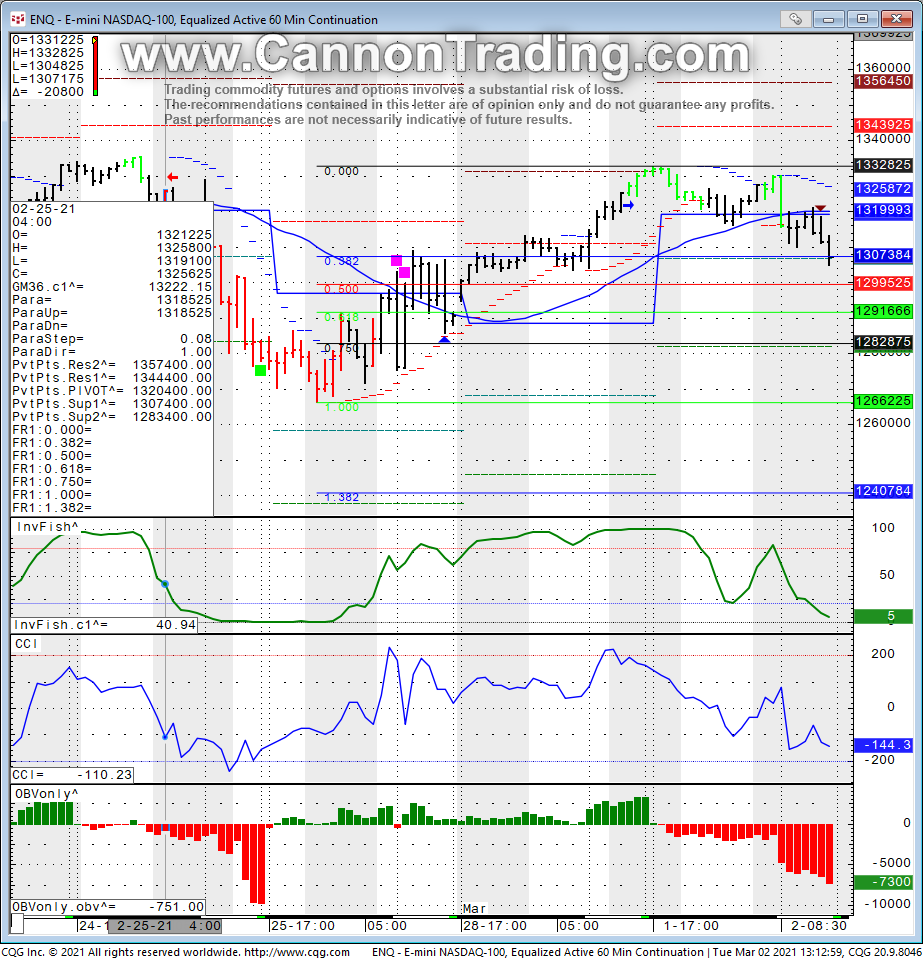
  1. Take a look at the below chart from today on the mini NASDAQ this volatility will play both sides and in MY OPINION this is not a market to just buy and hold using futures….You need to be able to react and adjust positions according to market action and sentiment.
  2. DON’T try to predict tops and bottoms….
  3. Learn to reduce trading size. Perhaps trade smaller contracts like the micros.
  4. Understand that loses are part of trading and this is definitely not a good time to “fight the markets”.
  5. Focus more on risk management and ways to protect certain positions as needed.
  6. Survive to trade another day.
  7. LIMITS guidelines visit: https://www.cmegroup.com/trading/equity-index/faq-sp-500-price-limits.html
Emini Nasdaq NQ Chart

Good Trading

Trading Futures, Options on Futures, and retail off-exchange foreign currency transactions involves substantial risk of loss and is not suitable for all investors.  You should carefully consider whether trading is suitable for you in light of your circumstances, knowledge, and financial resources. You may lose all or more of your initial investment. Opinions, market data, and recommendations are subject to change at any time when it comes to Futures Trading.


Futures Trading Levels

3-03-2021

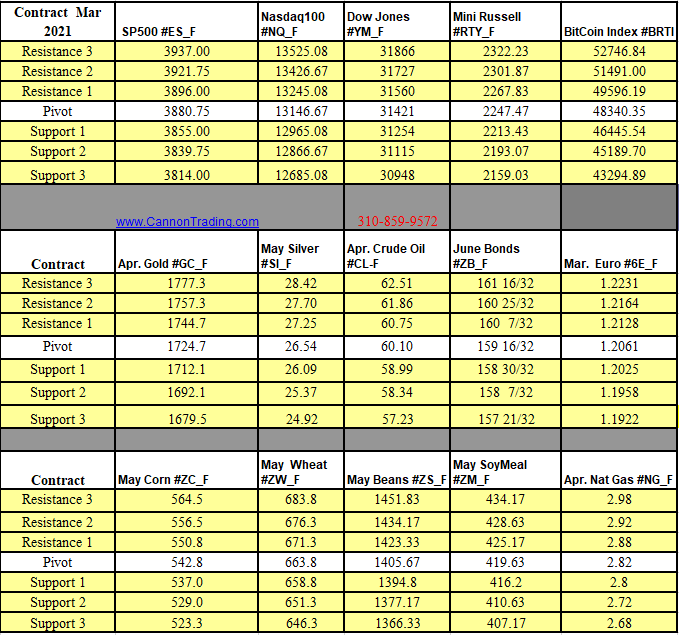
Futures Support & Resistance Levels 3.03.2021

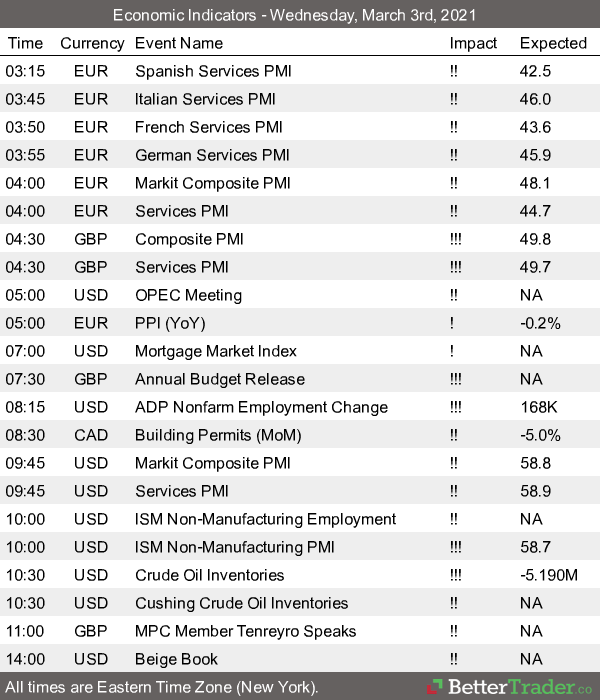
Economic Reports, source: 

 www.BetterTrader.co

BetterTrader Economic Indicators


This is not a solicitation of any order to buy or sell, but a current market view provided by Cannon Trading Inc. Any statement of facts here in contained are derived from sources believed to be reliable, but are not guaranteed as to accuracy, nor they purport to be complete. No responsibility is assumed with respect to any such statement or with respect to any expression of opinion herein contained. Readers are urged to exercise their own judgement in trading.

Futures Trading Levels, Types of Trading Days

Cannon Trading / E-Futures.com

The following is taken from a guide I have written that helps subscribers to my daily chart service. You can have a 2 week free trial to the daily live charts service along with buy/sell triggers and get the full guide along with chart examples, rules and much more by signing up at:

Cannon Trading Inc. Day Trading Webinar

General Notes:
At any given day, one must understand the trading environment that specific day has to offer and adjust their trading style accordingly. In our case it relates more to the size of stops and target based on volatility. Some days the market gives us many opportunities; some not as much; and some days it provides us with mostly risks…….take what the market gives you and not what you want it to give…..

I think if a trader understands early enough what type of trading day it is, he or she can choose which tools from the webinar are most suited for that days trading. If one can do that successfully (which is not easy), I think that is half the battle.

Not taking a trade is better than a bad trade.

My opinion is that there are 3 main types of trading days.

  1. Most common is two sided trading action with swings up and down – this type of trading day is most suitable for the main aspect of this model, which is taking trades based on the arrows.
  2. Strong trending day, mostly one directional – this type of trading day is the least common, many times this will happen on Mondays and maybe 3-5 times a month at most – this type of trading day is most suitable for using the color scheme I have on the charts. Green bars mean strong up trend, red bars mean strong down trend. If you determined that this is a trend day, then use pull backs to enter with the direction of trend and use the parabolic (little dashes) as you trailing stop.
  3. Slow and/ or choppy trading day – this type of trading day is best suited for taking small profits from the market by either using the main model or taking the diamonds as entry signal, and going for quick profits and tight stops.

Continue reading “Futures Trading Levels, Types of Trading Days”

Futures Trading Levels and Economic Reports for December 7th 2010

Today was a “slow trading day” when it came to stock indices, which leads me to a good point I would like to make. Most of our day traders, trade the e-mini stock index futures, mostly the mini SP because of its heavy daily volume and exposure.

However, I think that day-traders should be able to follow at least another market, maybe even two additional markets and look for different set up in these markets as well.

Good example from today is the Euro currency. While the mini SP was pretty dead….the Euro had nice range, good volatility and good volume which presents both risks and opportunities for day-traders.

Obviously, before you start trading a new market you should educate yourself on tick size, trading hours, “personality”, when is there more volume in that specific contract etc.

If you do so, I think you will achieve a couple of things, first is diversification. While some days trades in certain market may not work, trades in a different market may provide balance.

Also, if on certain days, certain markets are “sleepy” ( which most day-traders do NOT like), another market may have more action….

As always, do your homework, practice in simulation mode first and make sure you understand the “new contract” you may be trading along with the risks involved.

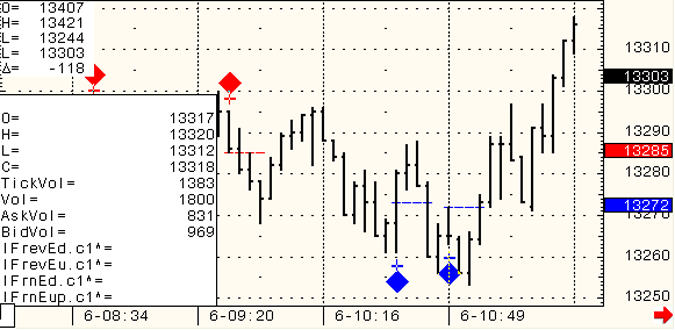
Below is a screen shot of the Euro Currency from todays webinar session :
( free trial at – https://www.cannontrading.com/tools/intraday-futures-trading-signals )

SP-500-Day-Trading-2010-12-07 Continue reading “Futures Trading Levels and Economic Reports for December 7th 2010”